
Thread
First boot of a new IIgs - help!
So I got an Apple IIgs from Uniserver - thanks! This is my first ever Apple II system. Now I just need to figure out how the heck this thing works.
When I first power it on, there's a short, robotic-sounding beep. Is this normal? Initially I thought it was some kind of diagnostic error sound, but now I'm thinking maybe it's normal. But it certainly doesn't sound like a "happy" sound.
I'm unable to get any video out of this machine. I hooked the composite output to a Dell monitor that I've used for other composite video projects, but it just shows a black image. Then I used a Mac monitor to VGA adapter, but the Dell monitor always shows "video signal out of range". I tried three different VGA adapters with the same results. Is the IIgs monitor output different from a Mac II series monitor output?
If I daisy chain a couple of floppy drives, I can see the IIgs try to access one, then the other, then it plays the robot-beep sound again and stops. I don't have any IIgs disks I can test it with, unfortunately.
Is this weird down-chord beep normal, or an indicator of a problem? Any suggestions for getting video going?
When I first power it on, there's a short, robotic-sounding beep. Is this normal? Initially I thought it was some kind of diagnostic error sound, but now I'm thinking maybe it's normal. But it certainly doesn't sound like a "happy" sound.
I'm unable to get any video out of this machine. I hooked the composite output to a Dell monitor that I've used for other composite video projects, but it just shows a black image. Then I used a Mac monitor to VGA adapter, but the Dell monitor always shows "video signal out of range". I tried three different VGA adapters with the same results. Is the IIgs monitor output different from a Mac II series monitor output?
If I daisy chain a couple of floppy drives, I can see the IIgs try to access one, then the other, then it plays the robot-beep sound again and stops. I don't have any IIgs disks I can test it with, unfortunately.
Is this weird down-chord beep normal, or an indicator of a problem? Any suggestions for getting video going?
Yes. It's analog RGB, but at TV scan rates (15MHz?). Your options are to use the composite out to a TV, or one of those arcade CGA/EGA converters to VGA.
I have a couple of LCD TVs here that have VGA inputs (as well as composite etc) and I'm hoping that one of them will sync to a IIGS via the VGA in, but I haven't tested this theory yet.
Some old NEC Multisync monitors can get down to 15MHz, but IIRC, mostly the CRT ones.
OK, it seems the composite video input on this Dell 2007WFP LCD is broken. Which is weird, because I've used it before with other composite video projects. In fact, it's the only reason I've kept this monitor around.
When I connect the IIgs to the composite video input on the large TV in the living room, I can see the image just fine (Apple IIgs ROM revision 01, check startup disk…) But on the Dell monitor there's nothing. So unless I'm missing something obvious, I need to hunt down another composite-capable LCD. I wonder what went wrong with this one?
When I connect the IIgs to the composite video input on the large TV in the living room, I can see the image just fine (Apple IIgs ROM revision 01, check startup disk…) But on the Dell monitor there's nothing. So unless I'm missing something obvious, I need to hunt down another composite-capable LCD. I wonder what went wrong with this one?
Yup, that "weird sound" is the startup chime.  I am not too smart sometimes.
Hmm, this is getting weirder. I hooked up a Nintendo Wii to the Dell monitor's composite video input, and the image shows up fine. So maybe there's something specific to the video signal from the IIgs that the Dell monitor doesn't like. Maybe it's not quite within the NTSC spec?
I am not too smart sometimes.Hmm, this is getting weirder. I hooked up a Nintendo Wii to the Dell monitor's composite video input, and the image shows up fine. So maybe there's something specific to the video signal from the IIgs that the Dell monitor doesn't like. Maybe it's not quite within the NTSC spec?
yup that boot tone is normal
sounds just like this one.
https://www.youtube.com/watch?v=XrAdW1jCH5s
once you get your hands deeper into it, you will realize its got a pretty nice sound system in it.
https://support.apple.com/kb/TA36236?locale=en_US&viewlocale=en_US
sounds just like this one.
https://www.youtube.com/watch?v=XrAdW1jCH5s
once you get your hands deeper into it, you will realize its got a pretty nice sound system in it.
https://support.apple.com/kb/TA36236?locale=en_US&viewlocale=en_US
Dang Dell… after doing more reading, it seems that lots of people have problems using classic computers and video game systems with the Dell 2007WFP. It must not be tolerant of composite video signals that aren't 100% in spec.
I really don't want to get a CRT, and I've heard scan converters have fairly poor quality with Apple II video. But the 4:3 Dell 2001FP is supposed to work nicely with the Apple II and IIgs. I think I'll probably go with that, but unfortunately that means a few more days before I can do much playing around with this new system.
I really don't want to get a CRT, and I've heard scan converters have fairly poor quality with Apple II video. But the 4:3 Dell 2001FP is supposed to work nicely with the Apple II and IIgs. I think I'll probably go with that, but unfortunately that means a few more days before I can do much playing around with this new system.
Do you have any other TVs or monitors with a composite input? The Dell probably expects a perfect RS-170a broadcast spec NTSC signal, meaning it likely screws up when connected to a VCR too. Old computers and game consoles output non-interlaced "240p" video which is certainly not broadcast spec, but CRTs didn't care and you got smooth flicker free 59.94fps video albeit with half the vertical resolution.
There are a handful of LCDs that can take 15khz RGB video via their VGA port too.
There are a handful of LCDs that can take 15khz RGB video via their VGA port too.
It works on the composite video input of my living room TV, a large Samsung HDTV. But using the IIgs in the living room on a 50" screen wasn't what I had in mind.
As luck would have it, a local person just posted a Dell 2001FP for sale on Craigslist yesterday. According to reviews I read, that model is much more tolerant of out-of-spec composite video from classic computers and game systems. So I met up with the guy this morning and bought it. Works great!
Now to find/make some startup disks, so I can do something other than look at the "check startup disk" test. I have an Apple 3.5 drive, so I think I can make IIgs startup disks using Disk Copy 4.2 on the Mac. A couple people have also had success using the Floppy Emu with the Apple 3.5 drive's daisy chain board, connected to the IIgs, so I'll try that too.
As luck would have it, a local person just posted a Dell 2001FP for sale on Craigslist yesterday. According to reviews I read, that model is much more tolerant of out-of-spec composite video from classic computers and game systems. So I met up with the guy this morning and bought it. Works great!
Now to find/make some startup disks, so I can do something other than look at the "check startup disk" test. I have an Apple 3.5 drive, so I think I can make IIgs startup disks using Disk Copy 4.2 on the Mac. A couple people have also had success using the Floppy Emu with the Apple 3.5 drive's daisy chain board, connected to the IIgs, so I'll try that too.
The 2001FP can likely work with the RGB output too going by the reports of Amiga users. Use a Mac to VGA adapter in "multisync mode" (the sense pins aren't used by the IIgs). Sometimes you have to fiddle with the composite,H+V,SoG switches on those adapters. The IIgs outputs composite sync.
For boot disks, check out ADTPro: http://adtpro.sourceforge.net/
It can zip over 800K 2IMG images of software to real disks in seconds. Heck, I find it easier then using Disk Copy in many cases.
For boot disks, check out ADTPro: http://adtpro.sourceforge.net/
It can zip over 800K 2IMG images of software to real disks in seconds. Heck, I find it easier then using Disk Copy in many cases.
Can anyone with a IIgs describe what the self-test display is supposed to look like, in terms of color? When I hold open-apple + option at startup, it puts the IIgs into a self-test routine. At first it draws lots of different hi-res patterns, which appear on the LCD in color. Then after a while, it shows some numbers at the bottom of the screen, and a solid border around it. The solid border is always some shade of gray (it changes depending on the number displayed). I'm guessing that border is supposed to be colored, but that's not how it appears.
Also, when I go into the IIgs control panel, display settings, and change the background color and border color, it just changes them to different shades of gray. Same behavior on the Dell 2001FP as well as my Samsung HDTV. It seems like maybe the composite video circuitry in both displays can handle color info from some IIgs video modes, but others only appear as grayscale. Both LCDs show colors during the initial parts of the IIgs self-test routine, but not anywhere else that I've noticed.
Cool, I'll try the RGB output with an adapter on the 2001FP. That would be nice! And ADTPro too, as soon as I can build an appropriate serial cable.
Also, when I go into the IIgs control panel, display settings, and change the background color and border color, it just changes them to different shades of gray. Same behavior on the Dell 2001FP as well as my Samsung HDTV. It seems like maybe the composite video circuitry in both displays can handle color info from some IIgs video modes, but others only appear as grayscale. Both LCDs show colors during the initial parts of the IIgs self-test routine, but not anywhere else that I've noticed.
Cool, I'll try the RGB output with an adapter on the 2001FP. That would be nice! And ADTPro too, as soon as I can build an appropriate serial cable.
Ah, so it *is* supposed to be color, but not seeing the color on a composite video output is normal? I guess I can live with that. I didn't have any success with the 2001FP's VGA input and adapter set to multisync mode, so I'll stick with the composite input for now.
Last night I stopped by Jameco just before they closed, to buy an Imagewriter II cable, with the intent of cutting it up and making a custom PC to IIgs serial cable. Well, I forgot about the other half of the cable. I have a USB-to-DB9 serial adapter that works on the PC, but I don't have any kind of DB9 cable that I can cut up and solder to the wires from the Imagewriter II cable. That means building a working cable for ADTPro will have to wait a while, until I have a chance to pick up a DB9 cable somewhere.
I got a copy of "The New Apple II User's Guide", and I plan to spend some time reading through it this afternoon, so I can post fewer dumb questions about robotic beep sounds and video modes.
Last night I stopped by Jameco just before they closed, to buy an Imagewriter II cable, with the intent of cutting it up and making a custom PC to IIgs serial cable. Well, I forgot about the other half of the cable. I have a USB-to-DB9 serial adapter that works on the PC, but I don't have any kind of DB9 cable that I can cut up and solder to the wires from the Imagewriter II cable. That means building a working cable for ADTPro will have to wait a while, until I have a chance to pick up a DB9 cable somewhere.
I got a copy of "The New Apple II User's Guide", and I plan to spend some time reading through it this afternoon, so I can post fewer dumb questions about robotic beep sounds and video modes.
OK, I'm a bit confused how to get GS/OS 6.0.1 onto this machine. Looking at the Apple mirror here: http://asa.max1zzz.co.uk/English-North_American/Apple_II/Apple_IIGS_System_6.0.1/
For a system with no hard drive, do I want Disk_2_of_7-System.Disk.sea.bin or Disk_3_of_7-SystemTools1.sea.bin? And these disks are MacBinary self-extracting archives -- not sure if they're IIgs self-extracting or Mac self-extracting. If IIgs, that creates a chicken-and-egg problem. Use a IIgs emulator to run the self-extractor?
Looking at this alternate download source: http://apple2.info/downloads
It has GS/OS 6.0.1 uncompressed, but the images are all 1.44MB disk images. I thought the IIgs only used 800K floppies? How do you mount a 1.44MB disk on the IIgs?
For a system with no hard drive, do I want Disk_2_of_7-System.Disk.sea.bin or Disk_3_of_7-SystemTools1.sea.bin? And these disks are MacBinary self-extracting archives -- not sure if they're IIgs self-extracting or Mac self-extracting. If IIgs, that creates a chicken-and-egg problem. Use a IIgs emulator to run the self-extractor?
Looking at this alternate download source: http://apple2.info/downloads
It has GS/OS 6.0.1 uncompressed, but the images are all 1.44MB disk images. I thought the IIgs only used 800K floppies? How do you mount a 1.44MB disk on the IIgs?
All the original files from Apple are 800k Disk Copy 4.2 images in self extracting archives. To install on a HD you need all 6 disks. Disk 7 is used for AppleShare servers only. Disk 2 is a basic boot disk, so try and get that one on an actual disk. Its really bare bones install though, System 6.0.1 ideally needs a hard drive or one of those exotic (for the Apple II anyway!) 1.4MB floppies.
Thanks. So I'm thinking I need to do this:
1. Install a IIgs emulator
2. Import the Apple SEA archive into the IIgs emulator
3. Run the SEA to uncompress it into an uncompressed Disk Copy 4.2 file
4. Export the DC42 file from the IIgs emulator
5. Copy the DC42 file to a vintage Mac somehow (Floppy Emu, network, etc)
6. Use Disk Copy 4.2 on the Mac to create an actual 800K disk from the DC42 file
Then I should be able to boot the real IIgs with that 800K floppy.
Neither of the two sources I linked has any version of GS/OS older than 6.0.1. So is GS/OS basically not really usable on a IIgs without a hard drive? Rats.
1. Install a IIgs emulator
2. Import the Apple SEA archive into the IIgs emulator
3. Run the SEA to uncompress it into an uncompressed Disk Copy 4.2 file
4. Export the DC42 file from the IIgs emulator
5. Copy the DC42 file to a vintage Mac somehow (Floppy Emu, network, etc)
6. Use Disk Copy 4.2 on the Mac to create an actual 800K disk from the DC42 file
Then I should be able to boot the real IIgs with that 800K floppy.
Neither of the two sources I linked has any version of GS/OS older than 6.0.1. So is GS/OS basically not really usable on a IIgs without a hard drive? Rats.
Possibly a long shot, but do you happen to have lying around from your Mac-hacking a Localtalk-to-Ethernet bridge? If you can lay your hands on one you can use the project files for "A2SERVER", a custom server package built around Netatalk for Linux to boot GS/OS over the network. I happen to have one and it's is why I've never gotten around to building an ADTpro cable. (The A2SERVER distribution includes a program able to write disk images hosted on a network share to a drive connected to your IIgs after you've booted it from the network.) AppleTalk is *somewhat* slow compared to a dedicated hard disk (although it's honestly in about the same ballpark as a SmartPort-based device) but from what I can tell it's a pretty workable solution and LocalTalk bridges tend to be cheaper than any IIgs hard disk unless you already have a SCSI card.
No LocalTalk-to-Ethernet bridge, unfortunately. Thanks for the offer of the CFFA, but I don't think I'll need it. Hopefully I can use the chain of tools I described above to make a GS/OS boot disk on the Mac. If that fails, I'll finish building the ADTPro serial cable that I started but never finished.
For a IIgs with no hard disk, would I be better off using an older version of GS/OS? Which version would you recommend?
For a IIgs with no hard disk, would I be better off using an older version of GS/OS? Which version would you recommend?
Progress - almost there! I used CiderPress to convert GS/OS 6.0.1 Disk 2 from 2MG format to DiskCopy 4.2 format. I then copied the the DC42 file over to a Mac SE and made an 800K disk. The IIgs boots from this disk - I get the "Welcome to the IIgs" screen and the progress bar fills all the way, but then I get a system error $0201. If I tell the IIgs to return from the error, then it continues to a dialog box asking "select the application you'd like to use". The only choice I can make from this list is BASIC.SYSTEM, but when I choose that I get system error $1104.
Error $0201 appears to be "could not allocate enough memory". I think this IIgs has 512K, is that not enough? $1104 is "file is not a load file", which is some kind of segment loader error.
The appearance of the GS/OS desktop with the composite video input on my Dell 2001FP LCD is really bad. If my only goal is to work on floppy emulation then I guess it's OK, but it would be nice to have something better. I'd really rather not get a CRT, though. Someone mentioned that a CGA to VGA adapter might work - have a link to any specific ones? Or any other recommended way of viewing the IIgs video without having a CRT?
Error $0201 appears to be "could not allocate enough memory". I think this IIgs has 512K, is that not enough? $1104 is "file is not a load file", which is some kind of segment loader error.
The appearance of the GS/OS desktop with the composite video input on my Dell 2001FP LCD is really bad. If my only goal is to work on floppy emulation then I guess it's OK, but it would be nice to have something better. I'd really rather not get a CRT, though. Someone mentioned that a CGA to VGA adapter might work - have a link to any specific ones? Or any other recommended way of viewing the IIgs video without having a CRT?
I plug my Apple II / Amiga stuff into my PM7500 composite in, using apple video player, always seems to work nice for me.
The 7500 has a Dell 19" LCD hooked up to it.
I think the only way to get a proper video out is to get a Monitor for your IIgs.
I have one that matches your IIgs, plugs into the RGB port. if you pay the shipping you can have er.
its a little yellow but works.
The 7500 has a Dell 19" LCD hooked up to it.
I think the only way to get a proper video out is to get a Monitor for your IIgs.
I have one that matches your IIgs, plugs into the RGB port. if you pay the shipping you can have er.
its a little yellow but works.
I assume your IIgs is a ROM01 with the standard 1MB-capacity card? (And it's only partially-populated?) It's possible you have some bad RAM. I don't remember what error number I was getting, but when I first got my *second* free Apple IIgs (the first had a bad keyboard controller) I had trouble doing the network boot thing into GS/OS, with the machine bombing out during the second phase of the boot. Swapping the RAM card from the dead-keyboard GS made the issue going away.
If your machine really is only 512k, well... this has two conflicting numbers in it but it sort of implies that you need at least 1MB to run 6.0. Can you make a plain ProDos disk with no GUI and see if the machine behaves? It should be able to run that even if you yank the RAM card out.
Re: the bad-looking desktop, well... I have one of those cheap "CGA to VGA" (note, they're not really according-to-Hoyle "CGA") scaler boards and it works "Okay"; it's certainly miles better than composite, but the GS desktop honestly looks pretty terrible under the best of circumstances. The guy I got it from packaged the board inside an old modem so I'd have to take it apart to get a model number off it, but I'm sure all those ones you see on TehBay are all based on the same guts.
If your machine really is only 512k, well... this has two conflicting numbers in it but it sort of implies that you need at least 1MB to run 6.0. Can you make a plain ProDos disk with no GUI and see if the machine behaves? It should be able to run that even if you yank the RAM card out.
Re: the bad-looking desktop, well... I have one of those cheap "CGA to VGA" (note, they're not really according-to-Hoyle "CGA") scaler boards and it works "Okay"; it's certainly miles better than composite, but the GS desktop honestly looks pretty terrible under the best of circumstances. The guy I got it from packaged the board inside an old modem so I'd have to take it apart to get a model number off it, but I'm sure all those ones you see on TehBay are all based on the same guts.
yep, pretty sure it only has 256k on the ram card, lots of sockets for more ram chips though.
So pretty sure it has 512k ram total right now.
Once Steve gets this all figured out ... I am going to definitely buy the loaded SD card option
Then (one) won't have to go through all this... haha The floppy emu will save the day.
Pretty sure Steve is due for another interview at RMC!!
So pretty sure it has 512k ram total right now.
Once Steve gets this all figured out ... I am going to definitely buy the loaded SD card option
Then (one) won't have to go through all this... haha The floppy emu will save the day.
Pretty sure Steve is due for another interview at RMC!!
I tried again with GS/OS 5.0.4 and it works! So yes, it seems 6.0.1 requires at least 1 MB. This is a ROM01 GS, and it appears to have 256K on the logic board and another 256K on a memory expansion card. Is that normal? I have no idea.
I guess the composite video input on the Dell 2001FP is usable, even if it is ugly. I wish it looked anywhere near as nice as those screenshots you linked! Here's what I'm seeing:
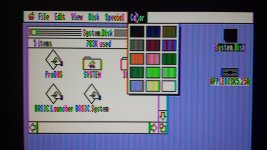
One thing I can't figure out is how to format another disk from within the GS. I'm guessing it requires some kind of disk utility program, which is probably on 5.0.4 disk #2 that I didn't make.
Now to figure out this disk emulation business...
I guess the composite video input on the Dell 2001FP is usable, even if it is ugly. I wish it looked anywhere near as nice as those screenshots you linked!
Here's what I'm seeing:One thing I can't figure out is how to format another disk from within the GS. I'm guessing it requires some kind of disk utility program, which is probably on 5.0.4 disk #2 that I didn't make.
Now to figure out this disk emulation business...
I'm pretty sure the images on the website were actually from an emulator. 
I'm not sure I'm motivated enough to actually go through dragging out the IIgs and all the netboot bits (its all cocooned up in the garage at the moment) to take a picture, but what I'll say about using it with the scaler board paired to a 17" 1280x1024 monitor is it's certainly far better than composite in terms of color clarity (the full-color resolution of NTSC composite is really only about 120-ish pixels horizontal, which is why you have that color fringing) but the combination ends up rendering the IIgs screen with a non-integer relationship between the input pixels and the output display grid so it looks a little, well, scaled. Games and whatnot look fine but that horrible blue pinstripe theme that Apple chose for the desktop background is pretty much the worst case scenario.
Of course, the original RGB monitors used for the IIgs weren't exactly the finest things in the world (fairly large dot pitch, etc) so I'm sure if you messed with the (limited) controls on the scaler board enough and matched it with the right monitor you might manage better than the original. It's just, well, you are sort of dealing with trying to make a silk purse out of a sow's ear, here. It's only 640x200 after all. (Apple should have probably included a 640x400 mono mode like that on the Atari ST.)
I'm not sure I'm motivated enough to actually go through dragging out the IIgs and all the netboot bits (its all cocooned up in the garage at the moment) to take a picture, but what I'll say about using it with the scaler board paired to a 17" 1280x1024 monitor is it's certainly far better than composite in terms of color clarity (the full-color resolution of NTSC composite is really only about 120-ish pixels horizontal, which is why you have that color fringing) but the combination ends up rendering the IIgs screen with a non-integer relationship between the input pixels and the output display grid so it looks a little, well, scaled. Games and whatnot look fine but that horrible blue pinstripe theme that Apple chose for the desktop background is pretty much the worst case scenario.
Of course, the original RGB monitors used for the IIgs weren't exactly the finest things in the world (fairly large dot pitch, etc) so I'm sure if you messed with the (limited) controls on the scaler board enough and matched it with the right monitor you might manage better than the original. It's just, well, you are sort of dealing with trying to make a silk purse out of a sow's ear, here. It's only 640x200 after all. (Apple should have probably included a 640x400 mono mode like that on the Atari ST.)
Under the hood, GS/OS is actually superior to MacOS of the same time period, it wasn't until System 7 that it surpassed the lowly Apple IIhaha
Makes you keep love for the Mac GUI, even @ 1bit B&W
At least that is how i feel
. The lack of RAM is why System 6.0.1 won't boot. Its fairly tight with only 1.25MB of RAM, but stuff will run. Net booting a IIgs is a good option if you don't have a HD, you can load up a fully equipped system with that sssssslllllooowwwlly over the network. Heck, Apple was forced to ship the machine with 512k of RAM shortly after release because 256k wasn't enough to actually run any 16bit software.Also the GS/OS disk images on Apple's site are self extracting Macintosh archives, not Apple II (those would have a .SDK extension).
That lack of quality helped, it smeared the dithered 16-colors together in a convincing fashion. You can see the real monitor in action on my YouTube channel.
https://www.youtube.com/watch?v=0bIpn9Dao1M
Along with some addons: https://www.youtube.com/watch?v=MYCb9JdMT4w
Lots of software and hardware info here (hint, FloppyEmu support for direct 2IMG loading would be nice): http://www.whatisthe2gs.apple2.org.za/
On a real monitor, the GS/OS desktop actually looks pretty good! Too bad there's no simple way to get similar quality on a modern LCD. As much as I love vintage computers, I draw the line at bringing 100-pound CRTs into my home.
I poked around some more, and got things into a pretty good state. GS/OS 5.0.4 Disk #2 did have a disk utility, as I expected. I also found an 800K disk image of ProDOS 8, with which I was able to boot the machine, and then create a bootable 5.25 inch ProDOS 8 disk. So now I think I have an example of every kind of disk I need.
So there are three kinds of Apple II disk emulation I hope to do with the Floppy Emu hardware. Some of these may end up requiring an external adapter of some kind.
1. 140K 5.25 floppy emulation (Disk II and similar)
2. 800K 3.5 floppy emulation (Apple 3.5 drive)
3. SmartPort disk emulation of any size up to 32MB
I'm not sure which one I'll start with, but maybe #2.
Direct support for 2MG disk images should almost certainly be possible, but I need to look into the details. Also .PO and .DSK (?) for 140K disks.
I poked around some more, and got things into a pretty good state. GS/OS 5.0.4 Disk #2 did have a disk utility, as I expected. I also found an 800K disk image of ProDOS 8, with which I was able to boot the machine, and then create a bootable 5.25 inch ProDOS 8 disk. So now I think I have an example of every kind of disk I need.
So there are three kinds of Apple II disk emulation I hope to do with the Floppy Emu hardware. Some of these may end up requiring an external adapter of some kind.
1. 140K 5.25 floppy emulation (Disk II and similar)
2. 800K 3.5 floppy emulation (Apple 3.5 drive)
3. SmartPort disk emulation of any size up to 32MB
I'm not sure which one I'll start with, but maybe #2.
Direct support for 2MG disk images should almost certainly be possible, but I need to look into the details. Also .PO and .DSK (?) for 140K disks.
Below are the major Apple II image formats, more detailed info is here: http://apple2.info/wiki/?title=Emulators_Part_3
.DSK: "DOS 3.3 Order" 140k 5.25" floppy images
.PO: "ProDOS Order" 140k 5.25" images
.NIB: Nibble data 140k 5.25" images, needed for certain copy protected software. None of the disk hardware replacements seem to support it.
.2MG: This format was created in 1998 or so to address the need for a standardized disk image format for 800k floppies and hard drives. Prior to that, the two major Apple IIgs emulators used their own in-house image format for 800k disks. For the most part its a ProDOS ordered image with a header, but it can contain DOS 3.3 ordered and nibble formatted images as well. Some detailed info here: http://apple2.org.za/gswv/a2zine/Docs/DiskImage_2MG_Info.txt
If you are looking for implementation of reading and writing these formats, Ciderpress' source would be good to look at: https://github.com/fadden/ciderpress/
.DSK: "DOS 3.3 Order" 140k 5.25" floppy images
.PO: "ProDOS Order" 140k 5.25" images
.NIB: Nibble data 140k 5.25" images, needed for certain copy protected software. None of the disk hardware replacements seem to support it.
.2MG: This format was created in 1998 or so to address the need for a standardized disk image format for 800k floppies and hard drives. Prior to that, the two major Apple IIgs emulators used their own in-house image format for 800k disks. For the most part its a ProDOS ordered image with a header, but it can contain DOS 3.3 ordered and nibble formatted images as well. Some detailed info here: http://apple2.org.za/gswv/a2zine/Docs/DiskImage_2MG_Info.txt
If you are looking for implementation of reading and writing these formats, Ciderpress' source would be good to look at: https://github.com/fadden/ciderpress/
I got home from doing some errands this evening, and there was an Apple IIe waiting for me! Unfortunately the shipper sent it with minimal packaging, and a couple of the corners were bent and broken, but it still works. I can power it up without any disks, and have fun in BASIC.
When I connect the 5.25 drive to the IIe, and attempt to boot from the ProDOS 8 5.25" disk that I made earlier with the IIgs, the disk just spins forever but nothing happens. Anything obvious I might be missing here? It makes the expected rattle-rattle sound when it's first powered up, so the computer is obviously trying to do something with the disk, but not succeeding. Maybe the version of ProDOS won't work on the IIe? It was ProDOS v2.0.3 if that matters.
When I connect the 5.25 drive to the IIe, and attempt to boot from the ProDOS 8 5.25" disk that I made earlier with the IIgs, the disk just spins forever but nothing happens. Anything obvious I might be missing here? It makes the expected rattle-rattle sound when it's first powered up, so the computer is obviously trying to do something with the disk, but not succeeding. Maybe the version of ProDOS won't work on the IIe? It was ProDOS v2.0.3 if that matters.
It's an unenhanced IIe - says "Apple ][" at power-up. It actually has both a Disk II controller (in slot 3, with two 20-pin connectors) and a 5.25 controller (in slot 6, with the 19-pin D-SUB). I removed the Disk II controller card, and also re-seated the 19-pin cable from the drive, which might have been a little bit loose before. Now it boots OK from the disk, except it shows a ProDOS banner and "Requires IIe enhanced or later". Rats. So I'll either need to find an earlier version of ProDOS on an 800K disk image, so I can use the IIgs to make a 5.25 disk of the older ProDOS, or use ADTPro directly on the IIe to create an older ProDOS or DOS 3.3 disk.
I've run into a snag with ADTPro. Using the audio out from my PC, I was able to successfully bootstrap the IIe and load the ADTPro client. But to actually transfer any disk images with ADTPro, it requires two-way communication using the PC's headphone out and microphone in, and I can't get that to work.
The input level on the PC's mic input seems too low for the ADTPro server to hear it. I know it's connected OK, because I can hear it beeping when I enable "listen" mode on the PC and play it through the PC speakers, but it's a fairly quiet beeping that shows as 0 out of 10 in the level meter in the sound recording control panel. This seems to be a common problem, and the ADT instructions recommend using Mic Boost or similar OS settings to fix it. But I've set the input level to 100% and I still get no joy. The PC identifies the input as "line in" as opposed to "microphone", so maybe that's part of the problem.
I have a bunch of different computers in the house, but amazingly only one of them has a sound input jack. Unless I can think of some other way to boost the input signal, it looks like ADTPro audio transfers won't be possible for the IIe. The IIe doesn't have a serial card either, so it might be totally out of luck.
That brings me back to using the IIgs with ADTPro, so I can make disks for both the IIgs and the IIe. The IIgs doesn't have audio in, so the only option there is a serial cable. I have the parts needed to build a custom DB-9 to Mini-DIN-8 serial cable, but I've been putting it off, because it would require reusing my USB-to-DB9 adapter and dismantling a custom wiring job I did for the Lisa serial port. And I actually still need the Lisa serial connection, until I'm completely done testing Floppy Emu with Lisa firmware.
So... there are solutions to all these problems, but none of them seem as easy as I'd first hoped, so I'm going to stop and think it through again. I really would like to get ADTPro working on the IIe, but I don't see any way to do that without building some kind of amplifier for the microphone signal, or finding a way on the PC to boost the input levels further than I've managed to already.
The input level on the PC's mic input seems too low for the ADTPro server to hear it. I know it's connected OK, because I can hear it beeping when I enable "listen" mode on the PC and play it through the PC speakers, but it's a fairly quiet beeping that shows as 0 out of 10 in the level meter in the sound recording control panel. This seems to be a common problem, and the ADT instructions recommend using Mic Boost or similar OS settings to fix it. But I've set the input level to 100% and I still get no joy. The PC identifies the input as "line in" as opposed to "microphone", so maybe that's part of the problem.
I have a bunch of different computers in the house, but amazingly only one of them has a sound input jack. Unless I can think of some other way to boost the input signal, it looks like ADTPro audio transfers won't be possible for the IIe. The IIe doesn't have a serial card either, so it might be totally out of luck.
That brings me back to using the IIgs with ADTPro, so I can make disks for both the IIgs and the IIe. The IIgs doesn't have audio in, so the only option there is a serial cable. I have the parts needed to build a custom DB-9 to Mini-DIN-8 serial cable, but I've been putting it off, because it would require reusing my USB-to-DB9 adapter and dismantling a custom wiring job I did for the Lisa serial port. And I actually still need the Lisa serial connection, until I'm completely done testing Floppy Emu with Lisa firmware.
So... there are solutions to all these problems, but none of them seem as easy as I'd first hoped, so I'm going to stop and think it through again. I really would like to get ADTPro working on the IIe, but I don't see any way to do that without building some kind of amplifier for the microphone signal, or finding a way on the PC to boost the input levels further than I've managed to already.
You do have a case of "you can't get there from here," don't you? You will be unhappy with audio even if/when you get it working. Yes, it's a line-in vs. mic amplification issue. But it's slow; painfully slow. You want to set your sights on serial. Wire up a cable, grab a cheap USB-RS232 dongle (you can get away with a crappy Prolific adapter on a PC; less so on a Mac, due to device driver differences) and go that route. This is better than spending $20+ on a super serial card for your IIe. But you don't want to go audio.
You will be unhappy with audio even if/when you get it working. Yes, it's a line-in vs. mic amplification issue. But it's slow; painfully slow. You want to set your sights on serial. Wire up a cable, grab a cheap USB-RS232 dongle (you can get away with a crappy Prolific adapter on a PC; less so on a Mac, due to device driver differences) and go that route. This is better than spending $20+ on a super serial card for your IIe. But you don't want to go audio.Ah, I guess you're right about audio. But won't I need the SSC anyway, unless I continue using the IIgs as a go-between disk making station for the IIe?
Medium to longer term, I'd like to pack away the IIgs, but the IIe will probably stay on my desk. For whatever reason, I find that the IIe really hits my retrocomputing nerve, in the same way as the old compact Macs. The IIgs and the Mac II and later Macs just aren't as interesting to me, despite their usefulness. And the poor Lisa doesn't do anything for me - interesting in a historical perspective, but not very enjoyable to use, and it takes up my entire desk. If I can eventually whittle things down to a single IIe and Mac 512K on my desk, I think that'll be just about perfect.
Yes, you're right. You would still need the GS as the go-between since it has the built-in serial communications. But at least you can get away with (for now) just hand-wiring up your MiniDIN-8 cable and a cheapie USB-RS232 adapter... I think that's your minimal cash path. But to really do it right, you want an SSC for the IIe. I use an accelerated GS for ADTPro testing and imaging tasks, and it's an able workhorse. But I agree, there's no nostalgic value in it for me. I need a II+ for that.
It's an evil thing to suggest, but does your IIgs' motherboard have the header soldered for a IIe keyboard? Since your IIe is already damaged you could use that as the excuse to cut holes for the IIgs motherboard's ports in the baseplate and turn it into a stealth-upgrade hybrid. It'd basically give you the equivalent of an enhanced IIe upgraded with an SSC, a 2.8mhz accelerator, a 3.5-inch capable controller, and some extra RAM.
(GS motherboards with the IIe connector are somewhat rare, unfortunately. One of the two "Woz Edition" machines I have has the connector, but unfortunately it's the one with the bad keyboard controller; it's damaged in such a way that it breaks both the header and the ADB port.)
Loaning/borrowing stuff is always a hassle but I'll toss this out there: if you're really hating your current data transfer solutions I could probably loan you my AppleTalk bridge for the time you're working on this disk emulation problem; I believe A2SERVER is available in a pre-built VM if you don't have a dedicated box you can slap Linux on. I could also loan you my "bad" RAM card; chances are it doesn't have more than one bad IC on it so it could probably be easily fixed with a chip pulled from the one you have; that would let you run GS OS over the network. Just give me a discount on a Floppy EMU once you have the Apple II support working and we'd be even.
(GS motherboards with the IIe connector are somewhat rare, unfortunately. One of the two "Woz Edition" machines I have has the connector, but unfortunately it's the one with the bad keyboard controller; it's damaged in such a way that it breaks both the header and the ADB port.)
Loaning/borrowing stuff is always a hassle but I'll toss this out there: if you're really hating your current data transfer solutions I could probably loan you my AppleTalk bridge for the time you're working on this disk emulation problem; I believe A2SERVER is available in a pre-built VM if you don't have a dedicated box you can slap Linux on. I could also loan you my "bad" RAM card; chances are it doesn't have more than one bad IC on it so it could probably be easily fixed with a chip pulled from the one you have; that would let you run GS OS over the network. Just give me a discount on a Floppy EMU once you have the Apple II support working and we'd be even.
Thanks for the offer! I think I won't need it, though: after much fussing and fiddling, I finally have a working IIgs serial cable for ADTPro *and* a working Lisa serial cable for capturing BLU logs. I made two different cable halves that can be alternately plugged into my USB-to-DB9 serial port on the PC. Of course, shortly before finishing I discovered I could have bought ready-made cables for both purposes at http://retrofloppy.com/products.html
I'd rather not Frankenstein the Apple II's, but it's an interesting thought. I didn't know you could connect an IIe keyboard to a GS logic board, but I guess it must be possible since there was a GS upgrade available at one time.
So.... where were we? I think I need to go play some Choplifter.
I'd rather not Frankenstein the Apple II's, but it's an interesting thought. I didn't know you could connect an IIe keyboard to a GS logic board, but I guess it must be possible since there was a GS upgrade available at one time.
So.... where were we? I think I need to go play some Choplifter.

Hmm, that USB sound card sure is cheap! I have no idea how they can make any money selling stuff like that for $3.
I just noticed that Apple ][ Disk Server does something very similar to ADTPro, transferring disk images via the audio/cassette port, but it doesn't require any microphone input. It's purely a one-way communication channel, from the PC's headphone output to the Apple II's cassette input. http://asciiexpress.net/diskserver
Why doesn't ADTPro work this way? I can understand it's probably less reliable then two-way communication, but it would be super helpful as a fallback for all the people like me who can't get the mic input to work well enough for ADTPro.
I just noticed that Apple ][ Disk Server does something very similar to ADTPro, transferring disk images via the audio/cassette port, but it doesn't require any microphone input. It's purely a one-way communication channel, from the PC's headphone output to the Apple II's cassette input. http://asciiexpress.net/diskserver
Why doesn't ADTPro work this way? I can understand it's probably less reliable then two-way communication, but it would be super helpful as a fallback for all the people like me who can't get the mic input to work well enough for ADTPro.
I've been carrying around one of those in my computer bag for years (found it free in a junk pile and it does work)... have you actually tried using one with ADTPro and had better luck than the built-in sound hardware? I ask because while I haven't actually had the need for ADTPro yet (I wish I did; I'd totally trade my IIgs for a ][plus...) I was some time ago attempting to transfer software to a TRS-80 Color Computer via the cassette ports and had what appeared to be a similar problem with inadequate input/output levels. (This was on a... 2011?, MacBook Pro.)
Or, for most of what Apple II Pi does you could just transfer your physical Apple II disks into images using ADTPro and run them on the same GSport emulator it uses for its Apple ][ environment on whatever laptop you have lying around and end up with a mostly superior user experience.
(Guess it sort of shows I don't really get the appeal. Sort of the point of having physical "retro-computers" lying around to play with is "authenticity", but when you're running Apple II software via A2Pi the only part of your Apple you're using is the keyboard, the rest is just as fake as if you were running it on your Windows 8 gamer-boy tower. Might as well save the wear and tear on your Apple II and just use a regular keyboard; as a bonus other software like web browsers will be running *way* faster than they do on a Raspberry Pi.)
(Guess it sort of shows I don't really get the appeal. Sort of the point of having physical "retro-computers" lying around to play with is "authenticity", but when you're running Apple II software via A2Pi the only part of your Apple you're using is the keyboard, the rest is just as fake as if you were running it on your Windows 8 gamer-boy tower. Might as well save the wear and tear on your Apple II and just use a regular keyboard; as a bonus other software like web browsers will be running *way* faster than they do on a Raspberry Pi.)
On the topic of IIgs RGB video output - does anyone know if it's the same as CGA video, found on old PC graphics cards? CGA is also described as a 15 kHz video signal with analog RGB. Maybe the sync is different? If it is the same, then it looks like you can buy CGA to VGA adapters that will do the job. http://www.arcadeshop.de/Audio-Video-Converter-CGA-to-VGA_778.html?osCsid=9pi5d808g4q2hbgoen7n1vaiq5
Yes, that unit will work, but the quality is likely "eh", "meh", or non-existent. The GBS-8220 board that likely came out of the same factory in China is commonly found for $30 or so and works on the IIgs. Quality control is non-existent, so what you get might not even work. Video scalers is one area that you get what you pay for. There is a good chance that the scaler in your monitor is of much better quality.
Perhpaps its scaler is better, but my monitor won't accept 15 kHz RGB, so it can only use composite video. I'm guessing 15 kHz RGB converted to VGA with one of these CGA adapters would look a lot better than that, even if it were still short of what a real CRT would look like.
A commenter on my blog also pointed out this homebrew adapter based on an Altera DE0-Nano. It's got a very nicely detailed write-up of how it works. https://sites.google.com/site/tandycocoloco/rgb2vga
A commenter on my blog also pointed out this homebrew adapter based on an Altera DE0-Nano. It's got a very nicely detailed write-up of how it works. https://sites.google.com/site/tandycocoloco/rgb2vga
I mentioned earlier in the thread that I've been using one of those "CGA to VGA" boards on my IIgs setup. (And I'm forced to be pedantic here: those boards *are not actually "CGA"; CGA is digital RGBI, not analog, and while those boards are tolerant of digital input they don't actually display CGA correctly without some external help because they don't have a separate "intensity" input. They are in fact more directly aimed at things like the IIgs, CoCo III, arcade boards, etc, which produce NTSC-rate RGB *analog* output... but I suppose that's neither here nor there for the moment.)
Anyway, the board I have is a definite improvement over the composite output, but as I said earlier it's not perfect, at least when paired with the LCD monitor I happen to have handy. In short, the issue is this: Remember back in the old days 8 and 16 bit computers would let you set the color for the border/overscan area of the screen? (On an old CRT that of course is a semi-significant percentage of the visible glass area of the monitor.) For authenticity (I guess) those scalers render the border area in their output, and what that ends up translating to is on, say, a 1280 pixel wide LCD display about a quarter of the pixels will be rendered in the border leaving 960 physical pixels for the 640 pixel wide high-res desktop output from the IIgs to be spread across. Obviously that means a non-integer scaling factor needs to be applied for that, and in the end the result is that certain things like the default pinstripe desktop in GS OS still look sort of bad.
In all fairness things like games look pretty darn good. The desktop *might* look better if you used a VGA CRT (granted that's sort of missing the point) or, perhaps, a higher-res monitor that could scale the output better? Those things really are more meant for games than "productivity applications" so I can't really fault it that much.
Anyway, the board I have is a definite improvement over the composite output, but as I said earlier it's not perfect, at least when paired with the LCD monitor I happen to have handy. In short, the issue is this: Remember back in the old days 8 and 16 bit computers would let you set the color for the border/overscan area of the screen? (On an old CRT that of course is a semi-significant percentage of the visible glass area of the monitor.) For authenticity (I guess) those scalers render the border area in their output, and what that ends up translating to is on, say, a 1280 pixel wide LCD display about a quarter of the pixels will be rendered in the border leaving 960 physical pixels for the 640 pixel wide high-res desktop output from the IIgs to be spread across. Obviously that means a non-integer scaling factor needs to be applied for that, and in the end the result is that certain things like the default pinstripe desktop in GS OS still look sort of bad.
In all fairness things like games look pretty darn good. The desktop *might* look better if you used a VGA CRT (granted that's sort of missing the point) or, perhaps, a higher-res monitor that could scale the output better? Those things really are more meant for games than "productivity applications" so I can't really fault it that much.
Ah, that makes perfect sense now. Thanks for explaining. Yeah, I can imagine pinstripe and checkerboard patterns would look pretty bad under those conditions. In a perfect world, there would be a switch on the adapter to select whether to display the overscan area. Maybe I'll try to design such a thing for a future project, if it doesn't already exist. It has a lot in common with the "video out for compact Macs" idea that I've been kicking around for a while.
The biggest problem with these "simple" scan-doublers is that they don't seem to work with LCDs properly. People ran into problems with older Amiga "flicker fixers" and the higher end Micomsoft XRGB2plus (the problem was bad enough that the manufacturer maintained a list of compatible LCDs on their site) . LCDs are picky about signal and sync timing as you found out, and many of these devices don't put out a VESA or VGA compliant signal, they simply line double an out of spec signal. See: https://web.archive.org/web/20141217134748/http://maricondo.org/
That is why the latest generation of scan doublers are full blown scalers with HDMI/DVI output. Also, if you are going to digitize the signal, you might as well scale it to the native resolution of the panel you are using and avoiding needless analog-to-digital-to-analog-digital conversions.
Oh, and if you want to read about scalers, the IIgs outputs 240p video for reference: http://retrogaming.hazard-city.de/