

Thread
Classic II Blank Screen
So I recently bought a classic II of of ebay, and it had the condition where it showed lines with static around them. I heard that a way you could fix this problem would be to wash the board, so I soaked the board in water for about 3 hours. I then left it for about 20 hours underneath a light source. I also removed the rom chips and put them back. Now when I turn the computer on I only get fan/hdd spinning noises, and this clicking noise, which happens about once per second. I do not get any startup ping, or screen output. What should I do? I have tried disconnecting the drives molex cable, but that doesn't help anything.
I am not sure where the hell you got directions like that for cleaning the board, but never do that again please.
Anyway, make sure your ROMS are set correctly. The sockets are longer than the chips. You want to configure for 128k & 256k most likely. That sets the chips in a way that they are closer to the RAM in the socket.
However, the clicking may be an analog issue.
Anyway, make sure your ROMS are set correctly. The sockets are longer than the chips. You want to configure for 128k & 256k most likely. That sets the chips in a way that they are closer to the RAM in the socket.
However, the clicking may be an analog issue.
It look like the sockets and the chips have the same number of pins, 16 per side. Also I heard that the clicking can be a problem with the PSU turning on and off rapidly. If that is the case, what should I do?
Also, C33 has beige stuff around it, how should I clean that? Or should I get the entire board recapped?
C33 on the logic board or analog board? Either way the board with that cap needs to be recapped if it is leaking.
Most Classic IIs can be brought back to life 90% of the time with a recap, it is the easiest of boards to resurrect - though there is a hard to replace cap on between ports on the back-right hand side of the machine.
Once the logic board is recapped and brought back to life, the analog board should be recapped as well. Also check for cracked solder joints along the connectors.
How many ROM Chips goes it have - 2 or 4?
Most Classic IIs can be brought back to life 90% of the time with a recap, it is the easiest of boards to resurrect - though there is a hard to replace cap on between ports on the back-right hand side of the machine.
Once the logic board is recapped and brought back to life, the analog board should be recapped as well. Also check for cracked solder joints along the connectors.
How many ROM Chips goes it have - 2 or 4?
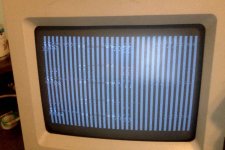
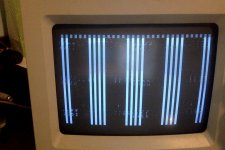
Now I am also getting the same screen that I saw when I powered it on for the first time. I'm starting to think that there is just a problem with the logic board just because the analog board is doing less of the clicky thing and more of the display-e thing, and more often.
Is the best option still to do a recap?
Is the best option still to do a recap?
Like I said, recapping the board will bring 90% of all dead Classic IIs with your symptoms. It did for many others including me:
https://68kmla.org/forums/index.php?/topic/23800-semi-successful-recap-on-classic-ii/
Did you use acetone when you washed the board?
Yes, recapping is the only option to repair 90% of all Classic II Boards. More work maybe needed if there is damage to the board (like mine and a couple others since the sound does not work but that's no biggie for me).
https://68kmla.org/forums/index.php?/topic/23800-semi-successful-recap-on-classic-ii/
Did you use acetone when you washed the board?
Yes, recapping is the only option to repair 90% of all Classic II Boards. More work maybe needed if there is damage to the board (like mine and a couple others since the sound does not work but that's no biggie for me).
Okay, sorry for all of the updates,
Elfen, on 17 Apr 2015 - 7:01 PM, said:
Like I said, recapping the board will bring 90% of all dead Classic IIs with your symptoms. It did for many others including me:
https://68kmla.org/forums/index.php?/topic/23800-semi-successful-recap-on-classic-ii/
Did you use acetone when you washed the board?
Yes, recapping is the only option to repair 90% of all Classic II Boards. More work maybe needed if there is damage to the board (like mine and a couple others since the sound does not work but that's no biggie for me).
I did not use acetone, just water. I can borrow some nail-polish remover, that is the same thing right?
Also I am kind of stupid and I touched the screen while it was doing its clicky thing, and I could definitely feel where my other hand was touching my leg being zapped. I won't do that anymore, that's for sure.
Elfen, on 17 Apr 2015 - 7:01 PM, said:
Like I said, recapping the board will bring 90% of all dead Classic IIs with your symptoms. It did for many others including me:
https://68kmla.org/forums/index.php?/topic/23800-semi-successful-recap-on-classic-ii/
Did you use acetone when you washed the board?
Yes, recapping is the only option to repair 90% of all Classic II Boards. More work maybe needed if there is damage to the board (like mine and a couple others since the sound does not work but that's no biggie for me).
I did not use acetone, just water. I can borrow some nail-polish remover, that is the same thing right?
Also I am kind of stupid and I touched the screen while it was doing its clicky thing, and I could definitely feel where my other hand was touching my leg being zapped. I won't do that anymore, that's for sure.
Nail polish remover is a little weaker than "Pure Acetone" but it will work when needed. Fill up a glass or ceramic Pie Pan and dunk the board in it, slough it about a bit for a few minutes and then take it out. Then with a hair dryer set to warm, blow out the board until it is dry and make sure to blow air under the chips. This will get rid of the leaky cap residue and possible shorts and other issues it creates. It will also stop the caps from corroding the board any further.
At this point you can recap the board or sent it to Uniserver for the recap. It will work if he does it because he will also repair other issues with the board. And he charges a very low price for parts and labor and he guarantees his work!
Congrats on your first static shock - this happens to all Mac Classics (from the 128 to Color Classis and LC500/5000 series) as static electricity builds up on the crt tube and touching it the static charge goes to you and then to where ever it can go from you. It is absolutely normal when you touch the screen. They never mention that on the Mac Owner Manual - LOL!
While the board is being recapped, clean up the case, mouse and keyboard, so when you get it back, you will have a clean Mac to put it into. Where the fan is inside the case, run the vacuum to get rid of the dust bunnies inside - they don't rent so out they must go!
Good luck on your problem and post up what happens!
At this point you can recap the board or sent it to Uniserver for the recap. It will work if he does it because he will also repair other issues with the board. And he charges a very low price for parts and labor and he guarantees his work!
Congrats on your first static shock - this happens to all Mac Classics (from the 128 to Color Classis and LC500/5000 series) as static electricity builds up on the crt tube and touching it the static charge goes to you and then to where ever it can go from you. It is absolutely normal when you touch the screen. They never mention that on the Mac Owner Manual - LOL!
While the board is being recapped, clean up the case, mouse and keyboard, so when you get it back, you will have a clean Mac to put it into. Where the fan is inside the case, run the vacuum to get rid of the dust bunnies inside - they don't rent so out they must go!
Good luck on your problem and post up what happens!
Acetone is to stop the cap goo from rotting the board any further. It is not going to help fix the machine because the caps themselves are either open or shorted out and to fix it they need to be replaced.
As is, the caps are still leaking and that goo is eating away at the board wires, breaking them. The more they break, the more work needs to fix it. Putting the board in acetone stops the goo from doing any further damage. That is why it must be done.
When the caps are replaced in the recapping process, the board is restored to near normal and most of the time will boot up on the first go. Most of the time. Question is, how much damage the cap goo did to the board and needs to be repaired? Most of the time this is minimal, and for Classic II easy to do. If this was a LC475, lets say... it becomes a much harder job to do.
As is, the caps are still leaking and that goo is eating away at the board wires, breaking them. The more they break, the more work needs to fix it. Putting the board in acetone stops the goo from doing any further damage. That is why it must be done.
When the caps are replaced in the recapping process, the board is restored to near normal and most of the time will boot up on the first go. Most of the time. Question is, how much damage the cap goo did to the board and needs to be repaired? Most of the time this is minimal, and for Classic II easy to do. If this was a LC475, lets say... it becomes a much harder job to do.
Well dont let it soak for 3 hours. You *might* not have much of a board left after. I never use acetone to clean my boards because I know it can easily dissolve certain plastics. Or make them very soft. But I can not say what plastics are used for the boards and never wanted to test drive it. Not saying its bad to use it, its not, just be smart.
I third it - Send it to Unsierver. He does an excellent job on recapping and he (as he told me long ago) guarantees his work. So when you get it back from him, it will work.
If it does not work, which I highly doubt, then the analog board needs recapping too. I do not believe it is the analog board from what you shown here so when you get it back, it will work.
I think I stated before, while the logic board is out for recapping, clean out the case. Put a vacuum to the fan of the bottom of the case and get the dust out of there.
Once you get the Classic II running again, you will be happy. Very Happy!
If it does not work, which I highly doubt, then the analog board needs recapping too. I do not believe it is the analog board from what you shown here so when you get it back, it will work.
I think I stated before, while the logic board is out for recapping, clean out the case. Put a vacuum to the fan of the bottom of the case and get the dust out of there.
Once you get the Classic II running again, you will be happy. Very Happy!
Oooo.... That is a touchy subject. The value of a working machine is high because it is working but it is not as high as one may think. It is not like a certain Ferrari Dino series which only 6 were made.
Consider this - the original price of the machine when it was sold, minus 10% for every year until on the 10th year is is worthless - $0. (This is insurance and FEMA recovery rates of lost items.) But after that is the machine has some value? I think it does. What does it cost to replace it? What does cost to repair it? Are there special things about it? What values are collectors and people like us put it at? How much you got it on ebay at that condition? And are you getting some use out of it, even fun? There is the value of the machine. You might have to wait 100 years for it to go at the original price, but what it is worth now, you got something.
Great to hear, bman12three4! And I wish you the best in getting this fixed one way or another.
There are people out there that do this - buy and then try to flip a Mac. The returns on this is quite low, especially if one has to repair the Mac before flipping it. The time, parts and money to fix it may be more than the actual value of a Mac they are trying to flip.
I collect old Macs on the basis that those were the machines I've used at work or personally at home. So I bought a few here and there and others I rescued from the trash. It's been fun working with all of them. (It also explains why I have more laptops than anything!)
Except for a few things, I find the older computers more useful than the newer ones.
There are people out there that do this - buy and then try to flip a Mac. The returns on this is quite low, especially if one has to repair the Mac before flipping it. The time, parts and money to fix it may be more than the actual value of a Mac they are trying to flip.
I collect old Macs on the basis that those were the machines I've used at work or personally at home. So I bought a few here and there and others I rescued from the trash. It's been fun working with all of them. (It also explains why I have more laptops than anything!)
Except for a few things, I find the older computers more useful than the newer ones.