Thread
My Latest Restoration
Hello,
I am new here. I am happy to join up with my many like-minded comrades. I wish I would have discovered this place earlier.
Here is my latest restoration, my first one in a while. It turned out to be a pretty easy one. The computer was missing a hard drive and only had on-board memory. I couldn't find my floppy disk stash, so I recovered the computer without any floppy disks; I was very happy to have an AppleCD 600e drive to help out. The LC III now has 36 MB RAM and a 40MB SCSI HD with System 7.5.3. Don't you wish modern computers had as much RAM as hard disk space? Well, maybe you don't care about modern computers at all.
http://patater.com/files/pictures/lciii.jpg
I'd like to put a IIe card into the LC III, but I haven't found any for sale that come with the cable.
My next project is restoring a SimasiMac SE/30. I haven't opened the case yet, but the machine looks to be in pretty bad shape. It will be quite an adventure.
http://patater.com/files/pictures/simasimacse30.jpg
Nice to meet you all.
I am new here. I am happy to join up with my many like-minded comrades. I wish I would have discovered this place earlier.
Here is my latest restoration, my first one in a while. It turned out to be a pretty easy one. The computer was missing a hard drive and only had on-board memory. I couldn't find my floppy disk stash, so I recovered the computer without any floppy disks; I was very happy to have an AppleCD 600e drive to help out. The LC III now has 36 MB RAM and a 40MB SCSI HD with System 7.5.3. Don't you wish modern computers had as much RAM as hard disk space? Well, maybe you don't care about modern computers at all.
http://patater.com/files/pictures/lciii.jpg
I'd like to put a IIe card into the LC III, but I haven't found any for sale that come with the cable.
My next project is restoring a SimasiMac SE/30. I haven't opened the case yet, but the machine looks to be in pretty bad shape. It will be quite an adventure.
http://patater.com/files/pictures/simasimacse30.jpg
Nice to meet you all.
Heh, I have a Dell 23" LCD, and it weighs nothing compared to most 14" CRTs, even the Macintosh Colour Display (which is pretty light for a CRT, I have to admit)
Its funny to think, the "Getting Started" guide that came with my LCIII suggested not to place a monitor on top of the machine any bigger than 14", since the LC case wasn't designed to support big monitors, however I'd have no trouble whatsoever parking my gargantuan 23" on top of there
Its funny to think, the "Getting Started" guide that came with my LCIII suggested not to place a monitor on top of the machine any bigger than 14", since the LC case wasn't designed to support big monitors, however I'd have no trouble whatsoever parking my gargantuan 23" on top of there
The monitor weighs more.Which weighs more, the III or the monitor?)
I'm not familiar with the identity you are referring to. (It may very well be an actual secret.) Might you be referring to this black SE/30? Or maybe this SE/30 bong? Or maybe its ability to run A/UX? It is hard for me to guess.
Do vertical stripes like the one in our smiley names SimasiMac really represent what a SimasiMac is? To me, a SimasiMac has horizontal bars. A mac with vertical bars is a jailed mac. If I am right, who should I talk with to get the smiley updated? :simasimac:
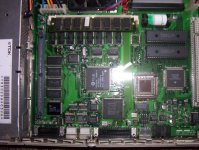
And just to make sure I don't post too much about the SE/30 in an LC III thread (well, more because I am curious about this), I would like to show you all something interesting I found inside the LC III. The LC III logic board has a few green wires connecting the chips U32, U22, and U7. I don't know what any of those chips are or how I could look them up (aside from just searching for numbers printed on them, which didn't get me anywhere). The wires were laid nicely and held in place with tiny beads of hot glue. The soldering quality isn't all that great though.
So, from this green wire find, I have two questions. First, do we have a good logic board reference we can use to find out what different parts are? Something like a BOM for various Macintosh models would be nice. And finally, what do you think those green wires are doing?
http://patater.com/files/pictures/lciii_greenwire_flash.jpg
Thank you all for your kind welcomes. I look forward to advancing the cause with you all.
I'm not at all surprised, the LCIII and the MicroQuadras are all lightweights, but the Microquadras are built to support heavier Monitors. My LC475 and Q605 were always happiest with my Apple Portrait Display sittin' on top.The monitor weighs more.Which weighs more, the III or the monitor?

Check the Developer Notes for each machine, they all have a rough logic diagram, listing the interconnections between the various ASICS, the CPU, what is connected to the Fast and Slow System buses and how.
Judging from the paths, lengths and the hot glue holding down the green wires. I'd say they were standard rework wiring for bad traces on that board in particular, or to fix an incorrect PCB layout.
I'd examine that board VERY closely for any verbiage, dates and revision#s you can find. With that much rework, you may have, either a very early production board or maybe even a prototype MoBo on your hands. [
] ]'>BTW, I LOVE your avatar, what's the resistance value?
) I just discovered these today. I thought they were more geared towards developers of expansion cards and software, but they might help in figuring out what these wires are doing. I will review the notes for the LC III and let you know what I can find out.
I don't know. I would have thought that Apple manufacturing techs would do a better job of rework than this. They could have at least washed the board when they were done.
All I can find is a black stamp that probably reads "9B", a bar code and serial number of sorts "*B13020Q5EN6B* SINGAPORE VAIL", and printed on the logic board PCB "APPLE COMPUTER INC., 820-0650-A © 1992, 630- - ".I'd examine that board VERY closely for any verbiage, dates and revision#s you can find. With that much rework, you may have, either a very early production board or maybe even a prototype MoBo on your hands. [
You must have one of those fancy color monitors.BTW, I LOVE your avatar, what's the resistance value?
Here's the LC's new home.
http://patater.com/files/pictures/lciii_desk.jpg
And, of course, there is the actual Apple serial number of "SG3030Z7VA2". I'm pretty sure this Mac is not a prototype. It would be interesting to know if any other LC III owners have similar green wires in their machines and if they are the Rev A logic boards and/or are manufactured around the same time as this LC III.