

Thread
Classic accelerator?
Can I be reading this right?
This advert appears to say that accelerators (at 25MHz and at 40MHz) for the Mac Classic were once sold.
Have never heard of them, and have never seen such a product — but would love to. Did such an accelerator actually exist? It would surely need to be a different logic board, would it not?
This advert appears to say that accelerators (at 25MHz and at 40MHz) for the Mac Classic were once sold.
Have never heard of them, and have never seen such a product — but would love to. Did such an accelerator actually exist? It would surely need to be a different logic board, would it not?
I have one (a Techworks 68030 at 40 MHz, sold by Sonnect) since 1995, this is the original web page that I made, I am translating into english so far I have translated 50%, enjoy:
http://www.webalice.it/beniamino.cenci.goga/68k/Macintosh_Classic_XLR8d.html
Ben
http://www.webalice.it/beniamino.cenci.goga/68k/Macintosh_Classic_XLR8d.html
Ben

Yep!
technight, I forgot to mention that I found the accelerated 128/Plus at a flea market, so it is still possible to find these things. But, if it hadn't been for the curious branding ironed "DayStar Inside" logo on the front, I would have missed out on the MicroMac accelerator upgrade in the Plus Bucket from the first of the 128k upgrade series.
IRS Refund Madness! Multiple Conquests!
technight, I forgot to mention that I found the accelerated 128/Plus at a flea market, so it is still possible to find these things. But, if it hadn't been for the curious branding ironed "DayStar Inside" logo on the front, I would have missed out on the MicroMac accelerator upgrade in the Plus Bucket from the first of the 128k upgrade series.
IRS Refund Madness! Multiple Conquests!
I like seeing interesting widgets in foriegn countries.
However I couldn't help but be piqued by the use of the word "retractor". The device or tool picutured in English is called a clamp, usually used for light clamping purposes such as holding some paper to some kind of backing material, or light sheet metal being held up onto a board while it is being painted. Specifically, the tool pictured is being used a prying tool, using the lips of the clamp to wedge the two case halves apart. A better tool is a metal spudger or putty knife.
Now a retractor can be many things: such as someone who goes someplace to retrieve something, or a tool used to grab something that fell someplace, like an automotive tech who dropped a bolt or nut down a chassis rail.
However I couldn't help but be piqued by the use of the word "retractor". The device or tool picutured in English is called a clamp, usually used for light clamping purposes such as holding some paper to some kind of backing material, or light sheet metal being held up onto a board while it is being painted. Specifically, the tool pictured is being used a prying tool, using the lips of the clamp to wedge the two case halves apart. A better tool is a metal spudger or putty knife.
Now a retractor can be many things: such as someone who goes someplace to retrieve something, or a tool used to grab something that fell someplace, like an automotive tech who dropped a bolt or nut down a chassis rail.
Hey trash, i made that post before i hit the hamvention in dayton in may of 2011. Thats when i discovered the plus with the hyperdrive 2000 emblem, which instead of the drive, it had the 030 accelerator. So ya, its still possible, but not probable.
Speaking of which, its that time of year again. hamvention is around the corner.
Speaking of which, its that time of year again. hamvention is around the corner.
thanks a lot, I was pretty sure of this term since I got it from the Techworks manual! I will amend and replace with "clamp".
The only thing is that clam is associated with clamping while the tool is actually used to wedge the two halves apart.
Ben
Ps, time to translate the second part too.
correct, but this beast is much faster!
Huh? That statement is very confusing: I think you mean to say...
"This clamp is used as a wedge to pry the two case halves apart."
There. Also, a "spanner" is usually a British English term for a what the Americans call a wrench, like a combination open end wrench with the other end being a box end (google it). The tool you translated is more accurately described as a Torx bit T-handle driver (the cheap version with no rubberizing or comfort grip: anybody wanna line up to remove a mega-over torqued bolt with that wire framed version? Not me).
The SE and SE/30 have a T15 size machine screw, I don't know if the Classic is the same, but giving people a reference helps sometimes

This exercise is much better than evening english classes! ;-)
I copied your sentence from the first message and I thought to have learnt a new verb: "to wedge" as a synonym for to pry!
By the way the action is not similar to a wedge as the two parts of the clamps for small movements (2 to 10 mm) are parallel and the risk of damaging the case is actually zero.
Will scan and post the Techworks user manual for the accelerator to see how they describe the thing.
Ben
![sdc11099j[1].jpg](/sites/default/files/forum-media/57/20/5720b6bf13f0b11d0c9656b7cd7b968c98a9250e.jpg "sdc11099j[1].jpg")
Hey bengi3, I enjoyed your write up on the accelerator. Well done.
One thing: Allen and Torx are two quite different shapes of heads and drivers - it may be best to remove the reference to Allen to save confusion.
For reference, here's the "official" Mac cracker, as used by authorized service shops back in the day:
[image TBA - still searching]
It's a wide spring clamp used in woodworking, often called a framer's or framing clamp, I believe. The idea is to apply pressure evenly along the length of the seam, and in both directions at once, as close to the direction of movement as possible. A spudger or putty knife can only apply pressure in one direction, unless you twist it - which is how gouges and chips taken out of the plastic happen.
The tool you have here, bengi3:
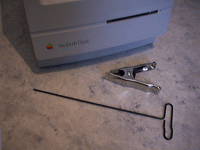
... is called a "spring clamp". I presume Techworks called it a retractor because that is what it is being used for when installing their kit - to "retract" the rear of the case.
They are widely available and cheap, and come in many sizes. This store has them up to four inches (or 12"??), and IMHO the wider the better for Mac cracking. Obviously, one removes the rubber protectors from the tips, and some advise flattening the tips in a vise as well.
This thread may also be of interest:
Suggestions for opening a compact sans Mac Cracker?
One thing: Allen and Torx are two quite different shapes of heads and drivers - it may be best to remove the reference to Allen to save confusion.
That's ... a horrible idea, and likely to lead to damage to the plastics along the seam.
For reference, here's the "official" Mac cracker, as used by authorized service shops back in the day:
[image TBA - still searching]
It's a wide spring clamp used in woodworking, often called a framer's or framing clamp, I believe. The idea is to apply pressure evenly along the length of the seam, and in both directions at once, as close to the direction of movement as possible. A spudger or putty knife can only apply pressure in one direction, unless you twist it - which is how gouges and chips taken out of the plastic happen.
The tool you have here, bengi3:
... is called a "spring clamp". I presume Techworks called it a retractor because that is what it is being used for when installing their kit - to "retract" the rear of the case.
They are widely available and cheap, and come in many sizes. This store has them up to four inches (or 12"??), and IMHO the wider the better for Mac cracking. Obviously, one removes the rubber protectors from the tips, and some advise flattening the tips in a vise as well.
This thread may also be of interest:
Suggestions for opening a compact sans Mac Cracker?
Usually if it has been opened before, then the old method of using inertia to eject the chassis from the back case over something like a bed works well. If it has been opened often, then there is usually no significant resistance to simply pulling the rear case off.
My preliminary search also turned up nothing, but I think veterans here and elsewhere know what they look like. The idea of using a putty knife may be scoffed at, but I can remember that tool being advised back then as a ... poor man's substitute. I'm not sure you'd want "pry" it open, as you would want to run it along the seams to try to break the bonds. Naturally, it helps if the screws are out first...
If someone is concerned about the difficulty of opening the case due to age or other factors and the attack of the tool upon the plastic, then electrical tape or masking tape can be applied along the edges. Skill, not brute force, is the preferred technique.
Alternatively, we should heed the advisory on the back panel: "To prevent electrical shock, do not remove cover. No user-serviceable parts inside. Refer servicing to qualified service personnel." I'm struggling on the concept of "qualified service personnel", I think we can self-certify ourselves (late April Fools certification test anyone?).

My preliminary search also turned up nothing, but I think veterans here and elsewhere know what they look like. The idea of using a putty knife may be scoffed at, but I can remember that tool being advised back then as a ... poor man's substitute. I'm not sure you'd want "pry" it open, as you would want to run it along the seams to try to break the bonds. Naturally, it helps if the screws are out first...
If someone is concerned about the difficulty of opening the case due to age or other factors and the attack of the tool upon the plastic, then electrical tape or masking tape can be applied along the edges. Skill, not brute force, is the preferred technique.
Alternatively, we should heed the advisory on the back panel: "To prevent electrical shock, do not remove cover. No user-serviceable parts inside. Refer servicing to qualified service personnel." I'm struggling on the concept of "qualified service personnel", I think we can self-certify ourselves (late April Fools certification test anyone?).
I used a long torx bit in a long screwdriver extension. Not perfect or elegant, but did the job!
The allens need to be torx, normal allens wont work.
The putty knife I believe is the advised tool for opening a mac mini, blunted off a bit of course!
I used an old credit card-style loyalty card to get the plus open, but it didn't give much resistance.
The allens need to be torx, normal allens wont work.
The putty knife I believe is the advised tool for opening a mac mini, blunted off a bit of course!
I used an old credit card-style loyalty card to get the plus open, but it didn't give much resistance.
[ nitpick clarification mode ]
The tool in the pic above actually is an allen wrench, sized to fit the torx screws and it works just fine. I have one that was included with the four 1MB SIMMs for my SE from Memory Plus(?) which came in a clever kit, packaged in a long zip-loc bag, with an antistatic wrist strap, along with the retractor in the picture. The tool in the pic very likely is a clamp, but retractor is the correct terminology for a surgical instrument that acts exactly as this tool does when employed as a Mac cracker. IIRC, a retractor has the same sort of widget as a hemostat, but to hold it open while spreading an incision, as opposed to clamping off a bleeder.
So the Mac Cracking Kit, had a great manual, a nice, single use, grounding strap and a pair of tools that were less than perfectly specified, but worked perfectly well for the procedures in which they were employed. The allen wrench was a very clever design, fitting into the twelve sided torx socket, as a twelve sided socket wrench works perfectly to drive a six sided nut.
Torx stock would be much more expensive and difficult (impossible?) to manufacture inexpensively in that bent T-handle configuration. The inexpensive, malleable "allen" stock (sized to fit the T-15 socket) gives a nice, twisting, cushioning, over-torque protecting action to the tool. Rounded vs. sharp edges notwithstanding, it is a very elegant engineering solution as the replacement for a real T-15 tool.
[ /nitpick clarification mode ]
:beige:
The tool in the pic above actually is an allen wrench, sized to fit the torx screws and it works just fine. I have one that was included with the four 1MB SIMMs for my SE from Memory Plus(?) which came in a clever kit, packaged in a long zip-loc bag, with an antistatic wrist strap, along with the retractor in the picture. The tool in the pic very likely is a clamp, but retractor is the correct terminology for a surgical instrument that acts exactly as this tool does when employed as a Mac cracker. IIRC, a retractor has the same sort of widget as a hemostat, but to hold it open while spreading an incision, as opposed to clamping off a bleeder.
So the Mac Cracking Kit, had a great manual, a nice, single use, grounding strap and a pair of tools that were less than perfectly specified, but worked perfectly well for the procedures in which they were employed. The allen wrench was a very clever design, fitting into the twelve sided torx socket, as a twelve sided socket wrench works perfectly to drive a six sided nut.
Torx stock would be much more expensive and difficult (impossible?) to manufacture inexpensively in that bent T-handle configuration. The inexpensive, malleable "allen" stock (sized to fit the T-15 socket) gives a nice, twisting, cushioning, over-torque protecting action to the tool. Rounded vs. sharp edges notwithstanding, it is a very elegant engineering solution as the replacement for a real T-15 tool.
[ /nitpick clarification mode ]
:beige:
Indeed. I am a vet, now I work as microbiolgist (http://www.facebook.com/ispezionealimenti, but in early '90s I started as a vet in large animal surgery and the term retractor made sense. Now, in the light of these post, I believe that another term should be used.
Ben
We still can't avoid the fact that using an allen tool on a torx screw is not a recognized "right" way. Sure it can work sometimes, sometimes it doesn't and can mangle the head. (I'd invite anybody to tackle some inverse torx bolts on a transmission bellhousing with conventional hex socket drivers.)
As for the manufactoring process, the tool change is minimal. You heat the end up (unless you want to do it cold forging) and smash the end in a die with a hydraulic ram. Deburr the end and move on to the next.
As for "retractor": If you're using it as something to hold something open, I'm garnering on "expander" or "wedge". An expander would be something similar to an outside snap ring, where you use a snap ring plier that can "expand" the snap ring until it can be removed.
Agreed, allen is not a recommended tool replacement for torx for general use. The operative words are, inexpensive, sized to fit, malleable, twisting action and over-torque protection, to which can be added low cycle count, and low torque application of the fasteners in question.
I've done a LOT of cold iron working on a significant percentage of the tools in the Whitney Catalog. For the stock in question, we're talking a low production run item for a specific purpose. I'll put a digital caliper on the "allen stock" in question and I have a sneaking suspicion it may not show up as a standard metric or fractional inch size.
BTW, the closer to round the stock, the lesser the resistance to the twisting motion that's designed into the tool for over-torque protection. The flutes on rounded corner torx stock would offer significantly more resistance, to the point of negating this feature.
As far as "retractor" goes, "case srerader" would have been just about right, but almost everyone has heard a surgeon in movies or on TV ask the scrub nurse for a "retractor," whilst very few would be familiar with tool nomenclature.
A "retractor" IS a spreader, but this is definitely a case where three syllables spread across two words would have been a much better choice than three syllables in a single word, even if it's the most correct word for a tool used in this application. [ ] ]'>
] ]'>
I've done a LOT of cold iron working on a significant percentage of the tools in the Whitney Catalog. For the stock in question, we're talking a low production run item for a specific purpose. I'll put a digital caliper on the "allen stock" in question and I have a sneaking suspicion it may not show up as a standard metric or fractional inch size.
BTW, the closer to round the stock, the lesser the resistance to the twisting motion that's designed into the tool for over-torque protection. The flutes on rounded corner torx stock would offer significantly more resistance, to the point of negating this feature.
As far as "retractor" goes, "case srerader" would have been just about right, but almost everyone has heard a surgeon in movies or on TV ask the scrub nurse for a "retractor," whilst very few would be familiar with tool nomenclature.
A "retractor" IS a spreader, but this is definitely a case where three syllables spread across two words would have been a much better choice than three syllables in a single word, even if it's the most correct word for a tool used in this application. [
] ]'>To sum up the medical retractor/mechanics tool/carpenter's clamp/case spreader terminology issue . . .
It's a Filmmaking tool used by Grips! )
)
I just found my Mac Cracking/Memory (MacConnection) Installation kit and then googled the mfr/part# and discovered that it's a Pony Grip Clip #2 -#3202 w/o covers!
I may order the Pony Clamp 3201 with tip and grip covers (#1 Grip Clip) with finger friendly cushy covers for less $$$$$!!!!!!!!!!!! :
Pony clamps, made right here in the good 'ole USA . . .
(no offense meant to any of my comrades anywhere else across the planet, this is as opposed to Made in China only! I don't think I need to fear offending anyone in "Communist" China)
. . . are apparently sold for everything under the sun.
It's definitely a "Mac Cracker" or "Compact Mac Case Spreader" for all intents and our purposes . . . other than hacking of course! [] ]'>
. . . we're ALL WRONG!!!!!! :lol:
It's a Filmmaking tool used by Grips!
) I just found my Mac Cracking/Memory (MacConnection) Installation kit and then googled the mfr/part# and discovered that it's a Pony Grip Clip #2 -#3202 w/o covers!
I may order the Pony Clamp 3201 with tip and grip covers (#1 Grip Clip) with finger friendly cushy covers for less $$$$$!!!!!!!!!!!! :
Pony clamps, made right here in the good 'ole USA . . .
(no offense meant to any of my comrades anywhere else across the planet, this is as opposed to Made in China only! I don't think I need to fear offending anyone in "Communist" China)
. . . are apparently sold for everything under the sun.
It's definitely a "Mac Cracker" or "Compact Mac Case Spreader" for all intents and our purposes . . . other than hacking of course! [
] ]'>