

Thread
TWO SLOT IIsi Nubus Card hack . . . (SE/30 hacks)
. . . is a notion I've been sittin' on ever since I finally got the IIsi. It seems that the Gemini Two Slot adapter for the DuoDock is hackable so that the "Upper Slot" in the Duo can be hacked onto the connector or thru-holes for the IIsi's NuBus Adapter Card.
This will entail hard wiring the HDD's Power Cable to get the MoBo pins & shroud out of the way, and maybe a couple of other minor hacks. to the IIsi MoBo.
From the Gemini side of things, the EuroDin Connector to the DuoDock MoBo will need to be desoldered for it to fit due to space limitations in the IIsi, unless the entire bottom portion (a passive straight signal passthrough slot expansion card similar to the PCI adapters for the 5XXX & 6XXX PCI risers) can be lopped off entirely. Machine pins will need to be soldered, socket side down, onto the soldertails of the Gemini's "outer" NuBus connector so the pins will insert into the NuBus Adapter's female sockets.
From the NuBus Expansion Adapter end of things, the only thing I can think of would be removing the digital glue that assigns the Slot ID from the card and possibly replacing the EuroDIN connector with machine pins as sockets to mate with the machine pins soldered socket side down to the underside of the Gemini Card's Outer NuBus connector (as mentioned above) in order to shorten the distance between the sandwiched adapter pair.
The length of the lower card will depend upon the height/form factor of the HDD installed in theIIsi, unless of course I move that, along with the speaker, to the empty space under the FDD that's currently under consideration for a ZIP or DVD installation.
The hardest part of this silly lil' project will actually be modifying the @$$ end of the IIsi with a two (or, preferably, three) slot backplane offset from the existing slot. The third (bottom) of the slots would be used for breaking out the IIsiCrawlspaceCardsHack™ connectors to the outside world.
IIsiCrawlspaceCardsHack™ thread to be posted later. }
This will entail hard wiring the HDD's Power Cable to get the MoBo pins & shroud out of the way, and maybe a couple of other minor hacks. to the IIsi MoBo.
From the Gemini side of things, the EuroDin Connector to the DuoDock MoBo will need to be desoldered for it to fit due to space limitations in the IIsi, unless the entire bottom portion (a passive straight signal passthrough slot expansion card similar to the PCI adapters for the 5XXX & 6XXX PCI risers) can be lopped off entirely. Machine pins will need to be soldered, socket side down, onto the soldertails of the Gemini's "outer" NuBus connector so the pins will insert into the NuBus Adapter's female sockets.
From the NuBus Expansion Adapter end of things, the only thing I can think of would be removing the digital glue that assigns the Slot ID from the card and possibly replacing the EuroDIN connector with machine pins as sockets to mate with the machine pins soldered socket side down to the underside of the Gemini Card's Outer NuBus connector (as mentioned above) in order to shorten the distance between the sandwiched adapter pair.
The length of the lower card will depend upon the height/form factor of the HDD installed in theIIsi, unless of course I move that, along with the speaker, to the empty space under the FDD that's currently under consideration for a ZIP or DVD installation.
The hardest part of this silly lil' project will actually be modifying the @$$ end of the IIsi with a two (or, preferably, three) slot backplane offset from the existing slot. The third (bottom) of the slots would be used for breaking out the IIsiCrawlspaceCardsHack™ connectors to the outside world.
IIsiCrawlspaceCardsHack™ thread to be posted later. }
This project is likely a non-starter. The IIsi only has three PseudoSlot IDs, one for the NuBus Card and the other two for the Radius Color Pivot II/IIsi VidCard and the 10bT NIC respectively.
I guess I could forgo the RCP2/IIsi VidCard for one of my Red Radius NuBus Powerhouse VidCards though! )
)
I guess I could forgo the RCP2/IIsi VidCard for one of my Red Radius NuBus Powerhouse VidCards though!
) Well, thanks to comrade znosko, I've got another pair of Gemini Cards and a pair of working DuDock LoBos to play around with for this and another two projects.
Now to check out the NuBus Standard Documentation for Slot ID hacking!
Has anyone broken ground on this front as yet? :?: I hate carving out new versions opf the wheel when they're already available in the form factor I require.)
< wonders what the 6100 NuBus adapter card looks like? } >
Now to check out the NuBus Standard Documentation for Slot ID hacking!
Has anyone broken ground on this front as yet? :?: I hate carving out new versions opf the wheel when they're already available in the form factor I require.
) < wonders what the 6100 NuBus adapter card looks like? }
>I just bought myself a little father's day present. I've got another IIsi NuBus Adapter on the way! [ ] ]'>
] ]'>
The original one will stay stock, but this one is headed for the soldering/de-soldering bench for a couple of address line rearrangements and a Gemini Card graft in the 2-Slot hack attempt.
Slot 1 - Rocket/SCSI II DaughterCard
Slot 2 - Futura VidCard with 10basetT Daughtercard
PDS undercarriage hack - Radius Pivot II/IIsi Card . . .
. . . or somethingorother . . . [}] ]'>
] ]'>The original one will stay stock, but this one is headed for the soldering/de-soldering bench for a couple of address line rearrangements and a Gemini Card graft in the 2-Slot hack attempt.
Slot 1 - Rocket/SCSI II DaughterCard
Slot 2 - Futura VidCard with 10basetT Daughtercard
PDS undercarriage hack - Radius Pivot II/IIsi Card . . .
. . . or somethingorother . . . [}
] ]'>I'm interested in this project, Trash, but can you explain it from the beginning.
I am not familiar with the Gemini card but I will start reading your other project thread: viewtopic.php?f=29&t=17721
I am not familiar with the Gemini card but I will start reading your other project thread: viewtopic.php?f=29&t=17721
Get one of the DuoDock service source PDFs and take a look at the exploded diagram. The Gemini Twin Slot Adapter is a passive 180 degree adapter that drops the Dock's two slots below and underneadth the MLB of the DuoDock. It has a reversed gender connection to the Logic Board that I'll be removing, once/if I can get the two slots working in the IIsi, so that I can get the lid closed.
There will be a horizontal offset of the NuBus Card's location by approx. one connector's height, but nothing a new BackPlane cover can't address. I've got a mint empty case for the final version of this cards sprouting every which way hack. I might graft a second backplane opening from the first case underneath the stock slot in the mint case.
Dunno, it's interesting intellectually and mechanically challenging. What's not to like? :approve:
There will be a horizontal offset of the NuBus Card's location by approx. one connector's height, but nothing a new BackPlane cover can't address. I've got a mint empty case for the final version of this cards sprouting every which way hack. I might graft a second backplane opening from the first case underneath the stock slot in the mint case.
Dunno, it's interesting intellectually and mechanically challenging. What's not to like? :approve:
I'm not so good with words when it comes to describing my hackin' plans . . . but graphics? :?:
'
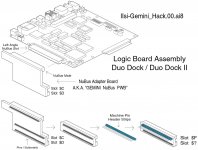
I've added just a single row of pins for the NuBus Connector's to the graphic for clarity's sake. There are a couple of ways to go about this for the final version. For starters, I'll solder "Machine Pin Header Strips" onto the soldertails of Slot C (Pseudoslot Address: $C) so I can just plug the full height Gemini Card straight into the IIsi NuBus Adapter's Connector. At this point, the top slot should be connected to the $F Address Space and Interrupt of the IIsi Adapter Card's Slot $F.
Hijacking another Interrupt/Address line to implement the second NuBus Slot will be the fun part of the hack! :approve:
Dunno, we'll see, that's why I've got a spare NuBus adapter and several spare Gemini Cards. [}] ]'>
If things work out well in the proof of concept stage, I'll do my best to muck it up by removing the upper section of the Gemini Card as shown on the right. For starters, the gender changed DuoDock connector and the top 2/5 of the card will remain intact. This will stick up about an inch higher than the top of the IIsi Case would be if it were in place.
If all goes to plan . . . : . . . I'll probably order a NuBus EuroDin Wire Wrap Socket. I'll remove the top slot's connector from the Gemini Card. Soldering the wire wrap connector to the Gemini Card first will allow the slots to be tested again in the NuBus connector on the IIsi Adapter. If all works at that stage, the Connector on the IIsi Adapter will be removed and the Wire Wrap pins will be inserted as deeply as possible (the crystal Can is the highest part to clear) into the vacated NuBus Slot's ThruHoles and soldered into place and the extra wire wrap pin length will be clipped. At this point, the pair of Gemini Card Slots will only be offset about a quarter of an inch farther from the NuBus Adapter PCB than the original, single NuBus Slot.
I'll do an edge on view of the Hack as soon as I can get around to it. The figures in the IIsi DevNote for the edge-on/cross sectional view of the NuBus Adapter, MoBo and NuBus Card are pretty rough and not done to scale at all.
I hope this clears things up just a bit.
'
I've added just a single row of pins for the NuBus Connector's to the graphic for clarity's sake. There are a couple of ways to go about this for the final version. For starters, I'll solder "Machine Pin Header Strips" onto the soldertails of Slot C (Pseudoslot Address: $C) so I can just plug the full height Gemini Card straight into the IIsi NuBus Adapter's Connector. At this point, the top slot should be connected to the $F Address Space and Interrupt of the IIsi Adapter Card's Slot $F.
Hijacking another Interrupt/Address line to implement the second NuBus Slot will be the fun part of the hack! :approve:
Dunno, we'll see, that's why I've got a spare NuBus adapter and several spare Gemini Cards. [}
] ]'>If things work out well in the proof of concept stage, I'll do my best to muck it up by removing the upper section of the Gemini Card as shown on the right. For starters, the gender changed DuoDock connector and the top 2/5 of the card will remain intact. This will stick up about an inch higher than the top of the IIsi Case would be if it were in place.
If all goes to plan . . . :
. . . I'll probably order a NuBus EuroDin Wire Wrap Socket. I'll remove the top slot's connector from the Gemini Card. Soldering the wire wrap connector to the Gemini Card first will allow the slots to be tested again in the NuBus connector on the IIsi Adapter. If all works at that stage, the Connector on the IIsi Adapter will be removed and the Wire Wrap pins will be inserted as deeply as possible (the crystal Can is the highest part to clear) into the vacated NuBus Slot's ThruHoles and soldered into place and the extra wire wrap pin length will be clipped. At this point, the pair of Gemini Card Slots will only be offset about a quarter of an inch farther from the NuBus Adapter PCB than the original, single NuBus Slot.I'll do an edge on view of the Hack as soon as I can get around to it. The figures in the IIsi DevNote for the edge-on/cross sectional view of the NuBus Adapter, MoBo and NuBus Card are pretty rough and not done to scale at all.
I hope this clears things up just a bit.
I played around with the NuBus Adapter Diagram from the DevNote and wound up doing a major overhaul.
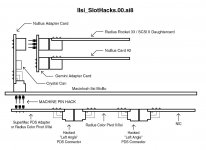
This diagram shows both the NuBus and Basement PDS hacks, both done by soldering Machine Pin strips to the soldertails of the Gemini Card and the IIsi PDS respectively. One of the two cards mentioned will have its Right Angle PDS Male Connector removed and replaced by Machine Pin Strips in their standard configuration as high reliability sockets on a PCB.
Lets see if this clears anything up! :
This diagram shows both the NuBus and Basement PDS hacks, both done by soldering Machine Pin strips to the soldertails of the Gemini Card and the IIsi PDS respectively. One of the two cards mentioned will have its Right Angle PDS Male Connector removed and replaced by Machine Pin Strips in their standard configuration as high reliability sockets on a PCB.
Lets see if this clears anything up! :
OOPSIE! :-/ I'll have to do an update on the graphic, I forgot the PDS Slot Connector on the Isi MoBo and a few other things.
If I had a spare IIsi MoBo ,I'd probably remove the soldertail connector with a wire wrap connector and permanently solder the SuperMac PDS Adapter with its Zeners Implemented onto the extended pins rather than doing the Machine Pin Hack . . . I just may do it anyway . . . time to order a couple of PDS and NuBus Wire Wrap EuroDin Connectors . . .
. . . that'll be the most reliable and compact I/O hack overall . . . if a bit riskier! [}] ]'>
If I had a spare IIsi MoBo ,I'd probably remove the soldertail connector with a wire wrap connector and permanently solder the SuperMac PDS Adapter with its Zeners Implemented onto the extended pins rather than doing the Machine Pin Hack . . . I just may do it anyway . . . time to order a couple of PDS and NuBus Wire Wrap EuroDin Connectors . . .
. . . that'll be the most reliable and compact I/O hack overall . . . if a bit riskier! [}
] ]'>Last update for this thread, my discussions w/bbraun abut the addressing issues of both of these I/O hacks are over in the main SuperIIsiHack™ AKA SE/30's BANE . . . thread
View attachment 16244
I've switched to a more aggressive hack of the IIsi MoBo by substituting the original soldertail PDS socket with a Wire-Wrap Socket that will join the Hacked SuperMac adapter to the Hacked SuperIIsi's Mobo permanently for the Basement PDS Card Hack. I've decided that going half-way using the "Machine Pin Hack" would be reversible, but less robust physically and therefor less reliable electrically.
The same holds true for the marginally less risky, but equally aggressive, removal of the NuBus Connector from my spare NuBus Adapter. The cut down Gemini Card (DuoDock Donation) will have its Male NuBus Connector replaced with a soldertail version as well, after this is fully tested in the unmodified NuBus Adapter's Slot, the NuBus Slot will be removed and the extra length pins on the wire wrap connector will be permanently soldered to the NuBus Adapter slot's pads.
Please let me know if this diagram is self-explanatory.
Do I need to show the NuBus Slot Hack alone for simplicity or is the combo graphic sufficient?
Might it be clearer with both posted individually?
View attachment 16244
I've switched to a more aggressive hack of the IIsi MoBo by substituting the original soldertail PDS socket with a Wire-Wrap Socket that will join the Hacked SuperMac adapter to the Hacked SuperIIsi's Mobo permanently for the Basement PDS Card Hack. I've decided that going half-way using the "Machine Pin Hack" would be reversible, but less robust physically and therefor less reliable electrically.
The same holds true for the marginally less risky, but equally aggressive, removal of the NuBus Connector from my spare NuBus Adapter. The cut down Gemini Card (DuoDock Donation) will have its Male NuBus Connector replaced with a soldertail version as well, after this is fully tested in the unmodified NuBus Adapter's Slot, the NuBus Slot will be removed and the extra length pins on the wire wrap connector will be permanently soldered to the NuBus Adapter slot's pads.
Please let me know if this diagram is self-explanatory.
Do I need to show the NuBus Slot Hack alone for simplicity or is the combo graphic sufficient?
Might it be clearer with both posted individually?
It feels great to have some time to play around in Illustrator 8 without being back in the production harness again!
View attachment 16246
NOTE: ATX Power Supply Hack required for more than 15W draw.
Here's a version of the basement expansion ploy that might not tax a stock IIsi's PSU.
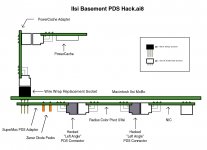
I'll post this in a different thread of its own with the proper title for any PowerCache jockeys with a IIsi to play with. [}] ]'>
View attachment 16246
NOTE: ATX Power Supply Hack required for more than 15W draw.
Here's a version of the basement expansion ploy that might not tax a stock IIsi's PSU.
I'll post this in a different thread of its own with the proper title for any PowerCache jockeys with a IIsi to play with. [}
] ]'>Hey Trash80 - your diagrams help a lot. Keep it up
One question - why is the passive SuperMac PDS adapter even in there, as opposed to mounting the machine pins directly on the back of the Pivot card? Just want to keep your mods off of active/working cards?
What interests me is - whether the basement approach could work with an SE/30 - with suitable chassis modifications of course.
Thanks for the feedback mate! I was really hoping they'd help clear up the muddiness of my .TXTual ramblings.
I've added the "passive" SuperMac Adapter Card into the mix for a few reasons.
1) The thruholes for the unimplemented Zener Diode Packs are shown as populated, which provides over-voltage protection to the entire PDS chain. SuperMac decided this protection was unnecessary for their IIsi Video Card, but I'm making an attempt at adding a lot more circuitry than a single VidCard to the PDS.
2) I haven't looked at the changes in trace length that might be a side effect of changing the direction of the PDS connectors yet. It doesn't seem to have any effect upon the function of the Radius Color Pivot II/IIsi, but I haven't modified one of them for straight "stacking" the NIC or tested its function yet. The SuperMac Adapter's traces could be cut and patched to correct any timing issues should they arise.
3) Similarly, the "passive adapter" makes a handy "breadboard" for cutting and patching traces to re-arrange address/interrupt lines or implementing them on N.C. pins in the PDS spec. The latter will likely make timing for the "second NuBus slot" an issue, but a reversible, ugly, unreliable/noisy proof of concept hack on an inexpensive basement level board beats mucking around with the NuBus Adapter Card's traces by a large margin!
4) Strain relief. This is less of an issue now that I've decided to use a "wire wrap replacement socket" approach, but it is/was important for the less robust "machine pin hack." Four standoffs mounted to the thin, clear plexi "basement floor" makes swapping the PDS expansion cards around down there a lot less likely to induce borkage.
I'll have to give the SE/30 notion some thought, offhand I'd say the approach would be considerably less advantageous.
I've added the "passive" SuperMac Adapter Card into the mix for a few reasons.
1) The thruholes for the unimplemented Zener Diode Packs are shown as populated, which provides over-voltage protection to the entire PDS chain. SuperMac decided this protection was unnecessary for their IIsi Video Card, but I'm making an attempt at adding a lot more circuitry than a single VidCard to the PDS.
2) I haven't looked at the changes in trace length that might be a side effect of changing the direction of the PDS connectors yet. It doesn't seem to have any effect upon the function of the Radius Color Pivot II/IIsi, but I haven't modified one of them for straight "stacking" the NIC or tested its function yet. The SuperMac Adapter's traces could be cut and patched to correct any timing issues should they arise.
3) Similarly, the "passive adapter" makes a handy "breadboard" for cutting and patching traces to re-arrange address/interrupt lines or implementing them on N.C. pins in the PDS spec. The latter will likely make timing for the "second NuBus slot" an issue, but a reversible, ugly, unreliable/noisy proof of concept hack on an inexpensive basement level board beats mucking around with the NuBus Adapter Card's traces by a large margin!
4) Strain relief. This is less of an issue now that I've decided to use a "wire wrap replacement socket" approach, but it is/was important for the less robust "machine pin hack." Four standoffs mounted to the thin, clear plexi "basement floor" makes swapping the PDS expansion cards around down there a lot less likely to induce borkage.
I'll have to give the SE/30 notion some thought, offhand I'd say the approach would be considerably less advantageous.
Don't worry about pin one, I've kept it and the rest of them "straight."
Look at it like this:
The first card is just flopped over from 90 degrees to flat onto the mobo, pin one is still pin one, the legs of the right angle connector are like the rings in a binder, the pages stay aligned on the rings as the connector wires do to the card and MoBo. You've just closed the half-open binder.
In a binder, you can remove a page and clip it behind the next page, that's the transition of that first card into the "basement" where it's still aligned with the MoBo Page on the binder rings.
As far as the "Left Angle Connector" replacements go, you're just laying the binder out flat from its halfway open position, all the holes line up with the original rings, it's just that more of the rings are exposed.
Does that help? :?:
Look at it like this:
The first card is just flopped over from 90 degrees to flat onto the mobo, pin one is still pin one, the legs of the right angle connector are like the rings in a binder, the pages stay aligned on the rings as the connector wires do to the card and MoBo. You've just closed the half-open binder.
In a binder, you can remove a page and clip it behind the next page, that's the transition of that first card into the "basement" where it's still aligned with the MoBo Page on the binder rings.
As far as the "Left Angle Connector" replacements go, you're just laying the binder out flat from its halfway open position, all the holes line up with the original rings, it's just that more of the rings are exposed.
Does that help? :?:
Have you modified the SE/30 logicboard PDS with machine pins there, or is that just a diagrammatic simpification? If so, why? As opposed to just mounting the appropriately gendered machine pin adapters on the rear of the first card.
It occurs to me that, barring address clashes and space issues, this approach could work for >1 PDS card in LC-PDS machines as well.
It occurs to me that, barring address clashes and space issues, this approach could work for >1 PDS card in LC-PDS machines as well.
I love tangential (ostensibly off topic) discussions! Sooooooo . . .
< . . . sneaks back to change thread topic . . . [}] ]'> >
The IIsi has a wider case with ribbing molded on the bottom that provides vertical height for the Basement Hack that's unavailable in the Compact Mac cases.
@ Charlieman: the Sub-Basement Hack approach that you've suggested is what I'm using in the MacintoshClassicIIIColorTVp™ Hack, but it would be cheating for this exercise. I'm imposing a "Within the Case" limitation to my SuperIIsi™ Hack to keep comparisons of it with the SE/30 gamba hacks on an even footing, so the reverse would need to be true as well. I'm also limiting the SuperIIsi™ to period correct technology/expansion options.

When I benchmark the final SuperIIsi™ hack, I'll do so with and without the SCSI II DaughterCard and the external Fast SCSI II RAID in the StudioArray implementation to preserve the "within the case" comparison limitation. A third possible configuration would be using the StudioArray's Short Cable in a loop-back config for an internal Fast/SCSI II implementation. This I'll do in simulation because I don't want to muck up the IIsi plastics any more than I have to. The unobtanium status of the SCSI II DaughterCard for the Rocket precludes any possibility of a present day hack of internal cabling to its external connector's soldertail pins. However, when the gamba hacks were done to the SE/30 during its practical use lifetime, hacking the Rocket's DaughterCard in this manner to avoid "outside the case" cheating would have been duck soup! [}] ]'>
< . . . wonders why he's even trying to help Team SE/30 in this I/O hacking competition in the first place . . . : >
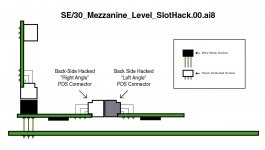
IDK, but I'm almost certain there's too little room in the mezzanine area of the SE and SE/30 at the rear of the case to leave the Stock PDS Connector on the MoBo intact for this hack.
1) Ceiling Height availability at the rear end of the mezzanine appears to be so tight that the Expansion Card PCBs will barely clear the metal ceiling at the rear end of the Chassis.
2) The Back-Side Connector Modification is required to clear the MoBo Components, even in the unlikely event that the MoBo PDS Connector can remain intact.
3) There is too little height available for the "Back-Side" Hacked PassThru Connectors, so an opening (SkyLight Hack) in the chassis will almost certainly need to be cut for them in any case.
4) If I had an SE/30 and wanted to try to compete with the SuperIIsi™/Rocket Hack, I think I'd probably resort to fabricating something similar to the clear plexi chassis of the MacintoshClassicIIIColorTVp™

This would open up a lot of expansion options for the Compacts. The only reason there's any vestige of the original Classic Chassis is that I want to demonstrate that the single Slot inverted Sonnetized MoBo Hack is practical within the confines of the Compact Mac case and chassis.

5) The diagram in the previous post shows a Soldertail Socket mod to a PDS expansion card that would then be soldered to the SE/30 MoBo slightly lower than the top of the removed PDS Connector. I should have indicated this in the diagram, so I'll play with it in illustrator and post new diagrams.
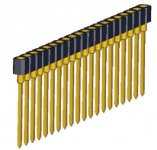
6) Machine pins won't work for this hack unless they are available in a wire wrap configuration. This is something I'll be checking out as a more readily available (and more vertically flexible!) part than wire wrap NuBus/PDS EuroDIN Connectors. The Mezzanine Transition Card needs to be a Male/Female Config, which is why the Wire Wrap EuroDIN Connector is shown.
_____________________________________________________________________________________
As far as the hacking of LC 'zaBoxen (absolute worst case scenario in terms of cubic availability . . . the most challenging . . . therefore the most interesting "case" to me! :approve: ) goes, I don't recall seeing any LC PDS Cards that have a PassThru other than the PowerCache Adapters, but you've given me the notion to do a Betwixt-MoBo-n-NIC hack for my LC! I've got a VidCard for it on order with macmetex, we'll see about such possibilities when I figure out the rest of the Radius stuff for the order. It will more likely wind up a Betwixt-MoBo-n-VidCard NIC Hack on second thought. Dunno, I'll have to source a NIC as well before exploring such things, PseudoSlot Addressing issues allowing, of course.
All that has to wait until the toy budget begins to replenish after the shipping budget fills-n-empties. :-/
< . . . sneaks back to change thread topic . . . [}
] ]'> >The IIsi has a wider case with ribbing molded on the bottom that provides vertical height for the Basement Hack that's unavailable in the Compact Mac cases.
@ Charlieman: the Sub-Basement Hack approach that you've suggested is what I'm using in the MacintoshClassicIIIColorTVp™ Hack, but it would be cheating for this exercise. I'm imposing a "Within the Case" limitation to my SuperIIsi™ Hack to keep comparisons of it with the SE/30 gamba hacks on an even footing, so the reverse would need to be true as well. I'm also limiting the SuperIIsi™ to period correct technology/expansion options.
When I benchmark the final SuperIIsi™ hack, I'll do so with and without the SCSI II DaughterCard and the external Fast SCSI II RAID in the StudioArray implementation to preserve the "within the case" comparison limitation. A third possible configuration would be using the StudioArray's Short Cable in a loop-back config for an internal Fast/SCSI II implementation. This I'll do in simulation because I don't want to muck up the IIsi plastics any more than I have to. The unobtanium status of the SCSI II DaughterCard for the Rocket precludes any possibility of a present day hack of internal cabling to its external connector's soldertail pins. However, when the gamba hacks were done to the SE/30 during its practical use lifetime, hacking the Rocket's DaughterCard in this manner to avoid "outside the case" cheating would have been duck soup! [}
] ]'>< . . . wonders why he's even trying to help Team SE/30 in this I/O hacking competition in the first place . . . :
>IDK, but I'm almost certain there's too little room in the mezzanine area of the SE and SE/30 at the rear of the case to leave the Stock PDS Connector on the MoBo intact for this hack.
1) Ceiling Height availability at the rear end of the mezzanine appears to be so tight that the Expansion Card PCBs will barely clear the metal ceiling at the rear end of the Chassis.
2) The Back-Side Connector Modification is required to clear the MoBo Components, even in the unlikely event that the MoBo PDS Connector can remain intact.
3) There is too little height available for the "Back-Side" Hacked PassThru Connectors, so an opening (SkyLight Hack) in the chassis will almost certainly need to be cut for them in any case.
4) If I had an SE/30 and wanted to try to compete with the SuperIIsi™/Rocket Hack, I think I'd probably resort to fabricating something similar to the clear plexi chassis of the MacintoshClassicIIIColorTVp™
This would open up a lot of expansion options for the Compacts. The only reason there's any vestige of the original Classic Chassis is that I want to demonstrate that the single Slot inverted Sonnetized MoBo Hack is practical within the confines of the Compact Mac case and chassis.
5) The diagram in the previous post shows a Soldertail Socket mod to a PDS expansion card that would then be soldered to the SE/30 MoBo slightly lower than the top of the removed PDS Connector. I should have indicated this in the diagram, so I'll play with it in illustrator and post new diagrams.
6) Machine pins won't work for this hack unless they are available in a wire wrap configuration. This is something I'll be checking out as a more readily available (and more vertically flexible!) part than wire wrap NuBus/PDS EuroDIN Connectors. The Mezzanine Transition Card needs to be a Male/Female Config, which is why the Wire Wrap EuroDIN Connector is shown.
_____________________________________________________________________________________
As far as the hacking of LC 'zaBoxen (absolute worst case scenario in terms of cubic availability . . . the most challenging . . . therefore the most interesting "case" to me! :approve: ) goes, I don't recall seeing any LC PDS Cards that have a PassThru other than the PowerCache Adapters, but you've given me the notion to do a Betwixt-MoBo-n-NIC hack for my LC! I've got a VidCard for it on order with macmetex, we'll see about such possibilities when I figure out the rest of the Radius stuff for the order. It will more likely wind up a Betwixt-MoBo-n-VidCard NIC Hack on second thought. Dunno, I'll have to source a NIC as well before exploring such things, PseudoSlot Addressing issues allowing, of course.
All that has to wait until the toy budget begins to replenish after the shipping budget fills-n-empties. :-/
Now that I've been dragged (kicking and screaming) back into SE/30 territory yet again . . . :-/
< . . . wonders how he can get back at Bunsen for this . . . >
Has anybody got a borked SE/30 MoBo, a spare chassis or a spare borked/fugly case (or even just the bucket) for an SE/30 to donate to the cause for the cost of shipping? :?:
< . . . wonders how he can get back at Bunsen for this . . . >
Has anybody got a borked SE/30 MoBo, a spare chassis or a spare borked/fugly case (or even just the bucket) for an SE/30 to donate to the cause for the cost of shipping? :?:
I have a case!
It's cosmetic condition probably doesn't matter, so you can have it as is.
It was actually my first compact Mac, but I'm willing to let it go in the name of education (which is what you're doing, so to speak; you're educating everybody here with your hackery.).
c
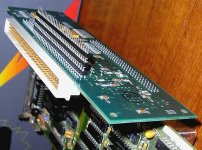
I took another look at the Mac Plus and it seems like the Mezzanine Slot Hack will leave the SE/30's PDS untouched . . .
. . . if it will work at all. It appears as though the Mezzanine Card will need to be mounted just a tad above the top of the PDS EuroDIN Connector. SolderTail Machine Pins replacing the PDS Card's Connector will do the job of raising the level of the card vertically and conserving vertical expansion space at the same time.
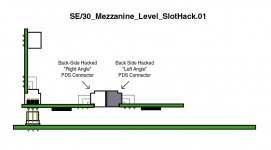
. . . if it will work at all. It appears as though the Mezzanine Card will need to be mounted just a tad above the top of the PDS EuroDIN Connector. SolderTail Machine Pins replacing the PDS Card's Connector will do the job of raising the level of the card vertically and conserving vertical expansion space at the same time.
Now we're talking! Thanks to trag's link to a parts supplier in another thread, I've got a source for the Wire Wrap SIP Machine Pin Strips that I need!
http://www.king-cart.com/phoenixent/category=SOCKETS+WIRE+WRAP+DIP+%2526+SIP
http://www.king-cart.com/phoenixent/category=SOCKETS+WIRE+WRAP+DIP+%2526+SIP
Unserviceable Slot Interrupt!!!!! [] ]'> YAY!!! Success . . .
. . . sort of, so far so good anyway! :approve:
And, amazingly enough . . . nothing had released the magic smoke to this point! 8-o
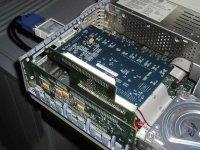
In this config I got the Radius splash screen, and then a boot to this error:
00000003
000000ff
Dunno, something like that, should have written it down . . .
. . . machs nix, when I hooked up the 12" RGB 'zaTopper after doing the documentation pics, I got the far more welcome error at the top of the post along with the Radius splash screen.
This was the fail at doing the machine pin Hack the way I'd originally envisioned doing it . . .
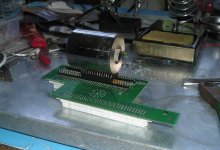
. . . but the bent to hell and gone 40 pin DIP socket, witha few machine pin legs for support on the opposite side, did do a great job of applying the gravitational force from a 1 1/4 inch, half inch drive Socket to the SIP Machine Pin strip . . .
. . . very sketchy result, so I started nipping pins off the Machine Pin Header Strip and tried a few approaches to the soldering . . .
. . . I finally resorted to doing one fluxed pin at at time on top of a Ball Grid I laid atop the soldertail cones of the DuoDock Gemini Card . . .
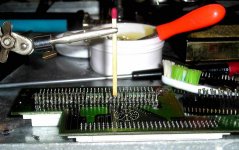
. . . great feedback when the downward force on the matchstick settled the machine pin onto the ball-melted slodertail cone after heating the pin itself . . .
. . . . here's the more refined version I posted of the prospective hack on the previous page . . .

. . . and here's the first run at FuglyTyping the hack . . .
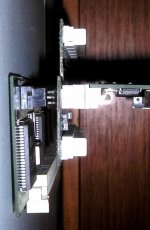
. . . and a look at the topside connector/board section to be excised from the Gemini Adapter . . .
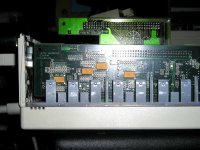
. . . and another . . .
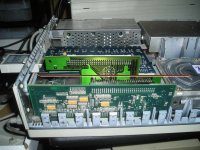
. . . and this is a better overall look at this most evil hack. }
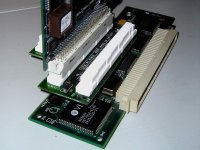
Now to address the interrupt/addressing issues and figure out how to switch the power and ground lines of the Gemini card straight to the board level inputs of the ATX hacked PSU to get around the Power Budget bludgeoning of having a Rocket AND a second NuBus Card hacked onto the IIsi NuBus Adapter.
The Rocket alone is faaarr outside design specs fot IIsi MoBo and NuBus adapter all by itself.
Question: Is the power/ground service from an ATX MoBo Connector clean enough to route to the Gemini Card without line conditioning? :?:
Next Step: Lop off and clean up the top section of the Gemini Card to see if I can at least get the same results, or document any reduction or improvement in the address/interrupt train wreck. I'm figuring that removing some pins and patching to the proper address/interrupt lines on the RAW PDS pins of the NuBus Adapter might enable both NuBus Slots, leaving me a third set for the basement PDS hack.
] ]'> YAY!!! Success . . .. . . sort of, so far so good anyway! :approve:
And, amazingly enough . . . nothing had released the magic smoke to this point! 8-o
In this config I got the Radius splash screen, and then a boot to this error:
00000003
000000ff
Dunno, something like that, should have written it down . . .
. . . machs nix, when I hooked up the 12" RGB 'zaTopper after doing the documentation pics, I got the far more welcome error at the top of the post along with the Radius splash screen.
This was the fail at doing the machine pin Hack the way I'd originally envisioned doing it . . .
. . . but the bent to hell and gone 40 pin DIP socket, witha few machine pin legs for support on the opposite side, did do a great job of applying the gravitational force from a 1 1/4 inch, half inch drive Socket to the SIP Machine Pin strip . . .
. . . very sketchy result, so I started nipping pins off the Machine Pin Header Strip and tried a few approaches to the soldering . . .
. . . I finally resorted to doing one fluxed pin at at time on top of a Ball Grid I laid atop the soldertail cones of the DuoDock Gemini Card . . .
. . . great feedback when the downward force on the matchstick settled the machine pin onto the ball-melted slodertail cone after heating the pin itself . . .
. . . . here's the more refined version I posted of the prospective hack on the previous page . . .
. . . and here's the first run at FuglyTyping the hack . . .
. . . and a look at the topside connector/board section to be excised from the Gemini Adapter . . .
. . . and another . . .
. . . and this is a better overall look at this most evil hack. }
Now to address the interrupt/addressing issues and figure out how to switch the power and ground lines of the Gemini card straight to the board level inputs of the ATX hacked PSU to get around the Power Budget bludgeoning of having a Rocket AND a second NuBus Card hacked onto the IIsi NuBus Adapter.
The Rocket alone is faaarr outside design specs fot IIsi MoBo and NuBus adapter all by itself.
Question: Is the power/ground service from an ATX MoBo Connector clean enough to route to the Gemini Card without line conditioning? :?:
Next Step: Lop off and clean up the top section of the Gemini Card to see if I can at least get the same results, or document any reduction or improvement in the address/interrupt train wreck. I'm figuring that removing some pins and patching to the proper address/interrupt lines on the RAW PDS pins of the NuBus Adapter might enable both NuBus Slots, leaving me a third set for the basement PDS hack.
I chopped the top off the Gemini Card, so the assembly will fit inside the IIsi . . .
Nothing changed, behavior is exactly as before. There are three possible states when the hacked Gemini Card is inserted into the IIsi NuBus Adapter:
A - Radius Card installed in top slot - Unserviceable Slot Interrupt
B - No NuBus Card installed - boots normally
C - Radius Card installed in bottom slot - boots normally
In Case C: If the Radius card were hooked up to the monitor, it would probably have the splash screen up from the ROM, but no comms with the MoBo, I did a screen shot and there's nothing in the Video Dump but the 12" RGB Display's window, as expected.
At any rate, now it fits!
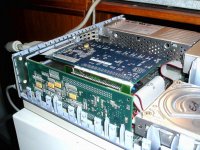
This shot is a bit closer to the Illustrator diagram:
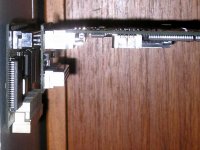
That's enough for today. I started to look at the signals on the PDS and NuBus in Illustrator. Gotta figure out which IRQs, 1, 2 or 3 to hack onto the Gemini Card and how the rest of the PseudoSlot assignment for each slot needs to be tweaked to work with the IIsi. That'll leave one open IRQ for a PDS card underneath the MoBo. I'm thinking about using the Futura IISX/10bT daughtercard for the second NuBus slot if it works out and the RCP2/IIsi card for a decent MoBo monitor under RocketShare if I can get the Rocket to take over the Futura's screen.
Lots of playtime ahead on this silly hack, but it just might pan out! :approve:
Nothing changed, behavior is exactly as before. There are three possible states when the hacked Gemini Card is inserted into the IIsi NuBus Adapter:
A - Radius Card installed in top slot - Unserviceable Slot Interrupt
B - No NuBus Card installed - boots normally
C - Radius Card installed in bottom slot - boots normally
In Case C: If the Radius card were hooked up to the monitor, it would probably have the splash screen up from the ROM, but no comms with the MoBo, I did a screen shot and there's nothing in the Video Dump but the 12" RGB Display's window, as expected.
At any rate, now it fits!
This shot is a bit closer to the Illustrator diagram:
That's enough for today. I started to look at the signals on the PDS and NuBus in Illustrator. Gotta figure out which IRQs, 1, 2 or 3 to hack onto the Gemini Card and how the rest of the PseudoSlot assignment for each slot needs to be tweaked to work with the IIsi. That'll leave one open IRQ for a PDS card underneath the MoBo. I'm thinking about using the Futura IISX/10bT daughtercard for the second NuBus slot if it works out and the RCP2/IIsi card for a decent MoBo monitor under RocketShare if I can get the Rocket to take over the Futura's screen.
Lots of playtime ahead on this silly hack, but it just might pan out! :approve:
Zactly! :approve:
(graphic on p.1)

Next test series will be to disconnect enough signals on the Gemini Card to get the IIsi to boot with a Card in the slot, but without the conflict.
After that, it's on to hooking up the proper signals from the NuBus Adapter to get the direct connect NuBus card to function.
Maybe wiring up the second slot from connections on the PDS will be trivial once I understand enough about hardware slot addressing to get the top slot to work. :?:
It's really handy that the DuoDock Logic Board is just one humongous, multi-function '030 PDS Card . . .
. . . with the same NuBus Chipset as the IIsi adapter! }
I'm glad you responded, it's frustrating when so many seem to read about it, but nobody comments. :-/
(graphic on p.1)
Next test series will be to disconnect enough signals on the Gemini Card to get the IIsi to boot with a Card in the slot, but without the conflict.
After that, it's on to hooking up the proper signals from the NuBus Adapter to get the direct connect NuBus card to function.
Maybe wiring up the second slot from connections on the PDS will be trivial once I understand enough about hardware slot addressing to get the top slot to work. :?:
It's really handy that the DuoDock Logic Board is just one humongous, multi-function '030 PDS Card . . .
. . . with the same NuBus Chipset as the IIsi adapter! }
I'm glad you responded, it's frustrating when so many seem to read about it, but nobody comments. :-/
The second rev of the SE/30 SlotHack at the top of the page might be helpful . . .
. . . and oh, just BTW . . . I never mentioned why that vertical card in the SE/30 diagram still has the RA connector intact . . .
. . . it's the IIsi's NuBus adapter. }
Figuring out WTHeck the missing /NuBus signal on the SE/30 PDS does for the IIsi PDS is a key part of this overall puzzle, so adding it to the SE/30 PDS might very well be possible.
One passing thought about the SE/30 would be the PowerCache adapter, it turn's the SE/30 slot into a IIci Cache Slot . . .
. . . has anyone tried to use the IIci PPC upgrade card in that adapter along with a IIci ROM SIMM to do an SE/30/PPC hack?
Might work better in the IIsi, but I feel the successful, impossible Rocket-in-a-IIsi hack has a much higher factor . . .
. . . an SE/30/PPC on the other hand . . .
p.s. thanks for the comments, guys, my hack threads usually feel like a wasteland. ;D
. . . and oh, just BTW . . . I never mentioned why that vertical card in the SE/30 diagram still has the RA connector intact . . .
. . . it's the IIsi's NuBus adapter. }
Figuring out WTHeck the missing /NuBus signal on the SE/30 PDS does for the IIsi PDS is a key part of this overall puzzle, so adding it to the SE/30 PDS might very well be possible.
One passing thought about the SE/30 would be the PowerCache adapter, it turn's the SE/30 slot into a IIci Cache Slot . . .
. . . has anyone tried to use the IIci PPC upgrade card in that adapter along with a IIci ROM SIMM to do an SE/30/PPC hack?
Might work better in the IIsi, but I feel the successful, impossible Rocket-in-a-IIsi hack has a much higher
factor . . .. . . an SE/30/PPC on the other hand . . .
p.s. thanks for the comments, guys, my hack threads usually feel like a wasteland. ;D
Well, consider the fact that you helped me to get back on track regarding the exploration of the differences between the SE/30 and IIsi PDS implementations as regards NuBus and that odd signal. Getting me thinking about the SE/30 diagram was a great reminder about that line of research.
I needed that jog, that's why I was thankful for the comments.
I needed that jog, that's why I was thankful for the comments.
Has anyone ever see or heard tell of the installation instructions or manual for that DGR box?
Spelunking that content on the wayback machine would be a great start. Meanwhile, I'm checking out Designing Cards and Drivers on this intentionally lazy Sunday afternoon . . .
. . . in between naps, movies and naps during movies. |)
Spelunking that content on the wayback machine would be a great start. Meanwhile, I'm checking out Designing Cards and Drivers on this intentionally lazy Sunday afternoon . . .
. . . in between naps, movies and naps during movies. |)
Forgot the great news. The other night I was searching NuBus info and got a hit for the Data Sheet on the generic 1988 version of the TI NuBus Transceivers Apple used in the DuoDock with their 1989 copyright and the TI logo on them.
The IIsi adapter packages have the same form factor/pincount with this H logo and 1989 Apple copyright as well.
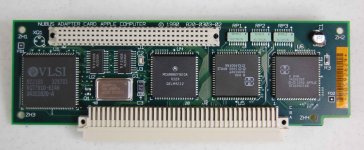
credit: http://www.vectronicsappleworld.com/collection/maciisi.html
How different could three NuBus transceivers be, I wonder? }
The IIsi adapter packages have the same form factor/pincount with this H logo and 1989 Apple copyright as well.
credit: http://www.vectronicsappleworld.com/collection/maciisi.html
How different could three NuBus transceivers be, I wonder? }
I also found a hit for attempting the SE/30 PPC from 2007, way to go DK!
My PPC SE/30 . . . not!
. . . and another: looks like other troopers have given it a go as well, from just two years ago:
Power Macintosh SE/30 (failure) report
Nice one TylerEss, I wonder what the hang up was? I think I remember that thread now. Cool stuff.
My PPC SE/30 . . . not!
. . . and another: looks like other troopers have given it a go as well, from just two years ago:
Power Macintosh SE/30 (failure) report
Nice one TylerEss, I wonder what the hang up was? I think I remember that thread now. Cool stuff.
Way back when (like when the Turbo601 was a new product), one of the Daystar guys told me that the Turbo601 basically has a PM6100 ROM on board. I don't know how true that is, as I've never compared dumps. But that's what the Daystar guy said, going on 20 years ago.