

Thread
SD-FDD
Forgive me if this is old news, but we need to encourage this guy to finish this!
http://www.bigmessowires.com/macintosh-floppy-emu/
or get someone here to finish it for him
http://www.bigmessowires.com/macintosh-floppy-emu/
or get someone here to finish it for him
Hi,
I think it's a wonderful idea, but I actually like having floppy drives (when they're working properly, of course ). It adds to the charm of using vintage hardware, I think.
On the other hand, if I were going to use, say, a Plus as my main computer, I'd probably prefer something like this over a traditional floppy (SD-cards are much more reliable), so I don't have to worry about losing stuff, but perhaps as a secondary drive (plugged into the port in back), so I could have both.
What I'm really excited about was his working prototype of a Mac Plus clone. I really wish he'd finish that up (in fact, weren't the Plus clone and the floppy emulator sort of like "co-projects"?)
c
I think it's a wonderful idea, but I actually like having floppy drives (when they're working properly, of course
). It adds to the charm of using vintage hardware, I think.On the other hand, if I were going to use, say, a Plus as my main computer, I'd probably prefer something like this over a traditional floppy (SD-cards are much more reliable), so I don't have to worry about losing stuff, but perhaps as a secondary drive (plugged into the port in back), so I could have both.
What I'm really excited about was his working prototype of a Mac Plus clone. I really wish he'd finish that up (in fact, weren't the Plus clone and the floppy emulator sort of like "co-projects"?)
c
I've been checking out bigmessowires' blog from time to time. His latest post kind of explains what happened -- he's working at Ouya, which was a pretty high-profile Kickstarter project to create a video game console. I'd bet he's keeping pretty busy these days
Hello! I'm still alive. Sadly, none of my Mac-related projects have seen any progress in months. If somebody wants to run with either the Floppy Emu or the Plus Too and try to finish them off, that's good by me. It's probably best to send me email through the Big Mess o Wires blog, since I haven't been logging in here very often.
Plus Too (the Mac Plus clone) is more of a research project than anything practical. It's probably only 25% done, though I never really defined what "done" was. It can boot a floppy image stored in ROM, and run System 6.0.7 and basic programs like TextEdit, but it's buggy and crashes at random times. There's no keyboard, sound, LocalTalk, or SCSI support. Something is wrong with the interrupt handling that I never figured out. It was fun to work on, but I'm not sure I'll take it further.
On the other hand, the Floppy Emu is maybe 80% of the way to being a usable product. It's only tested with 800K disk images (no 400K or 1.4MB), and writing to the emulated floppy only works on high-speed SD cards, and a few specific write operations like formatting the emulated floppy don't work at all. I also intended to write some software to let people manage a collection of different disk images on the SD card, but at the moment it's just one disk image per card, which is quite a waste with a 2GB SD card! But despite all those issues, it pretty much works as advertised. I used it just a couple weeks ago to boot a 512ke when my boot floppy went bad.
The biggest issue making Floppy Emus in any kind of volume might be cost and parts availability. I've forgotten now, but I think my prototype was like $50 in parts, before considering manufacturing cost and any kind of profit margin. It also requires a DB-19 connector, which is super difficult to find. I have the parts on hand to build two more, and that's it.
Plus Too (the Mac Plus clone) is more of a research project than anything practical. It's probably only 25% done, though I never really defined what "done" was. It can boot a floppy image stored in ROM, and run System 6.0.7 and basic programs like TextEdit, but it's buggy and crashes at random times. There's no keyboard, sound, LocalTalk, or SCSI support. Something is wrong with the interrupt handling that I never figured out. It was fun to work on, but I'm not sure I'll take it further.
On the other hand, the Floppy Emu is maybe 80% of the way to being a usable product. It's only tested with 800K disk images (no 400K or 1.4MB), and writing to the emulated floppy only works on high-speed SD cards, and a few specific write operations like formatting the emulated floppy don't work at all. I also intended to write some software to let people manage a collection of different disk images on the SD card, but at the moment it's just one disk image per card, which is quite a waste with a 2GB SD card! But despite all those issues, it pretty much works as advertised. I used it just a couple weeks ago to boot a 512ke when my boot floppy went bad.
The biggest issue making Floppy Emus in any kind of volume might be cost and parts availability. I've forgotten now, but I think my prototype was like $50 in parts, before considering manufacturing cost and any kind of profit margin. It also requires a DB-19 connector, which is super difficult to find. I have the parts on hand to build two more, and that's it.
Hey bmow, nice to hear from you again!
Just out of curiousity, did you make much use of the MESS Mac emulation code/docs when you were building the PlusToo?

Just out of curiousity, did you make much use of the MESS Mac emulation code/docs when you were building the PlusToo?
Not if it's mounted internally, or in an original external drive case
Is that so? I was just eyeing off the Ouya kickstarter and homepage in another tab. Looks like a cool product.
Hi Bunsen, yes for Plus Too I referred to the code in MESS, Mini vMac, and a couple of other emulators. Another Mac hacker also sent me some code from a similar project he did, which was very helpful.
I'll try to gather up all the design files and code for Plus Too and Floppy Emu and post them to my blog this weekend. That way someone else could take a shot at extending them if they'd like to.
Yes, I'm at OUYA as head of engineering or CTO or something like that (titles are intentionally vague). We ship first hardware at the end of this month. My job is mainly about the software development end of things, though.
I'll try to gather up all the design files and code for Plus Too and Floppy Emu and post them to my blog this weekend. That way someone else could take a shot at extending them if they'd like to.
Yes, I'm at OUYA as head of engineering or CTO or something like that (titles are intentionally vague). We ship first hardware at the end of this month. My job is mainly about the software development end of things, though.
I wonder if this is of any use?
viewtopic.php?f=29&t=19905
I put that forward in the original thread, when the DB-19 roadblock first came up.
OK guys, Merry Christmas! Because I love the 68kmla community, I spent half the day writing up super-detailed instructions on how to build your own Floppy Emu, complete with all the files required to do it. You'll need SMD soldering skills and a lot of patience, but it can be done! I hope this helps someone. Now let the SD floppy-ing begin!
http://www.bigmessowires.com/2012/12/15/build-your-own-floppy-emu/
http://www.bigmessowires.com/2012/12/15/build-your-own-floppy-emu/
WOW, thank you for your kind gift to the 68k Mac community, BMOW! I see you also released the design files for your Mac-Plus-on-an-FPGA. I personally am excited to look at the Verilog to try to get the hang of FPGAs/CPLDs. Thank you for your hard work creating these projects and for spending the time to package them up for everyone to play with. You rock!
Copy that, thanks so much, BMOW.
For those who don't mind ugly, you can always roll your own soldercup connectors.
Nothing beats Radio Shack's DB-25M<->DB25F inline jumper block for Mac Video Sense Line playtime.
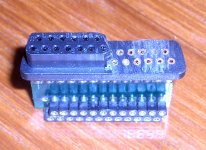
I couldn't find the real thing, both ends are mounted in a SwitchBox somewhere, probably in a landfill.
If you count pins, you'll see why I always buy extra parts for every project . . . :-/
Whatever . . . clamp an easy to come by Soldertail DB-25 connector in a vise and do your vertical diagonal cut FIRST! [] ]'>
For those who don't mind ugly, you can always roll your own soldercup connectors.
Nothing beats Radio Shack's DB-25M<->DB25F inline jumper block for Mac Video Sense Line playtime.
I couldn't find the real thing, both ends are mounted in a SwitchBox somewhere, probably in a landfill.
If you count pins, you'll see why I always buy extra parts for every project . . . :-/
Whatever . . . clamp an easy to come by Soldertail DB-25 connector in a vise and do your vertical diagonal cut FIRST! [
] ]'>In the process of disassembling a DOA Plus Mobo for a hack, I discovered a ready source for the elusive DB-19 connector. From now on, any MoBos blessed with the presence of this connector that have suffered particularly nasty forms of failure, such as irreparable cap leakage, should donate this connector to the cause before being recycled responsibly.
Desoldering is not even necessary, just donate the boards to the cause. Harvesting the SCSI Controller would for re-use would be an excellent organ for transplanting in the case of comrades doing the internal SCSI hack of the Plus.
I've got a bandsaw for rough cutting these parts for storage until requested by other comrades, PM me if you have prospective organ donors on hand. If you have any suggestions for other parts that should be kept in ZipLoc bags until needed, let me know. SIMM connectors come to mind as well.
Desoldering is not even necessary, just donate the boards to the cause. Harvesting the SCSI Controller would for re-use would be an excellent organ for transplanting in the case of comrades doing the internal SCSI hack of the Plus.
I've got a bandsaw for rough cutting these parts for storage until requested by other comrades, PM me if you have prospective organ donors on hand. If you have any suggestions for other parts that should be kept in ZipLoc bags until needed, let me know. SIMM connectors come to mind as well.
Another option for solid-state storage is the Sharp SmartPath - it's a floppy-shaped adapter for a SmartMedia card that works in floppy drives. Unfortunately it requires a PowerMac, a 1.4MB Superdrive, and drivers - so it's not bootable. They're also kind of rare.
I remember reading about those in a magazine, many many years ago. Unfortunately, another disadvantage is that SmartMedia itself is an obsolete format, and IIRC it maxes out at 128MB, correct? (in comparison, my LC III came with a 80MB HDD back in the day, and many older Macs came with 160+MB drives, so really apart from the solid state-ness, you're not really gaining anything)
I was able to test with both a 128k and a 512k and they weren't able to boot. After attempting to boot from the floppy, they came up with sadmac error code 0F0062, which doesn't seem to be documented in either the Apple KB or The Dead Mac Scrolls. When investigating, it looks like there's a sense code that determines the number of sides the drive supports? I'm not sure. Looking at the code, am I right in thinking the sense codes are handled by the CPLD?
If you've got time to look at such things, I can send you a 64K ROM 512K machine to test with.
I also hooked it up to a Classic, and it seemed like the Classic didn't recognize that the floppyemu was connected at all. It didn't try to boot from it, and didn't get a disk on the desktop. On the floppyemu LCD, it looked like it never received a seek or read, the tracks/sides never changed.
I hope to investigate some of this, I'm still familiarizing myself with the code.
Slightly off-topic, but someone did manage to do something similar for an old Sinclair ZX-80.
Got one for my old Timex Sinclair 1500.
Got one for my old Timex Sinclair 1500.
I had started researching this years ago.
One of my goals was to use commodity so that it would be easy for anyone to build. At the time I was looking at using an Ardunino. That never really panned out as it just did not have the horse power.
I've been thinking about the Raspberry PI. It has plenty of power and memory. Using a Linux Kernel patched for realtime it just might work.
One of my goals was to use commodity so that it would be easy for anyone to build. At the time I was looking at using an Ardunino. That never really panned out as it just did not have the horse power.
I've been thinking about the Raspberry PI. It has plenty of power and memory. Using a Linux Kernel patched for realtime it just might work.
Thanks to bbraun for the PCBs, I finished assembling two of them today:
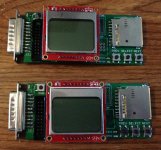
I did something pretty awesome -- plugged one of them into the internal floppy port on my IIci's motherboard, and the other into the external floppy connector. They both worked at the same time just fine, booted from one in System 6.0.8 and ran MacPaint from the other. Cool! Awesome job, bigmessowires! Thanks for releasing the design files and everything for this!
I did something pretty awesome -- plugged one of them into the internal floppy port on my IIci's motherboard, and the other into the external floppy connector. They both worked at the same time just fine, booted from one in System 6.0.8 and ran MacPaint from the other. Cool! Awesome job, bigmessowires! Thanks for releasing the design files and everything for this!
For the parts not counting the PCBs, I spent $54.80 from Digi-Key and $23.54 from SparkFun for parts for two. That's including shipping. Also had to buy two DB-19s from IEC for $2.60 each, plus shipping (bought some other stuff too so not sure what the shipping would actually be). So I'd say the parts come out to around $40 per floppy emu not including the PCBs.
It already can write. I think you have to make sure you have a fast SD card so it can keep up...