
Thread
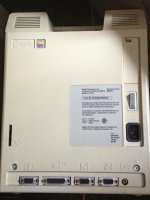
Macintosh 128 Proto (as far as i can tell)
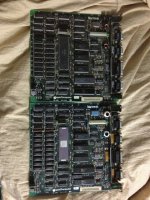
So I figured even tho I have had it for months that I would put it here. It just never dawned on me it may be special. From what I can tell both my 128's (that are actually 512's) have last revision C motherboards.
According to http://www.folklore.org/StoryView.py?project=Macintosh&story=Macintosh_Prototypes.txt
I will link all the photos I have taken of it here.
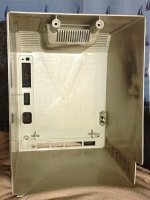
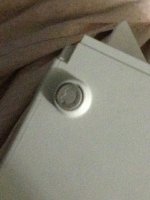
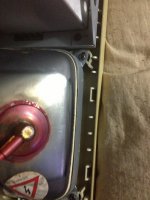
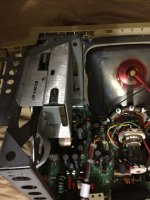
Couple of questions tho,
1) Are all the 128's and 512's have a hole big enought to put the twiggy in? I ask because I have not seen inside close enough of others than the ones I have.
2) Think the shielding was not addd to see the heat build up on plastic? I compared the 2 and they have residue in th same places but you cannot see it, only feel it on the shielded version.
3) The inside is as yellow as the outside, should I retrobrite or leave it alone?
4) The front off the other Mac analog board says 1986 so I am sure it was a 512 to begin with but its asset tag is M0001 serial F4423MSM001, so maybe just pieced together to keep it working?
I am pretty stoked now. Guess I got my Grail wether its real or not I will hit my "I believe" button anyway.
I hope you all enjoy me sharing it. If your ever up the Portland way let me know and we can get together. I love trading stories and parts.
According to http://www.folklore.org/StoryView.py?project=Macintosh&story=Macintosh_Prototypes.txt
I will link all the photos I have taken of it here.
Couple of questions tho,
1) Are all the 128's and 512's have a hole big enought to put the twiggy in? I ask because I have not seen inside close enough of others than the ones I have.
2) Think the shielding was not addd to see the heat build up on plastic? I compared the 2 and they have residue in th same places but you cannot see it, only feel it on the shielded version.
3) The inside is as yellow as the outside, should I retrobrite or leave it alone?
4) The front off the other Mac analog board says 1986 so I am sure it was a 512 to begin with but its asset tag is M0001 serial F4423MSM001, so maybe just pieced together to keep it working?
I am pretty stoked now. Guess I got my Grail wether its real or not I will hit my "I believe" button anyway.
I hope you all enjoy me sharing it. If your ever up the Portland way let me know and we can get together. I love trading stories and parts.
Wow, what is that? Never seen a Mac with the Apple logo like that. Looks like you have some sort of obscure undocumented prototype. How these things show up decades after the fact is a mystery.
Ya I menitioned it months ago here but just put it in its apple bag and forgot to photo it. When I mentioned I might give up 1 for someone to have a 128 they said hey that doesnt look quite right. Then all the internet news starts pouring in. I got the Mac from a lady whos husband past away, same woman who gave (I gave her 200 for a truckload of stuff and I do mean truckload) me 3 color classics and the mac portable. I wish I had more documentation, but as prototypes go I guess there wouldnt be much, thats where final product would come in.
:O The FDD "doesn't look quite right" either, you may have a prototype in that as well. 
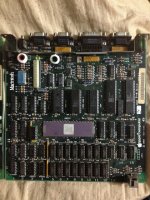
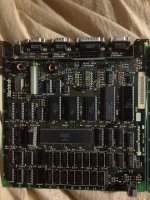
Very interesting differences in the boards as well. What's the legend say on the IC that was added between the two large ICs next to the IWM?
That score is the stuff MacDreams are made of! :approve:
Very interesting differences in the boards as well. What's the legend say on the IC that was added between the two large ICs next to the IWM?
That score is the stuff MacDreams are made of! :approve:
The Eproms were supposedly removable to facilitate changes. On both boards they look like they slide right up, but I am not even gonna try. Both Boards work, caps and all. Just gonna try and test the first OS on it as the real 512's cannot run it, I may be mistaken but I think I read that somewhere.
TRW
8428
810-1-222G
writing on the board between the two IC's, connected to 4 pins on the IC closest to the edge of the board.
8428
810-1-222G
writing on the board between the two IC's, connected to 4 pins on the IC closest to the edge of the board.
Apparently the 3.5 sony drive was a last minute D Day addition to the non twiggy Macs. After reading that it makes alot of sense why the hole is wide enough in the case for a twiggy but the drive mount has an apple part number with a crazy looking Sony drive in there.
I like the back story on the Mac. Pretty interesting reading.
I like the back story on the Mac. Pretty interesting reading.
That is very interesting one. It really must have been an early 128k development unit that have been later upgraded for 512k development, with just board swapped. Can't be that many around anymore, atleast there's no information around about those at all, except the famous twiggy-unit.
I had done some reading on folklore.org and it said somewhere that the "apple feet" were changed at the last minute. So it does look like you have a late model prototype!
the FEET gave her up! 
The Fokelore web site says the late model prototype has 512, that its not a different board.
Wow, very cool.
Yep! CheapFeets, weak@$$ flyback and RAMreaming substitutions were all bean-counter inspired degradation desecrations of the original design spec.
Higher price point or lower margins might have killed the Mac outright, however.
Fabulous score! :approve:
Higher price point or lower margins might have killed the Mac outright, however.
Fabulous score! :approve:
The 3.5" drive in the twiggy slot is cracking me up! It's looks funny! :lol:Floppy Drive Bracket different aluminum from frame.

Very cool. :O
I wonder if the Macintosh branded system is actually a release sample? Maybe a sample of the final product but not a production run. The CPU looks different than the production run of boards I've seen.
I wonder if the Macintosh branded system is actually a release sample? Maybe a sample of the final product but not a production run. The CPU looks different than the production run of boards I've seen.
Anyone else have a 128 or 512 they have opened up can tell me if the wide hole in the frame that can fit twiggy but has a 3.5 is in all of them? Its also interesting as they updated the mac they removed names no longer in the project.
Check out this site, they have several pics of a 128k teardown:
http://www.tcocd.de/Pictures/Micro/Apple/mac128.shtml
http://www.tcocd.de/Pictures/Micro/Apple/mac128.shtml
Ok floppy cage and metal inards look pretty standard then looking at those pictures. One motherboard is close but the changeable eprom makes it defferent to final. They had to change the floppy holder but the frame for logic board stayed regardless of the twiggy. Good thinking.
So the original Release mac had
- Cheaper feets
- Weaker Flyback - Worse quality?
- 128K Ram instead of 512K ram
Differences from the Release Candidates, Such as the one macdrone has?
http://folklore.org/StoryView.py?project=Macintosh&story=Wet_dreams_and_little_rubber_feet.1.txt&topic=Industrial%20Design&sortOrder=Sort%20by%20Date&detail=high&showcomments=1
I saw this in regards to the feets folklore-
I cannot believe they spent $8000(in 1983 money) on tooling for those rubber feet to have an apple logo...that would never fly where I work! :lol:
Also Steve jobs wanted to bypass sony for the drives since twiggys just were turnng out to be junk (why the eprom is replacable on my boards),so he went to someone else to build a similar drive. That fell through and his team kept the Sony deal for the 3.5 drive alive which saved the Mac.
i guess the question is? Your feets, how is the adhesive? do any of the feets seem like they are half peeling off?
The feets on the proto are solid in place and not peeling at all. All 4 intact apple and all. They are a little harder in comparison to the plus.
Okay, here's what I think it is:
A late prototype Macintosh. This was probably used by a Mac Team member who kept using it for a few years after the release of the Mac. As it was a daily use machine, it was upgraded as they went.
What's original? The case, frame, floppy drive bracket, floppy drive, logic board, ROM chips (342-0220 and 342-0221, right?)
What's new? The DRAM chips, the mini-mux board (the little "extra" board on the logic board at E3).
The mini-mux and 256kbit DRAM chips were a popular upgrade back in the day. If you wanted it to be "original", you would remove the mux board, repair the cut trace on the bottom of the logic board under the mux board area, and replace the 16 DRAM chips with 64kbit chips.
I'm a little surprised that the ROM chips are still the original 128k/512k versions. Many people upgraded these to the Mac Plus ROMs which added 800k drive support giving you a Mac 512ke.
According to the folklore site the proto late model was 512 not 128 so it's not upgraded.
Every Mac 128, 512, 512ke, Plus, SE, SE/30, Classic, and Classic II had the front brace-gap wide enough for the Twiggy drive. That's how people could easily hack slot load CD drives in them so frequently.
In your picture there is a metal cover on the back of the FDD with one screw that the ribbon sneaks up under. That is not regular production. I think you need to tear down further and see if you have a weird early Sony drive in there too.
In your picture there is a metal cover on the back of the FDD with one screw that the ribbon sneaks up under. That is not regular production. I think you need to tear down further and see if you have a weird early Sony drive in there too.
I don't have and have never seen a Classic II, but every Compact from 128k-Classic has provision for a full height 5.25" Drive built into the chassis.
If you think the 3.5" drive looks funny in the 5.25" TwiggyHole in the chassis from the back, get a load of it from the front!
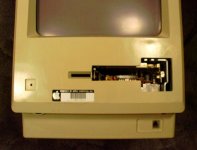
I need to pop my upgraded 128k open to see if has that fancy FDD bracket or the slab-sided simplification installed in later compacts.
ClearTwiggyProtoHoaxMacHacks™
If you think the 3.5" drive looks funny in the 5.25" TwiggyHole in the chassis from the back, get a load of it from the front!
I need to pop my upgraded 128k open to see if has that fancy FDD bracket or the slab-sided simplification installed in later compacts.
ClearTwiggyProtoHoaxMacHacks™
:lol: You beat me to the post, Al!
I thought that as well but someone linked a 128 tear down and all the units shown had that, as do both that I have. But I have them apart so I can deal with four screws to take some more photos.
That's horrible, it looks like Frankenstein didn't make it lol. It doesn't look like the Sony drive, maybe that was the other trial drive?
But yours is an upgraded 128k board. The little mux chip is the giveaway. The 128k board was designed to be easy to upgrade to 512k by adding that board when the 256kbit DRAM chips got cheaper. In fact, yours looks like the production 128k board. Mine had been upgraded in a similar manner by Videx but they skipped the board and soldered the mux chip directly to the board with wire wrap wire.
The real 512k board was a slightly different design supporting 128k or 512k of RAM without the patched-on board.
Thanks for those shots, mcd. I never realized that the Pre-Plus compacts had their A/B interconnect headers positioned so that they wouldn't be blocked by the MIA TwiggyBox. With the placement of that connector on the Plus, it's a real PITA to cycle that connection when playing around with makeshift replacements for the Twiggy Drive's enclosure.
AWESOME Mac you have there Macdrone. What an amazingly lucky find. Would love to have something like that myself. Hold onto it tight and look after it for us all 8-o
Can you take a picture of your upgrade? What were the number on the roms that were production as mine has two differnt roms?
I don't have any before pictures but I have the TMS mux chip still.
The 128k/512k ROMs are 342-0220 (HI) and 342-0221 (LO). They may have a revision suffix on the end (A, B, etc)
The 512ke/Plus ROMs are 342-0341 (HI) and 342-0342 (LO). Once again, there may be a revision suffix on the end. These ROMs added SCSI and 800k floppy support.
EDIT: it would be cool if you could trace this back to someone at Apple. Steve Capps is a customer of mine but I'd be way to chicken to ask. Isn't Andy Hertzfeld supposed to be approachable? Maybe he could at least confirm the lineage of the case.
I sent message to Andy, let's see if he replies.
Trash, is the mac in that pic yours? I noticed that as well as the missing apple logo and the drive area, The plastic looks almost reflective. The production 128s were textured, so am i right in assuming that definitely shows that the one in that picture is a prototype?
Nope, I wish it were. The only prototypes in my collection are the PEx MoBo and Paladin KBD/Trackball. I do collect every ProtoMac/Peripheral pic I can find, wherever I find it, in the hopes of doing a ProtoHoaxMacHack or three. I'll do so even if I need to "save page as" and and then strip the images out of a long series of folders to get around some idiotic copy protection scheme for eBay pics. Those I don't usually post here though. [] ]'>
That one is definitely a TwiggyMac prototype case they had laying around the joint. I wonder if it dated from before SJ was let in on the secret development effort? It wouldn't surprise me at all if the Sony drive in this prototype only spits the floppy in and out for engineering tests. Sony modified the MicroFloppy drive they were developing for the Mac to achieve 400k storage capacity, so they undoubtedly did physical testing while the multi-speed controllers were still in development. From what I recall in the ten years ago discussions about this prototype, it might have been used to make the measurements needed to develop the Micro-Floppy bezel tooling. The complex drive cages might have been manufactured by Sony and then retooled for a less expensive part at a later date. Has anyone seen any makers mark on the complex cages?
My much upgraded 128k has the same, bent only, slab-sided floppy cage as do my two Mac Pluses. This engineering test prototype has what appears to be the same complex, stamped metal floppy cage as Macdrone's Prototype. Also note the untextured finish of both prototype cases. Any Mac case that's untextured is, without question, a prototype case, whether it be from the soft tooling produced first go-round prototyping process or the last go-round of hard tooling development tests.
] ]'>That one is definitely a TwiggyMac prototype case they had laying around the joint. I wonder if it dated from before SJ was let in on the secret development effort? It wouldn't surprise me at all if the Sony drive in this prototype only spits the floppy in and out for engineering tests. Sony modified the MicroFloppy drive they were developing for the Mac to achieve 400k storage capacity, so they undoubtedly did physical testing while the multi-speed controllers were still in development. From what I recall in the ten years ago discussions about this prototype, it might have been used to make the measurements needed to develop the Micro-Floppy bezel tooling. The complex drive cages might have been manufactured by Sony and then retooled for a less expensive part at a later date. Has anyone seen any makers mark on the complex cages?
My much upgraded 128k has the same, bent only, slab-sided floppy cage as do my two Mac Pluses. This engineering test prototype has what appears to be the same complex, stamped metal floppy cage as Macdrone's Prototype. Also note the untextured finish of both prototype cases. Any Mac case that's untextured is, without question, a prototype case, whether it be from the soft tooling produced first go-round prototyping process or the last go-round of hard tooling development tests.
Both boards have original roms.
And we are seing the same case here as well:
http://www.mactechlab.jp/wp-content/uploads/mac128k_manual_05.jpg
http://www.mactechlab.jp/wp-content/uploads/mac128k_manual_05.jpg
Wow, amazed no one's caught that before.
And I'm amazed someone noticed that
I thought i had seen that before somewhere, just could not figure out where. In that picture, it's just not that clear (need to find higher resolution picture or the original booklet) if there's an Apple logo there, or just blank space - but surely it does look like the same. So it just have to be pre-production case/prototype.
The case I have is textured on the outside also. Looks just like that one. My plug is angled like that with apple on one end.
I know Alps Electronics never managed to get their drive into production, but I suppose that wouldn't have stopped them from building a couple of prototypes. Sony of course ended up getting the contract.
http://www.folklore.org/StoryView.py?project=Macintosh&story=Hide_Under_This_Desk.txt
The rubber feet are Trend Plastics custom stamped units, but they never proved to be successful with the adhesive.
http://www.folklore.org/StoryView.py?project=Macintosh&story=Wet_dreams_and_little_rubber_feet.1.txt
I'm aware many of us here would be very familiar with these stories by now, but for the sake of bringing anyone else up to speed, they're an interesting read.
I am gonna be honest and say that I completely skipped any real compact mac info in my day. I had up to an apple IIgs in school then went to a performa 638CD and that led to a color classic for fun and went to a new G3 B&W. I had no idea the folklore site existed till last week and was completely in the dark. I knew just enough about stuff to know kinda what to collect and what I thought I was excited about.
So as I mentioned months ago when I first posted to the site thank you all for the help and education. I can do more for old macs than I ever thought I could. These days its getting alot more fun.
So as I mentioned months ago when I first posted to the site thank you all for the help and education. I can do more for old macs than I ever thought I could. These days its getting alot more fun.
So I looked around on the sites about the early twiggy machines and all of them look to have RF paint/shielding in them. Is it possible to clean this stuff off without hurting the plastic? The only reason I wonder is if the man Bill Brown that passed away that I got these from maybe wanted to see the signatures better? Im just guessing here as the front panel doesnt have the paint either and the sticker is mostly still on it.
I don't think so, I think the missing shielding was how it should be. There was an interview with Daniel Kottke from about 10 years ago, and a picture of him holding the same sample signature case without the shielding.
http://www.digibarn.com/stories/dankottke/index.htm

http://www.digibarn.com/stories/dankottke/index.htm
Yep that's what it looks like. Just odd the twiggy case has shielding but not later prototypes. I thought there was less texture on the prototypes. Just so strange.
Remember, as far as Jobs was concerned in early 1983, the Twiggy FDD was a part of the final design of the product, so those Twiggy prototypes could've been nearly final. The Sony FDD cases were prototyped after the Twiggy drives were abandoned, which kicked the prototyping cycle way back. The Twiggy cases you've seen could've been close to final prototypes, but your Sony case could be much earlier in the process toward the final Sony case design.
Good point mineral. I hadn't thought of that. The only hole I see there is the back didn't change only the front, as someone mentioned to me earlier that they didn't even change the chassis. Like the 128 and the 512 have square holes on the back for ports but the Mac plus are cut to the outline of the ports.
Notice the top of that ProtoCase Dan Kottke is holding. The lack of the cooling vents installed in the top of the production units is a dead giveaway.
Mine has the vents.even stranger yet.
Hi Guys, I am the seller "wozniac" on eBay. I recently got my account here activated.
I just wanted to let you guys know that 1 year later, and after a pleasent visit down to California, the Twiggy Macintosh 128k now boots up! With the help of several persons, we have archived the only 2 known Twiggy Macintosh software disks and have been able to duplicate them. We have also archived the ROM's on the motherboard and the controller chip on the Macintosh Twiggy I/O board. I have many stories and info to share, Just thought I would share this info.

Cheers guys,
Adam
I just wanted to let you guys know that 1 year later, and after a pleasent visit down to California, the Twiggy Macintosh 128k now boots up! With the help of several persons, we have archived the only 2 known Twiggy Macintosh software disks and have been able to duplicate them. We have also archived the ROM's on the motherboard and the controller chip on the Macintosh Twiggy I/O board. I have many stories and info to share, Just thought I would share this info.
Cheers guys,
Adam
That's wonderfull! Please share all details about the disks, bootup success and everything!
You'll have to do a whole new thread and fill us in! We are all very keen to hear updates directly from the source!
Welcome aboard, Adam, glad to have you here and happier to see your TwiggyMac functional at last. I really didn't think it was going to get there, I'm happy to have been mistaken about the prospects. It must be quite a story!
Amazing...you should take a video of it in operation and share the story on here :beige:
I agree!
Wow! Can't wait to read/hear more!
In the interest of preservation: does having the image adjusted to such a large size put undue strain on that prehistoric Proto-A/B?
IIRC, recommended adjustment leaves about an inch of black border on all sides. It seems like a wise precaution to nudge it down a little on something that rare.
It's probably gone out due to age-I don't think they adjusted it.
that is pretty cool info

they were going to roll them out as 512k's at first… but those pesky ram chips were just digging to deep into apples wallet.
The 512 proto motherboards would have a paper label saying "Mac 512" and the RAM would have had a factory look of soldering. The label can easily go missing but the RAM would not look like it was added later. As for the floppy, if its original to the Prototype then it may still have a date on the side of the drive. It has to be taken out of the cage of course. But an easier way is to look in front and to the bottom right. It will should have a capacitor laying on its side. This was part of the original modification by Sony to get them into specs set by Apple. There are a couple other minor changes too. I took a pic to show what I mean by the capacitor.
The case frame would also end in a "-A" or "-B" with "-B" being production run on the early Macs.
The ROMs would not end in "-A" or "-B", original ROMs were just 342-0220/342-0221 including early production units.
The case frame would also end in a "-A" or "-B" with "-B" being production run on the early Macs.
The ROMs would not end in "-A" or "-B", original ROMs were just 342-0220/342-0221 including early production units.