

Thread
Mac Plus turns off after short time
Hi everyone,
Long time lurker but very short time poster!
I have looked through the forums but haven't seen a question same as mine yet (if there is I am sorry and I will delete this post).
There are 7 Mac Plus's at home I have been hoarding away (hate that word). The other day I got motivated to pull them out and have a play.
First one tripped the house circuit safety switch after about 3 minutes.
Turning the next 6 on achieved the same result, some after 30 sec and others after 2 or 3 minutes. Grr
Pulling these guys apart revealed no apparent capacitor problems wrt bulging or leaking caps on the logic or analog boards.
Where do I start?
I see C1 mentioned but seeing as all 7 have the same problem (all previously working a couple years ago) there must be a known cause?
The screens were bright and clear when they were running.
Any suggestions would be appreciated.
Thanks
Long time lurker but very short time poster!
I have looked through the forums but haven't seen a question same as mine yet (if there is I am sorry and I will delete this post).
There are 7 Mac Plus's at home I have been hoarding away (hate that word). The other day I got motivated to pull them out and have a play.
First one tripped the house circuit safety switch after about 3 minutes.
Turning the next 6 on achieved the same result, some after 30 sec and others after 2 or 3 minutes. Grr
Pulling these guys apart revealed no apparent capacitor problems wrt bulging or leaking caps on the logic or analog boards.
Where do I start?
I see C1 mentioned but seeing as all 7 have the same problem (all previously working a couple years ago) there must be a known cause?
The screens were bright and clear when they were running.
Any suggestions would be appreciated.
Thanks
High current draw like that sounds like a bad analog issue. But for all to have the same problem that is strange. I have three pluses and the power connector to analog board will draw and sometimes crack the so.der and has to be resoldered. The C1 is common but with a bright clear screen I would pull the plastic cover on the analog and look at the power connector back sides. As for all of them doing it try the units in different plugs as once the breaker was tripped it can take hours before its not easily trip able by any real load, especially if you don't have ground fault plugs with the resets.
I hope this info made sense and helps you.
I hope this info made sense and helps you.
If the same problem occurs with 7 different machines, I would be looking at the house current circuit. Do you have heaters or other high-load items (like washingmachines, stoves) running on the same power circuit? Maybe the circuit-breaker itself is getting a little old and over-sensitive?
I've never seen a classic trip a breaker. Since all the machines tripped, I'd say the outlet was suspect. Did you try somewhere else in the house?
I have all these Macs plugged in only 2 outlets and nothing ever trips:

I have all these Macs plugged in only 2 outlets and nothing ever trips:
Try taking a couple of the Pluses to a friend's house and try them there. If the problem goes away, then it's probably your circuit, not the innocent Plus.
Also, can you relate the turning off of the Pluses to any particular event (like a disk being ejected/formated)? Sometimes things like a disk ejecting and continous drive activity raise the Mac's power consumption significantly.
Also, can you relate the turning off of the Pluses to any particular event (like a disk being ejected/formated)? Sometimes things like a disk ejecting and continous drive activity raise the Mac's power consumption significantly.
That's quite an impressive display!
Unfortunately, I don't have anything else to add, except that it seems that if there were something wrong with the Pluses, they would be doing other odd things, and they would probably trip the breaker instantly.
What sort of circuit is this on? Unless it is overloaded with other devices, I doubt that over-current is tripping it. Is the breaker a GFCI (RCD in Europe) or AFCI? Both of those are somewhat notorious for nuisance trips, especially older generations. It's not uncommon for the noise suppression capacitors to leak enough current to ground to trip a GFCI. Try isolating the ground pin on the power cord and see if the problem remains. There's a good chance nothing at all is wrong with your Mac.
Thanks for all the replies so far.
It's the RCD in the house that they are tripping- no heaters operating.
I took one of the Mac's out to my parents place yesterday and got the same results after a couple minutes- had booted up and was justing sitting there doing nothing.
Plugging in other known good Macs to the same power outlets don't give any trips.
I will have another play today and see what I can find.
Isolating the ground pin? Will have a look.
Thanks
It's the RCD in the house that they are tripping- no heaters operating.
I took one of the Mac's out to my parents place yesterday and got the same results after a couple minutes- had booted up and was justing sitting there doing nothing.
Plugging in other known good Macs to the same power outlets don't give any trips.
I will have another play today and see what I can find.
Isolating the ground pin? Will have a look.
Thanks
DO NOT ISOLATE THE GROUND PIN!!!
It is there for your safety. If the Mac is causing earth leakage through the ground pin, then isolating said ground will cause the leakage to flow THROUGH YOU not safely to the ground.
Also, I believe that pin is used in the CRT system somewhere???
It is there for your safety. If the Mac is causing earth leakage through the ground pin, then isolating said ground will cause the leakage to flow THROUGH YOU not safely to the ground.
Also, I believe that pin is used in the CRT system somewhere???
Do you know what you're talking about? I am convinced that you do not. Isolating the ground will do nothing to YOU assuming you don't fawking touch live wires and/or circuitry inside the computer, which you would not be doing anyway.
Just to clear up YOUR misconceptions, the CRT ground lug is used when discharging the tube itself. http://apple.doit.wisc.edu/servicesource/ss/safety/safety.html#Discharge
OP - That is certainly an odd situation you have going on there. So you have ruled out the house wiring by testing it at your parents house.
Just to be clear, only one of the Pluses trips your RCD correct? Not all of them? The other six just lose video but stay powered on? I think you should pick one and carefully test the analog board. Touch up all of the solder joints if you want.
Relax, the ground/earth connection is a secondary safety system, intended to protect the user in case of a fault condition such as an internal short between a live wire and exposed metal parts. Obviously I'm not advocating permanently disconnecting the ground pin and leaving it that way, but isolating it temporarily is a perfectly valid troubleshooting method. In North America, many houses built prior to the 1960s don't have any grounding at all and it's not uncommon (though not advisable) to use adapters on grounded plugs that go into a 2-prong socket. You are supposed to ground these adapters but nobody ever does. Unless a fault in the equipment exists, there should never be measurable current flowing through the ground lead, that's what neutral is for. In fact, ground and neutral tie together in the panel and come from the same place.
A GFCI/RCD works by monitoring the current flowing through the live and neutral leads, and tripping if there is a difference of more than a few mA. The assumption being that any current passing through live that is not also passing through neutral is leaking to ground, possibly via one's body.
A lot of equipment has capacitors connected between live and ground and sometimes neutral to ground to shunt electrical noise before it gets out through the power entrance. Some of this stuff (such as old Macs) were designed before GFCI/RCD breakers became commonplace, and some GFCIs are more sensitive than others. The result is precisely the sort of nuisance trips you're experiencing. You may be able to replace the suppression capacitors with some of lower capacitance, or just disconnect them entirely, accepting that you may get a bit of interference on the radio, TV, or other RF devices around the house.
A GFCI/RCD works by monitoring the current flowing through the live and neutral leads, and tripping if there is a difference of more than a few mA. The assumption being that any current passing through live that is not also passing through neutral is leaking to ground, possibly via one's body.
A lot of equipment has capacitors connected between live and ground and sometimes neutral to ground to shunt electrical noise before it gets out through the power entrance. Some of this stuff (such as old Macs) were designed before GFCI/RCD breakers became commonplace, and some GFCIs are more sensitive than others. The result is precisely the sort of nuisance trips you're experiencing. You may be able to replace the suppression capacitors with some of lower capacitance, or just disconnect them entirely, accepting that you may get a bit of interference on the radio, TV, or other RF devices around the house.
James 1095 said:
Typically a too-large filter capacitance will trip a fuse or external circuit-breaker when the extra inrush current fills up the capacitor as it is first switched on. OP's symptoms take up to 3 minutes to trip them - suggests something cumulative, like heat buildup and/or ESR buildup in caps on the analog board. Weird that others haven't reported the same thing with Plus or other Compacts. Also defies probability that 7 machines would exhibit the same problem simultaneously.
Rick
Lower value filter caps sounds like a good thing to try. Not sure I'd recommend disconnecting entirely, though. Might you not get some electrical noise propagating inside the Mac, maybe affecting the CRT?
Typically a too-large filter capacitance will trip a fuse or external circuit-breaker when the extra inrush current fills up the capacitor as it is first switched on. OP's symptoms take up to 3 minutes to trip them - suggests something cumulative, like heat buildup and/or ESR buildup in caps on the analog board. Weird that others haven't reported the same thing with Plus or other Compacts. Also defies probability that 7 machines would exhibit the same problem simultaneously.
Rick
This is different. The filter capacitor you are referring to is the DC filter capacitor used to smooth the pulsating DC coming from the rectifier. A discharged capacitor has a very low impedance and acts much like a short circuit until it charges up, something that can take long enough to blow a fuse or trip a breaker in extreme cases. This is rarely an issue with small switchmode power supplies, but the very large filter capacitors used in 50/60Hz linear power supplies common in large audio amplifiers and such often have something to limit the inrush current.
The capacitors I'm referring to are small film capacitors used in the noise filter. They are there to block high frequency noise from the switching regulator and digital circuits from getting out of the computer and radiating from the power wiring which can potentially interfere with other devices. These capacitors are small enough to appear as a very high impedance to the 50-60Hz line frequency, while still shunting high frequency noise, but there is still *some* leakage current, sometimes enough to trip an excessively sensitive GFCI. It's not uncommon for a GFCI/RCD to take a bit of time to trip when the ground leakage is only just barely enough to trigger the thing.
The capacitors I'm referring to are small film capacitors used in the noise filter. They are there to block high frequency noise from the switching regulator and digital circuits from getting out of the computer and radiating from the power wiring which can potentially interfere with other devices. These capacitors are small enough to appear as a very high impedance to the 50-60Hz line frequency, while still shunting high frequency noise, but there is still *some* leakage current, sometimes enough to trip an excessively sensitive GFCI. It's not uncommon for a GFCI/RCD to take a bit of time to trip when the ground leakage is only just barely enough to trigger the thing.
Thanks for all the replies!
I was hoping for some success to report but nothing so far- I ordered a bunch of new caps for the analog board last Monday night and thought they would have arrived by now. No such luck.
I took one of the analog boards though and reflowed the solder on a lot of the connections, especially around where the power connecters, power switch and flyback tranny are.
Result is the computer boots and stays on for about 5 minutes then trips the RCD.
I would play more tonight but the family gets annoyed when the Mac takes their youtube, TV and internet with it...
Hopefully my replacement caps will arrive next week and will get some results (I wasn't able to order the lot though).
To answer an earlier question- all the Mac Plus's give the same result.
Oh, and for RickNel- there is a Mac Plus on eBay (Australia) with the same description at the moment.
Thanks guys.
I was hoping for some success to report but nothing so far- I ordered a bunch of new caps for the analog board last Monday night and thought they would have arrived by now. No such luck.
I took one of the analog boards though and reflowed the solder on a lot of the connections, especially around where the power connecters, power switch and flyback tranny are.
Result is the computer boots and stays on for about 5 minutes then trips the RCD.
I would play more tonight but the family gets annoyed when the Mac takes their youtube, TV and internet with it...
Hopefully my replacement caps will arrive next week and will get some results (I wasn't able to order the lot though).
To answer an earlier question- all the Mac Plus's give the same result.
Oh, and for RickNel- there is a Mac Plus on eBay (Australia) with the same description at the moment.
Thanks guys.
Timbo said:
Seller asking $70, no accessories - would cost me $100 including freight, for a possible wreck.
Same seller failed to sell a SE for that price a few weeks back. Need to get real.
The latest auction price for a non-working Plus on eBay here was $17. I might give $25 for a local purchase, freight free.
Rick
Thanks - I saw that. So it is very likely caps failure in the analog board, combined with modern circuit-breakers.
Seller asking $70, no accessories - would cost me $100 including freight, for a possible wreck.
Same seller failed to sell a SE for that price a few weeks back. Need to get real.
The latest auction price for a non-working Plus on eBay here was $17. I might give $25 for a local purchase, freight free.
Rick
I had two Macintosh Pluses that did this.
One I sold, but I still have one.
Mine would sit there on a white screen then trip, after about a minute. I then sold one and kept the one that looked better. However when I got it back out about a year later, it turned on with garbled image, If I thumped the side it would boot up. However it would then trip after about 5 minutes.
In my case I attribute it to the Flyback transformer slowly falling off the analogue board due to bad solder. However I am scared senseless of opening ANYTHING with a CRT in it!
One I sold, but I still have one.
Mine would sit there on a white screen then trip, after about a minute. I then sold one and kept the one that looked better. However when I got it back out about a year later, it turned on with garbled image, If I thumped the side it would boot up. However it would then trip after about 5 minutes.
In my case I attribute it to the Flyback transformer slowly falling off the analogue board due to bad solder. However I am scared senseless of opening ANYTHING with a CRT in it!
I really doubt it has anything at all to do with the flyback transformer, that is on the secondary side of the power supply. Look for film capacitors between live and ground near the input power connector.
No need to fear the CRT. The zap from that feels like a strong static electricity shock on a dry winter day. It doesn't feel good and should not be handled carelessly, but it's very unlikely to kill you. Also unless you remove the anode connection from the tube, all of the HV circuit is well insulated and fairly safe to handle. More dangerous is the electrolytic bulk filter capacitor in the power supply, these are charged to "only" 160 or 330V but pack a LOT more energy than the capacitance in a CRT. Either way unplug the thing and let it sit for a few minutes, most everything will discharge itself. For extra caution, take a cliplead and touch it across the capacitors you want to discharge.
No need to fear the CRT. The zap from that feels like a strong static electricity shock on a dry winter day. It doesn't feel good and should not be handled carelessly, but it's very unlikely to kill you. Also unless you remove the anode connection from the tube, all of the HV circuit is well insulated and fairly safe to handle. More dangerous is the electrolytic bulk filter capacitor in the power supply, these are charged to "only" 160 or 330V but pack a LOT more energy than the capacitance in a CRT. Either way unplug the thing and let it sit for a few minutes, most everything will discharge itself. For extra caution, take a cliplead and touch it across the capacitors you want to discharge.
Would the Capacitor really trip a circuit breaker though?
When I taled to some vintage Mac people about a year ago, they said that it was probably tripping from arching as the transformer slowly pulled away from the board.....
My Plus hasn't been turned on since about 2011 ish so would it be fine?
When I taled to some vintage Mac people about a year ago, they said that it was probably tripping from arching as the transformer slowly pulled away from the board.....
My Plus hasn't been turned on since about 2011 ish so would it be fine?
I was at first but haven't had any troubles. Common sense helps and I normally leave it turned off for a while anyway.
Got my first lot of new caps in the mail yesterday (but not all).
Have soldered in about a dozen but waiting for my new C1 and C33/36 (filter caps?).
Hopefully another couple days then I can power up a Mac Plus and see if it will work (for more than a few minutes).
There aren't any filter capacitors between the AC mains and the ground as these are Y2 EMI/RFI filter capacitors while the Mac Plus only has 3x X2 filter caps who sit between the mains near the power switch. However since these are behind a fast 1.5A blowfuse, it's unlikely they trip a standard RCB.
There are different types of circuit brakers in houses: the standard one's, RCB, only switch out on overload or short circuit, however others watch for loss between the fase and the ground,RCBO's,: I think it will be this one's that trip in your house.
Can you confirm this ? Otherwise post brand and model/type number of the circuit braker.
I also think there's a fault somewhere on the Analog boards where there's a loss between the mains and the ground, the AC circuit before the transformer is most obvious, however a loss on the DC side to the ground can also trip these RCBO circuit brakers.
Obviously you've been lucky-CRTs are known to be lethal under the wrong cirumstances. I would always discharge it before handling it (use a grounded screwdriver and touch it against the CRT).
It is possible that these Pluses have been stored under certain conditions that could cause this. And most likely they could have been stored, or possibly even used (although not as likely), together for a long time, so could all have been under the same circumstances.
Had a look- it's a Lanson LAN45RCD240. Looks like an RCD which is looking at the current difference between the active and neutral.
Storagewise- have turned these Macs on for about 5 or so years and have been stored away in the same storage room in the garage.
It's the combination of a circuit braker with integrated safety switch. It will be the safety switch, probably a 30ma one which is very sensitive when there's a difference between the ground and the active that trips the braker.
So recap the Analog board including the 3x EMI/RFI capacitors and all the film capacitors. So a full recap except for the ceramic dish one's as there only rarely go bad.
Definately replace this one's with identical one's:
http://uk.mouser.com/ProductDetail/Kemet/PME271M647KR30/?qs=sGAEpiMZZMv1cc3ydrPrF85GIl804cbNz76Q8vgSP44%3d
and
http://uk.mouser.com/ProductDetail/Kemet/PME271Y447MR30/?qs=sGAEpiMZZMv1cc3ydrPrF85GIl804cbNf9hsfZMK6uI%3d
Have a close look at the plastic casing of these 3x EMI/RFI surpression capacitors: do you see cracks in it, especially in the 2x smaller blocks ?
I have yet to hear of a single case of someone being electrocuted by the EHT in a small CRT monitor. Note that this is NOT an excuse to be careless, you *can* get hurt, but the biggest risk is tearing your hand open or falling and cracking your head on something when you jump back. *ALWAYS* discharge the CRT with a grounded screwdriver or probe, and attach a cliplead between the anode contact and the ground strap around the tube while you work on it as a small charge will often build back up from other charged parts of the tube. Again this residual charge will probably not hurt you, but if you get zapped and drop the tube on the floor, the resulting implosion might. Many people focus on the EHT for the CRT, not even realizing that the big electrolytic bulk filter(s) in the power supply pack a far more lethal punch despite being "only" a few hundred Volts. Use common sense and caution, but don't fear it. You are not going to have a giant lightning bolt jump out and strike you dead just by resoldering the flyback or yoke connector pins.
The fuse makes no difference in regards to the GFCI(USA)/RCD(UK, etc). You don't need an overload to trip these, just a small amount of leakage to ground/earth. In fact you can bridge neutral to ground and it will instantly trip the GFCI despite that there will be no sparks. If you have a capacitor between live and ground or neutral and ground, and that capacitor is just a hair too leaky (electrically speaking) and/or your GFCI is a tad too sensitive then you may trip it. A sure test of this as mentioned earlier is to temporarily isolate the ground/earth pin on the power cord and see if it still trips. You can also perform a leakage test by setting a multimeter to measure AC milliamps and connect it between the (now isolated) ground connection on the computer and a good ground connection in the power socket. Most GFCI breakers are designed to trip when leakage exceeds 5mA.
Hi all. Thanks for all the replies.
Just a quick post to say I am still waiting for a few replacement caps (which I have already removed from a couple Plus's in anticipation).
I ordered from a local site which showed stock and ready to ship. Turns out in stock/ ready to ship means they will be sent from another country (UK) when the local arm places their order....
Next week I am assured after ringing today.
Will post as soon as I get them soldered in!
Here are some of the caps I took out- the cases are split front and back.
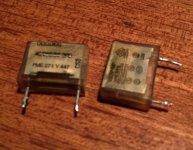
Just a quick post to say I am still waiting for a few replacement caps (which I have already removed from a couple Plus's in anticipation).
I ordered from a local site which showed stock and ready to ship. Turns out in stock/ ready to ship means they will be sent from another country (UK) when the local arm places their order....
Next week I am assured after ringing today.
Will post as soon as I get them soldered in!
Here are some of the caps I took out- the cases are split front and back.
so those caps being bad is causing your issues, because with out them, your mac backfeeds noise onto the ac line?
pretty interesting.
i would get a inductive current meter, here you can buy them for like 7 or 8 bucks at harbor freight.
open your Breaker box and see how much current is flowing through the breaker your on, maybe half the house is on one breaker?
Maybe you have special breakers installed? ones that are stupidly sensitive by design to detect such feedback.
Post the model / name of the breaker on your circuit? maybe a picture of your breaker box?
pretty interesting.
i would get a inductive current meter, here you can buy them for like 7 or 8 bucks at harbor freight.
open your Breaker box and see how much current is flowing through the breaker your on, maybe half the house is on one breaker?
Maybe you have special breakers installed? ones that are stupidly sensitive by design to detect such feedback.
Post the model / name of the breaker on your circuit? maybe a picture of your breaker box?
That won't really tell you much, since we know it isn't overcurrent causing the trip. If the Mac were drawing enough current to trip the branch circuit, the power cord would be getting hot. It has to be leakage current from hot to ground, bypassing neutral, and it's probably only a few mA, far too little to measure with a clamp meter.
Sorry guys but I can't do any more now till the weekend because I am away with work now.
Maybe it's just as well I can't play with this stuff everyday otherwise the frustration would set in!
Thanks,
Tim
Maybe it's just as well I can't play with this stuff everyday otherwise the frustration would set in!
Thanks,
Tim
I just want to say that I have a EU 230v Macintosh Plus and the same thing have happened to that one a year or two ago.
The house circuit fuse blows after a few minutes. I've tried it several places and it's the same. I've opened it and the same caps as in Timbo's picture were cracked.
I haven't ordered new caps yet because I'm a little bit unsure on what to replace them with...
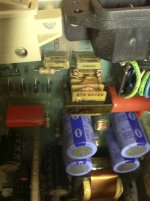
The house circuit fuse blows after a few minutes. I've tried it several places and it's the same. I've opened it and the same caps as in Timbo's picture were cracked.
I haven't ordered new caps yet because I'm a little bit unsure on what to replace them with...
I did post links from Mouser earlier in this topic where you can still buy the identical film capacitor. I think Digikey offers them as well.
Replace them and you're good to go for another 15 years

Yes, but I was thinking maybe I should change all of them before they started exploding/leaking. I have the international 230v board and I have had some problems finding replacements for every part because they seems to differ from the cap lists people have made in other replacement threads. So I need to sit down and find other types with the same properties, because it seems hard to find the exact same capI did post links from Mouser earlier in this topic where you can still buy the identical film capacitor. I think Digikey offers them as well.Replace them and you're good to go for another 15 years
My Macs are also International 230 volts versions. I have already recapped all of them in the last years ( so logic, analog, PSU ).
Finding exact replacements is often not that easy if you want to make it look right as for example a 100uf 200v capacitor from 25 years old is much larger than one with identical specs today.
So I measured all the original one's and looked for replacements that where about the same size so they look right on the Analog board.
The solution was choosing for the same capacitance but higher voltage and going for the more expensive 5000 or 7000 hours caps.
I made an inventary of each board in Excell including the part number of the replacement caps.
To avoid trouble: I replaced all the film and axials capacitors as well as you can see in this discussion: they can brake down too.
PM me what you need and I will send you the file.
Well, a few capacitors I was awaiting arrived this morning and I quickly soldered them in.
Success so far- I have left the Plus turned on now for over an hour with no issues. Works fine now.
Here is a picture of what I have replaced on the Analog board (in addition to those in the previous picture).
I certainly haven't replaced all the capacitors (C1 included because I haven't got them yet) but this seems enough to get going again.
Away with work now for another four days but on the weekend I will have a go at just replacing those two cracked filter caps and see if it makes a difference.
By the way, they are 240v boards I am playing with.
I was also wondering- can faulty diodes give similar problems? I haven't replaced any but they are probably getting pretty old too.
Oh, and for Loom- I ordered those filter caps locally through Element 14 but they actually came from the UK to me.
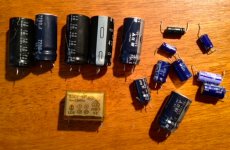
Success so far- I have left the Plus turned on now for over an hour with no issues. Works fine now.
Here is a picture of what I have replaced on the Analog board (in addition to those in the previous picture).
I certainly haven't replaced all the capacitors (C1 included because I haven't got them yet) but this seems enough to get going again.
Away with work now for another four days but on the weekend I will have a go at just replacing those two cracked filter caps and see if it makes a difference.
By the way, they are 240v boards I am playing with.
I was also wondering- can faulty diodes give similar problems? I haven't replaced any but they are probably getting pretty old too.
Oh, and for Loom- I ordered those filter caps locally through Element 14 but they actually came from the UK to me.
Chances are very thin that a faulty diode would cause problems like yours. Then the diode must make contact to the ground from the Mains, which is very unlikely.
Anyway: test the diodes, a cheap DMM can do this without desoldering them from the PCB.
Definately replace the C1 capacitor as well.
As some have mentioned, it's fairly common for these to fail, sometimes rather spectacularly. As long as the replacements are X2 rated, of equal or greater voltage rating, and similar capacitance they will work. You don't need to find exact replacements although it's nice when you do.
As a temporary test it's fine to remove them. It will likely cause interference on nearby AM radios but few people listen to AM radio anymore anyway.
As a temporary test it's fine to remove them. It will likely cause interference on nearby AM radios but few people listen to AM radio anymore anyway.
I listen to WJR 760 all the time
Or WSGW(online) (but they are news radio 790 in bay city), for Coast to Coast
Alex Jones is on (online) Shortwave and AM and FM. - Huge Audience. 3+ million
Rush Limbaugh has a Massive audience, over 20 million listeners.
I'm 33 and i'm starting to feel slightly old
Anyways, that makes sense, your home wiring would essentially turn into a big RF antenna
(with out proper filtering)I wonder if the Tempest macs can withstand and EMP?
re AM interference -
Yesterday I was booting up my IIsi with a SVGA LCD monitor. Another PC nearby was attached to an external audio amplifier. During the IIsi boot period, I was getting a clear signal from a local AM station showing up on the PC-attached audio. When the IIsi display stabilised on the SVGA monitor, the signal disappeared. I'm guessing that the VGA cable was acting as some kind of retransmitter, with the length of that cable coincidentally matching the AM station bandwidth. Strange that there was no connection between the Mac and the PC, but the signal was retransmitted.
Rick
Yesterday I was booting up my IIsi with a SVGA LCD monitor. Another PC nearby was attached to an external audio amplifier. During the IIsi boot period, I was getting a clear signal from a local AM station showing up on the PC-attached audio. When the IIsi display stabilised on the SVGA monitor, the signal disappeared. I'm guessing that the VGA cable was acting as some kind of retransmitter, with the length of that cable coincidentally matching the AM station bandwidth. Strange that there was no connection between the Mac and the PC, but the signal was retransmitted.
Rick
It's a fairly common problem. It's likely just a poorly shielded VGA cable and one of the signals is close to a multiple of the frequency you were tuned to.
I was recently playing with a FPGA board and found that it emits quite a lot of RF leakage, stomping over my reception of the 128.000 MHz AM aircraft band which happens to be 4x the 32 MHz master clock on the FPGA. I loaded a Commodore SID implementation into the FPGA and could then hear the SID tunes loud and clear on the scanner. Last year I was messing around with a small Tesla coil I had built, and we discovered it was stomping all over one of the local AM talk stations. My friend tuned it in his truck and could hear the Tesla coil down the street. RF is nifty stuff but keeping it just where you want it can be a real pain.
To clarify, there *are* people who still listen to AM, but they are certainly in the minority. Dozens of unfiltered computers buzzing away in the neighborhood could cause some problems, but running one vintage machine occasionally for a couple weeks while you wait for new caps to show up is unlikely to cause any harm. If it's interfering with something you're trying to listen to, just shut it off.
I was recently playing with a FPGA board and found that it emits quite a lot of RF leakage, stomping over my reception of the 128.000 MHz AM aircraft band which happens to be 4x the 32 MHz master clock on the FPGA. I loaded a Commodore SID implementation into the FPGA and could then hear the SID tunes loud and clear on the scanner. Last year I was messing around with a small Tesla coil I had built, and we discovered it was stomping all over one of the local AM talk stations. My friend tuned it in his truck and could hear the Tesla coil down the street. RF is nifty stuff but keeping it just where you want it can be a real pain.
To clarify, there *are* people who still listen to AM, but they are certainly in the minority. Dozens of unfiltered computers buzzing away in the neighborhood could cause some problems, but running one vintage machine occasionally for a couple weeks while you wait for new caps to show up is unlikely to cause any harm. If it's interfering with something you're trying to listen to, just shut it off.
I took the analog board out of another Plus today and replaced just the two 4700pF 250v filter caps.
It's been an hour now and it's still running!
Haven't replaced any C1's yet as that order still hasn't arrived.
By the way, I noticed some C1's are 3.9uF and others are 6.8uF. Would it make a difference if I swapped them over?
And, one more- should I bother with a hot glue gun (which I haven't got) to keep the caps I have replaced in one place? Would it really matter if I didn't bother?
Thanks
Tim
It need to be a 3,9Uf High Frequency Bi-Polar capacitor of at least 100 volts.
As far as I know the only alternate on the market is the Panasonic ECW-F2395JA film capacitor.
I used it in my all recaps and works perfect, fitting is just a bit of an issue.
No glue need: I actually remove all the old silicone from the original PCB.
I'll just stick in my 2c here. I have a 240V mac plus that behaved exactly this way when I first got it. It would boot up and after a short time would trip the residual current device at the fuse box. A quick peek inside revealed the likely culprit, X and Y rated caps in the mains filter were all cracked open. After I recapped the entire board this problem went away but I'm about 95% certain that the RCD trip was caused by these.
I replaced them with these which fit perfectly -
http://uk.farnell.com/jsp/search/productdetail.jsp?CMP=i-ddd7-00001003&sku=1006064
and this -
http://uk.mouser.com/ProductDetail/WIMA/MPX21W3470FK00MYSD/?qs=%2fha2pyFaduj0ApMVe66xmIlWTZwkT1%252btsdp6MlIXDNJF3KG5WmKzuXlIXCj2njBP
This one was a shade bigger than the original due it's rounded case and I had to temporarily remove the transformer to fit it, the pin spacing was not quite perfect either. Otherwise these parts were an exact match for what came out of the european power board in positions C33, C36 and C37.
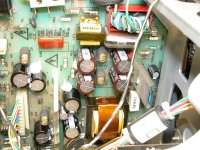
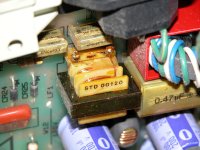
I replaced them with these which fit perfectly -
http://uk.farnell.com/jsp/search/productdetail.jsp?CMP=i-ddd7-00001003&sku=1006064
and this -
http://uk.mouser.com/ProductDetail/WIMA/MPX21W3470FK00MYSD/?qs=%2fha2pyFaduj0ApMVe66xmIlWTZwkT1%252btsdp6MlIXDNJF3KG5WmKzuXlIXCj2njBP
This one was a shade bigger than the original due it's rounded case and I had to temporarily remove the transformer to fit it, the pin spacing was not quite perfect either. Otherwise these parts were an exact match for what came out of the european power board in positions C33, C36 and C37.
II also have this issue with all three of my Pluses (which never gave issues until now), and recall a similar issue surfacing with one of my 512K's nearly 15 years ago. Never bothered to deal with it back then, but now that ALL my pluses are giving me problems I decided to google the symptoms and lo and behold there is a thread on 68k! 
Might pull the analog board out of my original Plus which I partially recapped in around 2003 and see how i go.
Might pull the analog board out of my original Plus which I partially recapped in around 2003 and see how i go.
Yep. I have replaced these in all my classic compact Macs (not just Plus's) and haven't had a recurrence. It's fairly obvious when they start to crack.
i like when they blow and make clouds of smoke.
And it stinks. The PSU in my TRS80 Model III made the whole office lobby stink for a few days when it blew two of them.
The funniest thing is the computer still works once these blow.
pop, Bang, Smoke billows out, the computer is still on no problem… haha
pop, Bang, Smoke billows out, the computer is still on no problem… haha
Those are either X1 or X2 rated safety capacitors, replace them with equivalents of that type.
I remember when the big electrolytic caps on one of my Plus A-boards went... big cloud of smoke and they bloody stunk to high heaven. Like burnt peanut butter mixed with flaming M&M's... No I wont go into how I know what they smell like! :lol:
Left a foul stench in my room for a couple of days anyway. :-/
Left a foul stench in my room for a couple of days anyway. :-/