

Thread
NeXT Development Board
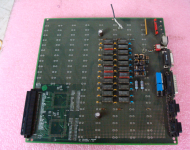
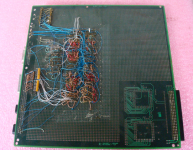
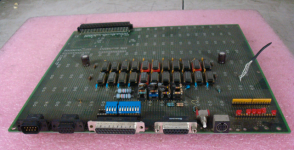
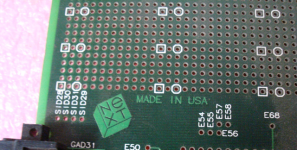
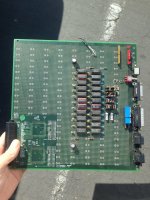
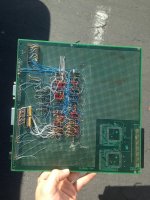
Interesting! Looks like someone has wirewrapped a circuit out of what seem like discreet logic chips, there's even some LED's as indicators there. Doesn't look like it's connected to the main bus, just to some connector on the back panel. SCSI maybe (did the NEXT have a 25pin SCSI connector?).
Some more hi-res pictures of the chips might give us a better idea of what is does (or should I say did ).
).
Some more hi-res pictures of the chips might give us a better idea of what is does (or should I say did
).There were a couple of dev board kits:
NeXTbus Development Kit
NBIC Prototyping Board
Here is a thread about the NeXTbus dev kit: http://www.nextcomputers.org/forums/viewtopic.php?t=5
NeXTbus Development Kit
NBIC Prototyping Board
Here is a thread about the NeXTbus dev kit: http://www.nextcomputers.org/forums/viewtopic.php?t=5
Should we not assume that the colour coding is important? Looking at the top view:
* There are a bunch of amber/yellow labeled 16 leg chips which might correspond with the amber/yellow chip pack (possibly resistors).
* The blue labels match up with a plausible SCSI port. If It has 25 pins, I presume it belongs with the first NeXT box.
* The red label matches a bunch of chip packs. And a reset switch?
On the underside view:
* There is another amber/yellow chip pack, possibly for SCSI termination.
* There are connectors going to the plausible serial ports for debugging.
* There is a tie up point for common connections at the top left corner.
---
So it is a funky RAM/SCSI "thing".
* There are a bunch of amber/yellow labeled 16 leg chips which might correspond with the amber/yellow chip pack (possibly resistors).
* The blue labels match up with a plausible SCSI port. If It has 25 pins, I presume it belongs with the first NeXT box.
* The red label matches a bunch of chip packs. And a reset switch?
On the underside view:
* There is another amber/yellow chip pack, possibly for SCSI termination.
* There are connectors going to the plausible serial ports for debugging.
* There is a tie up point for common connections at the top left corner.
---
So it is a funky RAM/SCSI "thing".
Man... memories. That was back in the time period where you could actually wirewrap digital circuits.
Cant do that these days unless your running slow speeds. With todays speeds, and processors like the ARM, etc.. the slew, ringing, and other noise will destroy the circuits ability to operate.
Cant do that these days unless your running slow speeds. With todays speeds, and processors like the ARM, etc.. the slew, ringing, and other noise will destroy the circuits ability to operate.
Ditto. I doubt it's a SCSI port or anything of the like, given that it's composed entirely of little 14/16 pin chips. A high-res picture of them (or list of part numbers) could clarify if they're memory chips or just a big pile of TTL goo. What's most interesting is the fact that the PCB is missing the Nubus transceiver chips and there's no wiring running to the bus connector. The possibility exists that whatever circuit is implemented on that board hasn't anything to do with a NeXT workstation and someone was just using the card as a piece of perfboard to prototype something unrelated.Some more hi-res pictures of the chips might give us a better idea of what is does (or should I say did
(Or, the in-between possibility, whatever's on there is designed to modify the output of one of a NeXT's standard ports and connects to them via external jumpers, only using the card cage connector to provide power for the circuit.)
311 or something like that. Wasn't thrilled about that price but also didn't think that it was unreasonable for something that I've never seen and doesn't seem like there were many made. Heck someone probably has 300 bucks invested in their time wiring it up just as it sits. I'm going to go with that for piece of mind :beige:
Well, the chips on that board add up to it doing *something* interesting, but whatever it was it didn't interface directly with the NeXT's bus. (The wiring makes that obvious.) There's a handful of 4 bit binary counters, a few shift registers, and, most interesting, a couple of RS-422-compliant line drivers. If I had to take a wild guess it's some sort of serial data buffer or baud rate converter?
Again, the only way the NeXT would be able to talk to it/through it is if it were jumpered to some other external port. There's absolutely nothing connected to the NuBus connector. (Except possibly the 5v and ground rails.) I am curious where that snipped off cable lead went to; I'm having trouble following the wires but it looks to me like the wires terminated on the input pins of one of the shift registers. Perhaps the other end of that wire "snooped" on something on the NeXT's motherboard and the shift register was used to capture some number of transitions (IE, the board acts like a crude logic analyzer) which allows the data to be read off to some external device via the connectors on the back. (Or, again, this board was being used for something completely off-the-wall unrelated.) I suppose the OP could try translating it into a schematic if so inclined.
Weird indeed...There's a couple of dip switches as parallel input to the circuit (the 25 pin connector seems to be used as a ground for the switches!) which are then serially shifted into loads of logic gates, flop-flops, inverters etc and the shifted back into an 8 bit parallel output which is fed to the LEDs.
Somehow to me this looks like someone has used this board to prototype some circuit (possible some state machine?) with switches as inputs and LEDs as outputs. But why are there some connections to external connectors on the back? Was the circuit possible simulating some device that would later be connected to serial port / ADB etc? Seems the output also goes through the RS422 line driver to the connector besides the push button. Is this a 8pin serial port?
Would someone be willing to reverse engineering this and build it in Pspice? :lol:
Somehow to me this looks like someone has used this board to prototype some circuit (possible some state machine?) with switches as inputs and LEDs as outputs. But why are there some connections to external connectors on the back? Was the circuit possible simulating some device that would later be connected to serial port / ADB etc? Seems the output also goes through the RS422 line driver to the connector besides the push button. Is this a 8pin serial port?
Would someone be willing to reverse engineering this and build it in Pspice? :lol:
Ditto, but CrapShack never sold perfboard with offset thru-holes for four D-Shell connectors. Did they sell them with any on board?
I don't remember anything like that being available from Jameco or anywhere else back in the wire-wrap day either. That's a very ProtoBoard without the NeXT connection, which wasn't worth much for very long even when that section was worth anything at all.
I don't remember anything like that being available from Jameco or anywhere else back in the wire-wrap day either. That's a very
ProtoBoard without the NeXT connection, which wasn't worth much for very long even when that section was worth anything at all.I've seen some pretty huge generic protoboards with edge-rails for connectors like that before, but I also second the notion that this may well have been a case of someone just happening to have this thing handy and using it to prototype some random thing that has nothing to do with NeXT. The only thing about it that at all suggests to me that *maybe* the board was intended to be seated into a NeXT chassis while running is I didn't see in my cursory glance at it an obvious place where they would have hooked up an external power supply and they were apparently using the "5v" and "ground" rails as labeled... which means it *could* have depended on the 5v rail coming through the NuBus slot connector to power it. But there may well be a wire to, say, one of those 9 pin connectors that provided the power feed, or something else that was snipped off.
(This was probably a very expensive board back in the day, certainly by protoboard standards. It's looks like it's multi-layer; the only thing the multi-layer-edness seems to be used for outside of the unpopulated NuBus connector section is for the power/ground rails, but that alone is pretty fancy.)
The NeXTBus dev board was nothing special at all. It was just a breadboard PCB with grounds and power traces added. The holes at the back for ports were for the end user since you can't buy connectors that plug into the grid conventional pattern. It looks a lot like someone started work on something but then gave up. Components are missing but the board shows no signs that they were desoldered.
I have NeXT's description of the board alongside a photo in their 1990 Products catalog. They were trying extremely hard to get vendors to build NeXTBus peripherals but even at $350 for the NBIC, full documentation and the board they didn't sell a lot of them (which sucks because they were literally telling people to go wild with the hardware).
What IS however special is the NBIC chip that linked your prototyping to the NeXTBus. It's missing from this board. Again, doesn't look like it was ever installed.
Without it, that was just one VERY expensive square circuit board with a NeXT logo. I hope the buyer knows that the board is neither all that valueable or useable.
Edited: It seems the catalog photo shows a board with a different layout where all the rear connectors are just what you would of expected on the older 030 cube boards (DSP, Serial, SCSI, Printer, Ethernet, Monitor).


I have NeXT's description of the board alongside a photo in their 1990 Products catalog. They were trying extremely hard to get vendors to build NeXTBus peripherals but even at $350 for the NBIC, full documentation and the board they didn't sell a lot of them (which sucks because they were literally telling people to go wild with the hardware).
What IS however special is the NBIC chip that linked your prototyping to the NeXTBus. It's missing from this board. Again, doesn't look like it was ever installed.
Without it, that was just one VERY expensive square circuit board with a NeXT logo. I hope the buyer knows that the board is neither all that valueable or useable.
Edited: It seems the catalog photo shows a board with a different layout where all the rear connectors are just what you would of expected on the older 030 cube boards (DSP, Serial, SCSI, Printer, Ethernet, Monitor).