
Macintosh Hardware Memory Map
Macintosh Hardware Memory Map
Macintosh · 1983 · PDF
| Filename | Macintosh_Hardware_Memory_Map_19830413.pdf |
|---|---|
| Size | 0.58 MB |
| Year | 1983 |
| Subsection | prototypes / 1983_Twiggy |
| Downloads | 2 |
Enjoying MacTrove?
Anonymous downloads are free and unlimited.
Create a free account to track favorites,
contribute metadata corrections, and join the
community chat.
Reader
Loading…
OCR / Text contents
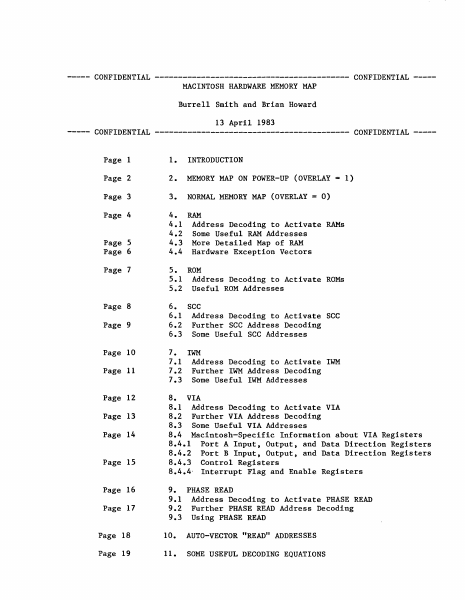
----- CONFIDENTIAL ------------------------------------------ CONFIDENTIAL ----MACINTOSH HARDWARE MEMORY MAP
Burrell Smith and Brian Howard
13 April 1983
----- CONFIDENTIAL ------------------------------------------ CONFIDENTIAL ----Page 1
1.
INTRODUCTION
Page 2
2.
MEMORY MAP ON POWER-UP (OVERLAY = 1)
Page 3
3.
NORMAL MEMORY MAP (OVERLAY = 0)
Page 4
4. RAM
4.1 Address Decoding to Activate RAMs
4.2 Some Useful RAM Addresses
4.3 More Detailed Map of RAM
4.4 Hardware Exception Vectors
Page 5
Page 6
Page 7
5. ROM
5.1 Address Decoding to Activate ROMs
5.2 Useful ROM Addresses
Page 8
6. SCC
6.1 Address Decoding to Activate SCC
6.2 Further SCC Address Decoding
6.3 Some Useful SCC Addresses
Page 9
Page 10
Page 11
Page 12
Page 13
Page 14
Page 15
Page 16
Page 17
7. IWM
7.1 Address Decoding to Activate IWM
7.2 Further IWM Address Decoding
7.3 Some Useful IWM Addresses
8. VIA
8.1 Address Decoding to Activate VIA
8.2 Further VIA Address Decoding
8.3 Some Useful VIA Addresses
8.4 Macintosh-Specific Information about VIA Registers
8.4.1 Port A Input, Output, and Data Direction Registers
8.4.2 Port B Input, Output, and Data Direction Registers
8.4.3 Control Registers
8.4.4' Interrupt Flag and Enable Registers
9. PHASE READ
9.1 Address Decoding to Activate PHASE READ
9.2 Further PHASE READ Address Decoding
9.3 Using PHASE READ
Page 18
10.
AUTO-VECTOR "READ" ADDRESSES
Page 19
11.
SOME USEFUL DECODING EQUATIONS
13 April 1983
1.
Macintosh Memory Map
Page 1
INTRODUCTION
The principle portions of Macintosh's memory consist of volatile read/write
memory (RAM) and permanent read-only memory (ROM). In addition to RAM and ROM,
three input/output devices are also selected using address lines, so that they
appear to occupy portions of the Macintosh memory space. These devices are the
6522 Versatl~e Interface Adapter (VIA), the 8530 Serial Communications,Chip
(SCC), and the disk interface chip (IWM).
When the Macintosh is first turned on, ROM appears at ehe bottom (lowest
-- >-"1
addresses) portion of the memory space. This is useful for the ROM-stored
software which starts the system running. Afte~·tup, the OVERLAY signal
from the VIA is changed to a low (zero), mapping RAM into its normal place at
the bottom of memory.
Selection of RAM, ROM, or other devices is done by from two to five of the
highest-order address lines, A23-A19. The VIA and IWM also use the four
address lines A12-A9 for further internal decoding and register selection,
while the SCC uses the three lowest-order address lines A2-A0 for internal
decoding.
In specifying "useful addresses" for most devices, unused address lines have
been set high (to a one) to save a small amount of power and to improve noise
immunity. Some address ranges are specified "Do Not Use" because they can
select two devices simultaneously. While this does not cause any damage to the
computer, data cannot be correctly transferred while these addresses are in
use.
13 April 1983
2.
Page 2
Macintosh Memor…
Showing first 3,000 characters of 21,546 total. Open the full document →