

MacApp 2.0 Object And Method Reference
MacApp 2.0 Object And Method Reference
Macintosh · PDF
| Filename | MacApp_2.0_Object_and_Method_Reference_198810.pdf |
|---|---|
| Size | 3.08 MB |
| Source | Apple Computer |
| Subsection | developer / MacApp / MacApp_2.0b5 |
| Downloads | 9 |
Enjoying MacTrove?
Anonymous downloads are free and unlimited.
Create a free account to track favorites
and contribute metadata corrections.
Reader
Loading…
OCR / Text contents
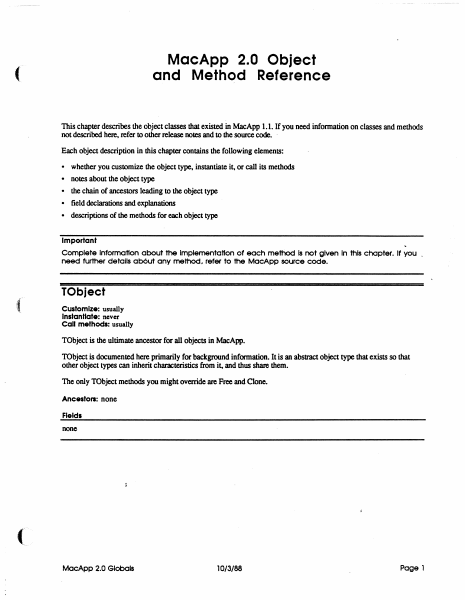
MacApp 2.0 Object
and Method Reference
(
This chapter describes the object classes that existed in MacApp 1.1. If you need infonnation on classes and methods
not described here, refer to other release notes and to the source code. .
Each object description in this chapter contains the following elements:
•
•
•
•
•
whether you customize the object type. instantiate it, or call its methods
notes about the Object type
the chain of ancestors leading to the object type
field declarations and explanations
descriptions of the methods for each object type
Important
Complete Information about the Implementation of each method Is not given In this chapter. It you _
need further details ab6ut any method, refer to the MocApp source code.
TObject
Customize: usually
Instantiate: never
Call methods: usually
TObject is the ultimate ancestor for all objects in MacApp.
TObject is documented here primarily for background information. It is an abstract object type that exists so that
other object types can inherit characteristics from it, and thus share them.
The only TObject methods you might override are Free and Clone.
Ancestors: none
Fields
none
MocApp 2.0 Globels
10/3/88
Page 1
Clone
FUNCTION TOb ject. Clone:
TOb ject;
The return value
An exact copy of the calling object
Purpose
To clone dependent objects referred to by the fields of an object as well as cloning
the object itself. An object is dependent on another object when the second object
has the only (or the only important) reference to the fU'St object Dependency is a
relatively vague condition; when you override this method. you need to determine
what objects are dependent on SELF.
The default version
Calls ShallowClone. and thus clones only the object itself
Override
Sometimes
Call
Sometimes
Free
PROCEDURE
TObject.Free;
Purpose
To free the calling object and any dependent objects referred to by its fields. An'
object is dependent on another object when the second object has the only (or the
only important) reference to the fU'St object Dependency is a relatively vague
condition; when you override this method. you need to determine what objects are
dependent on SELF.
The default version
Calls ShallowFree
Override
Often. Your version should free any dependent objects you have added for your
customization and then call INHERITED Free so that any ancestor methods can free
other dependent objects. The chain of INHERlTED calls leads to TObjectFree.
which calls TObject.ShallowFree. which frees SELF.
Call
Often
ShallowClone
FUNCTION
TObject.ShallowClone:
TObject;
The return value
Purpose
This is the lowest-level method for copying an object
Called by
TObjectOone
The default version
Calls HandToHand. an Inside Macintosh routine, to copy the object data
Override
Never
Call
Rarely
MacApp 2.0 Globals
10/3/88
Page 2
Shallow Free
PROCEDURE
(
TObject.ShallowFree;
Purpose
This is lhe lowest-level method for freeing an object
Called by
TObjecLFree
The default v…
Showing first 3,000 characters of 78,076 total. Open the full document →