

Front Desk Bus Rev 3.1
Front Desk Bus Rev 3.1
ADB · 1984 · PDF
| Filename | Front_Desk_Bus_Rev_3.1_19841029.pdf |
|---|---|
| Size | 0.94 MB |
| Year | 1984 |
| Source | Various hardware vendors |
| Subsection | fdb |
| Downloads | 9 |
Enjoying MacTrove?
Anonymous downloads are free and unlimited.
Create a free account to track favorites
and contribute metadata corrections.
Reader
Loading…
OCR / Text contents
••
,
I
To:
Bob Belleville
Date:
October 29, 1984
Bt11 Bu11
-c;ary· Butts
Mike Clark
Jerome Coonen
Dan Hil1man
Larry Kenyon
Burre11 Smith
?et,
From:
Peter Ashkln
Subj:
Front Desk Bus - rev 3.1
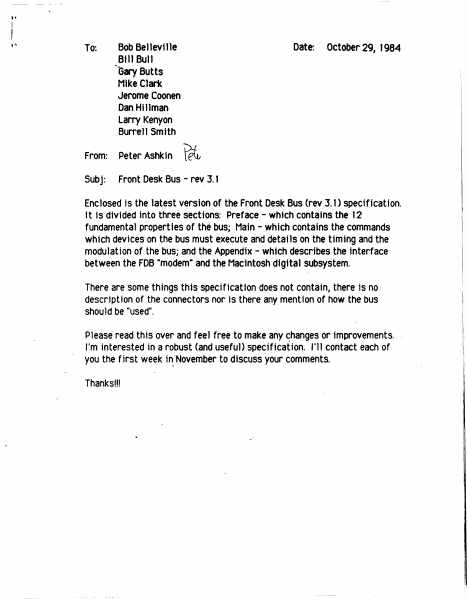
Enclosed is the latest version of the Front Desk Bus (rev 3.1) specification.
It is divided into three sections: Preface - which contains the 12
fundamental properties of the bus; Main - which contains the commands
which devices on the bus must execute and deta11s on the timing and the
moduJat ion of the bus; and the Appendix - which describes the interface
between the FOB "modem· and the Macintosh digital subsystem.
There are some things this specification does not contain, there is no
description of the connectors nor is there any mention of how the bus
should be "used".
Please read this over and feel free to make any changes or improvements.
I'm interested in a robust (and useful) spe~ification. 1911 contact each of
you the first week in_·November to discuss your comments.
Thanksm
••
rtrrae - rroat Int
..
I••
To mate the "Front Delk Bua" 1 more ne1ible and powerful interface, it
should have the f ollowina properties:
l.
The bus shall be bidirectional. (An input only bus is too
restrictive.)
2.
Bach device on the bus has a unique address. For
practical purposed the address range should be 0 - 1.f. Some of these
addresses may be reserved for broadcasting universal messages. (This
seems lite a sane number of devices, particularly since there eiists today
only three devices; keyboard, keypad and mouse.)
3.
All command transactions shall be eight bits Iona. All
data transactions shall be 16 bits long. (This facilitates the decoding of
commands by devices of limited intelligence.)
The host shall be the undisputed bus master. (This
removes any question of who's controlling the bus.)
4.
5.
There shall be a limited number of commands.
Commands should be broken into two groups, basic commands (TALI: and
LISTBN) which all devices on the bus shall understand; and advanced
commands which only intelligent devices (as appropriate) should
understand. (This makes the command interpreter, be it hardware or
software, simple. It also allows more comple1 devices to used some of the
fancier" features of the bus.)
·
0
6.
There shall be only one active talker on the bus at any
time, this may be the host or an addressed device. (A device addressed to
TALI: with data to send untalts itself after it sends its 16 bits of data or
if it has no data to send "untalts" itself immediately and allows the bus to
time-out.I
0
0
The bus protocol must accept devices that talk at
different speeds. The host, at a minimum, must be able to listen at various
speeds. (This implies that the data on the bus must be self-clocked". By
not rigidly filing the speed of transmission, the bus does not need to be
crystal (etc.) controlled.)
7.
0
There shall be only one active listener on the bus at any
time, this may be the host or an addressed device. (A device addressed to
LISTBN…
Showing first 3,000 characters of 25,709 total. Open the full document →