

Pat5428369
Pat5428369
ADB · 1995 · PDF
| Filename | pat5428369.pdf |
|---|---|
| Size | 0.57 MB |
| Year | 1995 |
| Source | Various hardware vendors |
| Subsection | Kensington / Kensington_Turbo_Mouse_Model_64210 |
| Downloads | 8 |
Enjoying MacTrove?
Anonymous downloads are free and unlimited.
Create a free account to track favorites
and contribute metadata corrections.
Reader
Loading…
OCR / Text contents
United States Patent 9
Pranger et al.
INNO
ENON
US005428369A.
[11] Patent Number: 5,428,369
[45] Date of Patent: Jun, 27, 1995
[54] COMPUTER POINTING DEVICE
[75] Inventors: Maarten R. Pranger, Morgan Hill,
Cristian A. Fraenkel, San Mateo;
Richard Pekelney, San Francisco;
David C. Shafer, Menlo Park, all of
Calif.
[73] Assignee: Kensington Microware Limited, San
Mateo, Calif.
[21] Appl. No.: 255,320
[22] Fiied: Jun. 7, 1994
(51] Int. CLS G09G 5/08
(52] U.S. CL. 345/166; 345/163;
345/167
[58] Field of Search ..........-s::sssssscsssessscees 345/163-167,
345/172, 156-158, 161, 162
[56] References Cited
U.S. PATENT DOCUMENTS
5,119,077 6/1992 Giorgio
Primary Examiner—Jefiery Brier
345/163
Attorney, Agent, or Firm—Townsend and Townsend
Khourie and Crew
[57] ABSTRACT
The present invention provides for an improved com-
puter pointing device such as a trackball or mouse, for
example. The improved computer pointing device al-
lows a user to set a communications protocol for use
with a particular computer system by using a user-
friendly configuration program designed for operation
on a different platform and by using a different commu-
nications protocol. Additionally, the computer pointing
device includes an LED encoder illumination control
system to provide varying levels of LED intensities.
During normal operation, an LED operates at a particu-
lar intensity level. The intensity level is controllable in
discrete steps: LED power is off for power up, LED
power is reduced for testing to test for unacceptable
signal levels, and LED power may be increased beyond
normal levels to counteract diminution of light intensity
as the LED ages.
12 Claims, 3 Drawing Sheets
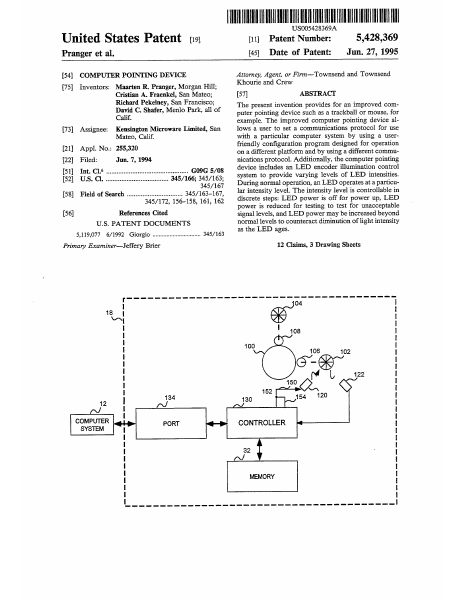
04 !
48 Se
“~ H
I 1
H 108 |
H 100 I
H 106 102 I
C-e
1 L 122 I
1 150 I
1 152
134 154 120 !
42 | 130
wt al Mad |
COMPUTER
SYSTEM iia PORT wi—p CONTROLLER
I 1
1 !
if 32 {
| law tl
I
1 MEMORY
I J
t {
1
U.S. Patent June 27, 1995 Sheet 1 of 3 5,428,369
a
22 20
—
U Oad 12 OU 18
LAS
mM rico re
FIG_1
Sheet 2 of 3 5,428,369
June 27, 1995
U.S. Patent
Z Ola
ra
os
Aiowew a6e10}S
Alowe-w JOyeJajN00 JOA
ypolqo - | weibold 7 A
abew| (Ag eBew| vy | soludeig 4 so1ydesD gy Ae\dsiq
Jew,
JOWUOW solydeisy
JAG J
pueoqhey og
JeAud
asnow re |
2a6eJo}S
810 ze |
Wvd
o€
(nd9)
yun Burssesold
jequeg
Sheet 3 of 3 5,428,369
June 27, 1995
U.S. Patent
AXOWAW
!
I
!
I
1
i |
} t
I
I
i
OSL
ooF
I
|
}
|
I
I
I
I
I
I
!
oY oct iv
vel
och zl
“xP
l
I
1
I
|
I
I
i
1
I
|
at et peer sine net ed NO GO SE RE SNE ey SY Se a ee SUSE SSL ED SO Sa MD GD ESR SOU SEND SR eet Se HN GN eT Me SA SE
YATIOULNOD => LuOd <4-+- >
WALSAS
YALAdWOD
iw)
(a)
5,428,369
1
COMPUTER POINTING DEVICE
BACKGROUND OF THE INVENTION
The present invention relates generally to computer
pointing devices, and more specifically, to computer
pointing devices that are capable of communicating
using several different types of protocols or to those
that use light-emitting diodes to generate positional
info…
Showing first 3,000 characters of 29,856 total. Open the full document →