
Apple Address Resolution Protocol
Apple Address Resolution Protocol
NuBus · 1987 · PDF
| Filename | Apple_Address_Resolution_Protocol_19870518.pdf |
|---|---|
| Size | 0.57 MB |
| Year | 1987 |
| Subsection | apple / 670-0205_3Com_Ethernet |
| Downloads | 5 |
Enjoying MacTrove?
Anonymous downloads are free and unlimited.
Create a free account to track favorites,
contribute metadata corrections, and join the
community chat.
Reader
Loading…
OCR / Text contents
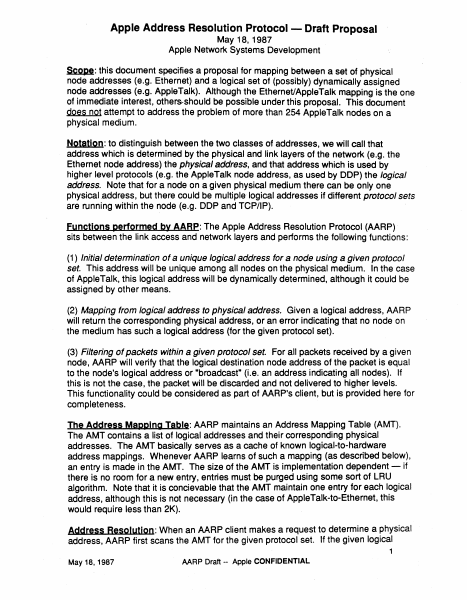
Apple Address Resolution Protocol - Draft Proposal
May 18, 1987
Apple Network Systems Development
Scope: this document specifies a proposal for mapping between a set of physical
node addresses (e.g. Ethernet) and a logical set of (possibly) dynamically assigned
node addresses (e.g. AppleTalk). Although the Ethernet/AppleTalk mapping is the one
of immediate interest, others-should be possible under this proposal. This document
does not attempt to address the problem of more than 254 AppleTalk nodes on a
physical medium.
Notation: to distinguish between the two classes of addresses, we will call that
address which is determined by the physical and link layers of the network (e.g. the
Ethernet node address) the physical address, and that address which is used by
higher level protocols (e.g. the AppleTalk node address, as used by DDP) the logical
address. Note that for a node on a given physical medium there can be only one
physical .address, but there could be multiple logical addresses if different protocol sets
are running within the node (e.g. DDP and TCP/IP).
Functions performed by AARP: The Apple Address Resolution Protocol (AARP)
sits between the link access and network layers and performs the following functions:
(1) Initial determination of a unique logical address for a node using a given protocol
set. This address will be unique among all nodes on the physical medium. In the case
of AppleTalk, this logical address will be dynamically determined, although it could be
assigned by other means.
(2) Mapping from logical address to physical address. Given a logical address, AARP
will return the corresponding physical address, or an error indicating that no node on
the medium has such a logical address (for the given protocol set).
(3) Filtering of packets within a given protocol set. For all packets received by a given
node, AARP will verify that the logical destination node address of the packet is equal
to the node's logical address or "broadcast" (i.e. an address indicating all nodes). If
this is not the case, the packet will be discarded and not delivered to higher levels.
This functionality could be considered as part of AARP's client, but is provided here for
completeness.
The Address Mapping Table: AARP maintains an Address Mapping Table (AMT).
The AMT contains a list of logical addresses and their corresponding physical
addresses. The AMT basically serves as a cache of known logical-to-hardware
address mappings. Whenever AARP learns of such a mapping (as described below),
an entry is made in the AMT. The size of the AMT is implementation dependent - if
there is no room for a new entry, entries must be purged using some sort of LRU
algorithm. Note that it is concievable that the AMT maintain one entry for each logical
address, although this is not necessary (in the case of AppleTalk-to-Ethernet, this
would require less than 2K).
Address Resolution: When an AARP client makes a request to determine a physical
address, AARP first scans the …
Showing first 3,000 characters of 13,267 total. Open the full document →