
Exec File Preprocessor Mar83
Exec File Preprocessor Mar83
Lisa · 1983 · PDF
| Filename | Exec_File_Preprocessor_Mar83.pdf |
|---|---|
| Size | 1.90 MB |
| Year | 1983 |
| Subsection | workshop_beta |
| Downloads | 3 |
Enjoying MacTrove?
Anonymous downloads are free and unlimited.
Create a free account to track favorites,
contribute metadata corrections, and join the
community chat.
Reader
Loading…
OCR / Text contents
Page 1
Exec FUe Pleplo;essor
Exec File Preprocessor
Overview
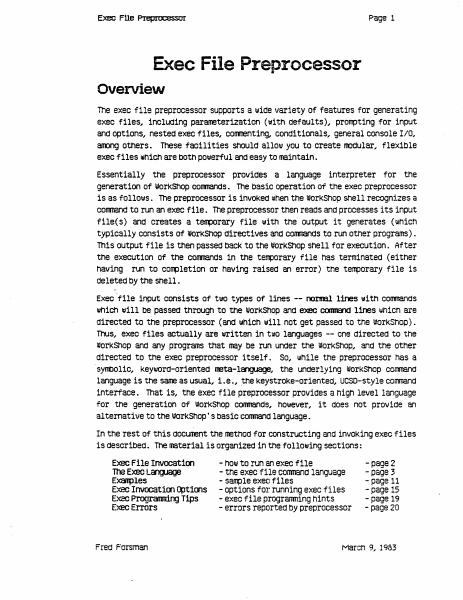
The exec file preprocessor supports a 1.111de variety of features for generating
exec files, inclUding parameterization (with defaults), prorrpting for input
and options, nested exec files, COITITenting, conditionals, general console IIO,
aroong others. These facilities should allol.ll you to create lOOdular.. flexible
exec files which are bOth pOlJlerful and easy to maintain.
Essentially the preprocessor provides a language interpreter for the
generation of IIJorKShop conmands. The basic operation of the exec preprocessor
is as follol.lls. The preprocessor is invoked when the workShop shell recognizes a
cornnand to run an exec file. The preprocessor then reads and processes its input
flle( s) and creates a teflllOrary file 1111th the output it generates (which
typically consists of WOrkShop directives and conmands to run other programs) .
This output file 1s then passed back to the I#OrKShOp Shell for execution. After
the execution of the conmands 1n the t~orary file haS terminated (either
having run to completion or having raised an error) the terrporary file is
deleted by the shell.
Execflle input consists of tlllO types of lines -- naI1lBl lines with conmands
lIIhiCh will be paSSed through to the workShop and e>eee COOII&1d lines whiCh are
directed to the preprocessor (and lIIhich w111 not get paSSed to the WOrkShop).
Thus, exec files actually are written in t\lO languages -- one directed to the
worKShop and any programs that may be run under the worKShop, and tne other
directed to the exec preprocessor i tself . So, I.IIhile the preprocessor has a
·syntlOl1c, KeYWOrd-oriented neta-l~, the underlying worKShop comnand
language 1s the sane as usual, 1.e., .the KeystroKe-oriented, UCSD-style corrmand
interface. That is, the exec file preprocessor provides a high level language
for the generation Of worKShOp CommandS, however, it does not provide an
a1 temative to the worKShop' S basic conmand language.
In the rest of this cIOcunent the methOd for constructing and inVOKing exec files
is described. The material is organized 1n the following sections:
Exec File Invocatioo
100 Exec language
E~les
Exec Invocat100 ~t1oos
Exec Programr1.rYJ Tips
Exec Errors
Fred Forsman
- hOIll to run an exec file
- tne exec file conmand language
- sarrple exec files
- options for running exec files
- exec file progranming hints
- errors reported by preprocessor
-page 2
- page 3
- page 11
- page 15
- page 19
- page 20
March 9, 1983
Exec f!le Prepnx:essor
!=Iage 2
Exec File Invocation .
An invocation line for the preprocessor has the follollling form:
<exec conmand> <exec file> [ «pararreter list»
[ <exec options> ]]
The <exec corrmand> can be either "EXECI'" or "<". The <exec file> is the name of
the exec file you lIIiSh to
A". TEXT" extension will be assuned if one 1s not
specified; holJlever, you may override the mechanism IJIhiCh supplies the". TEXT"
extension by ending your <exec file> name…
Showing first 3,000 characters of 39,736 total. Open the full document →