

Well, after further digging I came across a couple of pieces of information:
1. this from a Macworld discussion post:
"The port you send to is entirely irrelevant. You could send it on another IP protocol such as ICMP that doesn't have ports at all, or on MS or Apple's old systems (NetBEUI/AppleTalk) or even plain raw Ethernet. All that's required is that the network card see a certain sequence of bytes on the wire.
It's common to use UDP port 9 because this is the "Discard" port from the early days of IP. Using this means WOL won't interfere with anything else you might have running. However, using some other port might be handy if it's already opened to allow another service to run. TCP port 80 would be a good example - anyone who runs a Web server would be able to use WOL on 80 without any further configuration."
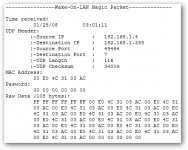
2. and this (available from any number of sources) contains an example of the "sequence of bytes" in question at the bottom — the numbers repeated 16 times being the target MAC address of the ethernet card. In this case UDP port 7 appears to have been used. Looks simple enough:
1. this from a Macworld discussion post:
"The port you send to is entirely irrelevant. You could send it on another IP protocol such as ICMP that doesn't have ports at all, or on MS or Apple's old systems (NetBEUI/AppleTalk) or even plain raw Ethernet. All that's required is that the network card see a certain sequence of bytes on the wire.
It's common to use UDP port 9 because this is the "Discard" port from the early days of IP. Using this means WOL won't interfere with anything else you might have running. However, using some other port might be handy if it's already opened to allow another service to run. TCP port 80 would be a good example - anyone who runs a Web server would be able to use WOL on 80 without any further configuration."
2. and this (available from any number of sources) contains an example of the "sequence of bytes" in question at the bottom — the numbers repeated 16 times being the target MAC address of the ethernet card. In this case UDP port 7 appears to have been used. Looks simple enough: