

Here are the before cleanup shots of the places where I should have used Mr. Ryoba's more thick, set free toothed blade instead of Mitzi's exceedingly thin blade with slightly set teeth.
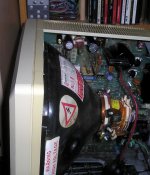
It's easy to spot, in hindsight, where the set of the teeth and thinness of the blade led to it straying off line when it met up with variations in the depth of the ABS it was cutting. Set teeth make for wobble room and cut drift in such situations. This can be particularly nasty when a bandsaw blade decides to follow the path of least resistance when ripping wood that has a strong grain pattern and hardness differential between grain layers. By the time you notice the top of the cut wandering offline, you can bet the bottom is way out of whack, feed rates and blade choice are critical for the bandsaw. The manual tool equivalents are the same raw deal. [ ] ]'>
] ]'>
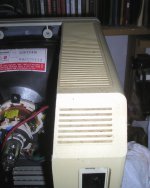
Note the nubbins of the bucket bolt tubes in this shot, they'll do nicely for final assembly.
The scrape marks in the rear view are from being a bit too hurried in using the Dozuki Noko Giri making the plunge cuts. The "first tooth" of these saws work very nicely as plexi scribe type tools when working ABS case parts. Again, the Ryoba should have been used, maybe the 06-240 Cross-cut RazorSaw that was misnamed Dozuki back when Japanese PullSaws were first hitting the mail order tool catalogs. The Dozuki Noko Giri was misnamed Dozuki Noko.
I'm learning about lots of new Japanese saws for the wish list along with more accurate nomenclature . . .
. . . we'll see if I can remember to use the correct names, but the simplified versions are so much shorter and easier!
If anyone wants to give these tools a try, There's a nice little Ryoba, that's equivocally named "Bear Saw" which is the mfr's name, IIRC. I got it at Lowe's for somewhere between 20 & 25 dollars as a knock-around field saw. When broken down to the blade & handle components, it fits in a medium size toolbox very nicely. Mine rests in an elongated, antique (it looks antique from general appearance, build quality and manufacturing methods) metal mechanic's toolbox.
Highly recommended!
WARNING: THESE SAWS ARE HIGHLY ADDICTIVE! }
It's easy to spot, in hindsight, where the set of the teeth and thinness of the blade led to it straying off line when it met up with variations in the depth of the ABS it was cutting. Set teeth make for wobble room and cut drift in such situations. This can be particularly nasty when a bandsaw blade decides to follow the path of least resistance when ripping wood that has a strong grain pattern and hardness differential between grain layers. By the time you notice the top of the cut wandering offline, you can bet the bottom is way out of whack, feed rates and blade choice are critical for the bandsaw. The manual tool equivalents are the same raw deal. [
] ]'>Note the nubbins of the bucket bolt tubes in this shot, they'll do nicely for final assembly.
The scrape marks in the rear view are from being a bit too hurried in using the Dozuki Noko Giri making the plunge cuts. The "first tooth" of these saws work very nicely as plexi scribe type tools when working ABS case parts. Again, the Ryoba should have been used, maybe the 06-240 Cross-cut RazorSaw that was misnamed Dozuki back when Japanese PullSaws were first hitting the mail order tool catalogs. The Dozuki Noko Giri was misnamed Dozuki Noko.
I'm learning about lots of new Japanese saws for the wish list along with more accurate nomenclature . . .
. . . we'll see if I can remember to use the correct names, but the simplified versions are so much shorter and easier!
If anyone wants to give these tools a try, There's a nice little Ryoba, that's equivocally named "Bear Saw" which is the mfr's name, IIRC. I got it at Lowe's for somewhere between 20 & 25 dollars as a knock-around field saw. When broken down to the blade & handle components, it fits in a medium size toolbox very nicely. Mine rests in an elongated, antique (it looks antique from general appearance, build quality and manufacturing methods) metal mechanic's toolbox.
Highly recommended!
WARNING: THESE SAWS ARE HIGHLY ADDICTIVE! }