
The first power-up test! For now, the same HSYNC signal drives both circuits.
Powering up the Mac without the horizontal coil attached, of course the result is a bright vertical line on the screen. Then bringing up the voltage on the yoke driver circuit, the display gradually widened until at about Vcc = 14V it looked like this:
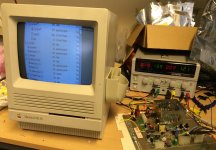
Well it's a start. The good news is that the display is clearly visible. The bad news is (1) it's much too tall, with the image extending off the edge of the screen, (2) it's out of focus with pin-cushion distortion, and (3) it's shifted over to the right.
Both (1) and (2) are results of the same thing, namely that the HV to the CRT is reduced from disconnecting the yoke. Lower HV = easier to deflect the beam = picture too tall, and all the other flyback-produced voltages are off as well. This wasn't a surprise since the yoke stores a substantial part of the energy in a flyback circuit.
So most recently my task has been to get the HV back to its original level, without needing an extra "dummy" yoke stuck inside the case somewhere. The first start, as I think it also was for techknight's VGA experiment, was C12. Here's what that signal looks like without the yoke:
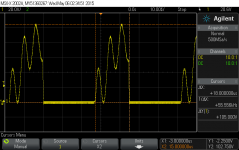
This is one unhappy HOT! The retrace is much too slow, so Q2 turns on before the retrace has finished. This is the kind of thing that cooks transistors over time.
In theory the speed of the retrace should be proportional to sqrt(L*C) where L is the inductance in the system and C is ostensibly C12. So by making C12 smaller, the whole thing should respond faster. Turns out that doesn't work. Here's 10nF instead of 33nF (green plot is the one that matters):
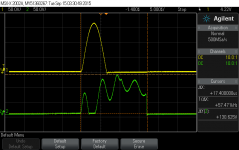
The retrace pulse doesn't actually get any faster at all! All it does is make the high-frequency ringing get a little higher. This was a surprise. I wondered if some other capacitor is setting this time constant, but after probing every pin on the flyback transformer, it's pretty clear that the other capacitors are all simple DC blockers or filter caps.
The only conclusion I can think of is that we're looking at the intrinsic winding capacitance of the flyback transformer itself. In other words, no matter what goes in C12, this circuit won't get any faster without the yoke attached. This may be one reason flyback transformers are only rated for certain frequency ranges.
The question then is what can replace the yoke...
Powering up the Mac without the horizontal coil attached, of course the result is a bright vertical line on the screen. Then bringing up the voltage on the yoke driver circuit, the display gradually widened until at about Vcc = 14V it looked like this:
Well it's a start. The good news is that the display is clearly visible. The bad news is (1) it's much too tall, with the image extending off the edge of the screen, (2) it's out of focus with pin-cushion distortion, and (3) it's shifted over to the right.
Both (1) and (2) are results of the same thing, namely that the HV to the CRT is reduced from disconnecting the yoke. Lower HV = easier to deflect the beam = picture too tall, and all the other flyback-produced voltages are off as well. This wasn't a surprise since the yoke stores a substantial part of the energy in a flyback circuit.
So most recently my task has been to get the HV back to its original level, without needing an extra "dummy" yoke stuck inside the case somewhere. The first start, as I think it also was for techknight's VGA experiment, was C12. Here's what that signal looks like without the yoke:
This is one unhappy HOT! The retrace is much too slow, so Q2 turns on before the retrace has finished. This is the kind of thing that cooks transistors over time.
In theory the speed of the retrace should be proportional to sqrt(L*C) where L is the inductance in the system and C is ostensibly C12. So by making C12 smaller, the whole thing should respond faster. Turns out that doesn't work. Here's 10nF instead of 33nF (green plot is the one that matters):
The retrace pulse doesn't actually get any faster at all! All it does is make the high-frequency ringing get a little higher. This was a surprise. I wondered if some other capacitor is setting this time constant, but after probing every pin on the flyback transformer, it's pretty clear that the other capacitors are all simple DC blockers or filter caps.
The only conclusion I can think of is that we're looking at the intrinsic winding capacitance of the flyback transformer itself. In other words, no matter what goes in C12, this circuit won't get any faster without the yoke attached. This may be one reason flyback transformers are only rated for certain frequency ranges.
The question then is what can replace the yoke...