
Finding a yoke replacement is tricky because it needs to handle quite a bit of current, at least several amps. My candidate replacement was Vishay IHA-305, a 100uH inductor rated at 4.2A. It has a DC resistance of 0.07 ohms so it's not far off from the original yoke itself.
The yoke coil measured around 80uH and the width coil just over 20uH, so I connected the new inductor to replace them both. This frees up the width coil to be used in the yoke driver circuit. Now powering up the Mac, the vertical line is sharper, brighter and about the right size:
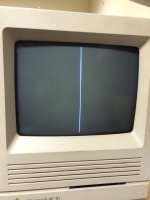
That's a good sign! The signals on the analog board also look normal again. So now bringing the voltage up on the yoke driver circuit, the image starts to emerge:
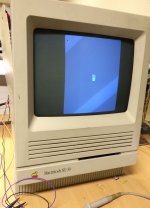
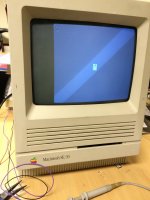
Except for the horizontal offset, it looks great. (The diagonal stripe is the usual camera artefact.) It's even in good focus without touching any of the adjustments.
Now that the HV is back to normal levels, it takes a larger supply voltage to get enough width on the screen. The adjustable power supply I was testing with maxes out at 20V, which is what produces the second image above. The current consumption is about 350mA = 7W to drive the yoke. Since the transistor shouldn't be absorbing much at all, it stands to reason that most of that gets dissipated in the yoke itself. I'm not about to touch it when it's running to see if it gets warm though!
On the other hand, the 100uH inductor does get quite warm-- not burning hot, but hotter than I'd like to run it with the case shut. I may have to look for an even higher-current replacement.
And here's what the pulse on the yoke driver circuit looks like now. I replaced C12 in that circuit with a smaller capacitor for testing (well okay, I've temporarily lost the original C12 somewhere in a pile of parts... ).
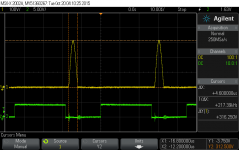
Point is, the pulse is narrower, just 4.6us. That's actually really good news because it means that this yoke should be able to handle much higher scan frequencies where the retrace period is shorter.
The next step is to fix the horizontal offset. It could be from DC current but more likely it's just about the timing of the sync signal versus the video. (This is how horizontal centering is adjusted on the later Classic analog boards.)
That's where I've gotten to for the moment. Now obviously I haven't actually changed the screen resolution, which is the whole point. But between the yoke and the flyback transformer, the latter is clearly the more temperamental part to deal with. Now that they're decoupled, it should be a more straightforward path to driving the horizontal deflection coil at whatever frequency we want.
The yoke coil measured around 80uH and the width coil just over 20uH, so I connected the new inductor to replace them both. This frees up the width coil to be used in the yoke driver circuit. Now powering up the Mac, the vertical line is sharper, brighter and about the right size:
That's a good sign! The signals on the analog board also look normal again. So now bringing the voltage up on the yoke driver circuit, the image starts to emerge:
Except for the horizontal offset, it looks great. (The diagonal stripe is the usual camera artefact.) It's even in good focus without touching any of the adjustments.
Now that the HV is back to normal levels, it takes a larger supply voltage to get enough width on the screen. The adjustable power supply I was testing with maxes out at 20V, which is what produces the second image above. The current consumption is about 350mA = 7W to drive the yoke. Since the transistor shouldn't be absorbing much at all, it stands to reason that most of that gets dissipated in the yoke itself. I'm not about to touch it when it's running to see if it gets warm though!
On the other hand, the 100uH inductor does get quite warm-- not burning hot, but hotter than I'd like to run it with the case shut. I may have to look for an even higher-current replacement.
And here's what the pulse on the yoke driver circuit looks like now. I replaced C12 in that circuit with a smaller capacitor for testing (well okay, I've temporarily lost the original C12 somewhere in a pile of parts...
).Point is, the pulse is narrower, just 4.6us. That's actually really good news because it means that this yoke should be able to handle much higher scan frequencies where the retrace period is shorter.
The next step is to fix the horizontal offset. It could be from DC current but more likely it's just about the timing of the sync signal versus the video. (This is how horizontal centering is adjusted on the later Classic analog boards.)
That's where I've gotten to for the moment. Now obviously I haven't actually changed the screen resolution, which is the whole point. But between the yoke and the flyback transformer, the latter is clearly the more temperamental part to deal with. Now that they're decoupled, it should be a more straightforward path to driving the horizontal deflection coil at whatever frequency we want.