Mail Router 110t

Mail Router
Communication · v110t
| Filename | mail-router-110t.hqx |
|---|---|
| Size | 207.2 KB (212209 bytes) |
| Mac OS | System 7Mac OS X |
| Architecture | PowerPC68K |
| Downloads | 15 |
Enjoying MacTrove?
Anonymous downloads are free and unlimited.
Create a free account to track favorites,
contribute metadata corrections, and join the
community chat.
About
Name of software: Avalonia MailRouter Version: 1.10 (trial version) Author: Bo Holst-Christensen, Cutisan Laboratorium A/S Category: Internet software, server extension Function: Extension to Apples Internet Mail Server. Used for forwarding and redirecting electronic mail. License payment: 1 copy - US$30, 1 site - US$75, world wide - US$150.
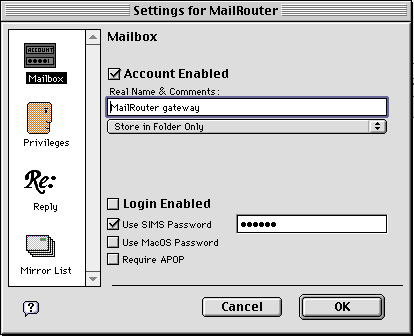
The Avalonia MailRouter is an extension to mail servers such as Apples Internet Mail Server (AIMS), Eudora Internet Mail Server (EIMS) or Stalker Internet Mail Server (SIMS). It is supposed to be running in the background on the same machine as the mail server, without taking more of the CPU and memory than absolutely needed.
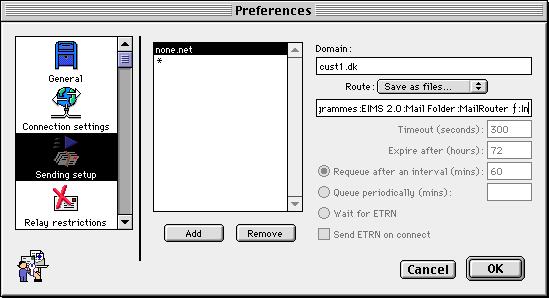
By using Avalonia the mail server is extended with functionality to handle many domains on one single machine. Apart from assigning mailboxes to each user on the different domains, MailRouter can also redirect mail based on account or domain names, handle subdomains, divide users on a big domain to a set of servers and handle unregistered addresses.
This package contains a trial version of the application that will allow you to try out all features. To obtain a full version of the Avalonia MailRouter a license fee must be payed:
- To run a single copy of MailRouter on a single machine, the fee is US$30. - To run an unlimited amount of copies of MailRouter on machines placed at a single physical location, the fee is US$75. - To run an unlimited amount of copies of MailRouter on machines inside the same organisation, placed anywhere in the world, the fee is US$150.
To run MailRouter, you need a copy of AIMS (preferably version 1.1.1 or newer), EIMS or SIMS running on a machine with at least a 68030 or a PowerPC. For best results the machine should be running MacOS System 7.5.5 or newer. Memory usage, depending on the amount of addresses handled: 110-500 KB.
Screenshots
File Info
Original Source: info-mac
This file is part of the MacTrove archive. See the Thank You page for the upstream mirrors we rely on. It is BinHex encoded. Use The Unarchiver to decode it.