

Thread
Repairing SE/30 battery acid damage... what's on D1 and D2, and crystal speed?
I have an SE/30 motherboard that had a battery explode on it. After initial cleanup and removal of the battery holder, it doesn't look too bad. Looks to be very repairable. Nothing looks to be completely eaten away. Some solder has corroded, a little bit of copper is showing in a couple places (but not broken or eaten through.) I'm going to give it a good scrub with some baking powder later on to make sure all the acid is neutralized, then give it a good clean. However, some surface mount components had apparently come off and I don't know what they are.
Does anyone know what I need at D1 and D2? And what speed crystal that can is? I think that's K1. If I have to replace UK4, I'm sure I can look up the part by the number on there.
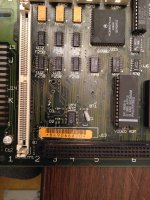
Does anyone know what I need at D1 and D2? And what speed crystal that can is? I think that's K1. If I have to replace UK4, I'm sure I can look up the part by the number on there.
All my can says is: F1 JAPAN.
D1 & D2 transistors: 5 D
D1 & D2 transistors: 5 D
You need to check the traces and resolder the chips on UI2 - UI4, UJ2 - UJ6, and UK4.
The chips should still be good themselves, but the corroded solder on them needs to be removed and replace and their traces checked out.
D1 & D2 are diodes though they look like transistors. It is the same ones used in the Mac II series D2 - D6 (see bottom right side of this Mac IIfx schematic):

The chips should still be good themselves, but the corroded solder on them needs to be removed and replace and their traces checked out.
D1 & D2 are diodes though they look like transistors. It is the same ones used in the Mac II series D2 - D6 (see bottom right side of this Mac IIfx schematic):
Any idea about the crystal?
the cool thing is none of that is needed to test functionality of the machine... just the Clock will not work.
power it up and see if it boots.
power it up and see if it boots.
Yeah, I was working on one earlier which was in similar condition (partial battery explosion)... until I made it worse 
I stupidly put my new SMD rework wand thingy over that area and put a big scorch mark there, basically destroying the traces for D1 and D2 in the process. I'm sure that the connections can be retraced and rework wires ran to new transistors, but still.... the stupidity!
Lesson learned: don't hold hot air in one spot too long (duh!)
</rant>
Anyway, best of luck there, oP! I might be able to apply what you're doing to my board, but I fear that there might be other stuff wrong (it simasimac-ed right off, so I don't know what else could be wrong.
Probably best to write mine off as a parts board at this rate, since I (luckily!) have a couple spares available to take its place.
c
I stupidly put my new SMD rework wand thingy over that area and put a big scorch mark there, basically destroying the traces for D1 and D2 in the process. I'm sure that the connections can be retraced and rework wires ran to new transistors, but still.... the stupidity!
Lesson learned: don't hold hot air in one spot too long (duh!)
</rant>
Anyway, best of luck there, oP! I might be able to apply what you're doing to my board, but I fear that there might be other stuff wrong (it simasimac-ed right off, so I don't know what else could be wrong.
Probably best to write mine off as a parts board at this rate, since I (luckily!) have a couple spares available to take its place.
c
Ive fixed a couple of battery eaten boards. Not fun. Both cases needed extensive via rework.
I agree - that looks like the timebase for the real-time clock. Should be pretty easy to find a replacement, the Sparkfun crystal that 360alaska linked should work, or get it at DigiKey along with your other replacement parts.
Elfen, how did you know D1 and D2 are diodes? Just from prior experience troubleshooting SE/30's? I guess since their names begin with D, that's a good clue too.
 If that is a SOT-23 sized footprint, then these diodes may work as replacements: http://www.digikey.com/product-detail/en/BAS16-TP/BAS16TPMSCT-ND/717314
I would be nervous about traces that have been eaten through with defects that are too small to see, or are even inside a via or inside one of the inner board layers. It would stink to replace all the components and have the board still not work.
Also, I'm thinking that crystal is probably Y1, not K1. I just found this explanation of board designators, which clarifies a lot of what I'd seen on various other boards.
OK, thanks guys. I'll stop by the parts store on my way home, pick up the components I need and cross my fingers. Also need to pick up a hard toothbrush and some baking soda.
I have both a (non-working) SE/30 and a (recapped and working) Mac IIfx. I noticed the similarities of the part on both machines and remembered that the Mac IIfx board/schematics and the SE/30 has them as 5D. 5D turns out to be on a 3 legged diode where two legs is the diode and the third is not connected - according to the IIfx startup schematics, a MMBD914.Elfen, how did you know D1 and D2 are diodes? Just from prior experience troubleshooting SE/30's? I guess since their names begin with D, that's a good clue too.
The part you listed should work, though Digikey has the diode in question, cheaper too (by 7¢):
http://www.digikey.com/product-detail/en/MMBD914-7-F/MMBD914-FDICT-ND/717888?WT.srch=1&WT.medium=cpc&WT.mc_id=IQ59989283-VQ2-g-VQ6-40609413315-VQ15-1t2-VQ16-c
Well, I can pick them up for about a penny at my local store + the cost of gas. Assuming they have them (which is likely, they have a lot of stuff.)
CC_333 and mori512k can attest to that.
CC_333 and mori512k can attest to that.
Thumbs up to that! Nothing beats "Pennies and the cost of gas" pricing!
Speaking of gas and pricing, there's a local gas station that's advertising $0.00!
Unfortunately, there was a fire recently and they're closed. But still... that price is, well, priceless!
Anyway, I can attest to those prices. A whole bag of capacitors that would've cost me well over $100 I managed to get there for ~$50.
I must go back sometime!
c
Unfortunately, there was a fire recently and they're closed. But still... that price is, well, priceless!
Anyway, I can attest to those prices. A whole bag of capacitors that would've cost me well over $100 I managed to get there for ~$50.
I must go back sometime!
c
Yep. I dropped $20 or so on over 200 caps of various capacity. Would have cost me over $100 through Mouser or Digikey. Hard to beat.
What brand and date code?
Don't know the brand. Yellow tantalum. Stopped by today. They had a bunch of diodes, but not the one I needed. 
Coming along. Gave it a bath and scrubbed it with baking soda, hopefully neutralized the acid. The solder pads are completely missing for D1. I can see where the traces are for the top and left pad, but not the right pad. Not sure how I'm going to fix that. Resoldered all those tiny chips, too. Acid got into the ROM SIMM socket, so I'm going to have to replace it. I'm hoping the PDS slot is clean. Can't tell... I just don't want to replace it. :-/
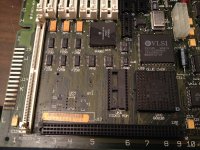
I also cleaned and retinned the pads on the ROM itself. The acid had eaten the contacts down to copper, but it took the solder just fine.
The big thing is going to be patching all the dead vias/open connections.
I don't know where the hell this pad goes. I've scratched away most of the PCB and I can't find any other trace. Anyone have any idea?
View attachment 4899
View attachment 4899
If its a diode, it may not go anywhere.
Its a diode, part of the startup/battery/PRAM circuitry. The third pad goes nowhere.
oldPigeon - hope this helps:

I verified it with my SE/30 board.
What worries me is all that corrosion on the chip and other areas. They can be part of the problem.
oldPigeon - hope this helps:
I verified it with my SE/30 board.
What worries me is all that corrosion on the chip and other areas. They can be part of the problem.
Not to Spam the board...
Managed to get a ID number off the crystal on my SE/30 board. It is: S3238E
Cant seem to get a frequency for it on Google. That number is linked to a lot of other things, including some part on a Lexus Automobile. Jeesh...
Managed to get a ID number off the crystal on my SE/30 board. It is: S3238E
Cant seem to get a frequency for it on Google. That number is linked to a lot of other things, including some part on a Lexus Automobile. Jeesh...
My googling came up with 32.768 kHz, which is what I replaced it with.
Unfortunately it still doesn't boot, so I may send it to Uniserver. I don't have the tools to check traces or anything. I did what repairs I could based on a visual inspection.
Unfortunately it still doesn't boot, so I may send it to Uniserver. I don't have the tools to check traces or anything. I did what repairs I could based on a visual inspection.
As I figured