

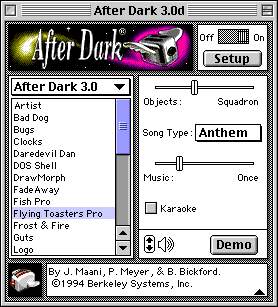
After Dark 3.0
| Filename | after_dark_3.0.sit |
|---|---|
| Size | 2,781.0 KB (2847793 bytes) |
| Year | 1994 |
| Developer | Berkeley Systems |
| Mac OS | Mac OS 9 |
| Downloads | 21 |
After Dark 3.0 is the 1993 release of Berkeley Systems' iconic Macintosh screensaver suite, a collection of animated modules that took over the screen during idle time and turned the once-dull task of CRT phosphor protection into a playful desktop spectacle synonymous with 1990s personal computing.
Modules
Version 3.0 bundled dozens of screensavers, headlined by the legendary Flying Toasters: chrome 1940s-style toasters with bird-like wings drifting across the screen alongside slices of toast. Other crowd favorites included Fish!, Lunatic Fringe, Mowin' Man, Hall of Mirrors, Rose, Stained Glass, and Daredevil Dan, plus an extensible architecture that let third-party developers ship hundreds more.
Engine
The After Dark engine ran modules as small executable plug-ins, scheduling them through the Mac's idle-time hooks and supporting password locking, randomized rotation, sound, and SystemIQ behaviors that paused or threw modules in response to user activity. Version 3.0 fully embraced 256-color palletized video and tighter PowerBook compatibility.
Development
After Dark was created at Berkeley Systems by engineers including Jack Eastman and Patrick Beard, with Ed Fries contributing the Fish! module before joining Microsoft. Berkeley Systems' founders Joan Blades and Wes Boyd later launched MoveOn.org. The company expanded the line with themed editions covering Star Trek, The Simpsons, Looney Tunes, Marvel, and Disney, and was acquired by Sierra On-Line in 1997.
Reception
After Dark became one of the best-selling Mac utilities of its era, with Flying Toasters entering popular culture as shorthand for the 1990s desktop. Its imagery was contested in court more than once, including a 1994 Jefferson Airplane suit dismissed for lack of trademark registration and a 1993 Delrina dispute over a screensaver depicting Opus the penguin shooting toasters down.
Original Source: macgarden
This file is part of the MacTrove archive. See the Thank You page for the upstream mirrors we rely on. It is a StuffIt/Compact Pro archive. Use The Unarchiver to extract it.


