Home Documents Lisa Atkinson LISA User Interface Standards
Atkinson LISA User Interface Standards

Atkinson LISA User Interface Standards
Lisa · 1980 · PDF
FilenameAtkinson_-_LISA_User_Interface_Standards_198009.pdf
Size0.84 MB
Year1980
Subsection development_history / memos
Downloads4
Enjoying MacTrove? Anonymous downloads are free and unlimited. Create a free account to track favorites, contribute metadata corrections, and join the community chat.
Reader
Atkinson LISA User Interface Standards
/
Loading…
OCR / Text contents
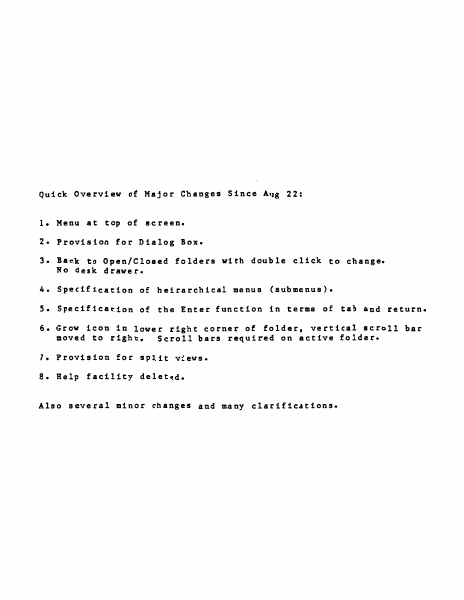
Quick Overview of Major Changes Since Aug 22: 1. Menu at top of screen. 2. Provision for Dialog Box. 3. Back to Open/Closed No desk drawer. fold~rs with double click to change. 4. Specification of heirarchical menus (submenus). S. Specification of the Enter function in terms of tab and return. 6. Grow icon in lower right corner of folder, vertical scroll bar moved to right. Scroll bars requi~ed on active folder. 7. Provision for split views. 8. Help facility deleted. Also several minor changes and many clarifications. TABLE .QI. CONTENTS o. Introduction • • • • • • • • • • • • • • • • • • • • • • • • • • 2. Mouse and Cursor • • • • • • • • • • • • 3. Pointing, Clicking, and Dragging • • • 4. Keyb card • • • • • • • • • • • • • • • • s. Memory • • • • • • • • • • • • • • 6. Mass Memory • • • • • • • • • • • • • 7. Initialization • • • • • • • • • • 8. In Everyday Operation • • • • • • • • • 9. What the Screen Looks Like • • • • • • • •••••••••••••• 10. Folders • 11. Basic Folder Appearance • • • • • • • • 1 • Display . 12. 13. 14. 15. 16. 1 7. 18. 19. 20. 21. 22. 23. 24. 25. 2 6. 2 7. 28. 29. 30. 31. 3 2. 33. 34. 35. 3 6. 3 7. 38. 39. 40. 41. 42. 43. 44. 45. 46. 4 7. 48. 49. so. 51. • • • • • • • • • • • • • • • • • • • • • • • • • • • • • . ' • •· • • • • • • • • • • • • • • • • • • • • • • • • • • • • • • • • • • • • • • • • • • • • • • • • • • . . • .. . . .. • • • • • • • • • • Open and Closed Folders ••• • •••• • The System Font •••••••••••• • The Active Folder • • • • • • • • • • • • Making a Folder Active • • • • • • • Moving a Folder •• . • • • • • • • • • • Growing the Active Folder , • • • • • • • • Scrolling ••••••••••••••• • How to,Scroll • • • • • • • • Split Views • • • • ••••••••• • The Selection • • • • • • • • • • • • • • Visibility of Operations on Selections • • Marking a Selection • • • • • • • • • • • The Menu Bar • • • • • • • • • • • • • • Making a Menu Choice • • • • • • • • • • • Menu Items that Do Nothing • • • • • • • • Contents of the Menu.Bar and Menus • • • • Making Menu Choices From the Keyboard • • The Dialog Box •••••••••••• • Text Editing Philosophy • • • •• • Typing Printing Characters • • • •• • Keys that Alter the Meaning of Other Keys Shift • • • • • • • • • • • • • • • Alpha Lock • • • • • • • • • • • • • • • • Apple Key • • • • • • • • • • • • • • Code • • • • • • • • • • • • • • • • • Repeating Keys • • • • • • • • • • • • • Type Ahead • • • • • • • • • • • Backspace •••• • • • • • • • • The Backspace Buff er • • • • • • Tab • • • • • • • • • • • • • Return • • • • • • • • • • • • • • • • • • the Edit Menu • • • • • • • • • • • • Cut • • • • • • • • • • • • • • • • Paste • • • • • • • • • • • • • Copy • • • • • • •. • • • • • • • Undo • • • • • • • • • • • • • • • Utility Documents and Folders • • • • • • The Scrap ••• • • • • • • • • • • • The Abbreviation Folder • • • • • • • • The User Profile Folder • • • • • • • • • ... .. • • • • • • • • • • • • • ..... • • • • • • • • • • •…

Showing first 3,000 characters of 39,339 total. Open the full document →
Home Documents Lisa Kato Lisa Hardware
Kato Lisa Hardware

Kato Lisa Hardware

Lisa · 1983 · PDF
FilenameKato_-_Lisa_Hardware_19851012.pdf
Size7.43 MB
Year1983
Subsection development_history / memos
Downloads3
Enjoying MacTrove? Anonymous downloads are free and unlimited. Create a free account to track favorites, contribute metadata corrections, and join the community chat.
Reader
Kato Lisa Hardware
/
Loading…
OCR / Text contents
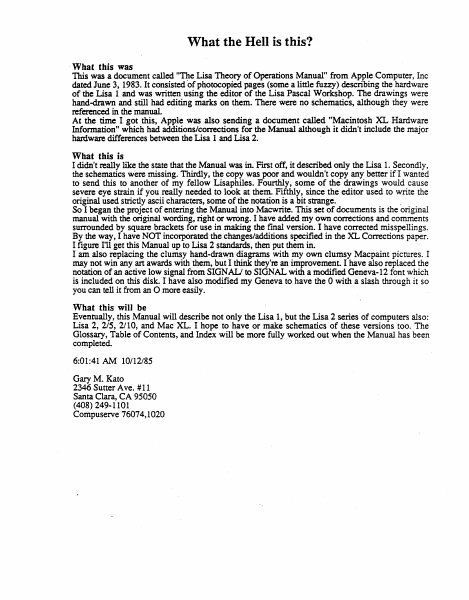
What the Hell is this? · What this was This was a document called "'nte Lisa Theory of Operations Manual" from Apple Computer, Inc dated June 3, 1983. It consisted of photocopied pages (some a little fuzzy) describing the hardware of the Lisa 1 and was written using the editor of the Lisa Pascal Workshop. The drawings were hand-drawn and still had editing marks on them. There were no schematics, although they were referenced in the manual. At the time I got this, Apple was also sending a document called "Macintosh XL Hardware Information" which had additions/corrections for the Manual although it didn't include the major hardware differences between the Lisa 1 and Lisa 2. , What this is I didn't really like the state that the Manual was in. First off, it described only the Lisa 1. Secondly, the schematics were missing. Thirdly, the copy was poor and wouldn't copy any better if I wanted to send this to another of my fell ow Lisaphiles. Fourthly, some of the drawings would cause severe eye strain if you really needed to look at them. Fifthly, since the editor used to write the original used strictly ascii characters, some of the notation is a bit strange. . So I began the project of entering the Manual into Macwrite. This set of documents is the original manual with the original wording, right or wrong. I have added my own corrections and comments surrounded by square brackets for use in making the final version. I have corrected misspellings. By the way, I have NOT incorporated the changes/additions specified in the XL Corrections paper. I figure I'll get this Manual up to Lisa 2 standards, then put them in. I am also replacing the clumsy hand-drawn diagrams with my own clumsy Macpaint pictures. I may not win any art awards with them, but I think they're an improvement I have also replaced the notation of an active low signal from SIGN ALJ to SIGNAL with a modified Geneva-12 font which is included on this disk. I have also modified my Geneva to have the 0 with a slash through it so you can tell it from an 0 more easily. · What this will be Eventually, this Manual will describe not only the Lisa 1, but the Lisa 2 series of computers also: Lisa 2, 215, 2/10, and Mac XL. I hope to have or make schematics of these versions too. The Glossary, Table of Contents, and Index will be more fully worked out when the Manual has been completed. · 6:01:41 AM 10112185 Gary M. Kato 2346 Sutter Ave. # 11 Santa Clara, CA 95050 (408) 249-1101 Compuserve 76074, 1020 Lisa Hardware Manual Lisa Theory of Operations [Let's use the Lisa script here! - gk] WARNING: This equipment has been certified to comply with the limits for a Class 8 computing device, pursuant to Subpart J of Part 15 of FCC rules. Only peripherals (computer input/output devices, terminal, printers, and the like) certified ·to comply with the Class B limits may be attached to this computer. Operation with noncertified peripherals is likely to result in interference to radio and TV reception. © Apple…

Showing first 3,000 characters of 276,093 total. Open the full document →

Home Documents Lisa Craig The Legacy Of The Apple Lisa Personal Computer An Outsiders View
Craig The Legacy Of The Apple Lisa Personal Computer An Outsiders View

Craig The Legacy Of The Apple Lisa Personal Computer An Outsiders View

Lisa · 1993 · PDF
FilenameCraig_-_The_Legacy_of_the_Apple_Lisa_Personal_Computer_-_An_Outsiders_View_199302.pdf
Size0.16 MB
Year1993
Subsection development_history / articles
Downloads3
Enjoying MacTrove? Anonymous downloads are free and unlimited. Create a free account to track favorites, contribute metadata corrections, and join the community chat.
Reader
Craig The Legacy Of The Apple Lisa Personal Computer An Outsiders View
/
Loading…
OCR / Text contents
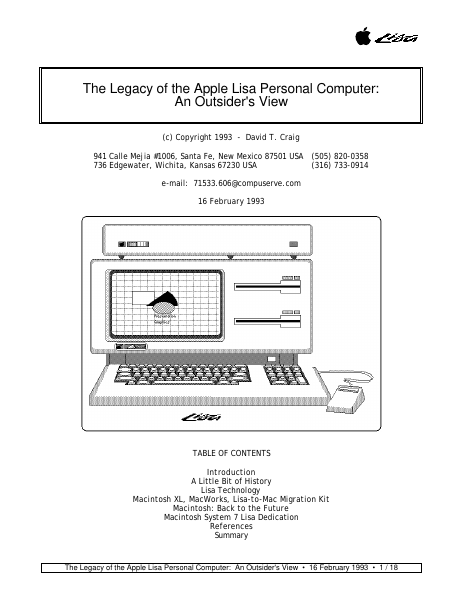
The Legacy of the Apple Lisa Personal Computer: An Outsider's View (c) Copyright 1993 - David T. Craig 941 Calle Mejia #1006, Santa Fe, New Mexico 87501 USA (505) 820-0358 736 Edgewater, Wichita, Kansas 67230 USA (316) 733-0914 e-mail: 71533.606@compuserve.com 16 February 1993 TABLE OF CONTENTS Introduction A Little Bit of History Lisa Technology Macintosh XL, MacWorks, Lisa-to-Mac Migration Kit Macintosh: Back to the Future Macintosh System 7 Lisa Dedication References Summary The Legacy of the Apple Lisa Personal Computer: An Outsider's View • 16 February 1993 • 1 / 18 • INTRODUCTION • This paper is an attempt by a long time Lisa user to clarify the significance of the Apple Lisa personal computer for the computing industry. The audience of this paper is anyone who has an interest in innovative computing technology and wants to learn a little about Apple Computer's brief foray into this area via the Lisa computer. This paper hopes to show why the Lisa was significant in its time and how some of what was called "Lisa Technology" is slowly migrating to other computer systems, mainly the Apple Macintosh computer series. The author has never worked for Apple and as such is not privy to any insider secrets about this machine. All facts contained herein were obtained from Apple's cornucopia of Lisa literature, Apple's Macintosh literature, discussions with other Lisa owners, and my personal involvement with and close observations of both machines since 1984. This paper is loosely based upon the excellent article "The Legacy of the Lisa" (MacWorld magazine, Sep. 1985) as written by Mr. Larry Tesler, one of the Lisa's main designers and currently a key technologist at Apple Computer. • A LITTLE BIT OF HISTORY • Apple began developing the Lisa computer in 1979. The Lisa charter was to build a revolutionary computer that was truly easy to use and thereby mitigate the limitations of existing computers. Developing a computer which was an order of magnitude easier to use than traditional computers required several major departures. The name "Lisa" has always been rather enigmatic for most computer users, including Lisa owners. To set the story straight (as far as I know) here are the facts behind the name "Lisa". Officially, Apple states that "Lisa" stood for Local Integrated Software Architecture. Unofficially, "Lisa" has been associated with the name of a child fathered by one of the Lisa designers (this may be the same person who is now head of Next Computer, Inc., Mr. Steve Jobs). The Lisa had several design goals: o o o o o o o Be intuitive, be consistent, conform to the ways people actually work, have enough performance to do the jobs that need doing, provide an open software and hardware architecture, be reliable, be pleasing and fit into an everyday work environment. The Lisa was built upon sophisticated hardware technology. This included a compact desktop unit containing a 12 inch black-and-white screen, and two revolutionary floppy disk driv…

Showing first 3,000 characters of 55,982 total. Open the full document →

Home Documents Lisa Hawkins Lisa Marketing Requirements Document
Hawkins Lisa Marketing Requirements Document

Hawkins Lisa Marketing Requirements Document

Lisa · 1994 · PDF
FilenameHawkins_-_Lisa_Marketing_Requirements_Document_198004.pdf
Size3.42 MB
Year1994
Subsection development_history / memos
Downloads4
Enjoying MacTrove? Anonymous downloads are free and unlimited. Create a free account to track favorites, contribute metadata corrections, and join the community chat.
Reader
Hawkins Lisa Marketing Requirements Document
/
Loading…
OCR / Text contents
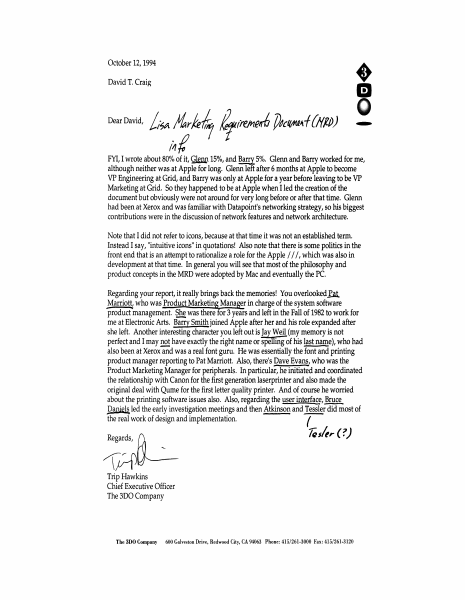
October 12, 1994 David T. Craig Dear David, Jt?A fkr 1~f fe' t,rl'ffrleJ ~clft#U~f{f(IP) •m0 FYI, I wrote about 80% of it, ~ 15%, and Bar:r 5%. Glenn and Barry worked for me, although neither was at Apple for long. Glenn left after 6 months at Apple to become VP Engineering at Grid, and Barry was only at Apple for a year before leaving to be VP Marketing at Grid. So they happened to be at Apple when I led the creation of the document but obviously were not around for very long before or after that time. Glenn had been at Xerox and was familiar with Datapoint's networking strategy, so his biggest contributions were in the discussion of network features and network architecture. Note that I did not refer to icons, because at that time it was not an established term. Instead I say, "intuitive icons" in quotations! Also note that there is some politics in the front end that is an attempt to rationalize a role for the Apple I I/, which was also in development at that time. In general you will see that most of the philosophy and product concepts in the MRD were adopted by Mac and eventually the PC. Regarding your report, it really brings back the memories! You overlooked.fat Marriott, who was Product Marketing_Manager in charge of the system software product management. ~was there for 3 years and left in the Fall of 1982 to work for me at Electronic Arts. Barry Smith joined Apple after her and his role expanded after she left. Another interesting character you left out is Jay W~(my memory is not perfect and I may !!Q! have exactly the right name or spelling of his last name), who had also been at Xerox and was a real font guru. He was essentially the font and printing product manager reporting to Pat Marriott. Also, there's Dave Evans, who was the Product Marketing Manager for peripherals. In particular, he initiated and coordinated the relationship with Canon for the first generation laserprinter and also made the original deal with Qume for the first letter quality printer. And of course he worried about the printing software issues also. Also, regarding the user interface,~ panie~ led the early investigation meetings and then Atkinson and Tessler did most of the real work of design and implementation. { Tes/tr(?} Trip Hawkins Chief Executive Officer The 3DO Company The 3DO Company 600 Galveston Drive, Redwood City, CA 94063 Phone: 415/261-3000 Fax: 415/261-3120 LISA M.'\RKETING REQUIRE."'1E~TS DOCUMENT APRIL 18, 1980 TRIP HAWKINS GLENN EDENS BARRY MARGERUM coNnDDmAL LISA MARKETING REQUIREMENTS DOCUMENT INDEX l EXECUTIVE SUMMARY •• , •••••••••••••••••••••••••••••••••••••••.•• , • • • • • • • • • . 1 2 PROJECT IDENTIFICATION ••••..••••••••••••••••••••••••••••••••••••••••••• , • 2 3 PRODUCT CONTRIBUTIONS ••••••••••••••••• , •••••••••••••••••••••••-.- • • • • • • • • • • 3 4 RELATIONSHIP TO OTHER APPLE PRODUCTS .••.••.•••••.••••...•••.. ~ •.••.•••••. 4 4.1 The Road To The Office Of The Future .•.•••....•....•.•.•••.•..•.....…

Showing first 3,000 characters of 141,838 total. Open the full document →

Home Documents Lisa Craig The Lisa Computer A Retrospective CHAC V2N1
Craig The Lisa Computer A Retrospective CHAC V2N1

Craig The Lisa Computer A Retrospective CHAC V2N1

Lisa · 1993 · PDF
FilenameCraig_-_The_Lisa_Computer_a_Retrospective_CHAC_V2N1_199407.pdf
Size2.38 MB
Year1993
Subsection development_history / articles
Downloads3
Enjoying MacTrove? Anonymous downloads are free and unlimited. Create a free account to track favorites, contribute metadata corrections, and join the community chat.
Reader
Craig The Lisa Computer A Retrospective CHAC V2N1
/
Loading…
OCR / Text contents
Page 18 The Analytical Engine July-September 1994 THE APPLE LISA COMPUTER: A RETROSPECTIVE (c) Copyright 1993 • David T. Craig1 CIS 71533,606 INTRODUCTION This paper is an attempt by a long-time Lisa user to clarify the significance of the Apple Lisa personal computer for the computing industry. The audience is anyone who has an interest in innovative computing technology, and wants to learn a little about Apple Computer's brief foray into this area via the Lisa computer. This paper hopes to show why the Lisa was significant in its time, and how some of what was called "Lisa Technology" is slowly migrating to other computer systems, notably the Apple Macintosh computer series. The author has never worked for Apple, and so is not privy to any "insider secrets" about this machine. All information contained herein was obtained from Apple's cornucopia of Lisa and Macintosh literature, from discussions with other Lisa owners, and through my personal involvement with and observation of both machines since 1984. This paper is loosely based upon the excellent article "The Legacy of the Lisa" (MacWorld magazine, Sep. 1985) as written by Mr. Larry Tesler, one of the Lisa's main designers and currently Chief Scientist at Apple Computer. A LITTLE BIT OF HISTORY Apple began developing the Lisa in 1979. The Lisa's charter was to build a revolutionary device that was truly easy to use, and thereby mitigate the limitations of existing computers. Developing a computer which was an order of magnitude easier to use than traditional computers required several major departures, not all of which were obvious. Even the name "Lisa" has always been rather enigmatic for most computer users, including Lisa owners. To set the story straight (as far as I know) here are the facts: Officially, Apple states that "Lisa" stood for "Local Integrated July-September 1994 The Analytical Engine Software Architecture." Unofficially, "Lisa" has been associated with the name of a child fathered by one of the Lisa designers.2 The Lisa had several design goals: * Be intuitive, * be consistent, * conform to the ways people actually work, * have enough performance to do the jobs that need doing, * provide an open software and hardware architecture, * be reliable, * be pleasing, and * fit into an everyday work environment. The Lisa was based on sophisticated hardware technology. The single compact desktop unit contained a 12-inch black-and-white screen, and two revolutionary floppy disk drives called "Twiggy" - after the English supermodel of the day, because she, and they, were so thin. The Lisa contained a Motorola 68000 processor and 1 megabyte of memory, expandable to 2 megabytes. Cabled to the Lisa's case were a keyboard, and a (then) uncommon peripheral called a "mouse," which was a key element of the Lisa's design. Apple introduced the Lisa to the general public in January 1983 at a price of $9,995. In April 1985, after only one and a half years, Apple discontinued the Lisa i…

Showing first 3,000 characters of 49,998 total. Open the full document →

Subscribe to development_history
mp.ls