

Thread
Identify this Board!
Does anyone know what the heck this is?? I am trying to find drivers for this accelerator board, but have no idea what it is.. The S/N is blank, and it has no writing on it that can identify it.. Plus it has these odd wires and orange chip looking thing on the back side...
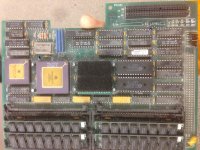
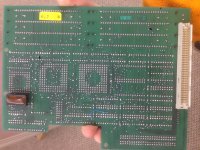
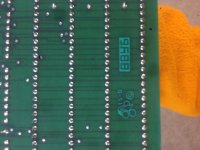
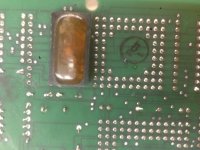
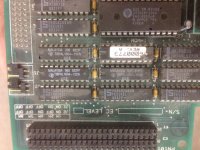
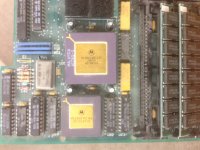
looks like a cpu / memory upgrade for an Mac Se.
might not need drivers... might be just a pop on and go.
well i tried messing around with it, the board includes spots for 2 rom chips, so I have the rom chips in the regular board AND in this board, plus ram in each board..
Should I be removing the ram/rom chips from the main board and only using them in the accelerator? It does boot up but I am not sure how I can tell if it is working
Should I be removing the ram/rom chips from the main board and only using them in the accelerator? It does boot up but I am not sure how I can tell if it is working
Nope, gotta shut down the 68000 at boot. Check NuBus Mafia over on 'fritter and have the Duck go to Gemini+Accelerator at a rough guess. Somebody OEM'd those in 68020/68030 for several direct marketing outfits back around 1990.
that is a pretty good question.
https://drive.google.com/folderview?id=0B49Tq8u-p8sKRjhwZ3l6clJkcjA&usp=sharing
dl this and run system info.
https://drive.google.com/folderview?id=0B49Tq8u-p8sKRjhwZ3l6clJkcjA&usp=sharing
dl this and run system info.
I had a board that looked very similar to that. It was called 'Orion' by MacPeak systems.
This didnt really make sense to me. So you are saying that I have to keep ram/rom in both boards correct?? No idea what that second sentence means..

when you run system info, if it says you have a 68020 and FPU installed then you know its working.
Yuppers
System Info Says
Test CPU: 68020 @ 16mhz
Test Display : Built-in Video (1 bit)
Test Volume: Hard Drive
Test FPU: Software
Does that mean everything is working?? What is FPU?
System Info Says
Test CPU: 68020 @ 16mhz
Test Display : Built-in Video (1 bit)
Test Volume: Hard Drive
Test FPU: Software
Does that mean everything is working?? What is FPU?
I have one of these. Good info in this thread. I never tried using it yet.
Havent gotten more than 4mb to work in it though... still trying to figure it out.. I know I have more than 4mb in both boards... so idk
I used to have a Novy Quick 30 that had extra RAM and you had to use Connectix Virtual to get the extra RAM to work.
You can find Conectix Compact Virtual 3.0.2 over on Gamba's page
http://home.earthlink.net/~gamba2/71more.html
http://home.earthlink.net/~gamba2/71more.html
Great, ill play around with it.. Connectix Compact Virtual sounds more like Virtual Ram and not enabling ram, but will check it out
It was , but it worked with on-board memory on some accelerator cards. It's worth a try.
I do not understand, Virtual ram is ram on HD, I can 't see why to activate real ram with virtual ram ...
I suppose this card is for multiprocessing, maybe photoshop acceleration
If you do not get the soft to use it, it will stay in a cloud (an old one)
the principle is the same as for the PC cards on mac or Dos cards on Ap
It says FPU : Software
There is a 68881 on that board.....
ple II
It can be a transwarp or a gemini card...
Connectix virtual will access the onboard ram and fpu
I dug out my card and had a look. It has the SE Superdrive ROMs. All RAM sockets are full, but not sure what is in them. The jumpers on my for selecting RAM sizes are missing. Your board and mine look identical except my CPU/crystal is rated at 20mhz.
By the way, is your board warped? Mine has a nasty bend to it.
Related, but not the same card. Its crazy how many accelerators there were out there. Many for the SE.
Did you folks figure out which one is in the OP yet? Some of these cards were done in 68020, 68020/68030 and 68030 versions. Macs cost a fortune, all really capable computers did in that time frame. Macs held their resale value well and there was a ready market for upgrades in order to get the RAM starved, slotless Compacts up to the task of early DTP production.
It was a great time!
It was a great time!
So it has a "Floating Point Processor" for calculations eh? what does it normally say? under FPU? How can I test it?
Also I need to check a disk (or repair it, scsi hdd) what's a good program and where can I get it? I was looking for Norton Disk Doctor because I remember using that in the past. Suggestions?
I only installed mine a few times because I felt that it did not fit into the SE case properly. You had to force it in and when it was in did looked warped.
These upgrade cards provide more RAM than the host machine allows. The host machine has an address/memory map built into its ROMs which controls where everything can be in address/memory space. This memory map has no provision for the extra memory that these upgrades provide.
So, the upgrade treats the extra memory as a RAM Disk, without ever being RAM. Then the Virtual software converts the RAM disk into virtual memory. So in a backwards way, the machine sees the extra memory as disk space, then uses a form of virtual memory to treat the disk space as RAM/memory and hence the extra memory is converted into usable memory in a round-a-bout way.