

Thread
Larger CRTs on Early Compacts


Whoops, sorry I didn't catch that before. Yeah that is way too far from the Mac's 22.x kHz for reusing the existing TRS analog board.
Yeah, I was wondering where you'd read a followup that said more than that, but this "success" doesn't negate the general point that it's not something you can count on.
It's certainly *possible* that if you threaded a Mac Plus analog board's yoke onto a randomly chosen 12" CRT it would produce a usable picture. But it has to be noted that the compact Mac analog board is also fairly notorious for being sort of marginally spec'ed for the job it does with the *stock* CRT so even if nothing else goes wrong the additional load from driving a bigger CRT might badly shorten its lifespan. Said analog board is also lacking in pots to adjust items like linearity, so if there's any distortion on the larger monitor (which is a distinct likelyhood unless you use a tube with exactly the same deflection angle and screen curvature of the smaller CRT) they'll be no way to fix it without component swaps. Even in the text for the PMGSP he admits that he never quite got the geometry right because he "used up" all the available range, IE: "The display is sharp and clear, but fails to use the full width of the screen...", in the adjustment available on the mono monitor's board, and the pictures do seem to back up that it's a little vertically stretched.
Having an "imperfect" screen certainly might be acceptable for someone building a "hackmac" for shock value; heck, it might even be cyberpunk-ish desirable if you call the thing an art project, but... still, at the very least someone embarking on this should at least *attempt* to know what they're doing beyond "The sockets match and I heard about some guy who did the opposite and it worked!". At least look up the datasheets for the CRT tubes and verify they're at least mostly matching in their electrical requirements? And don't kill yourself.
(And... although, yes, it's your own business what you do with your own stuff, but there are still other sources for monochrome CRTs (mono monitors, 12" B&W TVs, etc) that don't involve destroying other antique computers. Sigh. And learn to use a freaking soldering iron before you consider yourself qualified to do this *at all*, okay? Just swap a few capacitors and freshen up some solder joints, it's relatively easy, rewarding, and eventually all this stuff is going to "die" the same way so it's in the best interest of any computer collector to either learn how to do themselves or make friends with people who can and let *them* decide when something is "dead".)
Here's a PDF that's probably worth grabbing for anyone thinking about doing something crazy. It notes points of failure for the analog board, calls out a few components that control X/Y/Z that could be swapped to adjust items that don't have adjustment pots, etc. It also talks in general terms about what to look for when trying to modify a PC monitor for use with a Mac. For grins I'm staring at the monitor schematic in the Model III manual and it looks like it uses discrete parts instead of a 555 to build its horizontal oscillator, so you'd have to determine which of the roughly 7 components in that section would need to be swapped and if that might have cascading effects down the line. (The monitors most often hacked for "UglyMacs" were "MDA" TTL mono monitors which ran at 18-something Khz; the jump between 15khz and 22khz is *pretty big* even compared to that.)
The only thing when changing horizontal frequencies, is the tuning of the output stage. In other words, the flyback/yoke and caps/inductors in the output stage are closely tuned to match the scan frequency to give the best results for linearity, and efficiency. Along with the HV output.
Any time you deviate away from that, youll get reduced HV output and youll start getting linearity problems along with foldover, etc.
Any time you deviate away from that, youll get reduced HV output and youll start getting linearity problems along with foldover, etc.
Interlaced? Because there are a very small number of video cards for old-Macs that output to TV. I have an LC PDS one kicking around here someplace.
(standard "not plug and play" disclaimer goes here)
Compact Mac to EGA adapter. Repeat: this does nothing about timing and frequencies. It's also 100% not tested by me.
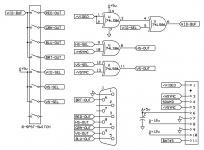
Well, it's not composite either so a "TV adapter" would have to be hacked to intercept separate Hsync/Vsync/video signals before they're mixed and knocked down from TTL levels. (Not a huge deal if you had the schematic and it was discrete components, but could be an issue if it's an ASIC.) Also, they're *TTL*, IE, black-and-white and I imagine an LC PDS card produces color/grayscale. That means more hacking either the card or the monitor circuitry. (And if the card uses an integrated analog DAC then you're probably stuck attacking the monitor side or setting up a crude one-bit ADC to compress an analog luminance signal down to digital.)
That schematic lines up with the need for inverters on H/Vsync noted in the mactech PDF. EGA is *almost* the same as the compact Mac when it comes to frequencies so I'd venture at least a plurality of EGA monitors could probably take the signals from this without further hacking. But, again, TRS-80 isn't even close to EGA.
(If the TRS-80 monitor *were* capable of accommodating the scan rate the requisite adaptor would dispense with the "red/green/blue/brightness" rigormoral as seen in that schematic, the output labeled "vid-buf" would go to the monitor's "video" line.)
I always thought compacts were supposed to have a bit of margin around the edges. He could have perhaps pulled the vertical in some and called it good.
But IIRC, the main reason for leaving the black border when adjusting them was not to strain the analog board, which as you say
Given that, this
is a very good point.
Quite so. Heck, get an old 12" VGA monitor - or a new LCD - and one of those Chinese EGA/CGA to VGA converters.
I've seen schematics around for sync separators (extracting sync from composite (I mean, that's what TVs do internally after all)) but I don't offhand recall where, or what parts they used, or how complex they were. There's probably an IC for it these days.
EvilTim's brightness / gain pot hack ;^)
No, and I don't in any sense mean to imply it is. Just wanted to post that schem for future reference and/or other attacks (eg, Mac -> EGA -> VGA -> newer monitor).
Speaking of which, I have an empty Model III in the store room myself ...
... with a CRT in it.
}
... with a CRT in it.
}
Okay, I just know someone's going to hate me for this ....
Macintosh Monitor Sense Codes: Technical Description
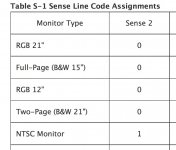
Macintosh Monitor Sense Codes: Technical Description