

Thread
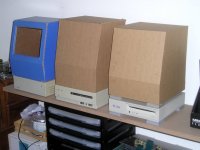
MacintoshClassicIIIColorTVp™ Hack
To me they were always called Slimline IDE connectors.
Slimline CD DVD JAE 50-Pin :?:
http://jae-connectors.com/en/index.cfm
http://www.pccables.com/00507.htm
My head hurts! :-/
http://jae-connectors.com/en/index.cfm
http://www.pccables.com/00507.htm
My head hurts! :-/
JAE connector. thats it. i remember now ;-)
its been a few years since i took my certification, so i happened to loose a lot of that knowledge.
its been a few years since i took my certification, so i happened to loose a lot of that knowledge.
Thanks, guys.
I got tired of trying to set up my network and pulled out this long neglected hack.
I'd been wondering about the small HP PSU I'm using to fit into the IIsi PSU's sheet metal for a surreptitious surge in power . . .
. . . so I thought I'd try the empty metal shell in the sub-basement of this kluge. [} ] ]'>
] ]'>
It fits . . . along with a slot-loader SuperDrive and a decent size HDD or two running off the Sonnet Tempo Trio Card along with USB and FireWire devices. [ ] ]'>
] ]'>

The DVD in the upper chamber is for feeding the TV/Tuner Card over S-Video and a 5.1 system for 50" projection screen playtime. The SuperDrive will be for the SonnetG3/6500 board's Optical and there will be a slot cut into one of the two thin grooves above the wide band. I just need to noodle out clearances for the VidCard dangling down into the Sub-Basement and the HDD base for the SuperDrive Sandwich.

The PSU casing completely clears the descending second slot, if 250W isn't enough, I've got a line on a smaller PSU that puts out 300W, I just need to make sure the 12V rail can run two opticals and a couple of HDDs.

In these two shots, you might be able to see how I've used the sheet metal tools to cut the fan housing & unswitched PSU assembly area off the @$$ end of the PSU. It sits nicely up against the original PSU fan, which moves a lot more air than the quiet little job in the ATX/ITX HP PSU. This should suffice for cooling the PSU, peripherals and the MoBo up in the Classic's basement. We'll see! [ ] ]'>
] ]'>

Looks like it's time to snag another one off eBay and get cracking on my ATX conversion PCB.
First, I think I'll test to make sure there's enough juice in the first one I bought to run each hack!
I've also been neglecting the DECstation ReCase of the hardware/software test unit. That's almost finished, maybe I'll do some pics and post that one too! )
)
I'd been wondering about the small HP PSU I'm using to fit into the IIsi PSU's sheet metal for a surreptitious surge in power . . .
. . . so I thought I'd try the empty metal shell in the sub-basement of this kluge. [}
] ]'>It fits . . . along with a slot-loader SuperDrive and a decent size HDD or two running off the Sonnet Tempo Trio Card along with USB and FireWire devices. [
] ]'>
The DVD in the upper chamber is for feeding the TV/Tuner Card over S-Video and a 5.1 system for 50" projection screen playtime. The SuperDrive will be for the SonnetG3/6500 board's Optical and there will be a slot cut into one of the two thin grooves above the wide band. I just need to noodle out clearances for the VidCard dangling down into the Sub-Basement and the HDD base for the SuperDrive Sandwich.
The PSU casing completely clears the descending second slot, if 250W isn't enough, I've got a line on a smaller PSU that puts out 300W, I just need to make sure the 12V rail can run two opticals and a couple of HDDs.
In these two shots, you might be able to see how I've used the sheet metal tools to cut the fan housing & unswitched PSU assembly area off the @$$ end of the PSU. It sits nicely up against the original PSU fan, which moves a lot more air than the quiet little job in the ATX/ITX HP PSU. This should suffice for cooling the PSU, peripherals and the MoBo up in the Classic's basement. We'll see! [
] ]'>
Looks like it's time to snag another one off eBay and get cracking on my ATX conversion PCB.
First, I think I'll test to make sure there's enough juice in the first one I bought to run each hack!
I've also been neglecting the DECstation ReCase of the hardware/software test unit. That's almost finished, maybe I'll do some pics and post that one too!
)
I think I've got about 7 different PCBs to make for various hacks now.
Is there a house that'll do a deal for something on the order of a square foot of PCB blank, with holes drilled for cutoff perforations of nested designs? :?:
Is there a house that'll do a deal for something on the order of a square foot of PCB blank, with holes drilled for cutoff perforations of nested designs? :?:
http://www.ourpcb.com/
http://www.seeedstudio.com/depot/-p-835.html?cPath=185
https://www.batchpcb.com/ (allied with Sparkfun)
This is not a recommendation; I'm just dropping in links I've collected along the way for my own much-stalled projects.
http://www.seeedstudio.com/depot/-p-835.html?cPath=185
https://www.batchpcb.com/ (allied with Sparkfun)
This is not a recommendation; I'm just dropping in links I've collected along the way for my own much-stalled projects.
THX for exactly what I was asking, avenues of exploration.
I guess this is as good a place as any:
I unpacked and gibletized one of these today: NEW 10" SVGA Color CRT - $40 [$16 + $24 S&H]
. . . never even tested it, I'll do that after it's safely installed in a different hack, but trying it out where the MIA CRT used to reside seemed like the thing to do:
This unit is shorter front to back and the PCB is far smaller, but the older one had better suited curvature than the new one, IIRC. It's very nice that the controls are on a separate board, so they can be relocated with ease. Strapping a modem case onto the back of the Classic would hide the CRT Neck/Board very nicely, that, or maybe a faked up HDD case. The board sits too high up the back of the Classis to try a BackPackHack, the angles are still all wrong.
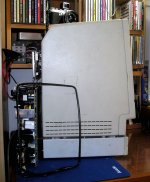
Here you can see how little sticks out the back . . .
edit: I have to take another shot of this, I tried to keep the lens centered across the backplane of the Classic, but it's too far forward. More sticks out the back than meets the eye here. This shot makes it look like the angle of the chamfer plane leads to the top edge of the deflection board, it doesn't. I'll take a better pic.
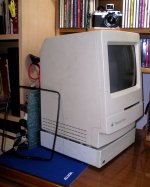
. . . the curvature leaves something to be desired . . . likely due to the shorter overall length . . . TANSTAFL . . .
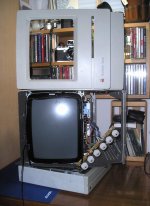
. . . there's just room enough to put a PowerBook SlotLoader behind the CD Slot underneath the PCB if it's mounted as closely to the neck assemby as possible . . .
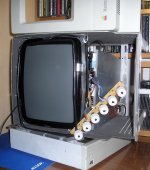
. . . I didn't trim back the ears on this one, but they don't stick as far out as the original CRT, note the slots cut in the bucket that hold the CRT in place . . .
. . . also note the nasty bow at the top edge of the bucket . . . I just barely got the bucket snugged up to the front bezel for the first two shots . . .
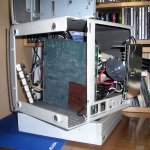
. . . low/back oblique of the monitor's giblets . . .
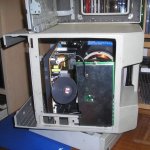
. . . @$$ end view . . .
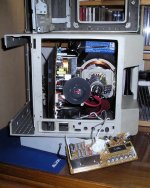
. . . @$$less view . . .
This monitor is a very nice little package. What's really nice about this one for a Classic Hack is that the curvature of the front bezel of the monitor is dead on with that of the Classic. There are even lines around the opening to use as a guide in making an even cut around the edge. Splicing the monitor's CRT Surround into the Classic's front bezel would yield a perfect fit and move the CRT & its @$$ end a significant, if not entirely effective, distance forward into the bucket . . .
. . . and it would look nice as hell from the front after painting the spliced together bezels. }
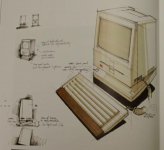
I unpacked and gibletized one of these today: NEW 10" SVGA Color CRT - $40 [$16 + $24 S&H]
. . . never even tested it, I'll do that after it's safely installed in a different hack, but trying it out where the MIA CRT used to reside seemed like the thing to do:
This unit is shorter front to back and the PCB is far smaller, but the older one had better suited curvature than the new one, IIRC. It's very nice that the controls are on a separate board, so they can be relocated with ease. Strapping a modem case onto the back of the Classic would hide the CRT Neck/Board very nicely, that, or maybe a faked up HDD case. The board sits too high up the back of the Classis to try a BackPackHack, the angles are still all wrong.
Here you can see how little sticks out the back . . .
edit: I have to take another shot of this, I tried to keep the lens centered across the backplane of the Classic, but it's too far forward. More sticks out the back than meets the eye here. This shot makes it look like the angle of the chamfer plane leads to the top edge of the deflection board, it doesn't. I'll take a better pic.
. . . the curvature leaves something to be desired . . . likely due to the shorter overall length . . . TANSTAFL . . .
. . . there's just room enough to put a PowerBook SlotLoader behind the CD Slot underneath the PCB if it's mounted as closely to the neck assemby as possible . . .
. . . I didn't trim back the ears on this one, but they don't stick as far out as the original CRT, note the slots cut in the bucket that hold the CRT in place . . .
. . . also note the nasty bow at the top edge of the bucket . . . I just barely got the bucket snugged up to the front bezel for the first two shots . . .
. . . low/back oblique of the monitor's giblets . . .
. . . @$$ end view . . .
. . . @$$less view . . .
This monitor is a very nice little package. What's really nice about this one for a Classic Hack is that the curvature of the front bezel of the monitor is dead on with that of the Classic. There are even lines around the opening to use as a guide in making an even cut around the edge. Splicing the monitor's CRT Surround into the Classic's front bezel would yield a perfect fit and move the CRT & its @$$ end a significant, if not entirely effective, distance forward into the bucket . . .
. . . and it would look nice as hell from the front after painting the spliced together bezels. }