

Thread
SE/30 + Retr0brite and disassembly
I've begun testing with my ADB mouse... submerging the smaller bits until I've got the gelling agents 
Will post results once I'm done with the first batch tonight!


Will post results once I'm done with the first batch tonight!
Re "dunking": filling the void inside a compact case with a bag filled with sand or water means you can use a much smaller quantity of liquid retr0bright
Bunsen, I could be wrong, but I believe it was Mac128 who in this March 2009 post first recommended the displacement method when dunking items as large as a compact Mac enclosure. And subsequently, it was el.Shus who reported in this Feb. 2010 post that he tried dunking his compact Macs housing in the liquid form of RetroBright, using an Ice Tea drum filled with water, although he then reported "peeling" of the shielding inside the housing after 1 day of deyellowing. I don't bring this up to condemn anyone or blast the dunking method (hardly, I think Mac128's displacement idea is brilliant). But these are facts we should ponder when discussing deyellowing and dunking the compact Mac enclosure.
@JDW
What was the consistency of your gel retr0brite? Mine is really sticky and doesnt' seem to spread evenly. I'm testing on the keyboard now and will try to post results when I'm finished. It doesn't seem as effective as dunking.
I'm trying to think of a way to protect the interior of the compact case so I can dunk... Perhaps if I can mix a slightly more aqueous solution (more a liquid than gel), seal the inside of the case, and fill a tub I can achieve the completeness of the dunk with a more leak-resistant gel.
What was the consistency of your gel retr0brite? Mine is really sticky and doesnt' seem to spread evenly. I'm testing on the keyboard now and will try to post results when I'm finished. It doesn't seem as effective as dunking.
I'm trying to think of a way to protect the interior of the compact case so I can dunk... Perhaps if I can mix a slightly more aqueous solution (more a liquid than gel), seal the inside of the case, and fill a tub I can achieve the completeness of the dunk with a more leak-resistant gel.
About as thick as a good clear gravy you'd pour over your turkey at thanksgiving. You can physically see that consistency in my gel mix photos. And if you have a look at the description under the photo of me at the table with the ingredients, you can see how much corn starch I applied. The corn starch is what thickens the mix into gel form. If you don't want yours as thick, just use less corn starch. And keep in mind that I used "heat" in my mix, which is required to get the corn starch to effectively thicken the mix.
As to your comments about dunking, it would be best I refrain from offering advice on that. I simply don't have experience with dunking entire cases myself. But my experience with both liquid and gel forms of RetroBright suggests that you may have a hard time to perfectly "seal" the inside of your Mac's housing.
Best of luck to you. Hopefully more among us here at 68kMLA will make the time to deyellow. It's worth it in the end.
Thanks, JDW, I had forgotten who first posted that idea and couldn't be bothered searching for it. Your reminder about the issues he encountered is a good one.
A coat or two of clear varnish, left to dry well?
one more plug for plastidip in a spaycan ?
Maybe I'm just doing it wrong, but I'm just not getting accurate (or stunning) results with the gel. It's difficult to apply and I think it creates unreliable results because it ends up foaming with the gas emissions. I soaked the keyboard keys and mouse and they looked awesome, and the solution was active for about 24 hours (still reacting).
The keyboard shell is still slightly yellow, and there's now a sort of 'gradient' – some areas are whiter than others, some look totally new, others look still noticeably yellow.
I think JDW is on to something saying that the concentration of H2O2 isn't important – I used up all of my 13% pretty quick and resorted to a bottle of 3%, and the keyboard keys look brand new. Not only is it cheaper, but it's just as effective.
I've sealed the compact case with vinyl tape which is waterproof (for 24 hrs anyways) and I'm gonna take the plunge (no pun intended) and see if I can get away with dunking the case. I think it will produce more impressive results.
The keyboard shell is still slightly yellow, and there's now a sort of 'gradient' – some areas are whiter than others, some look totally new, others look still noticeably yellow.
I think JDW is on to something saying that the concentration of H2O2 isn't important – I used up all of my 13% pretty quick and resorted to a bottle of 3%, and the keyboard keys look brand new. Not only is it cheaper, but it's just as effective.
I've sealed the compact case with vinyl tape which is waterproof (for 24 hrs anyways) and I'm gonna take the plunge (no pun intended) and see if I can get away with dunking the case. I think it will produce more impressive results.
Let there be no misunderstandings about the gel, you will be actively involved in the deyellowing process for the full day you deyellow with the gel, if you do it properly. By that I mean, I applied and reapplied the gel about once an hour. I did that based on observation and logic. After an hour in direct sun, the gel would dry on my SE/30 housing. And logically, there isn't going to be much deyellowing when the gel is no longer a gel. And so, I reapplied the gel as needed (about once an hour on average), so that the appearance of the item being deyellowed with the gel looked "wet" continually. When it started to look dull, I knew the gel was dried out, so I then painted on another coat. And when I reapplied the gel, I used my paintbrush in a scrubbing fashion to loosen up the dried undercoat so the fresh "wet" gel I was applying would directly touch the plastic.
In effect, I was doing what the liquid form of Retrobright does -- keeping it in contact with the plastic continually. And yes, folks, that means I made multiple batches of the gel throughout the day. I could have made one big batch. But I wanted the most potent form of the gel possible with my 3% H202, and the best way to do that is with a fresh batch, made about once an hour. (About the longest I left any given batch sit was 1 hour 45 minutes.) And if you have a look at my Flickr photos, you see the little glass vial I used, along with the small tupperware tub. It doesn't hold much gel at one time. But I didn't need much because I remade the gel over and over throughout the day.
That, my friends, was the key to my success at getting excellent results with the gel. No unevenness. No gradients. Just a perfect deyellowing job on my SE/30's enclosure and on my HD20SC's enclosure.
In effect, I was doing what the liquid form of Retrobright does -- keeping it in contact with the plastic continually. And yes, folks, that means I made multiple batches of the gel throughout the day. I could have made one big batch. But I wanted the most potent form of the gel possible with my 3% H202, and the best way to do that is with a fresh batch, made about once an hour. (About the longest I left any given batch sit was 1 hour 45 minutes.) And if you have a look at my Flickr photos, you see the little glass vial I used, along with the small tupperware tub. It doesn't hold much gel at one time. But I didn't need much because I remade the gel over and over throughout the day.
That, my friends, was the key to my success at getting excellent results with the gel. No unevenness. No gradients. Just a perfect deyellowing job on my SE/30's enclosure and on my HD20SC's enclosure.
JDW, I've read your posts and seen your photos, so I do know how active you were in your retr0briting process. The results clearly speak for it – your SE/30 looks incredible.
The obvious enemy here is the O2 being produced. Without an aqueous solution that allows oxygen to escape OR constant re-application, you just will not be successful.
The obvious enemy here is the O2 being produced. Without an aqueous solution that allows oxygen to escape OR constant re-application, you just will not be successful.
Only JDW would have the patience to go through such an arduous process. LOL
There is no way I would ever babysit my Mac, tending to it all day long. Then again, I have no particular love for the SE models, so it will never be an issue for me. Fill a tub with 3% H2O2 bought over the counter in bulk at the drugstore, throw in my Mac case, let process for a day in the sunlight while I go about my business and I'm done.
daver_cl, JDW has been "onto something" for quite a while, picking up from the anecdotal reports of those who used basic medicinal 3% H2O2. These guys with the expensive and dangerous 30% solutions are the ones who inevitably run into problems, yet they persist in this more-is-better mentality. Patience is a virtue, as JDW points out with his painstaking gel process. But for the rest of us where dunking is an option, there is no substitute for a mild solution and time to achieve good results.
FWIW, it seems to me, based on previous reports, that the only thing you risk by submersing your SE is that the RF shielding may peel off (and will otherwise do no harm to the case). Unless you are operating unshielded devices next to it, like an external monitor, or an external drive, or a radio, then I don't really see the problem with losing the internal shielding, save authenticities sake. The only reason it's there in the first place is because the FCC made them! Honestly, if the inside of my Mac 128K metallic paint would come off that easily and cleanly, I would be ecstatic, to reveal the pristine interior unseen by humans since that coating was sprayed on in 1984. So in truth, unless you are interested in preserving and/or restoring that SE for historical purposes, I'd dunk that sucker and take the risk.
There is no way I would ever babysit my Mac, tending to it all day long. Then again, I have no particular love for the SE models, so it will never be an issue for me. Fill a tub with 3% H2O2 bought over the counter in bulk at the drugstore, throw in my Mac case, let process for a day in the sunlight while I go about my business and I'm done.
daver_cl, JDW has been "onto something" for quite a while, picking up from the anecdotal reports of those who used basic medicinal 3% H2O2. These guys with the expensive and dangerous 30% solutions are the ones who inevitably run into problems, yet they persist in this more-is-better mentality. Patience is a virtue, as JDW points out with his painstaking gel process. But for the rest of us where dunking is an option, there is no substitute for a mild solution and time to achieve good results.
FWIW, it seems to me, based on previous reports, that the only thing you risk by submersing your SE is that the RF shielding may peel off (and will otherwise do no harm to the case). Unless you are operating unshielded devices next to it, like an external monitor, or an external drive, or a radio, then I don't really see the problem with losing the internal shielding, save authenticities sake. The only reason it's there in the first place is because the FCC made them! Honestly, if the inside of my Mac 128K metallic paint would come off that easily and cleanly, I would be ecstatic, to reveal the pristine interior unseen by humans since that coating was sprayed on in 1984. So in truth, unless you are interested in preserving and/or restoring that SE for historical purposes, I'd dunk that sucker and take the risk.
Mac128,
I'm not too anal about the inside of the case, but sealing it up has also given me the opportunity to fill the void with a water-filled bottle to weigh the case down and displace some of the volume I need to fill with the mixture. I have seen photos of chipping SE/30 metallic cases though, and it's just not pretty. If it came entirely off I'd be all for it, but unfortunately it leaves a brittle surface that could leave residue on the inside and, heaven forbid, bridge some connection on the analog/logic board. It was really a huge mess.
I was actually thinking I'd respray the interior with metallic spray paint... not sure yet though. Probably not.
I'm not too anal about the inside of the case, but sealing it up has also given me the opportunity to fill the void with a water-filled bottle to weigh the case down and displace some of the volume I need to fill with the mixture. I have seen photos of chipping SE/30 metallic cases though, and it's just not pretty. If it came entirely off I'd be all for it, but unfortunately it leaves a brittle surface that could leave residue on the inside and, heaven forbid, bridge some connection on the analog/logic board. It was really a huge mess.
I was actually thinking I'd respray the interior with metallic spray paint... not sure yet though. Probably not.


so far so good...
Good stuff
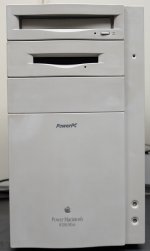
That silver apple looks awesome.
Great results!
And you can peel it off afterwards, correct? Wouldn't painting it on be less fiddly than spraying though?