

Thread
SuperIIsiHack™ AKA SE/30's BANE . . .
As I understand it, when the Rocket re-boots in Accelerator mode after enslaving the host CPU as a mere I/O CoPro, it runs the NuBus via AppleTalk over NuBus and does Block Transfer Mode with all Compatible Cards.
As I understood it back in the day, the Rocket acted independently of the host CPU, interpreting and issuing the interrupts for the NuBus Slots over the NuBus.
In this way, the Saturn V used a "lowly" SE/30 to copy its ROM to a multitude of Rockets set up in a huge expansion chassis without any regard for the SE/30 as anything but a simple controller terminal . . .
. . . amd the SE/30's not even NuBus Compatible other than via the Two Slot ExPanse Chassis, AFAIK! }
As I understood it back in the day, the Rocket acted independently of the host CPU, interpreting and issuing the interrupts for the NuBus Slots over the NuBus.
In this way, the Saturn V used a "lowly" SE/30 to copy its ROM to a multitude of Rockets set up in a huge expansion chassis without any regard for the SE/30 as anything but a simple controller terminal . . .
. . . amd the SE/30's not even NuBus Compatible other than via the Two Slot ExPanse Chassis, AFAIK! }
Looking at how things are routed, I just don't see a way a Nubus card can get any interrupts except its own without the host CPU and and consulting VIA2/RBV. Particularly when the Nubus card is sitting off a Nubus bridge off an 030 PDS. The signals just aren't present.
The Rocket can read VIA2/RBV directly, since it is capable of operating as a Nubus master, but it can't get /SLOTIRQ (or onboard SCSI interrupts, Sound interrupts, Egret-based NMI, etc.) without the host CPU. Once the Rocket has software running on the host CPU, nearly anything is possible, but it still has to work within the constraints of the hardware of the system it is running in while (mostly) preserving software compatibility.
The Rocket does change one thing pretty substantially though: it does complicate any software/ROM-based solutions to this problem since any software would need to be compatible with whatever contortions the Rocket software is doing.
But anyway, that's just my understanding, which is definitely subject to reality checks!
The Rocket can read VIA2/RBV directly, since it is capable of operating as a Nubus master, but it can't get /SLOTIRQ (or onboard SCSI interrupts, Sound interrupts, Egret-based NMI, etc.) without the host CPU. Once the Rocket has software running on the host CPU, nearly anything is possible, but it still has to work within the constraints of the hardware of the system it is running in while (mostly) preserving software compatibility.
The Rocket does change one thing pretty substantially though: it does complicate any software/ROM-based solutions to this problem since any software would need to be compatible with whatever contortions the Rocket software is doing.
But anyway, that's just my understanding, which is definitely subject to reality checks!
I was thinking that since it is the Rocket running the Slot Manager in Acceleration Mode, not the CPU relegated to hosting the non-NuBus I/O, similar to the 6502(?) I/O co-processors on the IIfx MoBo, the Rocket may be able to pull at least a few rabbits out of its hat.
I'll need to crack the books and DevNotes for info on Interrupt Lines/Slot IDs/PseudoSlot assignments for multi-slot implementations in oter Macs of the IIsi Adapter's NuBus ChipSet. IIRC, it's the same chipset found on the DuoDock (Rev 1) and possibly the IIci, IIcx and earlier II series Macs.
A few patch wires between a NuBus Slot Section hacked from another machine and the NuBus Adapter Bridge ASICs might do wonders for a Rocket running rampant over a brain-dead IIsi! }
I'll need to crack the books and DevNotes for info on Interrupt Lines/Slot IDs/PseudoSlot assignments for multi-slot implementations in oter Macs of the IIsi Adapter's NuBus ChipSet. IIRC, it's the same chipset found on the DuoDock (Rev 1) and possibly the IIci, IIcx and earlier II series Macs.
A few patch wires between a NuBus Slot Section hacked from another machine and the NuBus Adapter Bridge ASICs might do wonders for a Rocket running rampant over a brain-dead IIsi! }
Using JDW's pictures of the SE/30 twinspark thing, these are my best guesses at pin assignments of that chip on the adapter:
1 - CPU A37 (+5V)
2 - CPU A7 (/STERM)
3 - PDS A10 (/BGACK) & Cache B29 (A20)
4 - NC
5 - NC
6 - NC
7 - NC
8 - NC
9 - NC
10 - NC
11 - NC
12 - CPU A10 (/BGACK)
13 - JP3
14 - NC
15 - NC
16 - Cache C38 (CPUCLK)
17 - PDS C38 (CPUCLK)
18 - Cache A2 (/PDS.MASTER)
19 - NC
20 - NC
There might be connections I can't see, or I might have gotten all the assignments backwards. I followed the numbering on the board, and I don't know if that's accurate. But, it seems to be doing something more complex than just mucking with slotid.
1 - CPU A37 (+5V)
2 - CPU A7 (/STERM)
3 - PDS A10 (/BGACK) & Cache B29 (A20)
4 - NC
5 - NC
6 - NC
7 - NC
8 - NC
9 - NC
10 - NC
11 - NC
12 - CPU A10 (/BGACK)
13 - JP3
14 - NC
15 - NC
16 - Cache C38 (CPUCLK)
17 - PDS C38 (CPUCLK)
18 - Cache A2 (/PDS.MASTER)
19 - NC
20 - NC
There might be connections I can't see, or I might have gotten all the assignments backwards. I followed the numbering on the board, and I don't know if that's accurate. But, it seems to be doing something more complex than just mucking with slotid.
I'm confused now . . . :?:
After looking at those pics:
It looks like the ArtMix card simply converts the SE/30 PDS to a IIci PDS for using the accelerator . . .
. . . so isn't that PAL doing the same function as the PAL on the "official" SE/30 Adapter card and only providing a PassThru for a single SE/30 68030 PDS Card?
Is there even room to stack TWO Cards on top of that thing? :?:
Now I seriously doubt that the PAL on that card has anything at all to do with the PassThru connector or addressing an additional PDS slot . . .
. . . probably just another ASSuME or memory leak brain boo-boo! :-/
After looking at those pics:
It looks like the ArtMix card simply converts the SE/30 PDS to a IIci PDS for using the accelerator . . .
. . . so isn't that PAL doing the same function as the PAL on the "official" SE/30 Adapter card and only providing a PassThru for a single SE/30 68030 PDS Card?
Is there even room to stack TWO Cards on top of that thing? :?:
Now I seriously doubt that the PAL on that card has anything at all to do with the PassThru connector or addressing an additional PDS slot . . .
. . . probably just another ASSuME or memory leak brain boo-boo! :-/
I just re-read this thread to refresh the gray matter memory, spell-check, grammar check and clarity check my .TXT output and now my brain really hurts!
The extra batch of Machine Pin Strips have been here for over a week and the solder paste just might arrive today!
I've had the IIsi MoBo and bits transferred to the cherry IIsi case I got on eBay a few months back for a couple of days.
So this morning it's time to chop holes in the bottom of the yellowed original case to lower the floor of the basement for the PDS Cards. }
The extra batch of Machine Pin Strips have been here for over a week and the solder paste just might arrive today!
I've had the IIsi MoBo and bits transferred to the cherry IIsi case I got on eBay a few months back for a couple of days.
So this morning it's time to chop holes in the bottom of the yellowed original case to lower the floor of the basement for the PDS Cards. }
Ah, yup, a IIci cache connector makes sense! That connection to the cache card's BB29 pin becomes /BGACK, and makes a lot more sense.
Excellent! The building blocks are stable in the 'ole noggin' once more! :approve:
If you can noodle out ( "clean room" reverse-engineer ) the function of the PAL on the "official" SE/30 adapter card, we can design/fab a production run of lower profile "ArtMix/twinspark/whatever "type" adapter cards that can possibly provide correction for at least one "PDS Drift Unit" for the "Wrong Angle" PDS Card StackHack! [ ] ]'>
] ]'>
 -ness! [
 ] ]'>
] ]'>
edit: Maybe techknight can figure out how to do it with an embedded proc that will also multiplex/convert the PDS address/interrupt gobbledegook to do a three PDS Card Hack . . .
. . . unless a NuBusChipSetGraftHack™ for a vertical internal 7" NuBus Card Slot makes sense . . . }
edit: Move the NuBus slot as far forward as possible so a plate-less LittleRedRadiusPixelRocket™ faces the rear of the SE/30 and an internal cable can do a VGA conversion on the way to an HD-15 connector on the EtherNet breakout panel! Choose the original NuBus Chipset and it' becomes available for rework/forwardwork from a lot more donors than the relatively scarce IIsi NuBus Adapter. [}] ]'>
If you can noodle out ( "clean room" reverse-engineer ) the function of the PAL on the "official" SE/30 adapter card, we can design/fab a production run of lower profile "ArtMix/twinspark/whatever "type" adapter cards that can possibly provide correction for at least one "PDS Drift Unit" for the "Wrong Angle" PDS Card StackHack! [
] ]'> -ness! [] ]'>edit: Maybe techknight can figure out how to do it with an embedded proc that will also multiplex/convert the PDS address/interrupt gobbledegook to do a three PDS Card Hack . . .
. . . unless a NuBusChipSetGraftHack™ for a vertical internal 7" NuBus Card Slot makes sense . . . }
edit: Move the NuBus slot as far forward as possible so a plate-less LittleRedRadiusPixelRocket™ faces the rear of the SE/30 and an internal cable can do a VGA conversion on the way to an HD-15 connector on the EtherNet breakout panel! Choose the original NuBus Chipset and it' becomes available for rework/forwardwork from a lot more donors than the relatively scarce IIsi NuBus Adapter. [}
] ]'>
Let's try this again: YO! bbraun, come on back for some playtime!
I've Updated the TWO SLOT IIsi Nubus Card hack . . . thread with a couple of diagrams, one of which definitely belongs here . . .
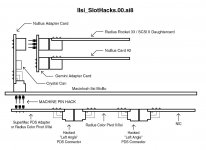
This diagram basically shows the Gemini Card's origins and how it needs to be modified for the TWO SLOT hack.
I've Updated the TWO SLOT IIsi Nubus Card hack . . . thread with a couple of diagrams, one of which definitely belongs here . . .
Lets see if this clears anything up! :
This diagram basically shows the Gemini Card's origins and how it needs to be modified for the TWO SLOT hack.
This was last update for this thread, since discussions w/bbraun abut the addressing issues of both of these I/O hacks are here I'm phasing out the TWO SLOT IIsi Nubus Card hack . . . thread

Please let me know if this diagram is self-explanatory.
Do I need to show the NuBus Slot Hack alone for simplicity or is the combo graphic sufficient?
Might it be clearer with both posted individually?
Please let me know if this diagram is self-explanatory.
Do I need to show the NuBus Slot Hack alone for simplicity or is the combo graphic sufficient?
Might it be clearer with both posted individually?
I've switched to a more aggressive hack of the IIsi MoBo by substituting the original soldertail PDS socket with a Wire-Wrap Socket that will join the Hacked SuperMac adapter to the Hacked SuperIIsi's Mobo permanently for the Basement PDS Card Hack. I've decided that going half-way using the "Machine Pin Hack" would be reversible, but less robust physically and therefore less reliable electrically.
The same holds true for the marginally less risky, but equally aggressive, removal of the NuBus Connector from my spare NuBus Adapter. The cut down Gemini Card (DuoDock Donation) will have its Male NuBus Connector replaced with a soldertail version as well, after this is fully tested in the unmodified NuBus Adapter's Slot, the NuBus Slot will be removed and the extra length pins on the wire wrap connector will be permanently soldered to the NuBus Adapter slot's pads.
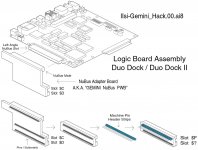
Here is the simplified (I hope) diagram, showing how the Wire Wrap connector moves the Gemini Board & slots closer to the NuBus Adapter:

The same holds true for the marginally less risky, but equally aggressive, removal of the NuBus Connector from my spare NuBus Adapter. The cut down Gemini Card (DuoDock Donation) will have its Male NuBus Connector replaced with a soldertail version as well, after this is fully tested in the unmodified NuBus Adapter's Slot, the NuBus Slot will be removed and the extra length pins on the wire wrap connector will be permanently soldered to the NuBus Adapter slot's pads.
Here is the simplified (I hope) diagram, showing how the Wire Wrap connector moves the Gemini Board & slots closer to the NuBus Adapter:
Extra, extra, read all about it! [] ]'>
Rocket lifts off, puts IIsi into orbit!
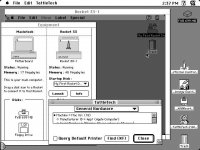
The RocketShare 1.0 install I did under 7.5.5 on the HDD in the DuoDock II just took a couple of screenshots of itself running on IIsi#2 and I'm ecstatic! :approve:
Now maybe I won't have to hack the 230/Dock_II/Rocket/VidCard into a IIsi to get a Rocket to work as an ersatz SuperIIsi™ after all.
Gotta go back to work . . . I'm afraid to shut it down . . . :-/
edit ; Restarted it w/32bit addressing on, still unborken! }
] ]'>Rocket lifts off, puts IIsi into orbit!
The RocketShare 1.0 install I did under 7.5.5 on the HDD in the DuoDock II just took a couple of screenshots of itself running on IIsi#2 and I'm ecstatic! :approve:
Now maybe I won't have to hack the 230/Dock_II/Rocket/VidCard into a IIsi to get a Rocket to work as an ersatz SuperIIsi™ after all.
Gotta go back to work . . . I'm afraid to shut it down . . . :-/
edit ; Restarted it w/32bit addressing on, still unborken! }
I played with the Rocket in the IIsi some more after work and booted it again just now. Good news and Meh news to report.
There are still a couple of gotchas that may need a workaround, the worst of which is the grayed out "Take Over Screen" command in the menus. That's a PITA that'll have to be addressed, but I found a reference to fixing that in the manual. One good thing is that the blueprint for the SuperIIsi™ calls for breaking its PDS out the bottom of the MoBo to make use of the other two interrupts/PseudoSlot_IDs. The Radius_Color_Pivot_II/IIsi supports Mac 16" and Portrait resolutions so that'd almost fix the screen issue acceptably. Running the Rocket at 640x480 within the larger window would be OK. It doesn't work so well set at 640x480 at 13"/14" RGB's matching res. but even just 12" RGB within the 640x480 Desktop still matches the SE/30 pixel for pixel . . .
. . . with the GS/Color Ace of Trump up its sleeve. }
Getting the Asante NIC to run alongside/on top of Classic networking in the RocketWare install will be a challenge, we'll see!
Be that as it may, the installation seems to be stable, which is pretty good on a machine that is supposed to be incompatible with the Rocket in any way shape or form.
Gotta try installing 7.1 and RocketWare on another HDD. Since RocketShare 1.0 doesn't appear to know it's not supposed to be compatible with the IIsi, maybe the first rev. of RocketWare won't know it shouldn't work with a Mac that was released after it was either.
Gotta try. :approve:
Anyone got a suggestion for a benchmarking app I can run to test this monstrosity against someone's tricked out SE/30? }
There are still a couple of gotchas that may need a workaround, the worst of which is the grayed out "Take Over Screen" command in the menus. That's a PITA that'll have to be addressed, but I found a reference to fixing that in the manual. One good thing is that the blueprint for the SuperIIsi™ calls for breaking its PDS out the bottom of the MoBo to make use of the other two interrupts/PseudoSlot_IDs. The Radius_Color_Pivot_II/IIsi supports Mac 16" and Portrait resolutions so that'd almost fix the screen issue acceptably. Running the Rocket at 640x480 within the larger window would be OK. It doesn't work so well set at 640x480 at 13"/14" RGB's matching res. but even just 12" RGB within the 640x480 Desktop still matches the SE/30 pixel for pixel . . .
. . . with the GS/Color Ace of Trump up its sleeve. }
Getting the Asante NIC to run alongside/on top of Classic networking in the RocketWare install will be a challenge, we'll see!
Be that as it may, the installation seems to be stable, which is pretty good on a machine that is supposed to be incompatible with the Rocket in any way shape or form.
Gotta try installing 7.1 and RocketWare on another HDD. Since RocketShare 1.0 doesn't appear to know it's not supposed to be compatible with the IIsi, maybe the first rev. of RocketWare won't know it shouldn't work with a Mac that was released after it was either.
Gotta try. :approve:
Anyone got a suggestion for a benchmarking app I can run to test this monstrosity against someone's tricked out SE/30? }
8-o i think i'm interested in what you have here, but i cannot understand what in the hell you are saying.
's OK, i cannot understand what in the hell I am doing.
I think he's setting up a IIsi with a dual slot adapter running an Ethernet card & a Radius Rocket on a machine that's technically not even supposed to be able to run just a Radius Rocket.
I guess I haven't posted a pic of the baseline SuperIIsi™ spec. as yet. The pics above were my attempt at explaining a more radical approach, involving installation of the more Capable Futura_II_SX/10baseT_Daughtercard, leaving me one remaining address . . .
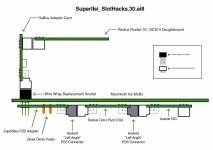
No Dual-Slot NuBus adapter hack involved unless I get overly ambitious, not great odds of success, really ugly patch wire address line hack required.
Now that the Rocket is up and running where it's not supposed to be, I can get to work on the basement PDS hack. Along with the NuBus Adapter, this will use up all three available address lines on the IIsi.
Meanwhile, back at the launch pad . . . the next step will be to configure the U160 boot drive for the Rocket on its SCSI II DaughterCard . . .
. . . then I can install a benchmarking app to see if the SuperIIsi™ is the SE/30's BANE that I originally set out to build as development stands ATM! }
No Dual-Slot NuBus adapter hack involved unless I get overly ambitious, not great odds of success, really ugly patch wire address line hack required.
Now that the Rocket is up and running where it's not supposed to be, I can get to work on the basement PDS hack. Along with the NuBus Adapter, this will use up all three available address lines on the IIsi.
Meanwhile, back at the launch pad . . . the next step will be to configure the U160 boot drive for the Rocket on its SCSI II DaughterCard . . .
. . . then I can install a benchmarking app to see if the SuperIIsi™ is the SE/30's BANE that I originally set out to build as development stands ATM! }
I'm having a grand old time with this. I haven't heard a Rocket's WHOOSH!!!!!!!!!!in almost 15 years, IIRC. ;D It's back to a 512x384 window within the 640x480 desktop, looks much more civilized.
The top is on the IIsi and I'm letting it get up to idle temperature to see if I need to install a fan pointing at the two procs before moving on to benchmarking.
This is some kinda sleeper! }
The top is on the IIsi and I'm letting it get up to idle temperature to see if I need to install a fan pointing at the two procs before moving on to benchmarking.
This is some kinda sleeper! }
Semi-off topic: could you use your subbasement principal to stack LCPDS cards? Solder a female connector to the top of an LCPDS Ethernet card and stack a video card onto it?
Now that is an interesting thought.
Dunno, you'd need to look at the 'zaBoxen DevNotes to see if they have more than one interrupt/PseudoSlot ID available. I think it's doubtful though, has anyone seen any kind of a selector setup on an LC PDS Card?
AFAIK, the only multiple card setup I recall did not specify whether it addressed the expansion cards simultaneously or cyclically:
DGR MAX = LC w/3 PDS slots & 68040
Physically, I don't see any problem other than the conspicuously missing basement in the LC series. The Quadra 605 might have room for a second card.
The IIsi has a nice, thick set of ribbing between the bottom of the MoBo and the top of the rubber feets, this cubic is sadly lacking in the LC Case.There isn't much of a pair of feets at the back of the case for additional height to snag either.
In a Classic Hull, you could stack 'em high!
MUAHAHAHAHAHAHAAAAAAAAAAA!!!!!!!!!!!!!!!!!!!!!!!!!!!!!!!!!!!!!!!!! :lol:
I'd dearly love to find one of those DGR or MicroMac expansion chasis. 3 PDS slots on an LC? That's just crazy talk!
If you look closely at the artwork in those adverts, there appears to be some logic involved with the multi-PDS adapter. Though from one angle, it looks like there's nothing more than a single EPROM on the board.
Still, that's just artwork, not a photo. It could be pre-release concept art for all we know.
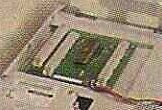
Nice shots, B, where did you find them?
An EPROM makes sense:
__I've seen tiny ROMs used for mapping memory configurations in 2-4 Chip arrays of 32k & 64k EPROMs in Font Cartridges
__in one of his Cookbooks, ISTR Don Lancaster describing KBD remapping scheme using only an EPROM & support glue
If there are three addressing control variables on the LC PDS, the ROM could easily be remapping slot access in real time, I wonder what the driver might look like.
With a simple manual switch setup, the same thing could be accomplished, I still wonder what a driver might look like . . .
. . . or if one might be needed? :?:
An EPROM makes sense:
__I've seen tiny ROMs used for mapping memory configurations in 2-4 Chip arrays of 32k & 64k EPROMs in Font Cartridges
__in one of his Cookbooks, ISTR Don Lancaster describing KBD remapping scheme using only an EPROM & support glue
If there are three addressing control variables on the LC PDS, the ROM could easily be remapping slot access in real time, I wonder what the driver might look like.
With a simple manual switch setup, the same thing could be accomplished, I still wonder what a driver might look like . . .
. . . or if one might be needed? :?:
I just cropped them from your scan.
D'oh! :
Meanwhile, back at the banana ranch:
I installed 7.1 on one of the new 2.5" Seagate SCA Drives in the IIsi and then moved it and the Rocket over to the mothballed IIfx for a RocketWare 1.5 install . . . then moved them back over to the IIsi. It didn't work, not that I really expected it to . . .
. . . but it does boot to the Whoosh/Reboot Screen and stays hung up there as really nice wallpaper. [] ]'>
Meanwhile, back at the banana ranch:
I installed 7.1 on one of the new 2.5" Seagate SCA Drives in the IIsi and then moved it and the Rocket over to the mothballed IIfx for a RocketWare 1.5 install . . . then moved them back over to the IIsi. It didn't work, not that I really expected it to . . .
. . . but it does boot to the Whoosh/Reboot Screen and stays hung up there as really nice wallpaper. [
] ]'>
Why all the moving back & forth?