

Thread
68k Soft/Hard Power and ATX conversions . . .
OlePigeon just asked me about this project in PM, so I thought I'd resurrect it to ask for help again with the Soft Power aspects. This feature isn't necessary for a IIsi ATX PSU Conversion, but it is for his IIci project, and I'd really like my PCB to be able to handle both applications. It has been long enough since I've looked at this that I'm starting over from scratch on the Soft Power revision for the IIsi PCB, so . . .
. . . Help! )
)
. . . Help!
)
Thanks! I tried the Quadra 700 power supply, but even that one wasn't powerful enough to run my RadiusRocket. I tested all three of my Rockets in my Quadra 950, and they worked perfectly, so I know the cards are good. I'm guessing these old power supplies just aren't powerful enough.
I'm betting you're right, I should check my paper docs on that. Check the ReadMe files in your software/driver installation files.
I just found a related, and very interesting, blurb in the VideoVision Studio 2.0 ReadMe.
I just found a related, and very interesting, blurb in the VideoVision Studio 2.0 ReadMe.
So do I just connect Pin for Pin from the ATX to the IIci pinout? The 24 pin ATX obviously has a lot more wires, does it matter which of the three 5v wires I connect? Any of the 3 will work?
If so, then according to this wikipedia pinout, I would do:
If so, then according to this wikipedia pinout, I would do:
Code:
ATX...IIci
1.....NC
2.....NC
3.....5
4.....2
5.....6
6.....3
7.....7
8.....9
9.....NC
10....1
11....NC
12....NC
13....NC
14....8
15....NC
16....10
17....NC
18....NC
19....NC
20....NC
21....NC
22....NC
23....NC
24....NC
Got links to the pinouts? Have they got the voltages/functions labeled? :approve:
I'll need to reread this thread and check out the 'fritter links especially before saying how setup will work out. Maybe one of our Boffins can be of assistance?
HELP!!!!!!!!!! :?:
I'll need to reread this thread and check out the 'fritter links especially before saying how setup will work out. Maybe one of our Boffins can be of assistance?
HELP!!!!!!!!!! :?:
DERP! So I finished my conversion, and it works... so long as I hold the power button down on the keyboard.
I looked at the YouTube video, and the guy says to install an ATX power supply with the switch on the back. Mine doesn't have one. :/ So I guess it only completes whatever circuit when I hold the power button down. Sigh.
I used wire nuts, so it shouldn't be too hard to take apart again. Other than that set back, it looks like it's going to work. Maybe I can modify the one I currently have. Anyone have an idea where I would install the on/off switch? Or should I just get a different ATX power supply?
I looked at the YouTube video, and the guy says to install an ATX power supply with the switch on the back. Mine doesn't have one. :/ So I guess it only completes whatever circuit when I hold the power button down. Sigh.
I used wire nuts, so it shouldn't be too hard to take apart again. Other than that set back, it looks like it's going to work. Maybe I can modify the one I currently have. Anyone have an idea where I would install the on/off switch? Or should I just get a different ATX power supply?
Something I learned: you may have to get a slightly thinner fan. The one in my IIci's power supply was too thick to fit with the new ATX power supply. Luckily I found a thinner 12v fan of the same dimensions, so I could screwed that in and it fit perfectly.
The one you have should definitely work, they're all the same AFAIK. I don't recall seeing a single ATX PSU with a Power Switch on the backplane. That'd probably be either some kind of super heavy duty gamer or server kinda deal.
The PSUs with switches on the back are old fashioned AT PSUs, which are perfect for powering a tower full of I/O peripherals.
ISTR someone, (Zuiko or ojfd?) posting a pic showing him using a paperclip as a momentary switch between the two lines you need to wire up for soft power. It's in this thread, one of the linked threads, or I've got it in my War Room links list, IIRC. I'll give it a look.
Meanwhile, you electronics and EE types . . . HELP!!!!!
The PSUs with switches on the back are old fashioned AT PSUs, which are perfect for powering a tower full of I/O peripherals.
ISTR someone, (Zuiko or ojfd?) posting a pic showing him using a paperclip as a momentary switch between the two lines you need to wire up for soft power. It's in this thread, one of the linked threads, or I've got it in my War Room links list, IIRC. I'll give it a look.
Meanwhile, you electronics and EE types . . . HELP!!!!!
SUCCESS! I grounded the Power-On (green) wire, and it booted! It turns on as soon as I plug in the power. So my next step is to find a power supply with an on/off switch. However, if someone here can work out a circuit or something to allow for soft on/off, that'd be awesome. I'd buy one.
Now to test my Radius Rocket.
Now to test my Radius Rocket.
AND WE HAVE LIFTOFF! ZOOM! IIci with a Radius Rocket!
Now to build the ultimate machine... IIci with THREE Radius Rockets?! Can it be done?! We'll find out! ... tomorrow. Cuz I have to get some sleep for work tomorrow. Damn, I'm so excited. It's finally working. :lol:
Now to build the ultimate machine... IIci with THREE Radius Rockets?! Can it be done?! We'll find out! ... tomorrow. Cuz I have to get some sleep for work tomorrow.
Damn, I'm so excited. It's finally working. :lol:
:lol: I hate to say it, but . . . I told you you needed to hack an ATX PSU in there to achieve liftoff! )
Congratulations, buddy, it was a long time coming and it's a hack well done! :approve:
) Congratulations, buddy, it was a long time coming and it's a hack well done! :approve:
I'm gonna be tired tomorrow, but I wanted to get these pics up. IIci 040 with 128MBs of RAM running a RadiusRocket 040 with 128MBs of RAM.  I'm going to try it as an accelerator, as well. Benchmark it against my Daystar. Since the Rocket is running 7.1, I'm going to go ahead and install System 7.1.1 Pro so I have a few more features that I take for granted on 7.5 (Drag Manager, AppleScript, etc.)
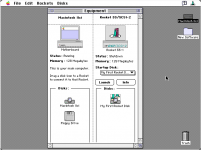
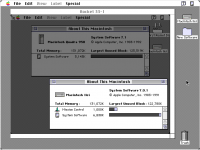
IIci 040 with 128MBs of RAM running a RadiusRocket 040 with 128MBs of RAM. I'm going to try it as an accelerator, as well. Benchmark it against my Daystar. Since the Rocket is running 7.1, I'm going to go ahead and install System 7.1.1 Pro so I have a few more features that I take for granted on 7.5 (Drag Manager, AppleScript, etc.)
Shucks. System crashes if I have both my Rocket and the Iomega extension installed. I wonder if it's crashing from the SCSI-2 Booster. I'll try connecting my Jaz drive the SCSI-2 card tomorrow and see if that helps. Anyway, this is awesome. Can't wait to play with it some more tomorrow.
One more picture. Last one for tonight, I swear!  My Block o' RAM, Daystar 040, Pirate ROM Arrr!, oddly-not-red PrecisionColor 24X, RadiusRocket 33 with 128MBs of RAM and SCSI-2 Booster, and the corner of my new ATX transplant.
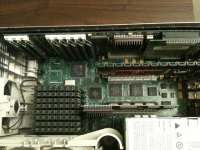
My Block o' RAM, Daystar 040, Pirate ROM Arrr!, oddly-not-red PrecisionColor 24X, RadiusRocket 33 with 128MBs of RAM and SCSI-2 Booster, and the corner of my new ATX transplant. There, I fixed it!
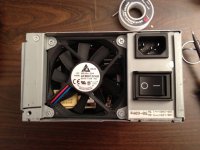
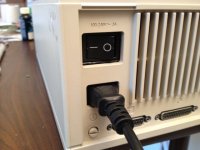
I soldered on a switch to my power supply. Now I can turn it on/off like an LC.
I had clip off the raised part of the switch there in that first picture, it was too big to slide in the power supply. In fact, the switch itself was a little too big. I had to force the case open a tiny bit get it to go in. Not sure if I'll be able to take it out.
Hi! Sorry for being so late to chime in -- very busy going back to work :'(
 but also the proof of concept that the ATX PSU can be soft-controlled by the IIsi... it's just a matter of placing an inverter between the /PFW line from the Mac and the /PS_ON input of the PSU -- they work just the opposite.
As you can see, there's no need to bother with a hex-inverter IC, a single transistor and a resistor will suffice. The complete schematic (sorry for the poor "scan") is:
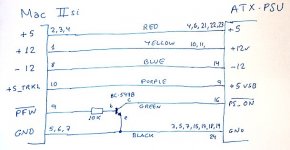
Any small-signal NPN transistor will do, I had a BC-547B at hand but I believe a 2N3904 (and many others) will do -- but do check the pinout! The 10 Kohm resistor value (1/4 W, or even less) isn't too critical, either.
Pinout on the ATX side is numbered according to the 24-pin standard -- for a 20-pin connector, pins 11, 12, 23 & 24 disappear, and 13-22 become 11-20. Colours are those of the ATX cabling.
Hope this helps,
Yup. It was here. It's a very sophisticated paperclip
but also the proof of concept that the ATX PSU can be soft-controlled by the IIsi... it's just a matter of placing an inverter between the /PFW line from the Mac and the /PS_ON input of the PSU -- they work just the opposite.As you can see, there's no need to bother with a hex-inverter IC, a single transistor and a resistor will suffice. The complete schematic (sorry for the poor "scan") is:
Any small-signal NPN transistor will do, I had a BC-547B at hand but I believe a 2N3904 (and many others) will do -- but do check the pinout! The 10 Kohm resistor value (1/4 W, or even less) isn't too critical, either.
Pinout on the ATX side is numbered according to the 24-pin standard -- for a 20-pin connector, pins 11, 12, 23 & 24 disappear, and 13-22 become 11-20. Colours are those of the ATX cabling.
Hope this helps,
That's amazing, thanks, Z! :approve: I totally missed the link to that thread in my index. It's about time for me to post something like The Power Supply Dump thread I suggested at the top of that particular thread.
I'm going to have to re-think my notion for doing the ATX conversion for the Quadra 700/7600/G4/800_hack now that I've got the missing piece of the puzzle. Looks like I'll need to have a PCB in there after all.
How much heat will this circuit generate? I'm assuming not very much at all. It'd be nice to skip the custom PCB . . . and do this conversion with wires inside the equivalent of an epoxy encased dongle . . . new thought, already! I can use one of the small IC Breakout Prototyping Boards from CrapShack . . . or even a quarter of one!
I still like the notion of an epoxy dongle conversion of a standard ATX extension cable, that way we can nip off all the extra lines (there must be several?) on the female side of the converter(maybe break out Molex Connector leads to bypass the Mobo (limitations?) for internal drive power . . .
. . . just thinking in .TXT here, I hope his makes some kind of sense. I'm seeing a converter that can be wire spliced, for those who prefer that method, or soldered right to the MoBo's thru holes for Neanderthals like myself. I guess I could also mount the PCB inside the Q700 PSU's sheet metal for this particular hack . . . hrmmm?
Whatcha think?
I'm going to have to re-think my notion for doing the ATX conversion for the Quadra 700/7600/G4/800_hack now that I've got the missing piece of the puzzle. Looks like I'll need to have a PCB in there after all.
How much heat will this circuit generate? I'm assuming not very much at all. It'd be nice to skip the custom PCB . . . and do this conversion with wires inside the equivalent of an epoxy encased dongle . . . new thought, already! I can use one of the small IC Breakout Prototyping Boards from CrapShack . . . or even a quarter of one!
I still like the notion of an epoxy dongle conversion of a standard ATX extension cable, that way we can nip off all the extra lines (there must be several?) on the female side of the converter(maybe break out Molex Connector leads to bypass the Mobo (limitations?) for internal drive power . . .
. . . just thinking in .TXT here, I hope his makes some kind of sense. I'm seeing a converter that can be wire spliced, for those who prefer that method, or soldered right to the MoBo's thru holes for Neanderthals like myself. I guess I could also mount the PCB inside the Q700 PSU's sheet metal for this particular hack . . . hrmmm?
Whatcha think?
So if I put a 10 Kohm resistor, I can get soft-power back? Mine is simply grounded, which is why I put on the switch.
Don't forget the transistor, I can't wait to try this! :approve:
Awesome, I'm going to stop by my electronics parts store and pick some up.
If I'm not mistaken, power dissipation should be around 1 mW -- won't generate any noticeable heat
Good idea! I believe a PCB/Protoboard, no matter how small, would be overkill for such a simple circuit.
Maybe this inverter could be installed inside the ATX PSU, alhough it no longer would be compatible with regular PCs...
No, it's the transistor the one which does the required signal inversion -- the resistor is only to avoid overloading the transistor.
As mentioned earlier, the particular model isn't critical -- the cheapest one you could find is likely to be perfectly valid for switching a low current, 5 V signal "slowly". BC547B is an European reference, but you should be able to get a similar 2N3904 very cheaply. If you have, say, a 2N2222 at hand, it would work fine too -- if a bit overkill for the task!
Awesome, thanks. I was so hasty to get my PSU working, that I destroyed the circuitry that allows daisy chaining the monitor power off the PSU. Now I wish I hadn't done that.
Oh well. I'll look around at the store, see if there isn't a replacement I could use.
Now I wish I hadn't done that.Oh well. I'll look around at the store, see if there isn't a replacement I could use.
I like the ProtoPCBpiece notion because it's much easier to see the circuit, for folks like myself, and to do it correctly the first time and every time. It's also easy to pre-form the epoxy putty casing for the dongle so it will have an open top and raised boxes (standoffs) to drill and tap for PCB mounting bolts and a cover plate. For those who don't do tapping, substitute drilled holes and screws. For those who don't need the PCB model for visualization/fabrication, they can do it in wiring in the same accessible epoxy putty dongle.
I like the KISS principle when it comes to this stuff. Simple for electronics/wiring types is different than Simple/Foolproof for non-electron pushers.
I like the plumbing metaphor, I do electron pipe work, so the piping needs to be elegantly done, (accessible so you don't need to punch a hole in the drywall to get at the leaky parts years later) strapped properly to the framing of the house, grounded and vented! [
] ]'>Neanderthal Luddites don't do schematics. :I
@ olePigeon: It's ALWAYS good to have a hard cutoff switch, external to the casing. That's code for Electrical Signs wherever codes make sense. If you're doing the KVM thing, a switching power port for a Monitor isn't necessary, but it is nice for a dedicated peripheral or eight. [
] ]'>Rehash of an earlier notion:
It might be a good idea to come up with a version of the universal PCB after all. It'd be great to have one single ATX PSU with pads to solder wires/connectors for every conceivable Mac that might need testing. A temporary PSU for use during a hack, or for out of case testing might be another good use for such a PCB/PSU. My SuperIIsi™ project, with the Quadra 700 PSU perched just a tad precariously atop the IIsi PSU's empty metal chassis, would be a prime example.
For any given single Mac application, all one need do would be to create and implement that portion of the PCB. HRMMM????? :?:
If I understand your idea correctly, that Universal PSU-Adapter PCB shouldn't be difficult at all... just take my previous schematic (for the IIsi) and connect the lines in parallel for each Mac-side connector. Some lines from the ATX PSU (e.g. the +3.3V rail, unused and thus not shown in the schematic) would go for certain Mac models only (like the 7600 etc).
You don't even need to put multiple transistors for soft power... just connect the /PFW lines (Mac side) together to the resistor, like the only one in my schematic. For those Macs without soft-power (LC, compacts...) a simple switch between the +5VSB line (purple cable) and /PFW would do a "force on" mode.
There's another thread somewhere here :?: explaining how to adapt the compact's video output to an old EGA monitor, which would be interesting for testing compact mobos alone ;-) Perhaps a 12" RGB could accept the compact's output (nearly 10% slower hsync freq.) but don't take my word for it! :disapprove:
Not sure if some "modern" Macs (G4?) would need extra voltages not available from the ATX PSU, though.
You don't even need to put multiple transistors for soft power... just connect the /PFW lines (Mac side) together to the resistor, like the only one in my schematic. For those Macs without soft-power (LC, compacts...) a simple switch between the +5VSB line (purple cable) and /PFW would do a "force on" mode.
There's another thread somewhere here :?: explaining how to adapt the compact's video output to an old EGA monitor, which would be interesting for testing compact mobos alone ;-) Perhaps a 12" RGB could accept the compact's output (nearly 10% slower hsync freq.) but don't take my word for it! :disapprove:
Not sure if some "modern" Macs (G4?) would need extra voltages not available from the ATX PSU, though.
Great idea about the EGA twist for compacts, we might add the PCB area for a side of PS/2 KBD/Mouse to go with your V and my PSU. I linked to a MicroController schematic for conversion of both in one of the threads. [] ]'>
We can show all these OSX-on-Core kiddies what a REAL Hackintosh is all about! :approve:
jruschme knows all about ATX->Gx conversions, As I understand it, that would only need to be separate section with a straight pin<->pin instead of the usual wire<->wire splice/shrinkwrap deal that gives me the heebeejeebies. I like bolting conversion boards up to something solid, that's my simple notion of strain relief. Clearly labeled connections on the PCB would give me the warm-n-fuzzies instead of the usual crash-n burn anxiety on the first fire-up!
< . . . HEH! :beige: Wonders just how difficult it could possibly be to do Compact Video to 60Hz VGA conversion, TTL was a snap back in the day. } . . . >
] ]'>We can show all these OSX-on-Core kiddies what a REAL Hackintosh is all about! :approve:
jruschme knows all about ATX->Gx conversions, As I understand it, that would only need to be separate section with a straight pin<->pin instead of the usual wire<->wire splice/shrinkwrap deal that gives me the heebeejeebies. I like bolting conversion boards up to something solid, that's my simple notion of strain relief. Clearly labeled connections on the PCB would give me the warm-n-fuzzies instead of the usual crash-n burn anxiety on the first fire-up!
< . . . HEH! :beige: Wonders just how difficult it could possibly be to do Compact Video to 60Hz VGA conversion, TTL was a snap back in the day. }
. . . >
. . . on second thought, belay that last, it's a bit over the top, go figure. To get a quick board layout, skip everything but the PSU conversions for now. For a second rev. I'd like to get suggestions for MicroControllers that the boffins here prefer to work with and just add a prototyping area with the SMT/breakout pads for a couple of them with thru-hole I/O and prototyping section for a PS2->128k Series peripheral converter. Suggestions? I think the initial ATX Converter production board would have plenty of room for that and it'll help speed up the process of getting that up and project up and running. The video portion of the Genuine Hackintosh™ board will have to wait for a later rev. of the Universal ATX->Mac Converter PCB.
I'm not familiar with the PCB blanks used for a Power Supply. They all appear to be a single sided copper clad substrate and I'll hazard a guess that the copper thickness is considerably different. You're our resident expert on that subject, ojfd, is this true? If so, can I get a similar thickness/conductive capacity for a homebrew PCB by etching the layout double sided on standard D/S Copper Clad FRP from the likes of CrapShack? I'll also guess that thicker, brownish PSU PCB material is more heat resistant and that there's no solder mask because of the heat considerations. Are these boards clear coated with something to prevent oxidation of the copper? I don't remember seeing green on any (working) PSU PCB.
BTW, this thread has been linked to, as well as several others, in The ATX -> Mac Gazette AKA: ATX LinksProject™ thread.
To get a quick board layout, skip everything but the PSU conversions for now. For a second rev. I'd like to get suggestions for MicroControllers that the boffins here prefer to work with and just add a prototyping area with the SMT/breakout pads for a couple of them with thru-hole I/O and prototyping section for a PS2->128k Series peripheral converter. Suggestions? I think the initial ATX Converter production board would have plenty of room for that and it'll help speed up the process of getting that up and project up and running. The video portion of the Genuine Hackintosh™ board will have to wait for a later rev. of the Universal ATX->Mac Converter PCB.I'm not familiar with the PCB blanks used for a Power Supply. They all appear to be a single sided copper clad substrate and I'll hazard a guess that the copper thickness is considerably different. You're our resident expert on that subject, ojfd, is this true? If so, can I get a similar thickness/conductive capacity for a homebrew PCB by etching the layout double sided on standard D/S Copper Clad FRP from the likes of CrapShack? I'll also guess that thicker, brownish PSU PCB material is more heat resistant and that there's no solder mask because of the heat considerations. Are these boards clear coated with something to prevent oxidation of the copper? I don't remember seeing green on any (working) PSU PCB.
BTW, this thread has been linked to, as well as several others, in The ATX -> Mac Gazette AKA: ATX LinksProject™ thread.
My local shop only had 2N2222 in stock, and not the other two. Fortunately they're only 10 cents. A little round metal can with three wires. Should there be markings on which wire is the base, collector, or emitter? I've never worked with transistors, and didn't know what a base, collector, or emitter was until I looked it up on Wikipedia.
A little round metal can with three wires. Should there be markings on which wire is the base, collector, or emitter? I've never worked with transistors, and didn't know what a base, collector, or emitter was until I looked it up on Wikipedia.
It would be in your best interest to read a datasheet. I say "a" datasheet as active components (2n2222, 2n****, TIP120, LM555, etc) sometimes come in different sizes, or packages by different manufacturers. Most of the time these different packages share conventions such as operating envelopes and pin arrangements. Its important to ensure you are looking at the datasheet referring to the package you have. With that in mind, there should be a small metal tab somewhere on the circumference on the cylindrical enclosure. Using this tab as reference you can check the linked datasheet to determine which leads are which.
:beige:
:beige: