
Thread
Warning! Exploding Maxell PRAM Batteries
Typically the Sony mechanisms are pretty reliable. I've had a couple that wouldn't read disks, but, one was due to a dodgy motherboard that didn't work with an 800K drive either. The other I suspect was just so dirty that it couldn't read a floppy without errors. Caps looked decent on the boards.
-J
-J
Mmmm onlky issues Ive had with SOny drives have generally been due to mistreatment and are usually mechanical in nature... things bent, broken or chucked out of allignment due to being dropped or having disks forcibly wrenched out of them etc. Electronically they don't appear to have any endemic issues as yet. 
And yeh I cut the pigtails as close to the battery as possible on the SE and IIgs... left plenty to play with for in case I ever decide i want a plastic holder in their.
And yeh I cut the pigtails as close to the battery as possible on the SE and IIgs... left plenty to play with for in case I ever decide i want a plastic holder in their.
I just wanted to confirm that I've also seen this happen with pretty much any brand of battery so it's not a really Maxell problem. I've noticed it's most likely to happen, but obviously not limited to, the really compact models like the original LC line. Obviously in more confined spaces there's also more damage. I purchased a pretty large lot of Mac and IIgs systems around 2006-ish and at least half the Macs and a handful of IIgs's were a total loss because of the batteries.  I'm sure storage conditions also contribute the the explosive failure rate as a lot of those system appeared to have been stored outside at some point, most likely as trash...
I'd also like to note that I've never seen it happen to the solder-on variety, only the replaceable ones.
These days if I don't plan on using a system for awhile, I always remove the batteries. Better safe than sorry, even with new batteries in them. (Battery quality seems to have gone down so...)
I'm sure storage conditions also contribute the the explosive failure rate as a lot of those system appeared to have been stored outside at some point, most likely as trash...I'd also like to note that I've never seen it happen to the solder-on variety, only the replaceable ones.
These days if I don't plan on using a system for awhile, I always remove the batteries. Better safe than sorry, even with new batteries in them. (Battery quality seems to have gone down so...)
Have to agree with the above... however it'd seem the explosive failures are generally limited to the Maxell ones as a rule of thumb. Even so, not worth taking the chance on any... Had I known or more to the point simply thought of this years ago, I'd have saved myself a few dead Macs by now.
Also, with regards to my earlier question regarding the square batteries, I sifted through my entire collection of 5xx LC's/Performas yesterday and it would appear these square clock batteries used in the LC575, Performa 580, and many variants of beige Powermac are also beginning to fail... I've thus far lost one 580 board to a badly leaking cube battery, and found others in LC575's that have begun to leak, so it'd be a good idea to remove any of these also.
Incidentally in this latest raid, I came across another Maxell that had ruptured less violently but had nonetheless leaked out and destroyed the logic board in a 520.
Also, with regards to my earlier question regarding the square batteries, I sifted through my entire collection of 5xx LC's/Performas yesterday and it would appear these square clock batteries used in the LC575, Performa 580, and many variants of beige Powermac are also beginning to fail... I've thus far lost one 580 board to a badly leaking cube battery, and found others in LC575's that have begun to leak, so it'd be a good idea to remove any of these also.
Incidentally in this latest raid, I came across another Maxell that had ruptured less violently but had nonetheless leaked out and destroyed the logic board in a 520.
Sheesh!
If the capacitors don't get them, the batteries will!
These Macs are beginning to become very high maintenance in their old age.
I'll have to check some of my machines (though, to my knowledge, none have the Maxell batteries, and those that did had them removed; this doesn't make them immune, however).
c
If the capacitors don't get them, the batteries will!
These Macs are beginning to become very high maintenance in their old age.
I'll have to check some of my machines (though, to my knowledge, none have the Maxell batteries, and those that did had them removed; this doesn't make them immune, however).
c
Who isnt high maintenance in thier old age? Think about that sentence for a few minutes. lol. Cars are a good example. Grannys are another one.
This might be stretching it a bit, but in some cases its worth baking the boards at a moderate temp (high enough to drive moisture, low enough not to melt plastics or blow caps). Or simply remove non-reflowable plastics, and the caps (you have to anyway).
Wash and bake.
This will drive out the moisture out of the PCBs, and especially the ICs. Then you can store the boards in desiccant filled antistatic bags.
This will reduce chip failure effects from aging.
I know this is a factor, because I had ordered some chips from digikey for replacement parts, or new builds and some of them come in a dessicant sealed bags with a shelf-life. Why? because they absorb moisture and can cause cracking/bubbling when doing a reflow. And of course, moisture can oxidize the metallized layers on the silicon die, causing leakage, noise, and shorts. (why old transistors are very noisy and temp sensitive especially in vintage audio gear). Now this effect is really really really minute, but that possibility is always there.
You wont totally prevent it, but you can definitely prolong it. That is the one thing that has me concerned with CMOS and TTL ICs, or any IC for that matter during the aging process. How much does the moisture exposure, get absorbed into the IC package, and then how long does it take to oxidize and eventually effect the core.
I think its already happening (bad ram, random bad SCSI ICs from sitting, or other random IC failures), but I just cant prove it. lol. How else do you explain putting a peice of arcade, or computer hardware that worked perfectly away, set for 20 years, come back and recap but it has bad RAM now. or some other weird failure.
Sorry for the ramblefication, but i had to throw my 2 cents into the pot.
This might be stretching it a bit, but in some cases its worth baking the boards at a moderate temp (high enough to drive moisture, low enough not to melt plastics or blow caps). Or simply remove non-reflowable plastics, and the caps (you have to anyway).
Wash and bake.
This will drive out the moisture out of the PCBs, and especially the ICs. Then you can store the boards in desiccant filled antistatic bags.
This will reduce chip failure effects from aging.
I know this is a factor, because I had ordered some chips from digikey for replacement parts, or new builds and some of them come in a dessicant sealed bags with a shelf-life. Why? because they absorb moisture and can cause cracking/bubbling when doing a reflow. And of course, moisture can oxidize the metallized layers on the silicon die, causing leakage, noise, and shorts. (why old transistors are very noisy and temp sensitive especially in vintage audio gear). Now this effect is really really really minute, but that possibility is always there.
You wont totally prevent it, but you can definitely prolong it. That is the one thing that has me concerned with CMOS and TTL ICs, or any IC for that matter during the aging process. How much does the moisture exposure, get absorbed into the IC package, and then how long does it take to oxidize and eventually effect the core.
I think its already happening (bad ram, random bad SCSI ICs from sitting, or other random IC failures), but I just cant prove it. lol. How else do you explain putting a peice of arcade, or computer hardware that worked perfectly away, set for 20 years, come back and recap but it has bad RAM now. or some other weird failure.
Sorry for the ramblefication, but i had to throw my 2 cents into the pot.
The above sounds entirely plausible and worthy of consideration to me! 
Well, I found ANOTHER one...
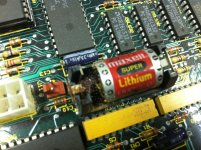
save-able?
I think this one is savable luckily, I just need to find a new battery tray... Thats the only hard part.
Who cares. Just remove the battery completely and forget about it. If you want one, you can buy replacements that have the wires already attached and can be soldered down. some of the SE units came this way.
.. and Apple IIGS, Macintosh II, IIx, IIfx, etc, etc
I never owned any of those, so I couldnt tell ya. lol.
Actually, take that back, I owned a half a dozen IIgs units that were liquidated in 1999. But i cant remember them well.
Actually, take that back, I owned a half a dozen IIgs units that were liquidated in 1999. But i cant remember them well.
It seems the removable batteries started showing up late in the SE run, and probably in the middle of the IIx run. Had a IIx board that had two PRAM battery holders instead of the soldered batteries.
A solution on those machines that have enough room, might be to use a triple AA battery holder, and three rechargeable AA batteries. Would be exactly 3.6 volts when charged up.
-J
A solution on those machines that have enough room, might be to use a triple AA battery holder, and three rechargeable AA batteries. Would be exactly 3.6 volts when charged up.
-J
and the II series had to have good batteries to turn the PS on? if i remember correctly...
I've got 3 IIgs's and the Limited Edition one has the battery on pigtails under the PSU, the other two have em in a different location in a plastic holder. And of the SE's, my old dual-drive SE and my current SE Superdrive had the soldered-on pigtail batteries too, but dad's SE FDHD had a removable Tadiran battery dated 88.
Yep. The II, IIx, and IIfx use two batteries, one for the softpower circuit, and one for the PRAM.
Sounds like the two with the plastic holders might be ROM 3 machines, or late ROM 01 machines. My old IIgs upgrade kit machine (ROM 01 version - board installed in June/July 1989) had the soldered Tadiran. Wonder if your SE Superdrive machine has an earlier board with the updated ROM chips. Both my original SE (a dual FDHD machine) and my current SE Superdrive had/have the removable batteries.
-J
ROM 01 machines all have soldered on batteries and the ROM 3 has the holder. My ROM 01 still has its original VARTA brand battery holding a charge after 25 years. 8-o
That's what I thought. Couldn't be certain, though. Yeah, one of my old 800K SE's was still trucking away, on its original Varta. Kept time, settings, everything. Was rather surprised.
-J
-J
What is your experience with the 'Saft' battery?

Yes I have also seen this, was very surprised still had its charge. Forget what machine it was in. Pretty sure it was a Macintosh SE.
They seem to be what RE-PC here in Seattle sells. Last time I used the G4 DA, it seemed to be fine, time-wise. Battery was installed prior to my buying the machine in early 2009. Was a LS14250.What is your experience with the 'Saft' battery?
-J
My turn ...

Scared by this thread, I decided to remove dead batteries from the most easily accessible in from my collection.
I removed 12, only 1 leaked, guess what brand it was...
It was in my PM 8100/80. Even the optical drive has signs of corrosion :O
Funny, the exploded/leaked Maxell battery was the newest of the 3. It had an expiration date reading 1993, while the two other had 1989 and 1990.
Those Sonnenschein Lithium batteries (the blue ones) seem to be reliable anyway.

Scared by this thread, I decided to remove dead batteries from the most easily accessible in from my collection.
I removed 12, only 1 leaked, guess what brand it was...
It was in my PM 8100/80. Even the optical drive has signs of corrosion :O
Funny, the exploded/leaked Maxell battery was the newest of the 3. It had an expiration date reading 1993, while the two other had 1989 and 1990.
Those Sonnenschein Lithium batteries (the blue ones) seem to be reliable anyway.
Another tragedy discovered today...
Quadra 610 and 660av didn't make it :'(

The mess was still liquid in the Q610 :

Funny though, another soldered Varta battery from a Mac II still showing some charge

Quadra 610 and 660av didn't make it :'(

The mess was still liquid in the Q610 :

Funny though, another soldered Varta battery from a Mac II still showing some charge

That's a real shame! Hopefully you'll be able to use some bits as spares.
Btw I believe the date printed on the batteries is the manufacturing date, not the expiry date. As far as I know expiry dates on batteries were only introduced recently.
Hopefully you'll be able to use some bits as spares.Btw I believe the date printed on the batteries is the manufacturing date, not the expiry date. As far as I know expiry dates on batteries were only introduced recently.
I believe there are good chances to save the Q610 mobo.
Concerning Q660's mobo, well I decided to get one from eBay.
Cost me US$ 81.20 with shipping and import taxes. D'oh!...
Concerning Q660's mobo, well I decided to get one from eBay.
Cost me US$ 81.20 with shipping and import taxes. D'oh!...
did you wash out the 660av
Yes.
But at least 3 capacitors are missing and lots of PCB traces are damaged as well.
Ram and CPU should be Ok though.
But at least 3 capacitors are missing and lots of PCB traces are damaged as well.
Ram and CPU should be Ok though.
Well it looks like it has the Full 040, You could sell that and recoup a good chunk of money back.
How many exploding batteries are a product of storing machines in extreme temperatures (both boiling and freezing)?