

Thread
Connecting 68k Macs to LCD Monitors
Has anyone ever tried to put together a reference to what modern LCD monitors are capable of syncing with 68k Macs? Every time that I set up one of my older machines (except for my IIci and IIx, which have really nice NuBus graphics cards), I fight to find a resolution that I can get to sync with most of my LCDs. And, I do have a wide variety of LCDs, to pick from: Dell 2001fpw, Dell 2405fpw, HP 2025, and NEC MultiSync 1980SX.
You'd think that 640x480@60Hz, separate sync, would work with just about any monitor, but it seems to not always be the case. My Quadra 605 and my Power Mac 6100 are the worst behaved, in that regard.
Any advice or pointers are welcome.
Thanks!
- Alex
You'd think that 640x480@60Hz, separate sync, would work with just about any monitor, but it seems to not always be the case. My Quadra 605 and my Power Mac 6100 are the worst behaved, in that regard.
Any advice or pointers are welcome.
Thanks!
- Alex
In a nutshell, the Mac Fixed-Res 640 x 480 @ 66.6Hz setting is LCD hostile and the 60Hz settings aren't well handled, when available at all from the Mac side, by many adapters.
Most LCDs sync at only 60Hz, a common VGA, SVGA & XGA sync rate considered flickery in the world of Big CRTs for Graphics and the Mac community in general when the standards were fluid. In the new world of LCDs, it's a different story. Some are Multi-Res to a point and some of the older ones are stellar in this regard.
Quite a bit of backup info on this is available, including a breakdown of the finicky nature of Modern Multi-Res LCDs, in these threads:
IIsiColorPivotII_PDS_Card related threads:
IIsiColorPivotII_PDS_Card_HackProject™
UNDERClocking a Video Card??????
Short-n-sweet:
Get yourself a KDS/Radius Rad-5 LCD, of one variety or other of the many styles available, and you'll be able to do just about any Mac Fixed Res, or VGA/SVGA setting up to 1024 x 768 just fine.
The KDS/RadiusKDS K715s 17" COLOR LCD MONITOR was just PayPal'd for, so I'm hoping it'll do the larger 1152 x whatever Mac TPD resolutions as well when it arrives.
I'll be posting a conquest thread about my KDS/Radius collection when the 17" one gets here and a peripherals review of them all when I get the chance.
There's a big honking 19" version, that's been listed here and there, that was not quite fugly enough not to tempt me, but it has the same native res as the more elegant 17 incher I just snagged.
Three are on the way and two are already here, but one needs work. The original dark gray one is a gem. I've got one with the gray speakers and a black one without that are already in transit. [ ] ]'>
] ]'>
Most LCDs sync at only 60Hz, a common VGA, SVGA & XGA sync rate considered flickery in the world of Big CRTs for Graphics and the Mac community in general when the standards were fluid. In the new world of LCDs, it's a different story. Some are Multi-Res to a point and some of the older ones are stellar in this regard.
Quite a bit of backup info on this is available, including a breakdown of the finicky nature of Modern Multi-Res LCDs, in these threads:
IIsiColorPivotII_PDS_Card related threads:
IIsiColorPivotII_PDS_Card_HackProject™
UNDERClocking a Video Card??????
Short-n-sweet:
Get yourself a KDS/Radius Rad-5 LCD, of one variety or other of the many styles available, and you'll be able to do just about any Mac Fixed Res, or VGA/SVGA setting up to 1024 x 768 just fine.
The KDS/RadiusKDS K715s 17" COLOR LCD MONITOR was just PayPal'd for, so I'm hoping it'll do the larger 1152 x whatever Mac TPD resolutions as well when it arrives.
I'll be posting a conquest thread about my KDS/Radius collection when the 17" one gets here and a peripherals review of them all when I get the chance.
There's a big honking 19" version, that's been listed here and there, that was not quite fugly enough not to tempt me, but it has the same native res as the more elegant 17 incher I just snagged.
Three are on the way and two are already here, but one needs work. The original dark gray one is a gem. I've got one with the gray speakers and a black one without that are already in transit. [
] ]'>
Thanks, Trash. That reason is why I have the NEC MultiSync 1980sx, as it's manual implied that it was truly a multisynchronous LCD, and should then sync to any source, within the possible clocks of the panel. However, I've found that not to be the case.
I'll start looking for a KDS/Radius LCD, though. Personal experience is definitely helpful, in this case. Much more, it seems, than the monitor specifications.
I'd love to find a VGA-to-VGA scan converter, though. That would handle all cases. The good ones seem to be pretty expensive, though. And, some, I can't find a price on, at all, like this one, which definitely supports Mac modes/frequencies: http://www.gomax-electronics.com.tw/product_show.php?show=138.
Thanks!
- Alex
I'll start looking for a KDS/Radius LCD, though. Personal experience is definitely helpful, in this case. Much more, it seems, than the monitor specifications.
I'd love to find a VGA-to-VGA scan converter, though. That would handle all cases. The good ones seem to be pretty expensive, though. And, some, I can't find a price on, at all, like this one, which definitely supports Mac modes/frequencies: http://www.gomax-electronics.com.tw/product_show.php?show=138.
Thanks!
- Alex
De Nada, try a really high quality Video Adapter, like the "Liberty" dial wheel type as a first step/flanking attack.
Again . . . as always . . . Radius ROCKED!!!!!!
. . . even in its death throes. :'(
Again . . . as always . . . Radius ROCKED!!!!!!
. . . even in its death throes. :'(
I have a few IBM T85A LCD panels which I use with my Macs. They like 1280 X 1024 @ 60 Hz the best but it also does 72Hz, 75Hz and 76Hz. Plus other frequencies at other resolutions. It even supports 832 X 624 @ 75 Hz. The color/brightness evenness on these panels is amazing. Unfortunately, the back lights are not as bright as they could be. They're good enough, but I'm tempted to try replacing the tubes to see if they're aged and dimmed or if this is as bright as they ever were.
http://support.lenovo.com/en_US/product-and-parts/detail.page?&LegacyDocID=VLAR-42RKN3
See the table of resolutions near the bottom.
User's Guide:
http://download.lenovo.com/ibmdl/pub/pc/pccbbs/options/t85aug.pdf
The T84H is similar but lacks two of the 1280 X 1024 frequencies. However, it has a DVI port, which is admittedly, not very useful in 68K Macs, but is nice if you want to have a modern computer and a legacy computer connected at the same time.
http://support.lenovo.com/en_US/product-and-parts/detail.page?&LegacyDocID=MIGR-4QDSS3
The page for the T85A claims that
I built these brackets

so that I could mount the thing on a wall mount. More images here:
http://www.prismnet.com/~trag/LCD_Bracket/
If you get a T85A somewhere you can have a mounting bracket for the cost of shipping. For reasons, I built 20 of the brackets, but I only have five of the panels. I did manage to sell one bracket on Ebay to (IIRC) a guy in Brazil many years ago.
Oh, look. You can get 100 of the later T860 model (fewer resolutions supported)
http://support.lenovo.com/en_US/downloads/detail.page?DocID=PD005055
for $2500 if you're in or near Connecticut:
http://www.ebay.com/itm/USED-LCD-Monitors-17-18-LOT-of-100-IBM-SAMSUNG-and-OTHERS-/110868023992?pt=Computer_Monitors&hash=item19d03fcab8
http://support.lenovo.com/en_US/product-and-parts/detail.page?&LegacyDocID=VLAR-42RKN3
See the table of resolutions near the bottom.
User's Guide:
http://download.lenovo.com/ibmdl/pub/pc/pccbbs/options/t85aug.pdf
The T84H is similar but lacks two of the 1280 X 1024 frequencies. However, it has a DVI port, which is admittedly, not very useful in 68K Macs, but is nice if you want to have a modern computer and a legacy computer connected at the same time.
http://support.lenovo.com/en_US/product-and-parts/detail.page?&LegacyDocID=MIGR-4QDSS3
The page for the T85A claims that
But if that thing's back meets the VESA mounting standard, it must be some part of the standard which no-one else ever used.
I built these brackets
so that I could mount the thing on a wall mount. More images here:
http://www.prismnet.com/~trag/LCD_Bracket/
If you get a T85A somewhere you can have a mounting bracket for the cost of shipping. For reasons, I built 20 of the brackets, but I only have five of the panels. I did manage to sell one bracket on Ebay to (IIRC) a guy in Brazil many years ago.
Oh, look. You can get 100 of the later T860 model (fewer resolutions supported)
http://support.lenovo.com/en_US/downloads/detail.page?DocID=PD005055
for $2500 if you're in or near Connecticut:
http://www.ebay.com/itm/USED-LCD-Monitors-17-18-LOT-of-100-IBM-SAMSUNG-and-OTHERS-/110868023992?pt=Computer_Monitors&hash=item19d03fcab8
Trash's Radius/KDS suggestion got me looking at other monitors that claim Mac support, and I noticed that my HP 2025 supports 832 x 624 @ 75 Hz and 1152 x 870 @ 75 Hz:
http://h18004.www1.hp.com/products/quickspecs/11484_div/11484_div.html
I'll have to see if I can get my current 8- or 10- switch adapters set to one of those resolutions. I can't seem to find a source for the Enhance Liberty adapters that he mentioned in the linked posts. Neither of my current adapters (Curtis and Viewsonic) have dials, but claim similar number of resolution/refresh rate combos as supported.
Thanks!
- Alex
http://h18004.www1.hp.com/products/quickspecs/11484_div/11484_div.html
I'll have to see if I can get my current 8- or 10- switch adapters set to one of those resolutions. I can't seem to find a source for the Enhance Liberty adapters that he mentioned in the linked posts. Neither of my current adapters (Curtis and Viewsonic) have dials, but claim similar number of resolution/refresh rate combos as supported.
Thanks!
- Alex
Several of the DIP switched models also work quite well.
Video Adapter Docs Scan Dump
. . . the MacVDO Docs make a great primer on the subject. [ ] ]'>
] ]'>
I recommend anything Radius, they pretty much developed Mac Video that went beyond the 9" Periscope in their role as Apple's principle OEM.
Video Adapter Docs Scan Dump
. . . the MacVDO Docs make a great primer on the subject. [
] ]'>I recommend anything Radius, they pretty much developed Mac Video that went beyond the 9" Periscope in their role as Apple's principle OEM.
I got a cheap Acer X163W LCD monitor and it syncs fine with all Macs, up to 1280x1024 @ 75 Hz -- panel is 1366x768, thus is not very sharp at such resolution, though.
The only Mac mode I can't use with it is... the 60 Hz RGB 12" mode (512 x 384)
The only Mac mode I can't use with it is... the 60 Hz RGB 12" mode (512 x 384)
How is the screen sharp/clearness @ 800x600 running on a 15" native 1024x768 screen, or a 17" native 1280x960? Are every LCD the same or is there any we should keep away from/or get?
I think the best option would be buying a 20" LCD on a native 1600x1200 resolution, because the 1:1 pixel ratio with 800x600 makes it nearly perfect.. Anyone have any experience with that?
It may be a bit more expensive and big though, you can't really use it for what's worth..
I think the best option would be buying a 20" LCD on a native 1600x1200 resolution, because the 1:1 pixel ratio with 800x600 makes it nearly perfect.. Anyone have any experience with that?
It may be a bit more expensive and big though, you can't really use it for what's worth..
It depends on the individual LCD screen, and how it does the interpolation... but don't expect miracles at any resolution other than the nominal one. My Acer monitor is not very good at this, though  For the 1600x1200 monitor, it depends too of the interpolating algorithms: a "nearest neighbour" approach may give perfect sharpness (scaled 2x), but some models could smooth it out anyway. BTW, all 17" (and 19") non-wide LCDs I know of are native 1280x1024 (5:4 ratio)
Vintage Macs have no "panoramic" modes, thus the best one for my Acer is 1024x768, which only has to be interpolated horizontally, while the vertical resolution matches the panel's resolution (768 lines). Unfortunately, this wasn't a classic Mac resolution, which went from 832x624 (16") to 1152x870 (21") -- both supported at 75 Hz by my Acer, but far from ideal sharpness. More recent machines (Quadra 700, LC475...) with a suitable adapter do support 1024x769 (aka 19")
For the 1600x1200 monitor, it depends too of the interpolating algorithms: a "nearest neighbour" approach may give perfect sharpness (scaled 2x), but some models could smooth it out anyway. BTW, all 17" (and 19") non-wide LCDs I know of are native 1280x1024 (5:4 ratio)Vintage Macs have no "panoramic" modes, thus the best one for my Acer is 1024x768, which only has to be interpolated horizontally, while the vertical resolution matches the panel's resolution (768 lines). Unfortunately, this wasn't a classic Mac resolution, which went from 832x624 (16") to 1152x870 (21") -- both supported at 75 Hz by my Acer, but far from ideal sharpness. More recent machines (Quadra 700, LC475...) with a suitable adapter do support 1024x769 (aka 19")
I use an HP L2025 (http://h18004.www1.hp.com/products/quickspecs/11484_na/11484_na.html), and it looks pretty darned good at 832x624, and 1152x870. This is a 20" LCD, 4x3 aspect ratio, that has a native resolution of 1600x1200.
The only standard Mac resolution that it won't do is 640x480@66Hz.
- Alex
The only standard Mac resolution that it won't do is 640x480@66Hz.
- Alex
I have a couple of NEC 15" LCDs about the same vintage as the MultiSync 1980sx. They support resolutions at up to 1024x768, and I've never had trouble using them with any of my Macs.
I also have an eMachines 19" widescreen that I picked up cheap last year, I got a nice surprise when I read the documentation (after buying it) and discovered that actually supports the vintage Apple oddball resolutions, such as 832x624 and 1152x870! And it puts black bars on the sides of the image rather than stretching it out. I never thought I'd find myself saying good things about an Acer/eMachines product, but well - there you go.
For what its worth, I have no idea as to model numbers and can't get them, all this stuff is at my parents' place, which is interstate.
I also have an eMachines 19" widescreen that I picked up cheap last year, I got a nice surprise when I read the documentation (after buying it) and discovered that actually supports the vintage Apple oddball resolutions, such as 832x624 and 1152x870! And it puts black bars on the sides of the image rather than stretching it out. I never thought I'd find myself saying good things about an Acer/eMachines product, but well - there you go.
For what its worth, I have no idea as to model numbers and can't get them, all this stuff is at my parents' place, which is interstate.
I guess I just have to try some of myself and see. The strange thing though is that some of the 68k machines support 1152x870, but not 1024x768. Why is that? 1024x768 is less, and if the machine have enough ram to make 1152x870 work, why not 1024 too? :-/
I've also seen 'hacks' like multi-resolutions.hqx where you could set a resolution yourself, but I don't know if this works on 68k machines. The source code was gives to a few people over at system7today (so it may be recompilable to 68k? If it's not too much ASM in it), but nobody have posted in the project thread for about 4 years now..
I don't know, but maybe the multi-resolutions extension can force it do to 1024x768 well.. or make it wide screen..
I've also seen 'hacks' like multi-resolutions.hqx where you could set a resolution yourself, but I don't know if this works on 68k machines. The source code was gives to a few people over at system7today (so it may be recompilable to 68k? If it's not too much ASM in it), but nobody have posted in the project thread for about 4 years now..
I don't know, but maybe the multi-resolutions extension can force it do to 1024x768 well.. or make it wide screen..
AFAIK, the only reason is because 1024x768 (XGA) is not a traditional 68k Mac resolution. It is amusing, though, that 1024x768 is exactly 2x the classic Macs' 512x384 resolution.
- Alex
- Alex
1024 x 768 was traditionally the Mac's 19" Resolution, but it was probably at 75Hz, which might confuse a multisync expecting it at 60Hz.
This question needs to be reworded. It is not about particular Macs but about particular video cards, which may or may not be built-in.
Ability for a video card to work with a monitor (assuming that it accepts analog input) is based on the following:
* Sync on green is weird, but it is the standard for some built-in Mac graphics cards. Work around it using an adapter that converts sync on green into something more acceptable, or use a different graphics card.
* Other sync methods have their own quirks.
* The video card needs to work with 60Hz at 640 * 480. 60Hz was the resolution for the first VGA monitors and cards, but most IBM clone manufacturers whacked it up to 70Hz for ergonomic reasons. However 60Hz is the baseline and everything should work.
* The video card needs to work with 60Hz at any resolution or some resolutions. Third party cards are more likely to achieve this than built-in graphics.
* Mac 15 pin video --> VGA 15 pin cable adapters behave differently. Collect different ones and record the switch settings for future reference.
Ability for a video card to work with a monitor (assuming that it accepts analog input) is based on the following:
* Sync on green is weird, but it is the standard for some built-in Mac graphics cards. Work around it using an adapter that converts sync on green into something more acceptable, or use a different graphics card.
* Other sync methods have their own quirks.
* The video card needs to work with 60Hz at 640 * 480. 60Hz was the resolution for the first VGA monitors and cards, but most IBM clone manufacturers whacked it up to 70Hz for ergonomic reasons. However 60Hz is the baseline and everything should work.
* The video card needs to work with 60Hz at any resolution or some resolutions. Third party cards are more likely to achieve this than built-in graphics.
* Mac 15 pin video --> VGA 15 pin cable adapters behave differently. Collect different ones and record the switch settings for future reference.
http://www.microcenter.com/single_product_results.phtml?product_id=0378636
i bought this back in the fall when it was 49 bucks, from microcenter.
looks like they are 64 bucks now,
its a great monitor, it will handle anything i throw at it!
LCI/II/III q605 / Mac IIsi / PM 6100 / 7500/100
i have a vga to db-15 adaptor with dip switches,
the IIsi will only work with the first dip setting on for 640x480,
the rest will multi sync with the second to last dip set to on.
i bought this back in the fall when it was 49 bucks, from microcenter.
looks like they are 64 bucks now,
its a great monitor, it will handle anything i throw at it!
LCI/II/III q605 / Mac IIsi / PM 6100 / 7500/100
i have a vga to db-15 adaptor with dip switches,
the IIsi will only work with the first dip setting on for 640x480,
the rest will multi sync with the second to last dip set to on.
The big question mark is the method of VGA Adaptation:
Even switched converters have their own quirks, while the switchless variety are mostly for PowerMacs, being from the MultiSync Ubiquity Era. That's a guess based upon what I've experienced in passing. I haven't read up on or tested this hypothesis.
IIfx couldn't get anything out of the Apple 24 AC Card that I sent him as part of a trade, other than baseline 640 x 480 until he bought a different adapter. Now it zooms along at all kinds of resolutions like mine do.
Even switched converters have their own quirks, while the switchless variety are mostly for PowerMacs, being from the MultiSync Ubiquity Era. That's a guess based upon what I've experienced in passing. I haven't read up on or tested this hypothesis.
IIfx couldn't get anything out of the Apple 24 AC Card that I sent him as part of a trade, other than baseline 640 x 480 until he bought a different adapter. Now it zooms along at all kinds of resolutions like mine do.
The monitor sense codes were very well thought, IMHO. First a bunch (0-6) of fixed resolutions, and the detected code (7) in the absence of monitor did halt video out. Then came the extended codes, read off a different method... from what would be seen by older cards as "7" (i.e., no monitor), avoiding damage to the unsupported monitor -- fixed freq. was rather common back in the day. 16" (832x642, 75 Hz) and 19" modes (1024x768, 75 Hz) were implemented this way.
But the funniest part was Multi-sync support: there were some extended codes for them, but the "regular" code supplied by these monitors was not 7, but 6 -- incidentally, the same as baseline 640x40 @ 66 Hz (aka 13"). Even if not supported by some certain card-OS combos, these MS monitors would work at least at that base resolution. Great!
All PPCs supported multi-sync monitors, of course; but some 68k too -- the Quadra 700, for instance. Not with any System Software, anyway.
Somewhat tangentially, I believe Apple went off from mainstream/industry standards because their "propietary" systems were easier to use: remember the fuzz of IRQ and DMA of ISA cards, compared to the (unusal back then) Plug-n-Play NuBus... even the much debated SCSI vs. IDE question has more to do with this, rather than actual performance -- which wasn't that great on Apple's DMA-less SCSI implementation :-/ I remember seeing a friend's PC (I never had such thing :b&w: ) where the number of sectors/heads/cylinders had to be set manually on the BIOS xx( And "they" had no possibilty of external HDs until the advent of USB, and then so at the sluggish 1.1 speeds... But as soon as Logical Block Addressing à la SCSI became common on IDE disks, Apple started using them for our convenience (and their profit)
But the funniest part was Multi-sync support: there were some extended codes for them, but the "regular" code supplied by these monitors was not 7, but 6 -- incidentally, the same as baseline 640x40 @ 66 Hz (aka 13"). Even if not supported by some certain card-OS combos, these MS monitors would work at least at that base resolution. Great!
All PPCs supported multi-sync monitors, of course; but some 68k too -- the Quadra 700, for instance. Not with any System Software, anyway.
Somewhat tangentially, I believe Apple went off from mainstream/industry standards because their "propietary" systems were easier to use: remember the fuzz of IRQ and DMA of ISA cards, compared to the (unusal back then) Plug-n-Play NuBus... even the much debated SCSI vs. IDE question has more to do with this, rather than actual performance -- which wasn't that great on Apple's DMA-less SCSI implementation :-/ I remember seeing a friend's PC (I never had such thing :b&w: ) where the number of sectors/heads/cylinders had to be set manually on the BIOS xx( And "they" had no possibilty of external HDs until the advent of USB, and then so at the sluggish 1.1 speeds... But as soon as Logical Block Addressing à la SCSI became common on IDE disks, Apple started using them for our convenience (and their profit)
Oh, yes. Into the Pentium era (I think some were auto-detecting by this time), if you wanted to install a new hard drive, you better copy down the sectors/heads/cylinder numbers written on the drive before putting it in the machine. Then configure the BIOS at start up so it would recognize the drive. Then run DOS so you could run Fdisk to partition the disk and then initialize it and assign it a fixed drive letter. Woe unto you if you were in a network environment in which networked volumes started at F: and you had a more than three hard drive devices (two hard drives and one optical drive, e.g.).
Blech.
The differences were compelling in those days, unlike now, where I often prefer to use my Windows XP laptop over using my OSX desktop machine. I can't really see an ease of use advantage in one over the other. In OSX Apple made everything just as much of a pain in the posterior as it is in Windows.
OH JEEZ. I used to hate entering drive parameters... especially if you forgot them, especially back then. You had to call the HD company to get the parameters.
Stickied.
There was a top tip in that rant, Jeff. For lots of drives the BIOS parameters are on the label on the top side, so write them down before you install the disk. Then write them down in that exercise book that you use to record all of your installation procedures.
Auto hard disk detection was probably a Pentium II-era feature. You had the option of LBA (Logical Block Addressing) for automatic detection or the painful way. The two cannot be mixed and you can't reliably swap a disk between different PCs.
When installing a disk in a vintage PC, assigning a drive letter is and was a bad thing to do. Let the horrible device make its own horrible decisions. Then sort out the horrible software that looks for a particular drive letter.
Drive letter F: was a choice determined by Novell in the late 1980s. Drive F: was the NetWare logon server volume and in common NetWare usage, it was used for the home directory. Smarter people re-mapped other drive letters to the NetWare home directory so that it was possible to log on to more than one NW server. But the last letter on the line was drive E:.
To be fair to Novell, they made that choice (late 1980s?) when it seemed unlikely that letters A to E would be filled. I think that they changed the drive F: logon volume requirement with NetWare 4 (early/mid 1990s) but that was not a solution for people with lots of old clients. And too late.
Microsoft twigged the problem too. LASTDRIVE in CONFIG.SYS specified the last allowable drive letter, and in non-Novell environments LASTDRIVE was Z. I didn't spend too much time with Microsoft's server offerings before Windows 2000 so I can't comment much, but with Windows 2000 it was clear that you mapped backwards from Z.
Actually, ISTR that auto-detection was a Pentium-1 era feature - most, if not all the Socket7 boards I've had have supported it.
My 486 board supports auto-detection. Though it would be a little late as it came with an AM486DX4-100. I am not sure how early 486 boards started supporting auto detection.
I guess that we are all right and all wrong.
The eras described below are very approximate and experience would vary depending on whether you bought PC junk or not.
Early 386 and prior: Cylinder Head and Sectors needed to be entered manually most of the time. Automatic CHS identification was emerging.
Early 486 and prior: Cylinder Head and Sectors needed to be entered manually some of the time. The BIOS could not always work them out for you. See http://en.wikipedia.org/wiki/Cylinder-head-sector
Later 486 (VL-Bus times) and early Pentium 1: The BIOS would make an even better stab at determining CHS values. If you installed a big disk, say 500MB+, manual assistance was required.
1996 onwards, so presumably later Pentium 1: LBA addressing was invented. Automatic identification started to work properly.
The eras described below are very approximate and experience would vary depending on whether you bought PC junk or not.
Early 386 and prior: Cylinder Head and Sectors needed to be entered manually most of the time. Automatic CHS identification was emerging.
Early 486 and prior: Cylinder Head and Sectors needed to be entered manually some of the time. The BIOS could not always work them out for you. See http://en.wikipedia.org/wiki/Cylinder-head-sector
Later 486 (VL-Bus times) and early Pentium 1: The BIOS would make an even better stab at determining CHS values. If you installed a big disk, say 500MB+, manual assistance was required.
1996 onwards, so presumably later Pentium 1: LBA addressing was invented. Automatic identification started to work properly.
Not to nudge this back onto topic or anything . . .  )
)
. . . I just ordered the last (hopefully) of my Radius LCD Collection. It's another 15" LCD, this time it's the RAD-5q variant. Same Mac/PC Compatibility, but an interesting case design that lends itself to a certain hack in the planning stages.
These things are great!
) . . . I just ordered the last (hopefully) of my Radius LCD Collection. It's another 15" LCD, this time it's the RAD-5q variant. Same Mac/PC Compatibility, but an interesting case design that lends itself to a certain hack in the planning stages.
These things are great!
Trash wrote:
The price of diversification was loss of focus and Radius were in trouble financially from late 1992 onwards. Radius fizzled out rather than ending abruptly. The SuperMac brand name was licensed to Umax for its range of PowerPC Mac clones in 1996, and support for legacy graphics cards and accelerators was spun off to a company called Radius Vintage (now defunct). In January 1999, Radius was relaunched as Digital Origin, specialising in digital video editing products, only to be purchased by Media 100 in December 1999. Pivot display technology was retained by Portrait Displays, a spin off company founded by Radius in 1993.
I'm presuming that your monitor is from Korean Data Systems (KDS). How does the Radius branding work?
Give us a hand then. My notes about the end of Radius:
The price of diversification was loss of focus and Radius were in trouble financially from late 1992 onwards. Radius fizzled out rather than ending abruptly. The SuperMac brand name was licensed to Umax for its range of PowerPC Mac clones in 1996, and support for legacy graphics cards and accelerators was spun off to a company called Radius Vintage (now defunct). In January 1999, Radius was relaunched as Digital Origin, specialising in digital video editing products, only to be purchased by Media 100 in December 1999. Pivot display technology was retained by Portrait Displays, a spin off company founded by Radius in 1993.
I'm presuming that your monitor is from Korean Data Systems (KDS). How does the Radius branding work?
Yep, IIRC, the monitor business was apparently sold off to Korea Data Systems Co., LTD.
Mac Implementation seems spotty in terms of the connectors, the first one I picked up was the sweet little KDS Radius RAD-5b. It's allegedly Black, but it's actually just a couple of shades darker than PowerBook Duo Gray. It has a metal plate covering the DA-19 port moulded into the back bezel and has only the HD-15 connector implemented.
While almost the entire series seems to have been tagged with the Rad-5, 7 and 9 model numbers, 15, 17 and 19 inch diagonals respectively, the Radius Branding on the front bezels seems to have been a bit spotty.
So far, I've received three beautiful, and beautifully working, LCDs along with one non-functional, but probably repairable LCD and one that might be a dumped lemon, but I got all my money back for that one.
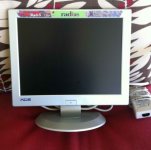
This is a non-functional unit that had tested as good, (w/pic of it working posted in the auction) from a reputable seller who was very concerned that it didn't work when received. But it was well packed and shipped in good faith, no problem! Haven't had a chance to crack the case for testing yet, but the AC adapter works fine.
While there's no logo on the lower right, somehow I think they were pushing the LCD's Radius heritage, the banner sticker is a little worn though.
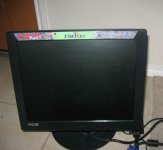
This is a beautifully working Black Rad-5 specimen, same model as the silver version above. It's a true, glossy black rather than the PB Grayer shade, so it matches up with modern KBDs and mice quite nicely.
While there's no logo on the lower right, the Radius marketing sticker is in perfect condition.
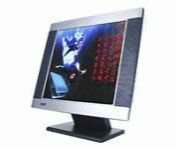
This is a non-functional unit I received without the AC Adapter, in MUCH too small a box with a dinged corner. This from a 100% rated, but very low feedback seller who never responded regarding my problems with the LCD. I opened a case and got a prompt refund, which funded this latest order. One day I'll figure out how to get money back out of my PayPal Account, but there's no hurry with so many wonderful toys available on eBay! [] ]'> Stock photo + low volume feedback = not a chance ever again!
You can't see it in the stock photo, but it has a beautiful monochrome blue Radius logo on the corner opposite the KDS logo.
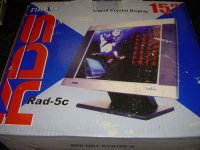
Heh! found the one I was watching that sold (used) in the box! Forgot to bid. :-/
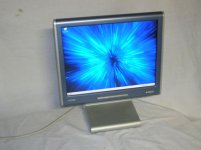
Latest acquisition, funded by the returned money from the no-goodnik mentioned above, who shall remain unidentified per the rules.
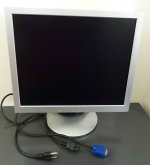
This is the prettiest and most useful of my KDS Radius LCD collection. I'm not sure if they'd dropped the Radius marketing ploy by this time or not. I'll have to check dates of mfr. on all the units when I get the "last one" here and tested. This one has 17" @ 1280 x 1024 x 24bits of Radius Heritage goodness and the 1152 x 8xx pixel settings scale very nicely on it.
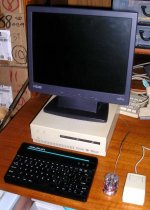
This is the one that started it all, I saw that beautiful gray coloring on an LCD with a Radius Logo and just had to have it! It's lovely and it has earned its keep and then some as the monitor of choice in my quest to build the SuperIIsi™ Hack and for testing in the Radius Color Pivot II/IIsi VidCard Hacks Project. I love the design's relatively thin bezel surrounding the LCD.
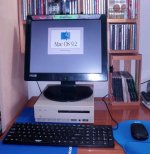
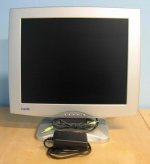
This is the 19" beast I'm hoping someone else grabs before I can no longer resist temptation. The only thing holding me back (besides the $$$$$$$$$ ) is the fact that the resolution is the same as my 17" beauty. Still, it's a great LCD Monitor to pair with an older Mac . . .
. . . thank goodness it doesn't have the Radius Logo on the corner . . . }
There are some White Rad-5 LCDs kicking around on eBay with speakers built into the base, but their design doesn't appeal to me.
Were you looking for some other kind of help? :?:
Mac Implementation seems spotty in terms of the connectors, the first one I picked up was the sweet little KDS Radius RAD-5b. It's allegedly Black, but it's actually just a couple of shades darker than PowerBook Duo Gray. It has a metal plate covering the DA-19 port moulded into the back bezel and has only the HD-15 connector implemented.
While almost the entire series seems to have been tagged with the Rad-5, 7 and 9 model numbers, 15, 17 and 19 inch diagonals respectively, the Radius Branding on the front bezels seems to have been a bit spotty.
So far, I've received three beautiful, and beautifully working, LCDs along with one non-functional, but probably repairable LCD and one that might be a dumped lemon, but I got all my money back for that one.
This is a non-functional unit that had tested as good, (w/pic of it working posted in the auction) from a reputable seller who was very concerned that it didn't work when received. But it was well packed and shipped in good faith, no problem! Haven't had a chance to crack the case for testing yet, but the AC adapter works fine.
While there's no logo on the lower right, somehow I think they were pushing the LCD's Radius heritage, the banner sticker is a little worn though.
This is a beautifully working Black Rad-5 specimen, same model as the silver version above. It's a true, glossy black rather than the PB Grayer shade, so it matches up with modern KBDs and mice quite nicely.
While there's no logo on the lower right, the Radius marketing sticker is in perfect condition.
This is a non-functional unit I received without the AC Adapter, in MUCH too small a box with a dinged corner. This from a 100% rated, but very low feedback seller who never responded regarding my problems with the LCD. I opened a case and got a prompt refund, which funded this latest order. One day I'll figure out how to get money back out of my PayPal Account, but there's no hurry with so many wonderful toys available on eBay! [
] ]'> Stock photo + low volume feedback = not a chance ever again!You can't see it in the stock photo, but it has a beautiful monochrome blue Radius logo on the corner opposite the KDS logo.
Heh! found the one I was watching that sold (used) in the box! Forgot to bid. :-/
Latest acquisition, funded by the returned money from the no-goodnik mentioned above, who shall remain unidentified per the rules.
This is the prettiest and most useful of my KDS Radius LCD collection. I'm not sure if they'd dropped the Radius marketing ploy by this time or not. I'll have to check dates of mfr. on all the units when I get the "last one" here and tested. This one has 17" @ 1280 x 1024 x 24bits of Radius Heritage goodness and the 1152 x 8xx pixel settings scale very nicely on it.
This is the one that started it all, I saw that beautiful gray coloring on an LCD with a Radius Logo and just had to have it! It's lovely and it has earned its keep and then some as the monitor of choice in my quest to build the SuperIIsi™ Hack and for testing in the Radius Color Pivot II/IIsi VidCard Hacks Project. I love the design's relatively thin bezel surrounding the LCD.
This is the 19" beast I'm hoping someone else grabs before I can no longer resist temptation. The only thing holding me back (besides the $$$$$$$$$ ) is the fact that the resolution is the same as my 17" beauty. Still, it's a great LCD Monitor to pair with an older Mac . . .
. . . thank goodness it doesn't have the Radius Logo on the corner . . . }
There are some White Rad-5 LCDs kicking around on eBay with speakers built into the base, but their design doesn't appeal to me.
Were you looking for some other kind of help? :?:
Used EIZO L365 monitors are available for a few bucks, still. Shape and colour of the case matches well the ancient Mac's design. Supported resolutions are from 640x480 up to the native resoulution of 1024x768, which is nice to use with the image diagonal of 15" (37.5 cm). It has VGA and DVI input connectors and inbuilt stereo speakers. Some of the non-Sony CRT equipped Apple displays use a connecting cable with a VGA-style DSub connector at one end and a Mac-style DSub connector at the other end. The L365 + such cable make a perfect companion for old Macs. Find details in the FlexScan L365 User's Manual.