

Thread
Connecting 68k Macs to LCD Monitors
That was MORE than enough information, Trash. But thanks a lot for the photos that show the Radius branding.
I am coming from a UK perspective and Radius didn't have much presence outside graphics shops or science. Radius was not a brand name that monitor purchasers would have recognised in, say, 1990. Would have that perception been different in the USA? KDS assumed that, but what do Americans recall?
I am coming from a UK perspective and Radius didn't have much presence outside graphics shops or science. Radius was not a brand name that monitor purchasers would have recognised in, say, 1990. Would have that perception been different in the USA? KDS assumed that, but what do Americans recall?
Radius wasn't well known here in the States as a consumer or even prosumer brand. I'm not sure they ever even made a mid-market model CRT Monitor, maybe the Pivots?
Dunno, they were always high-end, high-cost of entry displays for productivity in the most demanding markets. The Radius FPD & TPD, with their interfaces wedged onto the 68000 "PDS" in the Plus, gave Aldus PageMaker (and CAD packages for the Mac) a leg up in turning desktop publishing into a workable solution. This combination dragged the Mac into profitability for Apple. When the SE hit the market with a "real" 68000 PDS, Radius was right there, leading the way with Co-Pro equipped 68020 Accelerators. By the time the FDHD ROMs/Upgrade Kit hit the Mac II, Radius was already hip deep in the 68040 Rocket Project.
I wouldn't doubt that Radius OEM'd more Apple Portrait Displays and Apple Two Page Displays than they sold under their own branding. In the days of the development of the Mac's Video Output Standards, it was a Radius/Apple project from what I recall. It'd be interesting to find out how many of the TriniTrons with Apple Logos on board were OEM'd by Radius? Dunno, several other mfrs. joined the fray and diluted the market. Radius wound up snapping them up as they failed during the climb of high volume SVGA CRT offerings out of the gutter and into the "usable" category in terms of quality of output and size. ViewSonic, NEC and Sony itself come to mind. It was pretty much all over for Radius by the time the 17" SVGA CRT started to become the "standard" for business computers.
I didn't pay much attention to the VidCap offerings that wound up Radius' main line of development for long term survival, but I made my living running their Acelerators and using their B1G@$$ Displays. [ ] ]'>
] ]'>
edit: I'm fairly certain that KDS wanted the Radius Brand (and probably their LCD Controller Technology) for its High-End reputation. A couple of the comrades from oz commented on how great these were when they were in their prime and the period specific reviews I've read have all pretty much been raves.
Dunno, they were always high-end, high-cost of entry displays for productivity in the most demanding markets. The Radius FPD & TPD, with their interfaces wedged onto the 68000 "PDS" in the Plus, gave Aldus PageMaker (and CAD packages for the Mac) a leg up in turning desktop publishing into a workable solution. This combination dragged the Mac into profitability for Apple. When the SE hit the market with a "real" 68000 PDS, Radius was right there, leading the way with Co-Pro equipped 68020 Accelerators. By the time the FDHD ROMs/Upgrade Kit hit the Mac II, Radius was already hip deep in the 68040 Rocket Project.
I wouldn't doubt that Radius OEM'd more Apple Portrait Displays and Apple Two Page Displays than they sold under their own branding. In the days of the development of the Mac's Video Output Standards, it was a Radius/Apple project from what I recall. It'd be interesting to find out how many of the TriniTrons with Apple Logos on board were OEM'd by Radius? Dunno, several other mfrs. joined the fray and diluted the market. Radius wound up snapping them up as they failed during the climb of high volume SVGA CRT offerings out of the gutter and into the "usable" category in terms of quality of output and size. ViewSonic, NEC and Sony itself come to mind. It was pretty much all over for Radius by the time the 17" SVGA CRT started to become the "standard" for business computers.
I didn't pay much attention to the VidCap offerings that wound up Radius' main line of development for long term survival, but I made my living running their Acelerators and using their B1G@$$ Displays. [
] ]'>edit: I'm fairly certain that KDS wanted the Radius Brand (and probably their LCD Controller Technology) for its High-End reputation. A couple of the comrades from oz commented on how great these were when they were in their prime and the period specific reviews I've read have all pretty much been raves.
Trash wrote:
We could make a good guess based on serial numbers. For the 17" Trinitrons, my guess is that they were OEMed by Sony (I sent my last one to recycling years ago, so I can't check). The same would apply to large displays used by Sun, RasterOps, SuperMac et al.
Sony made every Trinitron Tube, but I'm not sure when Apple started manufacturing their own displays using CRTs from vendors/parts suppliers like Sony. Radius OEM'd the Large Grayscale Displays for Apple, dunno who made the tubes for those.
Sony wouldn't be considered the OEM for the display mfr's you mentioned unless they made the entire package, which seems doubtful to me. There was too much variation in feature sets and quality of the remainder of the parts used to build these displays.
Dunno, just an interesting question to me. The only 17" Trinitron I have ever had is a Sony! )
)
Who used the shadow mask tube technology, Matsushita?
Sony wouldn't be considered the OEM for the display mfr's you mentioned unless they made the entire package, which seems doubtful to me. There was too much variation in feature sets and quality of the remainder of the parts used to build these displays.
Dunno, just an interesting question to me. The only 17" Trinitron I have ever had is a Sony!
) Who used the shadow mask tube technology, Matsushita?
Sony UK sent a van to pickup AppleVision 1710s when we had a collection that needed servicing. I suspect that Sony were heavily involved in the manufacture but I don't have the time to investigate further.
Shadow mask seems to have emerged at Mitsubishi (see http://www.google.com/patents/US4973879) but it was later used with aperture grills. ViewSonic used the tech well in the late 1990s and I recall them using Mitsubishi branding.
Apple sold a 15" shadow mask monitor in the mid 1990s that was reasonable -- not Sony quality, not a goldfish bowl. I think Hitachi were the OEM.
Shadow mask seems to have emerged at Mitsubishi (see http://www.google.com/patents/US4973879) but it was later used with aperture grills. ViewSonic used the tech well in the late 1990s and I recall them using Mitsubishi branding.
Apple sold a 15" shadow mask monitor in the mid 1990s that was reasonable -- not Sony quality, not a goldfish bowl. I think Hitachi were the OEM.
I've got a 6100 (regrettably, out of order) that I've used before with an older Dell 15" monitor (I can go find the model # if anyone cares). I think it was one of the resolution s mentioned below, 832x624 or 1152x870 that worked at maybe 70/75hz. One of those somewhat generic adapters with the 8+ dip switches -- works both for my LCII and the Performa. My adapter came with a little pamphlet explaining the switch settings and required a bit of fiddling to find the right one (probably ought to label that come to think of it).
Something tells me that it's the older models with smaller screens that work the best. I know my 19" won't go lower than 800x600 if that. Really, if you have old macs, you might as well use a CRT (if you can't easily find an LCD) since it will probably tolerate those odd resolutions and frequencies better.
If we just make a list of all the monitors everyone has that works and at what resolutions and frequencies that would probably cover some ground.
Something tells me that it's the older models with smaller screens that work the best. I know my 19" won't go lower than 800x600 if that. Really, if you have old macs, you might as well use a CRT (if you can't easily find an LCD) since it will probably tolerate those odd resolutions and frequencies better.
If we just make a list of all the monitors everyone has that works and at what resolutions and frequencies that would probably cover some ground.
I live near a Microcenter. What is the Dell model number of this monitor?
For some reason, Microcenter doesn't list the number.
It's probably an UltraSharp 1707 or 1708.
Really, any UltraSharp 170xFP or 150xFP would be worth investigating and buying. For those who want to purchase new, the Dell P170 and P190 are more or less the same display, but at 17 and 19-inch sizes, instead of 15 and 17-inch sizes.
I have a 1505FP that I eventually intend to hook up to my 840av or Q610, using that should be nearly identical to using the original 15-inch LCD Apple Studio Display.
Really, any UltraSharp 170xFP or 150xFP would be worth investigating and buying. For those who want to purchase new, the Dell P170 and P190 are more or less the same display, but at 17 and 19-inch sizes, instead of 15 and 17-inch sizes.
I have a 1505FP that I eventually intend to hook up to my 840av or Q610, using that should be nearly identical to using the original 15-inch LCD Apple Studio Display.
I picked up several 15" Dell E153FPF monitors from a company that was going out of business, as well as an E170S. I've tried both models on my Quadra 840AV with one of those adapters that has the dip switches, and nothing seems to work. I've gone thru the gamut of settings on the dip switches (it has the switch settings printed on the back).
Anyone have any luck getting these screens to work on old Macs?
Anyone have any luck getting these screens to work on old Macs?
I just got 2 Phillips 150S5FG LCD monitors for $17 each. They appear to work perfectly with a regular dip switch adapter.
1024x768 @ 60Hz-75Hz, VGA connector, internal power supply, white in color. Match pretty well. Looks great using my Precision Color Pro 24X, full 1024x768 @ Millions.
1024x768 @ 60Hz-75Hz, VGA connector, internal power supply, white in color. Match pretty well. Looks great using my Precision Color Pro 24X, full 1024x768 @ Millions.
I had a 486 DX2-66 with auto detection, that was one of the earliest though. Previously you'd just enter the information printed on top of the drive, it was not particularly hard, but certainly less elegant than the Apple hardware of the era. Both systems had advantages and disadvantages. I was always a PC guy back in the day, but I do love the vintage Macs, they were in many ways ahead of their time.
Here's my LCD. 
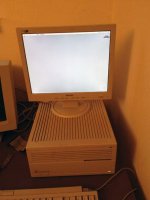
Although I haven't tested on a 68k, I hooked a PowerBook 3400c to an ASUS V198 20" LCD monitor (which I bought new this year) and seems to work well.

When my ps3 gave me crap about a burned DVD, used the powerbook g3 hooked to a 46" tv and it was just fine }
Although I haven't tried a 68k mac hooked to an LCD yet, a while back we had a Atari Falcon hooked to an LCD TV via a rigged composite cable my buddy soldered up.
No problems with the little 15" LG monitor I use in the basement for my G4 mini. hooked IIci up to it with just a regular mac to vga adaptor and it worked
crappy iPhone shot (No, I had not wiped the HDD yet either )
)

crappy iPhone shot (No, I had not wiped the HDD yet either
)
Has anyone tried the Apple Multiscan 15 display cable? I ask because the Multiscan 15 is VGA in the back but the cable converts it to the Apple Video Port. I have one unit, but two cables and I think this could be the most painless option to connect an LCD monitor.
GERI's desktop was FANTABULOUSSSSSSSS! )
) I just tried it. It's missing a pin or something compared to a regular VGA cable. When I plug it in, the image comes out washed to the point of almost grayscale, and the contrast is shot. I tried two different Apple cables with the same results.
Trash80, what is the keyboard in this shot?

olePigeon, I love the way your LCD matches the look of the IIci - what make & model is it?
olePigeon, I love the way your LCD matches the look of the IIci - what make & model is it?
http://vintagecomputer.com/dauphin-dtr-1-pen-tablet.html 
NIB off eBay for a song from someone who had a batch of them. I followed Pen Computing back in the day. Vertical market solutions have always been intriguing to me. We've come a very long way . . . hardware and gui-wise . . .
. . . but a KBD is still a necessity. :lol:
It looks like someone else has already made good use of a similar KBD in a display hack!
http://www.ebay.com/itm/ws/eBayISAPI.dll?ViewItem&item=200866277029
NIB off eBay for a song from someone who had a batch of them. I followed Pen Computing back in the day. Vertical market solutions have always been intriguing to me. We've come a very long way . . . hardware and gui-wise . . .
. . . but a KBD is still a necessity. :lol:
It looks like someone else has already made good use of a similar KBD in a display hack!
http://www.ebay.com/itm/ws/eBayISAPI.dll?ViewItem&item=200866277029
What mac is that? That's what I'm wondering. I know you mentioned IIsi but I have only seen fat ones? :O
I think what he has the monitor on is a apple cd caddy cdrom. Looks like it could be a mac but pretty sure thats what it looks like.
Yep that's the Apple CD-SC. It wasn't working and the ATOM NetTop board was in need of a home, so it almost took up residence in there. I think the case is back in the project box with its bits, slated to for reassembly.
It looked like a Snow White Design Language Mac Mini to me at the time, so naturally, I was looking for a set of black peripherals. Couldn't find my black Belkin mini-mouse, so the tiny clear one stood in for it, the tombstone mouse is there for scale. I think the ATOMICmini has finally found a home in the ZipPlus, dunno, I've got another six months to go before that project is overdue for completion, the ATOM, not the ZipPlus . . .
. . . the MoBo I got eighteen months ago. :I
It looked like a Snow White Design Language Mac Mini to me at the time, so naturally, I was looking for a set of black peripherals. Couldn't find my black Belkin mini-mouse, so the tiny clear one stood in for it, the tombstone mouse is there for scale. I think the ATOMICmini has finally found a home in the ZipPlus, dunno, I've got another six months to go before that project is overdue for completion, the ATOM, not the ZipPlus . . .
. . . the MoBo I got eighteen months ago. :I
My LCDs are Phillips 150S5FG.
This doesn't get enough attention. The sense code implementation is the main reason a lot of LCD monitors won't work with Compacts, even when they are nominally capable of appropriate sync rates. The Mac video chip is programmed to be adaptive, but to shut down if it doesn't recognise an acceptable static pattern on the 3 sense lines. Monitors with advanced VGA standard implementation will try to send a serial ID code over just one of those sense lines, and that can spook the Mac adapter into shutting down or sending the wrong sync signals. The monitors that work will be the ones that have VGA firmware that can detect an adapter mode that requires the deprecated passive ID sense codes, and to switch off the serial ID signal.
It's a mystery to me how the dip-switch adapter plugs handle this without any active electronics. They have to fool the Mac into believing the monitor has acceptable specs, and then rely on the monitor firmware to recognise the sync and adapt resolution to match. That's probably why success is a bit hit and miss.
Rick
I've just found another 17" LCD that works straight up and no fuss
Samsung Syncmaster 740A. ($15 from recycler)
This is a really good unit with telescopic stand for height adjustment and good onscreen menu.
Whatever upscaling it did, it had no problem at all with the 66Hz sync.
I wonder if we should start a list somewhere (a wiki, perhaps?) where people can add to the list any LCD monitors that they have been able to connect with a basic adapter. It could save others quite a bit of time and encourage saving of such monitors.
[bTW - mods.. when I access the wiki pages I just see plain text with basic HTML format, no style-sheet presentation. Is there a problem with the style-sheet or forum software there??]
Samsung Syncmaster 740A. ($15 from recycler)
This is a really good unit with telescopic stand for height adjustment and good onscreen menu.
Whatever upscaling it did, it had no problem at all with the 66Hz sync.
I wonder if we should start a list somewhere (a wiki, perhaps?) where people can add to the list any LCD monitors that they have been able to connect with a basic adapter. It could save others quite a bit of time and encourage saving of such monitors.
[bTW - mods.. when I access the wiki pages I just see plain text with basic HTML format, no style-sheet presentation. Is there a problem with the style-sheet or forum software there??]
Someone posted a link to a table of the sense-coding setup somewhere, there is one diode involved in the mix, however active you want to call something that simple.
I'll see if i can find it. Sounds like something I'd snag for local backup. }
I've got three 14" lcds (1024x768 native) that I use with my Macs. The last one I bought I paid $10 for from a pawn shop - it's a Dell. The others are an HP & a no-name. They all worked well with my Quadra 605.
I've found that the issue is usally with the adapter not the monitor. For the Q605 make sure you have 1 MB VRAM (two video modules installed) and it will do 1024 x 768 with no issues. Both Sys 7.5.5 & OS 8.1. If you hare having issues get a different video adapter with switches & set them for 1024x768.
I've found that the issue is usally with the adapter not the monitor. For the Q605 make sure you have 1 MB VRAM (two video modules installed) and it will do 1024 x 768 with no issues. Both Sys 7.5.5 & OS 8.1. If you hare having issues get a different video adapter with switches & set them for 1024x768.
I must admit, this topic has me hugely confused!
I'm thinking about getting an LCD monitor for my LC475, both to take advantage of higher resolutions and against the inevitable day when my CRT packs in. The gist of this thread (from what I can make out) is that many LCD monitors don't work properly with 68k Macs, even with the appropriate Mac/VGA adapter. Is this the case?
I have my eye on an old Dell E151FPp monitor on ebay (1024x728 @ 75Hz native resolution). Is this likely to work, or will it require technical jiggery pokery?
I'm thinking about getting an LCD monitor for my LC475, both to take advantage of higher resolutions and against the inevitable day when my CRT packs in. The gist of this thread (from what I can make out) is that many LCD monitors don't work properly with 68k Macs, even with the appropriate Mac/VGA adapter. Is this the case?
I have my eye on an old Dell E151FPp monitor on ebay (1024x728 @ 75Hz native resolution). Is this likely to work, or will it require technical jiggery pokery?
Many VGA LCDs only sync @ 60Hz, which is a problem with many Macs which don't put out a 60Hz resolution. MultiSync type LCDs work with traditional Mac resolutions/sync rates.
You've got me curious about your report on the Q605:
As for 1024 x 768 @ 75Hz, Macs can run this @ 60, 67 & 75 Hz rates, depending on the Mac. Some will output @ 75Hz while others won't IIRC. A lot depends upon when the Mac was introduced. VGA and Mac resolutions/sync rates developed in parallel, converging as time passed. In much of the 68k Mac history, 60Hz was considered flickery on a CRT, which isn't an issue for LCDs. By the Quadra era VGA resolutions began to be supported by Macs.
edit: has anyone got a link to Mac resolution/scan rate chart? The closest thing I could find online was:
http://home.earthlink.net/~gamba2/vid-mon-matrix.html (bottom of page)
You've got me curious about your report on the Q605:
Did you try running it at 800 x 600?re. the 605 said:
As for 1024 x 768 @ 75Hz, Macs can run this @ 60, 67 & 75 Hz rates, depending on the Mac. Some will output @ 75Hz while others won't IIRC. A lot depends upon when the Mac was introduced. VGA and Mac resolutions/sync rates developed in parallel, converging as time passed. In much of the 68k Mac history, 60Hz was considered flickery on a CRT, which isn't an issue for LCDs. By the Quadra era VGA resolutions began to be supported by Macs.
edit: has anyone got a link to Mac resolution/scan rate chart? The closest thing I could find online was:
http://home.earthlink.net/~gamba2/vid-mon-matrix.html (bottom of page)