

Thread
SCSI to IDE, z-80 conv:Prototype, looking for a project lead
Subject: Re: SCSI to IDE/SD bridge board project
Date: December 4, 2012 11:21:32 PM EST
To: RobJ , jwsmail@jwsss.com, douglas_goodall@mac.com, Andrew Lynch
|| There are many sources for the PLCC-44 sockets and Z80 CPU.
I was sure there would be; I was just having trouble finding them - and
being reasonably sure what I'd found was the right thing.
|| Here is Jameco, Digikey, and Futurlec links but are probably also
|| available locally or through any other electronic supply house.
Thank you! The Web URLs themselves are of little use (Jameco and
Digikey, in particular, have improved their websites to the point where
they refuse to work at all for me; Futurlec may work, even though
they're in the US - I need to investigate further), but the part
numbers embedded within some of them are very helpful.
|my personal expertise pretty much ends at assembling a pcb, that I
|can do. as far as firmware, I would be pretty much useless, unless
|someone is motivated enough to teach me a few things. That would
|probably detract from the current progress on this project.
Well, speaking personally, the project is not "get this piece of
electronics working as soon as possible, everything else can fall by
the wayside". I consider things like helping you people to the extent
that I can and you want to to be a perfectly fine part of it.
/~\ The ASCII Mouse
\ / Ribbon Campaign
X Against HTML mouse@rodents-montreal.org
/ \ Email! 7D C8 61 52 5D E7 2D 39 4E F1 31 3E E8 B3 27 4B
Date: December 4, 2012 11:21:32 PM EST
To: RobJ , jwsmail@jwsss.com, douglas_goodall@mac.com, Andrew Lynch
|| There are many sources for the PLCC-44 sockets and Z80 CPU.
I was sure there would be; I was just having trouble finding them - and
being reasonably sure what I'd found was the right thing.
|| Here is Jameco, Digikey, and Futurlec links but are probably also
|| available locally or through any other electronic supply house.
Thank you! The Web URLs themselves are of little use (Jameco and
Digikey, in particular, have improved their websites to the point where
they refuse to work at all for me; Futurlec may work, even though
they're in the US - I need to investigate further), but the part
numbers embedded within some of them are very helpful.
|my personal expertise pretty much ends at assembling a pcb, that I
|can do. as far as firmware, I would be pretty much useless, unless
|someone is motivated enough to teach me a few things. That would
|probably detract from the current progress on this project.
Well, speaking personally, the project is not "get this piece of
electronics working as soon as possible, everything else can fall by
the wayside". I consider things like helping you people to the extent
that I can and you want to to be a perfectly fine part of it.
/~\ The ASCII Mouse
\ / Ribbon Campaign
X Against HTML mouse@rodents-montreal.org
/ \ Email! 7D C8 61 52 5D E7 2D 39 4E F1 31 3E E8 B3 27 4B
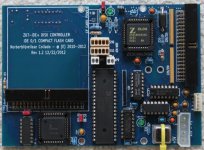
I’m very aware of the board capabilities and that is using sudo-DMA. I have the Z53C80 working on my Heathkit system (picture attached) using the sudo-DMA capability but it is running under the 8051 core.
On 1/6/13 4:12 PM, "alan@alanlee.org" wrote:
Few clarifications:
1) There is no termination - passive or active - on the current board design. You will need to use external termination resistor packs at the ends of the chain.
2) The Z53C80 is essentially just a PHY. It has no intelligence beyond a simple DMA initiator and counter to allow a bus master to sequentially clock out/in a series of data bytes to/from the bus. Beyond that it presents just a simple register interface to allow cycle status to be read and set and generate an interrupt on change.
3) The DMA feature is not connected as there is no DMA engine on the current board.
Bascially it's a Z80, 32K RAM, 32K ROM, UART, SCSI PHY, and bit-bangable IDE, SD card, and SCSI.
-Alan
On January 6, 2013 at 6:53 PM Norberto Collado wrote: > Hello Andrew, > > How much it will cost to get a SCSI2IDE pcb board along with the external > termination and any rework instructions? If you are planning to spin the > board, please add the termination resistors along with the termination > diode. Also add a 3 POSITION 6 PIN SLIDE DIP SWITCH to select target SCSI ID > during arbitration if possible. The target ID could be code hardwire and I > think this is the design intend. I will be interested on this new pcb board. > > Now that our Z67-IDE+ SCSI/SASI board is fully functional, I will have > "some" cycles to play with the SCSI2IDE board in target mode to enable it to > work with our Heathkit systems. Not sure what this group has accomplished so > far in FW to leverage, but the plan will be to do the following; > > 1. Enable the Serial Port for debugging > 2. Enable the 82C55 to write and read to the CF card or IDE drives via the > serial port (Pressing the "ESC" key enables the Menu). On power-on it will > scan the IDE bus and display hard drive information and slave ID. > 3. Enable the Z53C80 arbitration and to read and write to the CF card or IDE > drive > 4. Test and debug with the Heathkit systems to support SASI commands. Boot > HDOS and CP/M. > 4. Test and debug with the PC via Windows XP to support required SCSI-1 > commands. Boot Windows. > 5. Write code in assembly language. I will like to leverage on any code > already writing to support such board if possible. > > On the SD support, I will pass due to lack of experience in using it. > Perhaps next year! > > I'm not sure how the Zapple code comes into play with the SCSI2IDE board!!! > Does it allows me to download the hex file to the board via the serial port? > > Is there information on the board Memory/IO map and Interrupts? > > Also I see two 50 pin connectors, one for the SCSI-1 connection, but I'm > confused on the second 50 pin connector and its intend. > > Thanks, > > Norberto > > > > On 1/6/13 6:21 AM, "Andrew Lynch" wrote: > > > Hi Douglas! Thanks! Yes, I think adding the SCSI to IDE/SD to the existing > > N8VEM SVN tree would be a good idea. Maybe it would help elevate the > > visibility of the project a bit. > > > > We've made some real progress on this project in recent months and I would > > like to see if finally come to fruition. Every day that goes by diminishes > > the amount of real SCSI-1 drives remaining for the vintage/legacy/classic > > computers. Especially Wayne has made real progress checking out the IO > > subsystems so I am feeling good we can make this work. > > > > So far, I think the SCSI to IDE/SD needs a couple of hardware changes. > > First the U33 footprint needs to fixed (done) and optional pull-up resistors > > on the SCSI pins (next hardware version). However these are easily worked > > around with the existing prototypes. I think the key to getting over the > > rest of the issues on the board is to the Z53C80 SCSI controller. Assuming > > it is responsive and functioning writing the Z80 assembler code to use the > > SCSI controller in target mode is going to be a big job. > > > > Thanks and have a nice day! > > > > Andrew Lynch > > > > -----Original Message----- > > From: Douglas W. Goodall [mailto:douglas_goodall@mac.com] > > Sent: Tuesday, January 01, 2013 9:17 PM > > To: Andrew Lynch > > Subject: Re: lost emails on SCSI to IDE/SD converter project > > > > On 1/1/2013 5:42 PM, Andrew Lynch wrote: > >> Hi Douglas! Thanks! Rob is working on his SCSI to IDE/SD prototype > > board > >> and having some issues getting it started. > > I have been in contact with Rob on and off. > >> Does the current Zapple debug > >> monitor require either of the UART or the Z53C80 to be present in > >> order to boot? I don't think so but would like to double check. > > I have a vague recollection that having a UART is helpful if you want to > > interact with Zapple. > > > > I don't think that Zapple does anything with the SCSI chip though. > > > > Attached is the source code of the version of Zapple for the SCSI2IDE board, > > and the binary, and the doc (pdf). > > > > I think we should have an svn repository for the SCSI2IDE project, so that > > the various people working on it can post their work, both to take advantage > > of source code control, but also so we can access each other's work > > > > Files having to do with the project are in the wiki, here... > > http://n8vem-sbc.pbworks.com/w/browse/#view=ViewFolder&param=SCSI%20to%20IDE > > %2FSD%20prototypes > > > > By the way, I am happy to provide a SCSI I Terminator to any of the people > > working on the project for free. > > I just want to ask for shipping. You can announce this if you like. > > > > Thoughts? > > > > Respectfully, > > Douglas > > > > P.S. I am working with Wayne on the SCSI2IDE firmware. I just sent him a > > Micropolis SCSI I Hard Drive in a powered chassis to use as a SCSI I > > reference subsystem. I am also working on a modest operating system for the > > board. > > > > > >> It sounds like Rob's 8255 is broken although there may be an issue > >> with the PCB or some other part. I reworked the PCB and fixed a bunch > >> of problems but who knows what's still lurking in there. > >> > >> Thanks and have a Happy New Year! > >> > >> Andrew Lynch > >> > >>> -----Original Message----- > >>> From: Douglas W. Goodall [mailto:douglas_goodall@mac.com] > >>> Sent: Tuesday, January 01, 2013 6:44 PM > >>> To: Andrew Lynch > >>> Subject: Re: lost emails on SCSI to IDE/SD converter project > >>> > >>> Andrew, > >>> > >>> I have all the email traffic saved. Can you describe what your missing? > >>> > >>> I will dig it up and provide it. Assuming the emails in question came > >>> my > >> way > >>> originally. > >>> > >>> I will send a picture of the SCSI board signon asap. > >>> > >>> Douglas > >> > > > >
I dont know how much help I can be, but I'd be glad to test it. I'm working on a couple of other hardware related projects and know my way around software well enough, and I *might* be able to help. I can solder and test for sure though
Yes, pin 26 TERMPWR should not be connected to VCC and left open; great catch. On the other pins stated below based on the NCR documentation;
“On the single-ended signals, all odd numbered lines plus 20, 22, 24, 28, 30 and 34 are connected to ground on the controller and pin 25 is left open”.
Norberto
On 1/10/13 5:02 PM, "Alan Hightower" wrote:
I'm not sure where the last wiki update came from but it points out a problem. Pin 26 should not and cannot be a board power supply. It is termination power only. If you have a long cable with passive networks at both ends, SCSI supply is only guaranteed to provide enough power to handle peak switching loads from the pull ups. There's some margin but not enough to handle the hundreds of mV the emulator board pulls. If someone tries to power their emulator from it, they will eventually burn up the termination reg on their host controller.
Also pin 25 should be left un connected and not to ground. I've seen devices short pin 25 and 26 together. Pins 23, 24, 27, and 28 should also be open.
-Alan
Sent from my iPad
On Jan 10, 2013, at 7:26 PM, "Andrew Lynch" wrote:
Thank you very much Wayne! Your efforts have tremendously moved the S2I project forward! The wiki page is great!
All the recent interest has caused a bit of upsurge in interest in the S2I project in general. So far I have sent out three of the remaining four prototype PCBs. Hopefully this means we can continuing build and test and get some more diverse working systems out there to “shake down” the prototypes.
I really appreciate your leadership on the S2I project. This is going to benefit the wider hobbyist/vintage/classic computer community for many years to come.
Thank you!
Andrew Lynch
From: Wayne Warthen [mailto:wwarthen@gmail.com]
Sent: Thursday, January 10, 2013 1:03 AM
To: Andrew Lynch
Cc: Norberto Collado; Douglas Goodall; mouse@netbsd.org; Charles Phillips; jwsmail@jwsss.com; Alan Hightower; leonb@swiftdsl.com.au; nestor ruiz; Clem Maloney; Geoffrey Reed; Matthew Hudson; Ryan Wallmow; cotsco@frontiernet.net; Miro Svetlik; ..I'd rather be coding ASM!; Bob Devries; Marc Holz; Mark H. James; Mark Martin; RobJ; Bob Grieb
Subject: Re: lost emails on SCSI to IDE/SD converter project
Hi Folks,
I have posted a couple things to the Wiki tonight.
The file http://n8vem-sbc.pbworks.com/w/page/62549548/S2I%20Status is a document describing the status of the S2I Firmware Project. It includes how to build and use the firmware. It needs a lot more work, but should get folks going.
More importantly, the file http://n8vem-sbc.pbworks.com/w/file/62549540/S2I%20Firmware.zip is an archive with the firmware source and full build environment along with the current firmware build.
Everything is still really rough, but the rate of progress on this seems to be increasing. The firmware is definitely now monitoring the SCSI bus and appears to be accurately following bus signals. In theory, I am only a few hours away from adding enough code to prove that a SCSI command/response can be completed. See below for a sample of a test run of the firmware.
Contributions of any kind are welcome!
Thanks,
Wayne
“On the single-ended signals, all odd numbered lines plus 20, 22, 24, 28, 30 and 34 are connected to ground on the controller and pin 25 is left open”.
Norberto
On 1/10/13 5:02 PM, "Alan Hightower" wrote:
I'm not sure where the last wiki update came from but it points out a problem. Pin 26 should not and cannot be a board power supply. It is termination power only. If you have a long cable with passive networks at both ends, SCSI supply is only guaranteed to provide enough power to handle peak switching loads from the pull ups. There's some margin but not enough to handle the hundreds of mV the emulator board pulls. If someone tries to power their emulator from it, they will eventually burn up the termination reg on their host controller.
Also pin 25 should be left un connected and not to ground. I've seen devices short pin 25 and 26 together. Pins 23, 24, 27, and 28 should also be open.
-Alan
Sent from my iPad
On Jan 10, 2013, at 7:26 PM, "Andrew Lynch" wrote:
Thank you very much Wayne! Your efforts have tremendously moved the S2I project forward! The wiki page is great!
All the recent interest has caused a bit of upsurge in interest in the S2I project in general. So far I have sent out three of the remaining four prototype PCBs. Hopefully this means we can continuing build and test and get some more diverse working systems out there to “shake down” the prototypes.
I really appreciate your leadership on the S2I project. This is going to benefit the wider hobbyist/vintage/classic computer community for many years to come.
Thank you!
Andrew Lynch
From: Wayne Warthen [mailto:wwarthen@gmail.com]
Sent: Thursday, January 10, 2013 1:03 AM
To: Andrew Lynch
Cc: Norberto Collado; Douglas Goodall; mouse@netbsd.org; Charles Phillips; jwsmail@jwsss.com; Alan Hightower; leonb@swiftdsl.com.au; nestor ruiz; Clem Maloney; Geoffrey Reed; Matthew Hudson; Ryan Wallmow; cotsco@frontiernet.net; Miro Svetlik; ..I'd rather be coding ASM!; Bob Devries; Marc Holz; Mark H. James; Mark Martin; RobJ; Bob Grieb
Subject: Re: lost emails on SCSI to IDE/SD converter project
Hi Folks,
I have posted a couple things to the Wiki tonight.
The file http://n8vem-sbc.pbworks.com/w/page/62549548/S2I%20Status is a document describing the status of the S2I Firmware Project. It includes how to build and use the firmware. It needs a lot more work, but should get folks going.
More importantly, the file http://n8vem-sbc.pbworks.com/w/file/62549540/S2I%20Firmware.zip is an archive with the firmware source and full build environment along with the current firmware build.
Everything is still really rough, but the rate of progress on this seems to be increasing. The firmware is definitely now monitoring the SCSI bus and appears to be accurately following bus signals. In theory, I am only a few hours away from adding enough code to prove that a SCSI command/response can be completed. See below for a sample of a test run of the firmware.
Contributions of any kind are welcome!
Thanks,
Wayne
*** hey guys, if you have any spare cash to throw toward this project, the main man is in need, anything will help at this point.
----->
Hi Charles! I think we are getting close to a S2I demonstration in the near future. I would like to respin the prototype board with all the fixes so far and get another small batch of 10 for the builders. There have been many improvements such as optional termination, fixed SCSI connection, new option jumpers, better layout, etc.
Would you be able to do some fund raising on 68KMLA? A bunch of $5 and $10 donations would go a long way. As a rough estimate I’ll need about $200 for 10 new PCBs. It normally takes about three weeks from time of delivery. I would prefer to provide the boards to the builders for free since it is using their time to build and test. Otherwise I’ll provide the PCBs as normal N8VEM boards ($20 each) to cover expenses.
I think these PCBs are going to be close to if not fully production representative. Hopefully they will be very helpful for those vintage 68K Macs, Amiga 1000’s, Atari ST’s, ancient DEC’s, etc who depend on SCSI-1 drives. You can gather the funds or just have them send to me at LYNCHAJ@YAHOO.COM (PayPal) with “S2I prototype boards fund” in the subject line.
Any and all help greatly appreciated. Thanks and have a nice day!
Andrew Lynch
----->
Hi Charles! I think we are getting close to a S2I demonstration in the near future. I would like to respin the prototype board with all the fixes so far and get another small batch of 10 for the builders. There have been many improvements such as optional termination, fixed SCSI connection, new option jumpers, better layout, etc.
Would you be able to do some fund raising on 68KMLA? A bunch of $5 and $10 donations would go a long way. As a rough estimate I’ll need about $200 for 10 new PCBs. It normally takes about three weeks from time of delivery. I would prefer to provide the boards to the builders for free since it is using their time to build and test. Otherwise I’ll provide the PCBs as normal N8VEM boards ($20 each) to cover expenses.
I think these PCBs are going to be close to if not fully production representative. Hopefully they will be very helpful for those vintage 68K Macs, Amiga 1000’s, Atari ST’s, ancient DEC’s, etc who depend on SCSI-1 drives. You can gather the funds or just have them send to me at LYNCHAJ@YAHOO.COM (PayPal) with “S2I prototype boards fund” in the subject line.
Any and all help greatly appreciated. Thanks and have a nice day!
Andrew Lynch
**** read above post **** This project Needs some cash to move this project forward,
(Its finally aggressively moving along)
(I just sent the most I could humanly come up with because I feel the priority of this project is very high)
To: LYNCHAJ@YAHOO.COM
Amount: $50.00 USD
Sent on: January 14, 2013
Subject line of your payment email: S2I prototype boards fund
Message in your payment email: I sent you about the most I (personally) can scrounge up this month, thanks sir hope it helps. This project is really top priority! I can't think of any single project that has more real world use then this.
(Its finally aggressively moving along)
(I just sent the most I could humanly come up with because I feel the priority of this project is very high)
To: LYNCHAJ@YAHOO.COM
Amount: $50.00 USD
Sent on: January 14, 2013
Subject line of your payment email: S2I prototype boards fund
Message in your payment email: I sent you about the most I (personally) can scrounge up this month, thanks sir hope it helps. This project is really top priority! I can't think of any single project that has more real world use then this.
** read above posts if you can donate, please do. **
-------- Original Message --------
Subject: RE: lost emails on SCSI to IDE/SD converter project
Date: Mon, 14 Jan 2013 21:03:42 -0500
From: "Andrew Lynch"
To: "'Ryan Wallmow'"
Cc: "'Rob Jarratt'" , "'Wayne Warthen'" , "'Norberto Collado'" , "'Douglas Goodall'" , , , , "'nestor ruiz'" , "'Clem Maloney'" , "'Geoffrey Reed'" , "'Matthew Hudson'" , , "'Miro Svetlik'" , "'..I'd rather be coding ASM!'" , "'Bob Devries'" , "'Marc Holz'" , "'Mark H. James'" , "'Mark Martin'" , "'Bob Grieb'"
Thank you Charles! I very much appreciate your efforts!
Have a nice day!
Andrew Lynch
SENT: Monday, January 14, 2013 5:07 PM
TO: Ryan Wallmow
CC: Rob Jarratt; Wayne Warthen; Andrew Lynch; Norberto Collado; Douglas
Goodall; mouse@netbsd.org; jwsmail@jwsss.com; Alan Hightower;
leonb@swiftdsl.com.au; nestor ruiz; Clem Maloney; Geoffrey Reed; Matthew
Hudson; cotsco@frontiernet.net; Miro Svetlik; ..I'd rather be coding
ASM!; Bob Devries; Marc Holz; Mark H. James; Mark Martin; Bob Grieb
SUBJECT: Re: lost emails on SCSI to IDE/SD converter project
i am trying hard to get some more donations for this project!
On Jan 14, 2013, at 5:04 PM, Ryan Wallmow wrote:
With all this talk lately, I might have to work on mine again, I left
mine with all the sockets installed, but I hadn't yet started to
purchase components due to lack of funds and time, now that things have
changed, it gives me reason to go for it again ;-)
Good work everyone!
On Mon, Jan 14, 2013 at 3:58 PM, Rob Jarratt wrote:
This sounds like great progress! I need to find my last component and
then work out how to use the programmer to get the board to do something
(and find the time to do it!)
Regards
Rob
FROM: Wayne Warthen [mailto:wwarthen@gmail.com [2]]
SENT: 14 January 2013 02:22
TO: Andrew Lynch
CC: Norberto Collado; Douglas Goodall; mouse@netbsd.org [3]; Charles
Phillips; jwsmail@jwsss.com [4]; Alan Hightower; leonb@swiftdsl.com.au
[5]; nestor ruiz; Clem Maloney; Geoffrey Reed; Matthew Hudson; Ryan
Wallmow; cotsco@frontiernet.net [6]; Miro Svetlik; ..I'd rather be
coding ASM!; Bob Devries; Marc Holz; Mark H. James; Mark Martin; RobJ;
Bob Grieb
SUBJECT: Re: lost emails on SCSI to IDE/SD converter project
More progress this weekend. Still a long way to go, but this is good
stuff. I have been able to exchange data with a host initiator to the
point where the host knows the target is there and basic information
like it's name and capacity. Here are links to some pictures I just
posted on the Wiki. I can see the host asking for a "READ DATA" command
now, but have not had time to implement it, but very close.
LUN Discovery.jpg shows my test harness (Sergey's Xi8088 running a
Future Domain SCSI Controller). Notice that the SCSI device has been
detected and identified!
By the way, I am desperately seeking a good SCSI-1 reference...
Thanks,
Wayne
-------- Original Message --------
Subject: RE: lost emails on SCSI to IDE/SD converter project
Date: Mon, 14 Jan 2013 21:03:42 -0500
From: "Andrew Lynch"
To: "'Ryan Wallmow'"
Cc: "'Rob Jarratt'" , "'Wayne Warthen'" , "'Norberto Collado'" , "'Douglas Goodall'" , , , , "'nestor ruiz'" , "'Clem Maloney'" , "'Geoffrey Reed'" , "'Matthew Hudson'" , , "'Miro Svetlik'" , "'..I'd rather be coding ASM!'" , "'Bob Devries'" , "'Marc Holz'" , "'Mark H. James'" , "'Mark Martin'" , "'Bob Grieb'"
Thank you Charles! I very much appreciate your efforts!
Have a nice day!
Andrew Lynch
SENT: Monday, January 14, 2013 5:07 PM
TO: Ryan Wallmow
CC: Rob Jarratt; Wayne Warthen; Andrew Lynch; Norberto Collado; Douglas
Goodall; mouse@netbsd.org; jwsmail@jwsss.com; Alan Hightower;
leonb@swiftdsl.com.au; nestor ruiz; Clem Maloney; Geoffrey Reed; Matthew
Hudson; cotsco@frontiernet.net; Miro Svetlik; ..I'd rather be coding
ASM!; Bob Devries; Marc Holz; Mark H. James; Mark Martin; Bob Grieb
SUBJECT: Re: lost emails on SCSI to IDE/SD converter project
i am trying hard to get some more donations for this project!
On Jan 14, 2013, at 5:04 PM, Ryan Wallmow wrote:
With all this talk lately, I might have to work on mine again, I left
mine with all the sockets installed, but I hadn't yet started to
purchase components due to lack of funds and time, now that things have
changed, it gives me reason to go for it again ;-)
Good work everyone!
On Mon, Jan 14, 2013 at 3:58 PM, Rob Jarratt wrote:
This sounds like great progress! I need to find my last component and
then work out how to use the programmer to get the board to do something
(and find the time to do it!)
Regards
Rob
FROM: Wayne Warthen [mailto:wwarthen@gmail.com [2]]
SENT: 14 January 2013 02:22
TO: Andrew Lynch
CC: Norberto Collado; Douglas Goodall; mouse@netbsd.org [3]; Charles
Phillips; jwsmail@jwsss.com [4]; Alan Hightower; leonb@swiftdsl.com.au
[5]; nestor ruiz; Clem Maloney; Geoffrey Reed; Matthew Hudson; Ryan
Wallmow; cotsco@frontiernet.net [6]; Miro Svetlik; ..I'd rather be
coding ASM!; Bob Devries; Marc Holz; Mark H. James; Mark Martin; RobJ;
Bob Grieb
SUBJECT: Re: lost emails on SCSI to IDE/SD converter project
More progress this weekend. Still a long way to go, but this is good
stuff. I have been able to exchange data with a host initiator to the
point where the host knows the target is there and basic information
like it's name and capacity. Here are links to some pictures I just
posted on the Wiki. I can see the host asking for a "READ DATA" command
now, but have not had time to implement it, but very close.
LUN Discovery.jpg shows my test harness (Sergey's Xi8088 running a
Future Domain SCSI Controller). Notice that the SCSI device has been
detected and identified!
By the way, I am desperately seeking a good SCSI-1 reference...
Thanks,
Wayne
Just out of curiosity: Did all those people agree to you pasting their email addresses in plain text onto an Internet forum?
Even $5 bucks would help, this project is hot.
Need to get on it, while the Firmware/Hardware guys are motivated.
LYNCHAJ@YAHOO.COM (PayPal) with “S2I prototype boards fund” in the subject line.
Need to get on it, while the Firmware/Hardware guys are motivated.
LYNCHAJ@YAHOO.COM (PayPal) with “S2I prototype boards fund” in the subject line.
Hi Folks,
Just another quick progress report. I managed to get a few hours of uninterrupted time yesterday and continued to have more success.
Although the code is a complete disaster, I now have full read/write functionality. I am running the SCSI2IDE from my Xi 8088 with a Future Domain adapter that has a boot ROM. I am able to run DOS from the SDSI2IDE with no problems. Reading and writing data between the host and my CF card seems to be rock solid. I even ran an Adaptec utility that does a read/write test and it worked fine. At present, I am dumping a lot of diagnostics with every command including portions of data, so it is very slow. Additionally, I have not implemented the pseudo-dma mode. I am nowhere near working on performance -- that comes last.
The only anomaly I have observed is that DOS 6.22 FDISK reports "No space for DOS partition on drive" when I try to use it to create a primary partition. However, I am completely successful if I use DOS 3.3 FDISK to create the partition, then use DOS 6.22 to format the partition and make it bootable. I see odd command requests from the host when trying to use DOS 6.22 FDISK to create the partition and suspect there is something about the ROM in my adapter that is problematic for newer versions of DOS. To be clear, the command requests are valid SCSI commands, it is just that they don't make sense given what FDISK is supposed to be doing.
I will try to get the code straightened out enough to post an update on the Wiki in the next few days. We are very close to the point where it will be helpful to get others running this "alpha" code on a variety of different systems for compatibility testing. I'm hoping some of you folks can help with that.
Thanks,
Wayne
Just another quick progress report. I managed to get a few hours of uninterrupted time yesterday and continued to have more success.
Although the code is a complete disaster, I now have full read/write functionality. I am running the SCSI2IDE from my Xi 8088 with a Future Domain adapter that has a boot ROM. I am able to run DOS from the SDSI2IDE with no problems. Reading and writing data between the host and my CF card seems to be rock solid. I even ran an Adaptec utility that does a read/write test and it worked fine. At present, I am dumping a lot of diagnostics with every command including portions of data, so it is very slow. Additionally, I have not implemented the pseudo-dma mode. I am nowhere near working on performance -- that comes last.
The only anomaly I have observed is that DOS 6.22 FDISK reports "No space for DOS partition on drive" when I try to use it to create a primary partition. However, I am completely successful if I use DOS 3.3 FDISK to create the partition, then use DOS 6.22 to format the partition and make it bootable. I see odd command requests from the host when trying to use DOS 6.22 FDISK to create the partition and suspect there is something about the ROM in my adapter that is problematic for newer versions of DOS. To be clear, the command requests are valid SCSI commands, it is just that they don't make sense given what FDISK is supposed to be doing.
I will try to get the code straightened out enough to post an update on the Wiki in the next few days. We are very close to the point where it will be helpful to get others running this "alpha" code on a variety of different systems for compatibility testing. I'm hoping some of you folks can help with that.
Thanks,
Wayne
Small donation sent, about the only way I can help...I have zero technical knowledge on that level, lol.
Please keep us up-to-date on any needed funding!
Please keep us up-to-date on any needed funding!
Woo Hoo! I am doing somersaults and back flips with joy! This is GREAT!
Wayne are you able to boot your PC using the S2I? It sounds like you can.
This is really fantastic news! Booting MS-DOS 3.3 basically proves this is working beyond any doubt.
Are you using the latest ROM for the Future Domain SCSI adapter?
It may be one of the earlier ones. I recall there are problems with some of the versions. I am assuming you have a Future Domain TMC-850?
http://www.vintage-computer.com/vcforum/archive/index.php/t-2178.html
However, I would not get worried about the TMC-850, if MS-DOS 3.3 boots and works OK then we are good.
Yes, soon the compatibility testing begins in earnest. I would like to see the board spread out to other machines for gather compatibility testing.
Once you are ready, I would like to start recruiting some Mac and Amiga fans to do some compatibility testing. I am sure they’ll throw some real curve balls.
THANK YOU THANK YOU THANK YOU THANK YOU!
Great job! You just made my day! Have a nice day!
Andrew Lynch
Wayne are you able to boot your PC using the S2I? It sounds like you can.
This is really fantastic news! Booting MS-DOS 3.3 basically proves this is working beyond any doubt.
Are you using the latest ROM for the Future Domain SCSI adapter?
It may be one of the earlier ones. I recall there are problems with some of the versions. I am assuming you have a Future Domain TMC-850?
http://www.vintage-computer.com/vcforum/archive/index.php/t-2178.html
However, I would not get worried about the TMC-850, if MS-DOS 3.3 boots and works OK then we are good.
Yes, soon the compatibility testing begins in earnest. I would like to see the board spread out to other machines for gather compatibility testing.
Once you are ready, I would like to start recruiting some Mac and Amiga fans to do some compatibility testing. I am sure they’ll throw some real curve balls.
THANK YOU THANK YOU THANK YOU THANK YOU!
Great job! You just made my day! Have a nice day!
Andrew Lynch
Yes, this is going very well.
Yes, I can use DOS 3.3 on Xi 8088 to partition, format, and boot from SCSI2IDE. Fully functional in all respects, just a bit slow due to rampant diagnostic messaging at this time to the serial port. I can format and boot on DOS 6.22, but have issues just with FDISK. I owe Norberto a log, but have run out of time today...
I am using the a TMC-860 with ROM v6.01. If there are sources of newer/different versions of the ROM, I will happily try them. I will mention that the ST125N disk Douglas provided me DOES work with this setup including FDISK. So, it is probably something that can be resolved, but unfortunately, I cannot actually see the command flow between the ST125N and my Xi 8088.
I have just posted my latest firmware on the Wiki. I am indeed ready for others to start doing some very preliminary compatibility testing. I need to know what areas of the protocol might need work and it will likely vary between hosts. We need to caveat everything with saying that it is very slow right now. Gobs of diagnostics and I have not even implemented pseudo-dma.
Thanks,
Wayne
Yes, I can use DOS 3.3 on Xi 8088 to partition, format, and boot from SCSI2IDE. Fully functional in all respects, just a bit slow due to rampant diagnostic messaging at this time to the serial port. I can format and boot on DOS 6.22, but have issues just with FDISK. I owe Norberto a log, but have run out of time today...
I am using the a TMC-860 with ROM v6.01. If there are sources of newer/different versions of the ROM, I will happily try them. I will mention that the ST125N disk Douglas provided me DOES work with this setup including FDISK. So, it is probably something that can be resolved, but unfortunately, I cannot actually see the command flow between the ST125N and my Xi 8088.
I have just posted my latest firmware on the Wiki. I am indeed ready for others to start doing some very preliminary compatibility testing. I need to know what areas of the protocol might need work and it will likely vary between hosts. We need to caveat everything with saying that it is very slow right now. Gobs of diagnostics and I have not even implemented pseudo-dma.
Thanks,
Wayne
There is S2I information on the N8VEM wiki here including a parts list.
http://n8vem-sbc.pbworks.com/w/browse/#view=ViewFolder&param=SCSI%20to%20IDE%2FSD%20prototypes
At the moment it is just the name of the parts although as the number of working boards grows I suspect we'll get a more detailed parts list. It depends a bit on the style of the builder and what parts they already have available. It is a fairly simple design so there is a lot of latitude regarding parts. Everything should be available at Digikey, Jameco, Mouser, etc. The Z53C80 is available at Digikey for sure plus eBay and UTsource.net plus other distributors. That's probably the most challenging part and that's fairly common still.
I hope this helps! Please let me know if you have any other questions! Thanks and have a nice day!
Andrew Lynch
http://n8vem-sbc.pbworks.com/w/browse/#view=ViewFolder&param=SCSI%20to%20IDE%2FSD%20prototypes
At the moment it is just the name of the parts although as the number of working boards grows I suspect we'll get a more detailed parts list. It depends a bit on the style of the builder and what parts they already have available. It is a fairly simple design so there is a lot of latitude regarding parts. Everything should be available at Digikey, Jameco, Mouser, etc. The Z53C80 is available at Digikey for sure plus eBay and UTsource.net plus other distributors. That's probably the most challenging part and that's fairly common still.
I hope this helps! Please let me know if you have any other questions! Thanks and have a nice day!
Andrew Lynch
This sounds like absolutely great progress! My intended application is with DEC MicroVAXen so that should be a bit different to the systems mentioned so far.
I have two hurdles to cross before I can get a working board.
The first is the 1.8432MHz oscillator. I have had a devil of a time sourcing this part. In the end I had to pay through the nose for Digikey to ship them from the US and answer all sorts of export control questions. Appeal to Andrew on this: where possible please design future boards with parts that are more commonly available, in particular this part seems to be more readily available in a large DIP14 package rather than DIP8.
The second is the EPROM Programmer. I was given something not so long ago which I hope will work, but I need to put together a machine with a parallel port first. I have seen some discussion about this over the last couple of days, and it seems to be a bit of a problem, a cheap USB solution that works on 64-bit Windows would be great if anyone knows of one.
Regards
Rob
I have two hurdles to cross before I can get a working board.
The first is the 1.8432MHz oscillator. I have had a devil of a time sourcing this part. In the end I had to pay through the nose for Digikey to ship them from the US and answer all sorts of export control questions. Appeal to Andrew on this: where possible please design future boards with parts that are more commonly available, in particular this part seems to be more readily available in a large DIP14 package rather than DIP8.
The second is the EPROM Programmer. I was given something not so long ago which I hope will work, but I need to put together a machine with a parallel port first. I have seen some discussion about this over the last couple of days, and it seems to be a bit of a problem, a cheap USB solution that works on 64-bit Windows would be great if anyone knows of one.
Regards
Rob
Thanks Rob! That’s good news! I suspect if you have a full can 1.8432 oscillator you could make that work too. Attach some stiff 24 gauge wire to the pins and line them up with the socket pins 1, 4, 5, and 8. The relative order of the pins are identical for half and full sized can TTL oscillators. That is unfortunate you could not find one locally. I checked with Farnell UK and they only offer the SMD versions of the oscillators. Those might work too but would be a real PITA to adapt. I wonder if there are some UK and/or European builders who would have some more ideas for part sources.
Regarding the DEC MicroVAX testing that would be super! Programming the EPROM/EEPROM should be not too hard since the parts are common-as-dirt 27C256 or 28C256 chips. Personally I recommend the el-cheapo Willem Programmers on ebay. They are practically disposable they are so inexpensive. However I use mine quite a bit and it is indispensable which is amazing for something that cost so little. There are USB only programmers as well but those tend to be a bit more expensive – relative to this job I doubt there is any real difference since every model will support such common chips. Probably worth it in the long term. Personally I have several programmers for different jobs. Nothing beats the Data IO 29B for the *really* old stuff.
By the way, I know your S2I is almost done and running but for anyone else on this email distribution list… if you have an S2I board that you are not using or for whatever reason cannot get around to build and test PLEASE PLEASE return the board to me or another builder so we can utilize it. I am getting *MANY* requests for the prototypes to support testing so it is a shame to leave even these crude S2I prototypes just gathering dust somewhere. I will be glad to cover shipping if that’s an issue.
Thank you very much! Have a nice day!
Andrew Lynch
Regarding the DEC MicroVAX testing that would be super! Programming the EPROM/EEPROM should be not too hard since the parts are common-as-dirt 27C256 or 28C256 chips. Personally I recommend the el-cheapo Willem Programmers on ebay. They are practically disposable they are so inexpensive. However I use mine quite a bit and it is indispensable which is amazing for something that cost so little. There are USB only programmers as well but those tend to be a bit more expensive – relative to this job I doubt there is any real difference since every model will support such common chips. Probably worth it in the long term. Personally I have several programmers for different jobs. Nothing beats the Data IO 29B for the *really* old stuff.
By the way, I know your S2I is almost done and running but for anyone else on this email distribution list… if you have an S2I board that you are not using or for whatever reason cannot get around to build and test PLEASE PLEASE return the board to me or another builder so we can utilize it. I am getting *MANY* requests for the prototypes to support testing so it is a shame to leave even these crude S2I prototypes just gathering dust somewhere. I will be glad to cover shipping if that’s an issue.
Thank you very much! Have a nice day!
Andrew Lynch
Hi! Who has a working S2I unit or is close to a working unit?
As I recall, only Wayne and Douglas have working units.
However, I think there may be others who are close.
Does anyone else have a working S2I board or something close?
Please let me know if you need any help procuring parts, making updates, or
anything else.
It would be very beneficial if we could get more units into service to
conduct some additional testing with the latest firmware from Wayne.
http://n8vem-sbc.pbworks.com/w/page/62549548/S2I%20Status
As I understand it, the current firmware emulates a basic 20 MB SCSI drive
with some common parameters.
It may not be fast at the moment but there are many things which can be done
to improve speed.
However I would like to find out what sort of basic compatibility the S2I
has and/or what can be done to improve compatibility as necessary.
Optimizations can wait! For instance, the Z80H CPU *starts* at 8 MHz but is
capable of up to and beyond 20 MHz operation without issue.
Please let me know if you would like be removed from the email distribution
list.
Thanks and have a nice day!
Andrew Lynch
As I recall, only Wayne and Douglas have working units.
However, I think there may be others who are close.
Does anyone else have a working S2I board or something close?
Please let me know if you need any help procuring parts, making updates, or
anything else.
It would be very beneficial if we could get more units into service to
conduct some additional testing with the latest firmware from Wayne.
http://n8vem-sbc.pbworks.com/w/page/62549548/S2I%20Status
As I understand it, the current firmware emulates a basic 20 MB SCSI drive
with some common parameters.
It may not be fast at the moment but there are many things which can be done
to improve speed.
However I would like to find out what sort of basic compatibility the S2I
has and/or what can be done to improve compatibility as necessary.
Optimizations can wait! For instance, the Z80H CPU *starts* at 8 MHz but is
capable of up to and beyond 20 MHz operation without issue.
Please let me know if you would like be removed from the email distribution
list.
Thanks and have a nice day!
Andrew Lynch
Hi Rob! Thanks! Yes, the current firmware is IDE only at the moment. In fact, I strongly recommend using an IDE/CF adapter. The SD is currently not supported but hopefully will be soon. However I suspect the SD will have noticeably reduced performance relative to the IDE/CF due to the serialized nature of SD.
One day something I would like to know is if the 8-bit mode common on many CF cards would provide a more efficient storage mode and/or speedier interface. I have heard although do not know for a fact that the 8-bit IDE/CF mode has quite a bit less overhead and complexity.
Not only is the 8-bit IDE/CF interface much simpler the achievable throughput is actually higher than the regular 16-bit mode. I know that may sound a bit paradoxical but I think it is true. Fortunately we are using a PPIDE interface so either mode is possible. However, this is just a curiosity for now and we should continue to focus on compatibility testing.
Thanks and have a nice day!
Andrew Lynch
One day something I would like to know is if the 8-bit mode common on many CF cards would provide a more efficient storage mode and/or speedier interface. I have heard although do not know for a fact that the 8-bit IDE/CF mode has quite a bit less overhead and complexity.
Not only is the 8-bit IDE/CF interface much simpler the achievable throughput is actually higher than the regular 16-bit mode. I know that may sound a bit paradoxical but I think it is true. Fortunately we are using a PPIDE interface so either mode is possible. However, this is just a curiosity for now and we should continue to focus on compatibility testing.
Thanks and have a nice day!
Andrew Lynch
On 1/26/2013 4:47 PM, Andrew Lynch wrote:
However I suspect the SD will have noticeably reduced performance
relative to the IDE/CF due to the serialized nature of SD
SD /can/ support 4-bit nibbles at a 50 MHz clock rate. That's a 25 MByte
per second transfer rate. I think newer devices can go double data rate
beyond that...
Plus it has zero rotational latency and zero seek times.
That's pretty respectable compared to IDE disks.
Rob Doyle
However I suspect the SD will have noticeably reduced performance
relative to the IDE/CF due to the serialized nature of SD
SD /can/ support 4-bit nibbles at a 50 MHz clock rate. That's a 25 MByte
per second transfer rate. I think newer devices can go double data rate
beyond that...
Plus it has zero rotational latency and zero seek times.
That's pretty respectable compared to IDE disks.
Rob Doyle
Ummm... well... I seem to have the SD card fully functional now.
I am fairly mystified by this. I know what I did wrong in the code, but it really doesn't explain what I was seeing with my logic probe. I intend to do some voltage checking when I have a bit more time.
Regardless, I think we can basically check one more subsystem off as tested! In fact, the SD card driver is now fully functional and the S2I firmware can use either the IDE device or the SD Card device for storage. I will post updated firmware in the next few days.
Also, I quickly checked the config latches. They absolutely work, but noticed that I need to read the port twice if I change the shorting blocks without a power cycle. On the first port read after moving the shorting blocks, I get the previous value. On the second read, I get the updated value. Is that expected???
Thanks,
Wayne
I am fairly mystified by this. I know what I did wrong in the code, but it really doesn't explain what I was seeing with my logic probe. I intend to do some voltage checking when I have a bit more time.
Regardless, I think we can basically check one more subsystem off as tested! In fact, the SD card driver is now fully functional and the S2I firmware can use either the IDE device or the SD Card device for storage. I will post updated firmware in the next few days.
Also, I quickly checked the config latches. They absolutely work, but noticed that I need to read the port twice if I change the shorting blocks without a power cycle. On the first port read after moving the shorting blocks, I get the previous value. On the second read, I get the updated value. Is that expected???
Thanks,
Wayne
WOW.. this project is hot. LOL.
So as I read correctly, they have the board working, and able to use the device to create partitions/read/write like an HDD?
Well at least this one uses a genuine SCSI IC.
So as I read correctly, they have the board working, and able to use the device to create partitions/read/write like an HDD?
Well at least this one uses a genuine SCSI IC.
I went over the firmware, I dont know jack about the Z80, and too bad its not in C or some other high level language.
Would have been nice, because I could have gotten the parts count down by compiling for a processor thats integrated, like a PIC or AVR. But... Something is better than nothing.
Might check and see if we can get these ICs in SMD packages to miniaturize the board.
Would have been nice, because I could have gotten the parts count down by compiling for a processor thats integrated, like a PIC or AVR. But... Something is better than nothing.
Might check and see if we can get these ICs in SMD packages to miniaturize the board.
We have quote tags for a reason -- if you're going to copy other people's writing into the forum wholesale, you should probably use a quote tag and ideally tell us where you got the information. (link to the blog post or forum post, for example.)
Something like this:
It would also be super good if you could stop posting other people's email addresses in here.
I'm assuming you have actual permission to publically post a private conversation?
That's actually a disadvantage - those are not easily obtainable in small quantities (ie, not 100,000+), or indeed much at all it seems. Those that are are NOS, generally only have a handful in supply, and are expensive.
/ETA/ Also, the Z53C80, IIRC, tops out at ~1.5MB/s
Well its faster than the Micha method. because if i recall, the software SCSI stack, among other things is actually worse. it tops around 150 to 180KBPS
Wow, that's disappointing  You're a bit familiar with AVRs iirc; would a faster AVR help there at all?
I have a few of the CURIO SCSI ICs, but no docs
You're a bit familiar with AVRs iirc; would a faster AVR help there at all?I have a few of the CURIO SCSI ICs, but no docs