

Thread
What's the difference between the various Radius 24 cards?
So I happen to have a Radius 24X, 24XP, and 24XK.
According to LEM, the 24XP appears to be the budget card. It doesn't do the higher 1152 resolution, though it it's still 24-bit and accelerated.
The 24X and the 24XK, on the other hand, I can't tell the difference. I tried both on my IIci, and I think the 24XK is faster. It may just be because it's red and looks awesome compared to the plane Jane 24X. The 24XK seems to play nicer with my LCD, too. On the 24X I have some convergence issues when in B&W mode, but the 24XK doesn't have the issue. The 24XK also has a newer ROM than the 24X.
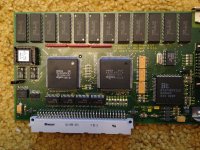
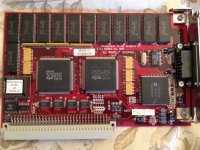
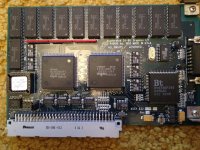
I did notice one nifty thing about them, though, and that is Radius used different colored PCBs for each card. They look pretty cool all next to each other. The 24X is Green, the 24XP is Blue, and the 24XK is Red.
According to LEM, the 24XP appears to be the budget card. It doesn't do the higher 1152 resolution, though it it's still 24-bit and accelerated.
The 24X and the 24XK, on the other hand, I can't tell the difference. I tried both on my IIci, and I think the 24XK is faster. It may just be because it's red and looks awesome compared to the plane Jane 24X.
The 24XK seems to play nicer with my LCD, too. On the 24X I have some convergence issues when in B&W mode, but the 24XK doesn't have the issue. The 24XK also has a newer ROM than the 24X.I did notice one nifty thing about them, though, and that is Radius used different colored PCBs for each card. They look pretty cool all next to each other. The 24X is Green, the 24XP is Blue, and the 24XK is Red.
 I wonder if it was intentional.
Radius made a line of PrecisionColor 24 cards.
Then they made a line of PrecisionColor Pro 24 cards.
My understanding is that the former were long NuBus cards and the latter were short (7.25"?). The latter were also faster than the former. So back when such things were still sold by stores, one had to be careful about whether one was getting the original or the 'Pro' version. It mattered, a lot.
If all your cards are PCP 24 cards, I bet they're the same speed with differing amounts of VRAM. However, it's possible that the highest end card has an amount of VRAM that lends itself to more efficient interleaving tricks -- more memory, more banks, more choices for interleaving in creative ways. I'm just speculating, but it was always my understanding that they were all the same power, with differing VRAM, so if one is faster, the only ways I can see for that to be true are that my information was wrong, or that the extra VRAM chips creates an opportunity for more efficient interleaving and therefore faster memory access.
Oh, I know. Compare the part numbers of the large ASICs on the boards. That will tell you if there's truly any difference in the hardware.
Then they made a line of PrecisionColor Pro 24 cards.
My understanding is that the former were long NuBus cards and the latter were short (7.25"?). The latter were also faster than the former. So back when such things were still sold by stores, one had to be careful about whether one was getting the original or the 'Pro' version. It mattered, a lot.
If all your cards are PCP 24 cards, I bet they're the same speed with differing amounts of VRAM. However, it's possible that the highest end card has an amount of VRAM that lends itself to more efficient interleaving tricks -- more memory, more banks, more choices for interleaving in creative ways. I'm just speculating, but it was always my understanding that they were all the same power, with differing VRAM, so if one is faster, the only ways I can see for that to be true are that my information was wrong, or that the extra VRAM chips creates an opportunity for more efficient interleaving and therefore faster memory access.
Oh, I know. Compare the part numbers of the large ASICs on the boards. That will tell you if there's truly any difference in the hardware.
The XK differs from the XP and X on one of the larger chips (lower right). Different brand, but I can't tell if it's the same type. The XP has a different kind of memory module than the X and XK. All three have different Firmware versions and slight differences in chips, jumpers, and overall PCB layout.
Radius Precision Color Pro 24X [v1.5 Firmware]:
Radius Precision Color Pro 24XK [v2.0 Firmware]:
Radius Precision Color Pro 24XP [v1.51 Firmware:
Radius Precision Color Pro 24X [v1.5 Firmware]:
Radius Precision Color Pro 24XK [v2.0 Firmware]:
Radius Precision Color Pro 24XP [v1.51 Firmware:
That looks like they used a different brand of RAMDAC, but the similarity in part numbers suggests that it's a commodity part available from multiple vendors. In other words, the difference in that chip probably doesn't indicate any difference in functionality.
The RAMDAC takes the digital pixel information and converts it to analog voltage levels for the three colors. Often, they also have internal memory for color mapping/tables.
The RAMDAC takes the digital pixel information and converts it to analog voltage levels for the three colors. Often, they also have internal memory for color mapping/tables.
I can personally attest to the quality difference between the two different RAMDACs. The red XK handles the conversion a lot better than the X and XP. I had convergence issues in B&W mode with the X and XP, but the XK works perfectly.
I'd say overall the XK is just simply a better card, and it also has the latest firmware. I'm tempted to swap the firmwares around and see if that does anything.
I'd say overall the XK is just simply a better card, and it also has the latest firmware. I'm tempted to swap the firmwares around and see if that does anything.
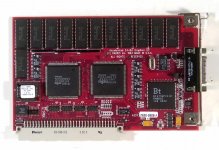
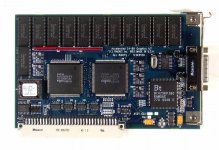
It looks like my Red 24X is a later version than your Green 24X. Mine has the 2.0 ROM and it's in the lower position, hrmmm?
Interesting, My XP also has the 2.0 ROM, this is probably good news for you experiment. I ran the 24X 2.0 ROM on the 24XP successfully. It didn't work, probably because of the lower capacity RAMDAC. However it made a great grayscale 21" TPD card out of the 16" Resolution 24XP.
Jailbreaking the Radius PrecisionColor 24XP . . .
We'll have to check compatibility with OS9.x.x with these cards. I'm wondering if your X will do 9.1, even with the 2.0 ROM. If mine is a 24X at all. :?: