

Thread
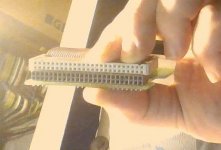
Macintosh Classic II, FPU / Math Card (Picture)
Posting this only because i have never seen one yet, until now.
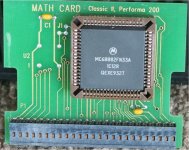
Oooh - very nice! Any pictures of the other side?
nope just the one picture 
I'm not going to lie, The little kid in me wants that all for my self, that is why i did not post the ebay link.
I think my 2 year old is rubbing off on me ;-)
I think my 2 year old is rubbing off on me ;-)
by the way, the seller is a cool dude.
He shot a pic of the rear for me
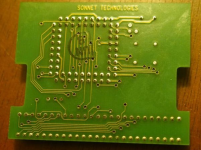
He shot a pic of the rear for me
Well that is interestingly simple, no?
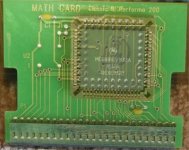
With a classic memory module an fpu and some time could you recreate it?
2 caps, some wire wrap, and a FPU and one could re create it.
interestingly simple, Yes.
interestingly simple, Yes.
So ill send you a memory and fpu and you can make it happen after you buy it?
haha, i dunno
from the seller, Info on the 2 caps on there.
A little info on those caps.
http://www.picaxeforum.co.uk/showthread.php?15901-K5M-104-Capacitor-Polarity
http://www.picaxeforum.co.uk/showthread.php?15901-K5M-104-Capacitor-Polarity
Still need to know what's going on under the chip, and the connector.
Buy it and dissect it!
Buy it and dissect it!
Some bidder sniped it and won it for a dollar over my max bid.
My max bid was 41 bucks. I did not want to pay over that,
I already have the wire wrap, I have those caps in-stock, I have a 16mhz FPU.
I will solder the wires right to the header on the motherboard.
maybe get a little hobby pcb from the shack, to set the FPU on.
I don't have the time to do this now, but it appears less complicated then the InternalHardDriveinaPluShAcK™lol
My max bid was 41 bucks. I did not want to pay over that,
I already have the wire wrap, I have those caps in-stock, I have a 16mhz FPU.
I will solder the wires right to the header on the motherboard.
maybe get a little hobby pcb from the shack, to set the FPU on.
I don't have the time to do this now, but it appears less complicated then the InternalHardDriveinaPluShAcK™lol
FWIW, the ClassicII dev note has the pinout of the connector. It's pretty much just directly throwing the 68882 on the bus, with the only trick being the 16 bit bus, so doubling up the data lines and using the /DSACK 0 & 1 signals.
I've put some labels on those pictures, to illustrate. For the most part, the labeling refers to the 68882 pins, not necessarily the Classic2's connector. For instance, D16 on the Classic2's connector goes to D0 on the 68882, and I've labeled it D0:
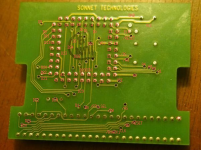
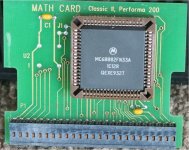
You can also put a ROM in that socket, up to 3MB worth.
I've put some labels on those pictures, to illustrate. For the most part, the labeling refers to the 68882 pins, not necessarily the Classic2's connector. For instance, D16 on the Classic2's connector goes to D0 on the 68882, and I've labeled it D0:
You can also put a ROM in that socket, up to 3MB worth.
you are the F'in man!
So, you could put a little 7.x boot image in ROM and do the Classic trick in a Classic II?
I'm really not sure about that. I haven't looked at the ClassicII ROM in particular. There's a good chance it has the EDisk driver, which is what the Classic used to boot (also RAM disk driver, and pcmcia flash card in laptops). That driver looks over some set of addresses (I don't recall how it determines that), for a valid header. So, it might be possible you could put a valid EDisk driver's ROM disk image into ROM there and have it automagically bootable.
I managed to locate images for a Classic II FPU of a non-socketed design:
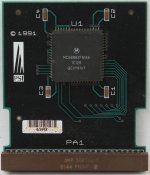
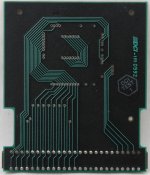
Nice, how many layers is that board?
Did you guys noodle out the PCB puzzle yet? I doesn't look too bad, especially now with two different layouts to match each other against the documented pinouts of the Memory Slot and the FPU.
Nice graphic, mcd!
Did you guys noodle out the PCB puzzle yet? I doesn't look too bad, especially now with two different layouts to match each other against the documented pinouts of the Memory Slot and the FPU.
Nice graphic, mcd!
no, but i am still slightly motivated to make one!!!!!!!!!!!!!!!!!!!!!
! don't know why either. maybe only because there is very few classic II's out there with a FPU installed??
! don't know why either. maybe only because there is very few classic II's out there with a FPU installed??
If you make one, I'll buy it.
i'm thinking of soldering wires right to the rom/fpu pins from the FPU?
and maybe gooping the fpu upside down to the rom's or something?
and maybe gooping the fpu upside down to the rom's or something?
Oh, I thought you meant an actual card.
nope, care if i experiment on your classic ii?
I don't have mine any more, ben needed it more then me.
I don't have mine any more, ben needed it more then me.
It's no problem with me. Hopefully once you get it open it will be up to the task. It needs some TLC.
I'm always glad to contribute to the gestalt of Mac 68k knowledge.
lol just kidding, your classic II is just gettin a cap job, I wouldn't be all soldering wires from your rom/fpu slot
Meh. You're a professional. I'd trust you to restore the FPU slot/ROM connections to their original state when you were done.
If somebody came up with a basic but reliable "ROM socket + FPU" card for Classic IIs (even if it were just an FPU socket instead of the actual chip), I'd buy one right away... assuming the cost were reasonable, of course. A board that small shouldn't cost too much to make even in small runs, thanks to the various prototyping services that have sprung up. I bet the worst part would be finding that weird-ass expansion-header connector for a reasonable price. Would a card like that even need any passives on the board, beyond maybe a decoupling cap or two?
From what I can tell, you're right, it just needs a few caps, and that's it.
Being able to actually use the ROM capabilities of the slot is very interesting. It would be great to be able to load from ROM like a Classic.
However, as you said, just a card with an FPU socket would be great.
Being able to actually use the ROM capabilities of the slot is very interesting. It would be great to be able to load from ROM like a Classic.
However, as you said, just a card with an FPU socket would be great.
the only thing that is slightly strange is that header,
the only 2 guys that i know right off hand that whip up PCB's are:
dougg3
bigmessowires
techknight
if any of these guys wanna whip up a board?
i think mcdermd has the ability, his brother is in the PCB making biz i think.
but he is busier then a worker ant.
i could do it, but i'm more of a stick with with i know type of guy, home brew up something, would end up trying to make a aweful looking but functional prototype thing. Maybe hack off a scsi connector and glue it to a proto board, glue the fpu to the board, and a to b, with those 2 caps/fpu?
the only 2 guys that i know right off hand that whip up PCB's are:
dougg3
bigmessowires
techknight
if any of these guys wanna whip up a board?
i think mcdermd has the ability, his brother is in the PCB making biz i think.
but he is busier then a worker ant.
i could do it, but i'm more of a stick with with i know type of guy, home brew up something, would end up trying to make a aweful looking but functional prototype thing. Maybe hack off a scsi connector and glue it to a proto board, glue the fpu to the board, and a to b, with those 2 caps/fpu?
I think having a socket you can put a custom ROM into is at least as important as having a socket with, or at least for, a 68882. Most older applications never used the FPU because they used to be so rare, but anyone who can download a hacked image might want to be able to plug in a custom ROM.
dougg3 could you please make a pcb for this?
also what would be the benefit of having a FPU in a Classic II? /w its crappy 10meg ram limit……
and how many people would want to buy one for their classic II?
I would assume a target price of $45 + shipping would be reasonable?
Can it be done professionally and sold at that target price?
next, bigmessowires, can you make a clone of the current SCSI to Ethernet adaptors that are out there?
i would assume you could get just as much for those as your floppy emu…
that would be the only way for machines like the Plus/ Classic/ Classic II and Portable to get online
also what would be the benefit of having a FPU in a Classic II? /w its crappy 10meg ram limit……
and how many people would want to buy one for their classic II?
I would assume a target price of $45 + shipping would be reasonable?
Can it be done professionally and sold at that target price?
next, bigmessowires, can you make a clone of the current SCSI to Ethernet adaptors that are out there?
i would assume you could get just as much for those as your floppy emu…
that would be the only way for machines like the Plus/ Classic/ Classic II and Portable to get online
I just happen to have one of the sonnet fpu cards. Don't have a classic iii to test with, but as simple as this card is - I doubt it could ever go bad. Would be happy to take some high-res photos. Or, make an offer if you want the card itself.
If anyone's interested, shoot me a pm.
If anyone's interested, shoot me a pm.
$25 plus shipping?
Hopefully my PM got to him first 
Has anyone heard anything from joekster? I sent him a PM, but didn't hear anything. I don't want to keep hoping to get this math card if someone already has worked out a deal with him.
Sorry for ignoring everyone, I was busy with the hoard in Tampa. The card was claimed by uniserver, who did send the first PM for it. I got it from an amiga person, who bought it for just the fpu (and pulled it out of. The socket). I'll ask if he has any more, but don't hold any breaths...
Congrats, Uni. If you decide not to hold onto it after you're done studying it, let me know.
I think the plan is after he's done studying it he'll be making his own!
Well, then he won't need the original any longer
great news.
a 50 pin scsi cable will connect right to the fpu port(pin for pin) , now all i have to do is make a pinout trash 80 style, get 2 caps, and solder the wires to a fpu.
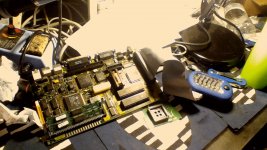
a 50 pin scsi cable will connect right to the fpu port(pin for pin) , now all i have to do is make a pinout trash 80 style, get 2 caps, and solder the wires to a fpu.
Uniserver, have you had a chance to try this yet? It sounds like a simple enough build that even I could pull it off, so I’m really eager to hear about your results.
ok sounds good… go ahead and pull it off… i have not had the time yet for this one.
do it to it!
do it to it!
I haven't sent the motherboard and video card for you yet, but if you get one working I would love one, that and your greyscale se30 mod }
Sure, sounds good. It’ll make a good project to show the SRCS in the new year. One slight hiccough in the plan, though — does anyone have a compatible 68882 to lend to the effort? I’ll be happy to mail it back afterwards (I have enough caution to solder to a socket, not the chip), but I haven’t any idea what clock speed or what version of the physical package I need. Most VLSI chips came in numerous package types and I’ve no idea where to look for information about it now that this decades-obsolete stuff is getting to be left behind by Freescale’s website. I’ll ask locally too, of course, but I do not anticipate anyone having one (there are few if any Motorola hardware hackers at our meetings just now).
Bah, that’s what I get for posting before doing my homework. Turns out the things are only $6 each on Fleabay (with $2 sockets) and any that was ever sold will work just fine in a Classic II, what with its feeble 16MHz bus (no 68882s slower than that were ever sold). The only thing to watch is that if I ever do up a proper design and turn these things into a saleable product I need to stay away from the FN-marked PLCC version. It isn’t lead-free-standards compliant.
I will keep you all posted on my progress. Do not expect great rapidity.
I will keep you all posted on my progress. Do not expect great rapidity.
Faster fpus will work fine. I bought and put in faster fpus in my color classic. It's a lot like ram in that respect, you can go faster , just not slower. I'll look and see if I have any 68882's around.
Still hoping someone can lend a 68882 to the effort. I can probably afford the $2 socket, but $10 for the chip+shipping is a bridge too far at this point (more needed for groceries and gas). Anyone out there feeling helpful?
Do you have one yet?
Shipping is a bit prohibitive from/to Canada but I can dredge one up and send if need be.
Shipping is a bit prohibitive from/to Canada but I can dredge one up and send if need be.
I am pretty sure if someone wants to take a 50 pin scsi cable. cut it and just solder the wires to an fpu socket, then you will have a home brew FPU for your Classic II.
...A bit off topic for the 'FPU card' side of it, but AFAIK the expansion slot on the Classic II also handles the external ROM slot as well (up to 1MB IIRC).
If you're designing a board at all, why not include the potential future ROM upgrades by including a ROM socket as well?
I'd love to see a "IIsi" style ROM for the CII in the future...
If you're designing a board at all, why not include the potential future ROM upgrades by including a ROM socket as well?
I'd love to see a "IIsi" style ROM for the CII in the future...
It’s actually 2–3 MiB, varying according to a jumper on the motherboard. The Classic II can have up to 4 megs of ROM, and the jumper determines whether 1 or 2 of those megabytes are on the motherboard.
Well, yes, that’s exactly what I’m working towards. See earlier posts in this thread.If you're designing a board at all, why not include the potential future ROM upgrades by including a ROM socket as well?
I'd love to see a "IIsi" style ROM for the CII in the future...
Alas, I haven’t had a whisper. And while I am grateful to you for volunteering to lend one of yours, I agree that Canuckistani postal rates are prohibitively expensive. I don’t know the detailed fee schedule but it’d likely be more expensive even than buying one from a US source on Fleabay and putting my address as the destination.
One thing I can say is that any 68882 at all will work — the FN-marked ones may be a problem to resell in a finished product due to RoHS rules, but that hardly matters for a prototype.
Broadly correct, but you’d likely want to kludge a decoupling cap or two as well. When you add in the ROM socket on top of that, a real board starts to look like a good idea.
for sure…
for sure!
Have you whipped one up yet?
Chop Chop :-D
for sure!
Have you whipped one up yet?
Chop Chop :-D