

Thread
PowerBook 5300 Battery disassembly
Not sure If I should post this here, but it seems appropriate…
I'm trying to disassemble a leaking 5300 battery (want to remove the cells and put a few weights in there), but I can't seem to get the dang thing open…
Haven't found any pictures of disassembly, either…
Any advice on how I could crack it open with the least of damage?
I'm trying to disassemble a leaking 5300 battery (want to remove the cells and put a few weights in there), but I can't seem to get the dang thing open…
Haven't found any pictures of disassembly, either…
Any advice on how I could crack it open with the least of damage?
Didn't see specifics on the procedure here, but . . .
http://www.alksoft.com/5300_FAQ/FAQ_2.10.php#2106
. . . I'm sure someone had done a rebuild howto. Why the weights?
I'll look around some more, somebody must have linkage . . .
http://www.alksoft.com/5300_FAQ/FAQ_2.10.php#2106
. . . I'm sure someone had done a rebuild howto. Why the weights?
I'll look around some more, somebody must have linkage . . .
I just something to cover up that hole in the side of my 5300, the weights would return it's balance…
Might as well take a stab at re-celling if the leakage hasn't destroyed the electronics inside the case. AA NiMH ought to be a lot easier than sourcing Duo-Dads.
Yeah, but why recell it when I could buy a new one? I just want to plug up that hole in the side of the 'Book with minimal expense.
K, I see your point. If you have no desire to put it back together, it doesn't matter much how you take it apart . . .
< . . . wanders off . . . finds one with corrosion . . . [} ] ]'> . . . hacks it open just to see . . . >
I just tore one apart so it'll look perfect from the outside. I'll post some pics later.
< . . . wanders off . . . finds one with corrosion . . . [}
] ]'> . . . hacks it open just to see . . . >I just tore one apart so it'll look perfect from the outside. I'll post some pics later.
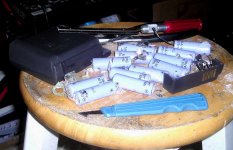
I'm doing a 5300 hack that'll probably lose the battery contents, so I cut mine off in a way that I'd still have full support across the palm rest. Bottom and side slots were cut to the joint and that was cut away to free the section, leaving the bit by the trackball intact.
I used a plexi scribe with a try square to get things started and the X-Acto Razor Saw to do the bulk of the cutting and then prized it apart using a heavier plexi scribe. The cells I ripped out with the pliers. [}
] ]'>I nicked the plastic cover on a few cells, but all metal housings are intact, the nasties remain contained and the cells are ready for recycling tomorrow.
More pictures! Is it really impossible to open without cutting half off?
K!  b:
b:
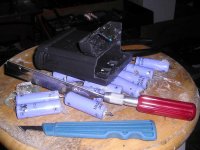
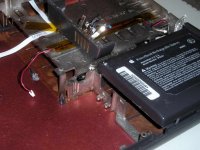
How much is too much? Most times folks split 'em at the seam, but that would show on a 5300, so I took off just enough that I was sure I could yank its guts out. I aligned the cut so that it would have been between the barcode and label on the topside if I were going to try to do a re-cell job on it. This way it's pretty much intact in terms of structural integrity for the palm rest. That's how the four-sided doors/lids are cut out of the completed, enclosed box/carcass of a hand dovetailed toolbox.
edit: do these pics open up to 1024x768 for you? When I open them they look smaller than the preview! :?:
b: How much is too much? Most times folks split 'em at the seam, but that would show on a 5300, so I took off just enough that I was sure I could yank its guts out. I aligned the cut so that it would have been between the barcode and label on the topside if I were going to try to do a re-cell job on it. This way it's pretty much intact in terms of structural integrity for the palm rest. That's how the four-sided doors/lids are cut out of the completed, enclosed box/carcass of a hand dovetailed toolbox.
edit: do these pics open up to 1024x768 for you? When I open them they look smaller than the preview! :?:
So, it's impossible to open without a saw? Dang.
Keep looking for a howto in that case.
I sure wouldn't want to try to split one of these at the seam, the wall thickness where it's chemically welded is considerable. The latch appears to be molded into the bottom section and the seam between the two sections runs around the corner from front to side of the 5300 and is part of the main visual dividing line between top and bottom of the case design.
Good luck with that!
I sure wouldn't want to try to split one of these at the seam, the wall thickness where it's chemically welded is considerable. The latch appears to be molded into the bottom section and the seam between the two sections runs around the corner from front to side of the 5300 and is part of the main visual dividing line between top and bottom of the case design.
Good luck with that!
I guess I'll saw it, then. That end will be stuck into the computer, anyway...
Exactly! Use a razor saw that cuts a really thin kerf so that you can glue it back together again when you're done for full structural integrity.
batteries plus uses a acetone, and a deadblow to pop them open,
when they rebuild battery packs.
when they rebuild battery packs.
That makes sense, but I wonder what that external seam looks like afterward on the 190-Kanga batteries?
On the G3 series, the crack is at the bottom and there's no seam on the face of the 1400's bat. The rest of the faces are removable, sliding latches from what I recall? :?:
On the G3 series, the crack is at the bottom and there's no seam on the face of the 1400's bat. The rest of the faces are removable, sliding latches from what I recall? :?:
I asked the guy, he said they use the same methods at all the batteries plus locations. He said the key is using a dead blow, you know the kind that are all plastic, and rattle when you shake them. 1LB and a hard surface to set the item on, Cinder block / Ibeam / concrete floor etc.
Bought one over the weekend at your guys favorite store of high quality (Harbor Freight) and used it to open my Macintosh Portable battery pack. I must say it worked better then any of the other solutions I have used. I would say it worked about 90% how it should have. The other 10% was unintended chips around one of the gold plated terminals, and one corner got a slight vertical crack, with the splitting of the horizontal seam.
I'm thinking I still need to prefect the art
Bought one over the weekend at your guys favorite store of high quality (Harbor Freight) and used it to open my Macintosh Portable battery pack. I must say it worked better then any of the other solutions I have used. I would say it worked about 90% how it should have. The other 10% was unintended chips around one of the gold plated terminals, and one corner got a slight vertical crack, with the splitting of the horizontal seam.
I'm thinking I still need to prefect the art
Yup, the rattling would be lead pellets in the classic dead-blow hammer, good idea to explain that to the gang!
http://en.wikipedia.org/wiki/Dead_blow_hammer
The dead blow spreads the application force from one mass to another over time and across a wider surface, minimizing damage and making it a particularly effective way of giving something a wallop. [}] ]'> Got one, gotta get some acetone, nasty stuff. [] ]'>
http://en.wikipedia.org/wiki/Dead_blow_hammer
The dead blow spreads the application force from one mass to another over time and across a wider surface, minimizing damage and making it a particularly effective way of giving something a wallop. [}
] ]'> Got one, gotta get some acetone, nasty stuff. [] ]'>
Acetone and a dead-blow hammer, eh? Hmm…
I wonder if they're doing it at an angle against the battery held from lateral movement to introduce shear into the force equation?
How do they apply the acetone, by submersion or by wicking it along the seam from a brush or syringe bottle?
Ketones and plastics don't get together very amicably.
How do they apply the acetone, by submersion or by wicking it along the seam from a brush or syringe bottle?
Ketones and plastics don't get together very amicably.
I saw the bottle he uses.
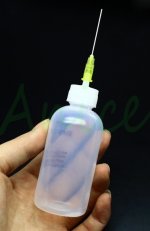
He had some of these exact bottles… ones labeled ACE / H20 / FLUX
http://www.ebay.com/itm/Solder-Soldering-Flux-Syringe-Funnel-Empty-Plastic-Bottle-50ml-/120857576741?pt=LH_DefaultDomain_0&hash=item1c23ac4525
i didn't ask how he applies the ACE,
I think he just uses that bottle / needle, and runs some in the seam and then starts beating right on the seam all the way around.
i didn't expect him to disclose all his secrets to me (in one sitting)
He had some of these exact bottles… ones labeled ACE / H20 / FLUX
http://www.ebay.com/itm/Solder-Soldering-Flux-Syringe-Funnel-Empty-Plastic-Bottle-50ml-/120857576741?pt=LH_DefaultDomain_0&hash=item1c23ac4525
i didn't ask how he applies the ACE,
I think he just uses that bottle / needle, and runs some in the seam and then starts beating right on the seam all the way around.
i didn't expect him to disclose all his secrets to me (in one sitting)
The glue he uses is clear, He would not tell me what it is… he said its faster then super glue.
It was in the same size bottle, 50ML's Clear with an industrial use only type label.
It was in the same size bottle, 50ML's Clear with an industrial use only type label.
Was it PVC cement? Toxic as all hell and bonds the shit out of plastic.
It's probably Acrylic Cement, same MEK base as PVC and ABS or PVC/ABS cements at your local home improvement emporium. Could be straight MEK or MEK with clear ABS dissolved in it, like the way you make or thicken arcylic cement.
MEK is at the nasty end of the Ketone family, acetone, the simplest form of Ketone, is bad for you in many ways, but it's a naturally occurring bodily byproduct, run through the kidneys and out you know where. Just don't breathe it, ingest it, or get it on your eyes and try to keep it off your skin as much as possible in its straight form.
While a chemical weld in plastic sets faster than Cyanoacrylate (crazy glue) does, it doesn't achieve full strength as quickly. It really needs to cure overnight, sometimes more, depending upon the surface area/margin widths fused.
Plexi fabrication 101, same bottle used, pointed water color brushes or glass syringes with real hypodermic needles for fine work. [}] ]'>
MEK is at the nasty end of the Ketone family, acetone, the simplest form of Ketone, is bad for you in many ways, but it's a naturally occurring bodily byproduct, run through the kidneys and out you know where. Just don't breathe it, ingest it, or get it on your eyes and try to keep it off your skin as much as possible in its straight form.
While a chemical weld in plastic sets faster than Cyanoacrylate (crazy glue) does, it doesn't achieve full strength as quickly. It really needs to cure overnight, sometimes more, depending upon the surface area/margin widths fused.
Plexi fabrication 101, same bottle used, pointed water color brushes or glass syringes with real hypodermic needles for fine work. [}
] ]'>
Wonder if that stuff would work ok for keeping/reinforcing the bond on PB-1XX standoffs?
it should be able to repair it, sort of melts the plastic together. maybe if you add more plastic to support it as well it can be more efficient.
That stuff follows a seam and wicks underneath and across a new joint when applied by syringe or brush by capillary action, IIRC. That's the way you fuse things together and that'd be the way to introduce acetone into the joint to weaken it.
Beating around the seam of the 190-Kanga series battery seems like a very bad idea to me, given the way the latch assembly looks inside the one I opened up. Application of vacuum pressure a/o clamping forces to the top and bottom sections might be a pretty slick way to get 'em apart without latch borkage. I'll give it a look-see in daylight.
How much does OWC charge for a rebuilt? I'm beginning to agree with fink that re-celling one of these is worth just paying the tariff and dispensing with the gotta DIY attitude. :approve:
If you have the facility to test and charge those cells individually, you may find a couple of good ones in there to keep in your project box for whatever. It only takes one dead cell in a series pack to render the whole pack unusable.
Well, that would certainly make a rebuild cheaper than the majority of other Mac batteries, which use less common size cells.
Bad news: I haven't measured yet, but they look like they may be A cells, not AA, they're a larger in diameter . . .
Good news: they're about as much longer than AA that off the shelf AA rechargeable bats could replace the tabbed cells in the battery . . .
. . . an interchangeable externally rechargeable cell pack from the standard 190-Kanga BatPack might work! }
Edit: what's the voltage of these stock cells? If it's 1.5V we've got a winner:
Confirmed: Three standard CrapShack serial AA battery holder packs (parts from four would be easier) will be NoPro to install sideways in groups of six cells. Three AA cell holders would be perfect, use two as hinged (duct tape! [}] ]'> )barn doors on bottom or top of the casing with the standard double row clip offset and all is very, very 
Good news: they're about as much longer than AA that off the shelf AA rechargeable bats could replace the tabbed cells in the battery . . .
. . . an interchangeable externally rechargeable cell pack from the standard 190-Kanga BatPack might work! }
Edit: what's the voltage of these stock cells? If it's 1.5V we've got a winner:
Confirmed: Three standard CrapShack serial AA battery holder packs (parts from four would be easier) will be NoPro to install sideways in groups of six cells. Three AA cell holders would be perfect, use two as hinged (duct tape! [}
] ]'> )barn doors on bottom or top of the casing with the standard double row clip offset and all is very, very
Sixteen AA cells in the standard orientation is duck soup . . .
. . . with a tad of judicious filing/sanding on the side panels at the bottom of the case 20 AA Cells could will fit in there! 8-o
. . . with a tad of judicious filing/sanding on the side panels at the bottom of the case 20 AA Cells could will fit in there! 8-o
You need to replace the same number of cells to get the same pack voltage, or twice as many in a series/parallel double pack. No other combination will work.
The cell voltage is a function of the cell chemistry. All NiMHs are 1.2V