

Thread
Mac Portable, Anyone know what this strange card is?
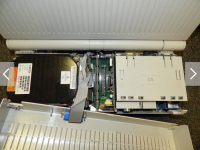
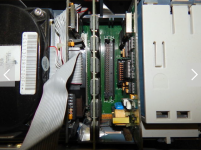
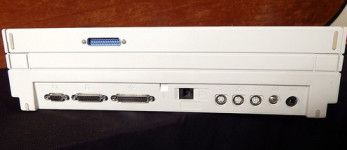
its definitely in the PDS slot.
Looks like a Parallel port…
yes, but isn't parallel port female? could also be a rs232
Whoops, haven't seen a Parallel port in a while…
Pictures of the board?
Pictures of the board?
i asked the seller, ill post em once available.
I would say parallel port card. For use with some mac/pc printer. The gender change cables are pretty abundant. You can still get them at radio shack in the drawers, I saw some the other day.
If that were the case, why wouldn't they use the correct gender in the first place? Male DB-25 is a serial port in the PC world, although most were DB-9 by the Mac Portable era. I'm guessing that was a custom interface for whatever peripheral it came with.
It would help greatly to see what's on the card.
It would help greatly to see what's on the card.
well since all three that have passed through my hands were from business, I would shudder to guess like an engraver...... Its like a mystery game. I am just making fun, take no malice from my comment please.
On the serious note you have a point, why wouldn't they put the correct gender from the get go? That is a good point, but a lot of gear was odd back then. SCSI was weird like that also, male to female, gender changes, different pin outs, different modes and settings. It seems like IDE was like the automatic transmission in a car while scsi was a manual transmission.
On the serious note you have a point, why wouldn't they put the correct gender from the get go? That is a good point, but a lot of gear was odd back then. SCSI was weird like that also, male to female, gender changes, different pin outs, different modes and settings. It seems like IDE was like the automatic transmission in a car while scsi was a manual transmission.
IDE was a simple hard disk interface, little more than an extension to the AT bus. SCSI was a multi-purpose peripheral bus. It was designed right from the start to be much more than a hard drive interface.
The original IDE port on a PC motherboard is basically an ISA slot pinout in a different form factor. All an early ISA IDE "interface" consisted of were a few 74-series parts acting as address decoders for 0x170-17Fh and 0x370-137Fh address lines connected to a 40pin IDC socket.
As for the Portable, I recall seeing a unit on ebay a few months ago that had a video adapter in the PDS slot, but the output was a standard DA-15 Macintosh video port.
As for the Portable, I recall seeing a unit on ebay a few months ago that had a video adapter in the PDS slot, but the output was a standard DA-15 Macintosh video port.
I've got the card now and here's some photos. Anyone ever seen one, or know more about it?
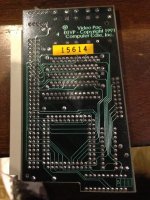
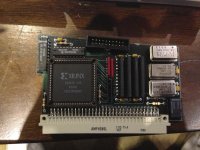
here is the data sheet on the main chip
http://www.labmaster.com/surplus/parts/html/941557-pl/xc2000.pdf
http://www.labmaster.com/surplus/parts/html/941557-pl/xc2000.pdf
The design is oddly similar to the memory card in my Portable. No surprise considering it was made by the same company. I'm guessing its some sort of video card.
What kind of display though? I've never seen a plug like that for video.
Who knows. Some probing with a scope can be used to find the sync pins. Information is scare: https://www.google.com/search?q=Video+Mac+PAC&btnG=Search+Books&tbm=bks&tbo=1#q=%22Computer+Care%22+Video+Mac+PAC&tbm=bks
Says its based on the Lapis DisplayServe, which appears to have been a NuBus video card. None of them used that type of video port though. Hopefully the driver/software is on the machine and can be retrieved!
Says its based on the Lapis DisplayServe, which appears to have been a NuBus video card. None of them used that type of video port though. Hopefully the driver/software is on the machine and can be retrieved!
Yeah!
Already loaded them onto my M5126. It seems more like its for data though. I'll have to look at what the extension was called but it was something like Interface Port
Cool!
Hap, you have all the cool stuff!
They'd be nothing more than cool paperweights if it wasn't for your help Charles! Your the man. You were also right about the fact it was probably for an engineer... The port on the back for the interface out is seriously flawless. Looks like something Apple would have done. I'd guess they chucked that bad boy up in a CNC and that's how they made the opening. It's definitely no dremel job.
Played some with the search terms and found something that might fit with the VRAM and unconventional connector on board that interface card for the setup. For a pricey projection unit for the luggable, the oddball connector choice makes a lot of sense.
Does the card draw Power & ground connections from the external connector? That would fit in with the draconian Power budgeting of the Portable. When the projection panel wasn't plugged in the Video Card would be comatose in its powered down state, drawing no power from the Luggable.
Does the card draw Power & ground connections from the external connector? That would fit in with the draconian Power budgeting of the Portable. When the projection panel wasn't plugged in the Video Card would be comatose in its powered down state, drawing no power from the Luggable.
so it will run one of these ?
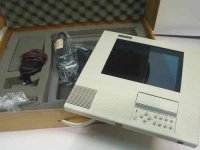
http://www.ebay.com/itm/Proxima-Corporation-A480SC-MultiMode-Compact-Business-Office-Data-Display-Panel-/380647337929?_trksid=p3284.m263&_trkparms=algo%3DSIC%26its%3DI%26itu%3DUCI%252BIA%252BUA%252BFICS%252BUFI%26otn%3D21%26pmod%3D151105566872%26ps%3D54
i think this is kind cool
http://www.ebay.com/itm/Proxima-Corporation-A480SC-MultiMode-Compact-Business-Office-Data-Display-Panel-/380647337929?_trksid=p3284.m263&_trkparms=algo%3DSIC%26its%3DI%26itu%3DUCI%252BIA%252BUA%252BFICS%252BUFI%26otn%3D21%26pmod%3D151105566872%26ps%3D54
i think this is kind cool
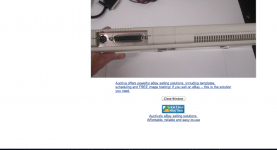
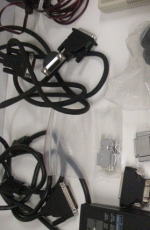
its like PRE DATA projector  BYO-data i guess most places already had the projector
BYO-data i guess most places already had the projector It's an FPGA, so there could be just about any logic on there. Most FPGAs need a bitstream loaded in order to work. I don't see a flash chip on there, so the FPGA probably needs to be loaded by a driver on the computer. In other words, you're definitely gonna need the software for it
The 57.2832 MHz crystal sounds a lot like what would be used to generate the dot clock for the monitor...
The mystery is solved!
I wouldn't be too sure of that, but the possibility is there. The search terms aren't an exact match and the verbiage in that article is equivocal. No mention is made of an interface card for the Portable or of any two level pricing if that's what's needed for the Luggable. It could be that the mention of the Portable was a mistake in that first section. The portable is clearly indicated later on in the article.
The name on the interface card doesn't jibe with the projector info, that's the kicker. The rest might just be coincidence.
The name on the interface card doesn't jibe with the projector info, that's the kicker. The rest might just be coincidence.
looks like those are pretty cheap the one they only want 8 bucks for.
According to my notes, the first video card produced by Lapis was the SE DisplayServer. It was a dual mode card (digital/TTL EGA AND analog VGA/SVGA) initially but Lapis developed it for other analog monitors, probably dropping digital/TTL support at some point. Mac Plus versions (clip-on) were also produced.
When the Mac Classic arrived, Lapis produced an analog graphics card with RAM expansion. This model was also sold by Computer Care.
The Portable board being discussed seems to be an intermediary member of the family. Hopefully, drivers will be found on the more numerous support disks for other DisplayServers.
The DisplayServer II cards (NuBus) were also unconventional. A 9 pin D connector was provided for TTL monitors and/or an HD-15 connector for all analog monitors (an adapter was required for the Apple D15 connector). The DisplayServer II-DPD-TV was designed to work with NTSC TVs.
Edited to correct "When the Mac Classic arrived" for Mac Plus