

Thread
Macintosh 128k 240v Analog Board Component Identification
Good morning all,
I am currently working on the restoration of a Macintosh 128k. After replacing a 1.6A 250V fuse (which was not present when I opened the Mac up) on the analog board I switched on the Macintosh to be confronted with a cloud of smoke!
I have narrowed down the problem to two components; the second of which I cannot identify.
The analog board in question is an International one with a sticker marked '630-0122' and '240V'.
The board reference is 'Q10' and the component is marked 'C3260'. Above the '0' there is the number '48'.
I have attached a photograph below.
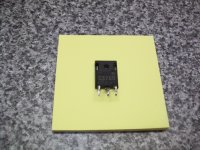
Any help in identifying and sourcing a replacement for this component will be much appreciated!
I am currently working on the restoration of a Macintosh 128k. After replacing a 1.6A 250V fuse (which was not present when I opened the Mac up) on the analog board I switched on the Macintosh to be confronted with a cloud of smoke!
I have narrowed down the problem to two components; the second of which I cannot identify.
The analog board in question is an International one with a sticker marked '630-0122' and '240V'.
The board reference is 'Q10' and the component is marked 'C3260'. Above the '0' there is the number '48'.
I have attached a photograph below.
Any help in identifying and sourcing a replacement for this component will be much appreciated!
It's a fast SCR ( Silicon controlled rectifier ) E0122 (or E0102YA). It's part of the power supply circuit.
http://pdf.datasheetarchive.com/datasheetsmain/Datasheets-35/DSA-697395.pdf
http://pdf.datasheetarchive.com/datasheetsmain/Datasheets-35/DSA-697395.pdf
Thank you for your response nvdeynde!
Using the information you've provided I am trying to find a suitable replacement.
On Ebay i've found the following listing: http://tinyurl.com/qz75vxy
Its specifications match up with ones given in the datasheet: 0.8A, 30V and a TO 92 package.
Would this be a suitable replacement for the SCR that failed on my 240V analog board?
Thank you
Using the information you've provided I am trying to find a suitable replacement.
On Ebay i've found the following listing: http://tinyurl.com/qz75vxy
Its specifications match up with ones given in the datasheet: 0.8A, 30V and a TO 92 package.
Would this be a suitable replacement for the SCR that failed on my 240V analog board?
Thank you
Are you sure that's the right picture? What I see there is a 2SC3260 (the 2S is usually omitted from the printed number) which is listed as an 800V 3A NPN power transistor. I suspect that's the chopper transistor in the power supply.
I've never seen an SCR in that package style.
I've never seen an SCR in that package style.
Hello James,
I am in agreement with you that the failed component at Q10 is indeed a '2SC3260' from the power supply.
Would you have any recommendations for a replacement part that would be available online?
Would any power transistor with the same values do?
Thank you
NTE2309 - would this perhaps be a suitable replacement?
http://www.nteinc.com/specs/2300to2399/pdf/nte2309.pdf
BTW what other components blew on your analogue board? My 240V board also had a blown fuse and burnt out bridge rectifier diodes. I never did get it working though Perhaps I should try replacing this Q10 as well. I did get a 110V analogue board from another very kind forum member, but they have quite a different PCB layout compared to 240V version and need a good quality step down transformer to use here in the UK.
http://www.nteinc.com/specs/2300to2399/pdf/nte2309.pdf
BTW what other components blew on your analogue board? My 240V board also had a blown fuse and burnt out bridge rectifier diodes. I never did get it working though
Perhaps I should try replacing this Q10 as well. I did get a 110V analogue board from another very kind forum member, but they have quite a different PCB layout compared to 240V version and need a good quality step down transformer to use here in the UK.It's best to replace it with the same part if you can find it and the price is not too obscene. I would expect quite a few similarly rated parts to work, but sometimes rely on specific characteristics of the original part and may not perform well with a sub. Using an exact replacement greatly simplifies the diagnostic process. If you install a sub and it blows up, was it because the sub was not suitable, or do further problems exist? It isn't always easy to tell.
Sorry I made a mistake here. I was looking at the schematics of an original 110 volts analog board instead of the International one so my orignal reply was faulty. Oops... :I
Indeed James has identified the component correctly.
td75,
On behalf of your recommendations I bought the '2SC3260' on Ebay this morning; it will be coming from Taiwan. I will report back when it arrives. Thanks for the help!
The other component that failed was a RIFA 40/085/56 GPC metallised film capacitor. I think the board reference is C37. Or the component is next to C37.NTE2309 - would this perhaps be a suitable replacement?
http://www.nteinc.com/specs/2300to2399/pdf/nte2309.pdf
BTW what other components blew on your analogue board? My 240V board also had a blown fuse and burnt out bridge rectifier diodes. I never did get it working though
Before I turned on the Macintosh I checked the analog board to assess its condition. I noticed that the film capacitor's case was cracked in places.
Once the Macintosh was turned on the capacitor exploded!
The following blog post helped me as we had similar problems: http://tinyurl.com/pz4w9gg.
I sourced a replacement on Ebay: http://tinyurl.com/p9pm3jh.
With regards to Q10; the component left three singe marks on the back of the analog board and its heatsink has been discoloured by heat.
C37 sounds like one of the mains filter capacitors. Guessing by the number, I would say it's probably 0.56uF 400V 85 degree C rating, but the value is not critical and the replacement you found ought to work fine.
Transistors are fairly easy to test if you have a multimeter with a diode check function. Power transistors usually fail completely shorted between all three leads. I've seen some that got so hot they desoldered themselves and fell out yet still worked fine. Unless there is a crater in the housing, a visual test is not reliable for determining the health of a semiconductor.
Transistors are fairly easy to test if you have a multimeter with a diode check function. Power transistors usually fail completely shorted between all three leads. I've seen some that got so hot they desoldered themselves and fell out yet still worked fine. Unless there is a crater in the housing, a visual test is not reliable for determining the health of a semiconductor.
Hope you don't think I'm hijacking your thread! Another part I can't seem to find is U3 on 240v analog board. In classic mac repair guide it is shown as an optoisolator. Does anyone know a compatible replacement part for this?
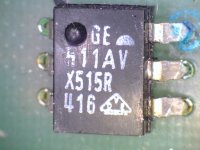
There are lots of similar opto-isolators out there. I can't make out all the numbers on that part, but a 4N35 or similar part will probably work. Do you have reason to believe that the optocoupler is bad?
Part number GE H11AV brings up some parts in Google but seem to be variations so wasn't sure would be compatible. My analog board had quite a few faulty components when I received it, most likely caused by power surge. Have replaced quite a few parts already but someone who looked at the board suggested I should replace U3 as well so thought would be no harm. Hopefully one day I can get this analog board working again, seems almost impossible to source replacement 240v boards here in the UK.
Ah, H11AV, I couldn't tell what the H was.
Datasheet is here:
http://pdf1.alldatasheet.com/datasheet-pdf/view/52725/FAIRCHILD/H11AV1.html
Most of the variations you see are likely package and lead styles, temperature ranges, or the sort of packaging the parts come in. There are often slightly different part numbers for parts that ship loose in IC tubes, cut tape, bandoliers for automated assembly, etc.
Looking over that datasheet, the most relevant item is the 70V C-E rating and the fact that it's a phototransistor output. Looks like the CNY17F series would be a good match.
http://www.fairchildsemi.com/ds/CN/CNY172M.pdf
It's worth checking whether the Base of the phototransistor (pin 6) is connected to anything. Usually it isn't and many/most transistor output optoisolators don't connect it internally but if it is used then you'll want to get a part that has it.
You can test the optoisolator fairly easily. Connect a voltage source of perhaps 5-20V through a 10k or so resistor to the collector and connect the emitter to ground. Wire the LED up through about a 470 Ohm resistor to a source of 5V and then measure from the C-E pins with a voltmeter. The voltage should drop to a fraction of a Volt with the LED powered, and rise to the supply voltage without the LED connected.
Datasheet is here:
http://pdf1.alldatasheet.com/datasheet-pdf/view/52725/FAIRCHILD/H11AV1.html
Most of the variations you see are likely package and lead styles, temperature ranges, or the sort of packaging the parts come in. There are often slightly different part numbers for parts that ship loose in IC tubes, cut tape, bandoliers for automated assembly, etc.
Looking over that datasheet, the most relevant item is the 70V C-E rating and the fact that it's a phototransistor output. Looks like the CNY17F series would be a good match.
http://www.fairchildsemi.com/ds/CN/CNY172M.pdf
It's worth checking whether the Base of the phototransistor (pin 6) is connected to anything. Usually it isn't and many/most transistor output optoisolators don't connect it internally but if it is used then you'll want to get a part that has it.
You can test the optoisolator fairly easily. Connect a voltage source of perhaps 5-20V through a 10k or so resistor to the collector and connect the emitter to ground. Wire the LED up through about a 470 Ohm resistor to a source of 5V and then measure from the C-E pins with a voltmeter. The voltage should drop to a fraction of a Volt with the LED powered, and rise to the supply voltage without the LED connected.
Great thank you very much for that. I will probably just change it anyway. Hopefully this one CNY17F-1 will be compatible at Farnell http://uk.farnell.com/vishay-semiconductor/cny17f-1/optocoupler-transistor-o-p/dp/1469493
That looks like it ought to work just fine. For this sort of application the specs are not usually terribly critical. As long as the specs are in the same ballpark it will probably work.
You can actually still buy the identical filter capacitors. There are 3 on the board and are from Kemet. Here are the part numbers and correct values for the International 240 Volts Analog board.
The filter capacitors have the following values:
-2x 4700pf 250Vac - Kemet PME271Y447MR30
http://be.mouser.com/ProductDetail/Kemet/PME271Y447MR30/?qs=sGAEpiMZZMv1cc3ydrPrF85GIl804cbNf9hsfZMK6uI%3d
-1x 0.47uf 250vac - Kemet PME271M647KR30
http://be.mouser.com/ProductDetail/Kemet/PME271M647KR30/?qs=sGAEpiMZZMv1cc3ydrPrF85GIl804cbNz76Q8vgSP44%3d
Good Afternoon,
I've just encountered a minor setback in receiving my replacement '2SC3260'.
The seller refunded my PayPal payment saying that he had none in stock even though 37 or so of them were in stock when I bought the item!
So be carefull if you want to buy your replacement '2SC3260' from Taiwan.
After I bought one I saw that somebody else also had bought one, a Liberation Army member perhaps?
This should not be a problem as I have noticed some for sale in the UK; there are double the price but should be here by Tuesday.
The 'Classic Mac Repair Notes' describe C1 as 'the capacitor that often dies'. A visual inspection of the Capacitor tells me that it is fine, but should I replace it as a precaution?
Would this be a suitable replacement? http://tinyurl.com/qyw57b6
On the board itself I've noticed there is no +/- for the polarity of C1. Will it work any way?
Hopefully all of this can come together and make my Macintosh work!
Thank you
I've just encountered a minor setback in receiving my replacement '2SC3260'.
The seller refunded my PayPal payment saying that he had none in stock even though 37 or so of them were in stock when I bought the item!
So be carefull if you want to buy your replacement '2SC3260' from Taiwan.
After I bought one I saw that somebody else also had bought one, a Liberation Army member perhaps?
This should not be a problem as I have noticed some for sale in the UK; there are double the price but should be here by Tuesday.
The 'Classic Mac Repair Notes' describe C1 as 'the capacitor that often dies'. A visual inspection of the Capacitor tells me that it is fine, but should I replace it as a precaution?
Would this be a suitable replacement? http://tinyurl.com/qyw57b6
On the board itself I've noticed there is no +/- for the polarity of C1. Will it work any way?
Hopefully all of this can come together and make my Macintosh work!
Thank you
Yes the Panasonic ECW-F2395JA is the right replacement for C1: it's a bi-polar, high frequency Film capacitor. They don't exist in radial electrolyte version like the original one anymore as far as I know. Since this capacitor is Bi-polar it doesn't matter how you mount it on the PCB ( +/- ).
However I do recommend to replace all capacitors instead of just this one and the filter caps. Do the whole board if you want it to last in the long term.
Visable inspection often doesn't tell much with capacitors unless they are clearly leaking or bulging as they can be open, shorted, out of specs, dried out,... without any visable signs.
Good evening,
Is there anything special about the 10uf 160v and 470uf 10v caps? Low ESR etc. Their different colour jacket makes me think this. Could I replace them with a standard cap?
I'm having a difficult time finding the four large 100uf 200v capacitors. Are they still made anymore? What would be a recommended replacement?
Thank you
I have sourced most of the replacement capacitors but I am not sure about the following ones: 10uf 160v, 470uf 10v *2 and 100uf 200v*4.
Is there anything special about the 10uf 160v and 470uf 10v caps? Low ESR etc. Their different colour jacket makes me think this. Could I replace them with a standard cap?
I'm having a difficult time finding the four large 100uf 200v capacitors. Are they still made anymore? What would be a recommended replacement?
Thank you
Good evening,
Sorry with the questions but could somebody please tell me if this would be a suitable replacement for C1? http://tinyurl.com/ndzup92
It's a 3.9uf 250v axial capacitor. It looks the same as a capacitor on the analog board of my SE/30.
RS Components want to charge a fortune for the Panasonic part! Especially since that is the only thing I am buying from them!
I'll try to get the parts ordered today so they will arrive in the middle of next week.
Any help is much appreciated!
Sorry with the questions but could somebody please tell me if this would be a suitable replacement for C1? http://tinyurl.com/ndzup92
It's a 3.9uf 250v axial capacitor. It looks the same as a capacitor on the analog board of my SE/30.
RS Components want to charge a fortune for the Panasonic part! Especially since that is the only thing I am buying from them!
I'll try to get the parts ordered today so they will arrive in the middle of next week.
Any help is much appreciated!
I also bought from same eBay seller and had payment refunded! I also ended up buying from UK from here: http://www.electronicrepair.org.uk/webstore/index.php?main_page=product_info&cPath=47_22&products_id=58
Noticed on the back of Q10 there was a bit of plastic that ended up crumbling.. is Q10 supposed to be insulated from the heatsink?
Noticed on the back of Q10 there was a bit of plastic that ended up crumbling.. is Q10 supposed to be insulated from the heatsink?
td75,
Heatsink --> A transparent plastic sticker --> Thermal compound --> Q10
Therefore I think that Q10 should be insulated from the heatsink.
I hope this helps!
When I look at the heatsink then Q10 I see:
Heatsink --> A transparent plastic sticker --> Thermal compound --> Q10
Therefore I think that Q10 should be insulated from the heatsink.
I hope this helps!
The replacement capacitors and 2SC3260 arrived today and have been soldered onto the analog board.
I'm still not sure about the four 100uf 200v capacitors but I will leave them in for the meantime.
Capacitors have replaced with ones of the same value but the sizes have shrunk dramatically!
I will replace C1 tomorrow then proceed to turn on and test the Macintosh.
I hope it does not blow up!
td75: Has your replacement Q10 worked for you?
I'm still not sure about the four 100uf 200v capacitors but I will leave them in for the meantime.
Capacitors have replaced with ones of the same value but the sizes have shrunk dramatically!
I will replace C1 tomorrow then proceed to turn on and test the Macintosh.
I hope it does not blow up!
td75: Has your replacement Q10 worked for you?
Replacing the Q10 has stopped the speaker clicking noise so I'm sure it was faulty, but still doesn't turn on I'm not even sure the logic board or CRT is fully working. Still lots more testing. I bought a step down converter so going to try with a 110v analog board to make sure the rest of the machine is actually working.
I'm not even sure the logic board or CRT is fully working. Still lots more testing. I bought a step down converter so going to try with a 110v analog board to make sure the rest of the machine is actually working.Good evening,
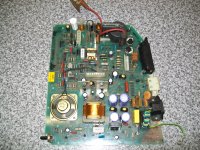
I have replaced most of the capacitors on the analog board; these include:
R uf V
C1 3.9 25 with 3.9uf 250v axial
C2 4700 16
C3 220 16
C24 2200 16
C27 2200 10
C28 1000 16
C30 2200 10
C31 220 16
C32 2200 16
C45 470 10
C42 470 10
I have not replaced C11: 10uf 160uf or the four large capacitors in the middle of the board: 100uf 200v.
Also the two components that failed, 2SC3260 and a RIFA metallised film capacitor, have been replaced.
For the first time in a while I reassembled the Macintosh and turned it on. Nothing, no chime or any indication that the Mac was alive. Nothing happens when the brightness knob is turned.
I have tested voltages on the floppy port and they all read under 1.00v.
I've compiled a list of capacitors on a spreadsheet which I will try to upload to the forums.
I really don't know where to start to solve this next problem? Any ideas would be much appreciated!
I have replaced most of the capacitors on the analog board; these include:
R uf V
C1 3.9 25 with 3.9uf 250v axial
C2 4700 16
C3 220 16
C24 2200 16
C27 2200 10
C28 1000 16
C30 2200 10
C31 220 16
C32 2200 16
C45 470 10
C42 470 10
I have not replaced C11: 10uf 160uf or the four large capacitors in the middle of the board: 100uf 200v.
Also the two components that failed, 2SC3260 and a RIFA metallised film capacitor, have been replaced.
For the first time in a while I reassembled the Macintosh and turned it on. Nothing, no chime or any indication that the Mac was alive. Nothing happens when the brightness knob is turned.
I have tested voltages on the floppy port and they all read under 1.00v.
I've compiled a list of capacitors on a spreadsheet which I will try to upload to the forums.
I really don't know where to start to solve this next problem? Any ideas would be much appreciated!
Good evening,
I think the problems I am currently facing outgrow the purpose of this topic.
Therefore I will start a new topic to discuss these new problems.
Thank you to anybody who helped me source replacement components!
If anybody else needs a component identified feel free to 'hijack' this topic!
I think the problems I am currently facing outgrow the purpose of this topic.
Therefore I will start a new topic to discuss these new problems.
Thank you to anybody who helped me source replacement components!
If anybody else needs a component identified feel free to 'hijack' this topic!