

Thread
Decked out Apple IIgs vs. Decked out PLUS
is that what these things are?
there was piles of em.
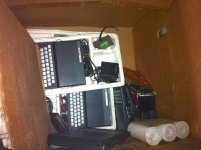
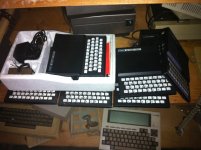
there was piles of em.
Yup.
ZX-81s/TS-1000s were like cockroaches for a while, crawling out of the woodwork when you least expected it. Sometime around 1990 a friend of the family was given a box of three of them (two of one and one of the other models, I *think* the TS-1000s outnumbered the ZX-81s) because someone they knew heard "Oh, you don't have a computer at home? But your kid (then about five) needs to learn computers!" and thought they were helping by donating them. I was asked for help to set up their "new" computer, and upon seeing what they were given I volunteered to trade them an IBM XT I got at the government surplus depot for... what was it, $15? for the lot. No kid deserves to have a Timex Sinclair inflicted on them.
In addition to being a good source of Z-80s they did indeed make excellent doorstops.
In addition to being a good source of Z-80s they did indeed make excellent doorstops.
good i am glad i didn't go to alot of trouble to get em.
A close second for worthless is the Commodore Plus/4. If anyone wants one in the box, I have one for you.
Ah the ZX81 wasn't all that bad, very affordable when it came out (even cheaper if you built it yourself) and great for learning BASIC. But a ZX81 in 1990...
Actually neither was the Plus4, especially with a proper graphical operating system running on it in the form of GEOS (once the 3rd most popular OS in the world by sales).
Well basically you can fun with pretty much any old piece of junk if you're into that
Actually neither was the Plus4, especially with a proper graphical operating system running on it in the form of GEOS (once the 3rd most popular OS in the world by sales).
Well basically you can fun with pretty much any old piece of junk if you're into that
Im interested in a Plus 4, looking for a 16 too...
Uniserver, did you grab any of those? I think both the sinclair and the Plus were pretty much only used with tape drives.
That kit is interesting, but for that much money I think I would pay the extra and build an Apple 1 clone.
yeah the keyboard of the ZX81 was the first thing to go, i replaced it with a keyboard of a mainframe workstation where i re-wired the individual keys,
then built a wooden enclosure for the keyboard where the whole ZX81 board fitted under, like a VIC-20 / Comodore 64 type.
i might still have it somewhere at my parent's place with all my other childhood stuff
then built a wooden enclosure for the keyboard where the whole ZX81 board fitted under, like a VIC-20 / Comodore 64 type.
i might still have it somewhere at my parent's place with all my other childhood stuff
That would be pretty cool to see.
I have 2 of then I think. I can't remember of they are the same model or not.
I need to hook up an old TV and see of they still work.
I have 2 of then I think. I can't remember of they are the same model or not.
I need to hook up an old TV and see of they still work.
the second mod was to remove the RF modulator and hooked it bypassing the tuner on the TV for better picture, and i could then also simulate different monitor colors, amber (yellow), green, black on white and reverse.
i also ended up getting a 16K expansion.
that's the one i learned my programming skills, when i got bored of the limitations, that's when i switched to a IIe clone (could not afford a real one)
i also ended up getting a 16K expansion.
that's the one i learned my programming skills, when i got bored of the limitations, that's when i switched to a IIe clone (could not afford a real one)
It's strange how common they seem to be to this day. There's almost always at least one on the local Craigslist. (Either stand alone, or in the pile when someone's selling off their Commodore collection.) Commodore must have made a lot of the things, impressive given what a spectacular flop they were.
I remember playing around with a COCO2, i think it was in-between my c64 and 286, it seemed like a pretty good computer.
I think it had dos 3.3.
http://starringthecomputer.com/computer.html?c=179
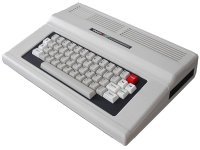
I think it had dos 3.3.
http://starringthecomputer.com/computer.html?c=179
Are you sure it wasn't a Tandy 1000 EX:

Or 1000 HX?:

The CoCo didn't run "DOS". (Well, at least not MS-DOS.) It was a Motorola 6809-based 8-bit system that normally ran its built-in Microsoft BASIC-based environment. (There were several alternative OSes available for it, including the more-than-vaguely UNIX-ish OS-9 from Microware Systems.) The 1000EX/HX were sorta-mostly-PC compatible systems packaged in the odd home computer-shaped console case and had a few unique features, like a stripped down version of DOS in ROM they could boot from instead of a floppy.
I would love to find a broken EX/HX and cram a Mini-ITX-style motherboard into one.
I remember it had a floppy drive, and would boot up to a command prompt, and I think if you typed in ver it said ms dos 3.0 or 3.3.
The guy who i got the thing from was very computer savvy i remember.
The guy who i got the thing from was very computer savvy i remember.
Well, this is what a Color Computer 2 looks like when it boots up:

And "VER" returns:
?SN ERROR
(Happen to have MESS with a CoCo ROM handy.) So, yeah, almost certainly a 1000EX/HX. Or a *really* impressive casemod. (A CoCo 2 would be hard to fit a Mini-ITX motherboard into, let alone the guts of any 80's PC clone.)
And "VER" returns:
?SN ERROR
(Happen to have MESS with a CoCo ROM handy.) So, yeah, almost certainly a 1000EX/HX. Or a *really* impressive casemod. (A CoCo 2 would be hard to fit a Mini-ITX motherboard into, let alone the guts of any 80's PC clone.)
what happens when you want to list whats on the floppy disk?
Dir?
Dir?
Was the computer you remember capable of displaying lowercase letters? A Coco can't.
(And yes, the command for getting a directory in disk color basic happens to be "DIR", but the drive names are numbers, not letters like ms-dos, and most other commands are different. My first two computers were members of the Tandy CoCo family, so I'm pretty darn sure the machine you remember wasn't one.)
(And yes, the command for getting a directory in disk color basic happens to be "DIR", but the drive names are numbers, not letters like ms-dos, and most other commands are different. My first two computers were members of the Tandy CoCo family, so I'm pretty darn sure the machine you remember wasn't one.)
Oh then DIR?
Yes, I do not remember case being an option.
i remember the upper part of the case was not screwed, it was just sitting there.
Sometimes the color would get strange, he had some kind of mod to the video circuit, use some temporary spring loaded test clip things, but in a permanent way. You had to give it a little wiggle on occasion.
I remember asking the kid, why his dad did this? he said, I'm sure it was some kind of imporvment.
Yes, I do not remember case being an option.
i remember the upper part of the case was not screwed, it was just sitting there.
Sometimes the color would get strange, he had some kind of mod to the video circuit, use some temporary spring loaded test clip things, but in a permanent way. You had to give it a little wiggle on occasion.
I remember asking the kid, why his dad did this? he said, I'm sure it was some kind of imporvment.
You said yourself this thing ran MS-DOS. A TANDY COLOR COMPUTER 2 DOESN'T.
lol now that you are getting all hissy about it
The floppy drive must of had DOS, (Disk Operating System) ?? yes?
ok its all coming back to me now!!!
i got it!
It ran windows 95, and pretty darn good i might add!!
The floppy drive must of had DOS, (Disk Operating System) ?? yes?
ok its all coming back to me now!!!
i got it!
It ran windows 95, and pretty darn good i might add!!
*snicker* Hey, whatever. If you treasure the memory of the time you met a magical kid from the future who's dad somehow hacked a Tandy CoCo to run an OS for a completely different in almost every possible way computer who am I to take that from you? Maybe he crammed a flux capacitor in there while he was at it.
Ya know what? In all seriousness...
Was there version 3 or 3.3 of basic? maybe? i took, that VER + under lic from Microsoft and drew my own conclusion?
I hear those flux capacitors are pretty fantastic. but in order for it to work properly the computer has to travel at 88mph.
yeah i did treasure that memory but my heart will go on.
Was there version 3 or 3.3 of basic? maybe? i took, that VER + under lic from Microsoft and drew my own conclusion?
I hear those flux capacitors are pretty fantastic. but in order for it to work properly the computer has to travel at 88mph.
yeah i did treasure that memory but my heart will go on.
A coco usually *wasn't* booted from a "dos" disk. The ROM-resident basic (the ROM was in the disk controller pak, a plastic box about the size of an 8-track tape that plugged into the cartridge slot on the side, where the black door is) contained a rudimentary set of disk management commands. BASIC versions varied from 1.0 to 1.2.
Maybe you're confusing two different sets of memories in your head. (The kid had a hacked with CoCo and you just don't really remember anything much about how it worked specifically. Honestly. .. the CoCo would not have made much of an impression on a kid with a c64. The 6809 in them is one of the best 8-bit CPUs of the era and it had a good BASIC, but the graphics and other features were frankly crummy compared to most of the competition. They're the sort of thing engineers and Ham Radio nuts appreciated.)
Maybe you're confusing two different sets of memories in your head. (The kid had a hacked with CoCo and you just don't really remember anything much about how it worked specifically. Honestly. .. the CoCo would not have made much of an impression on a kid with a c64. The 6809 in them is one of the best 8-bit CPUs of the era and it had a good BASIC, but the graphics and other features were frankly crummy compared to most of the competition. They're the sort of thing engineers and Ham Radio nuts appreciated.)
ah yeah you are correct.
Here is what i remember about it though.
The kid would call it Trash 80 and it didn't make sense to me.
Because that COCO2 I had seemed like a good working, solid machine.
I remember, I was able to type in some basic programs from a magazine.
Run them, and then save em onto floppy. It was straight forward…
I do know that i liked it more then the c64.
but the gap between the C64 and the 286 was narrow, so my coco2 experience was short.
but the memory was fond!
The next thing I remember of computer importance was discovering SMARTDRV.EXE Woha!
I was in heaven! And that's the way it is. :-D
Or was it that it was pleasing to use, for these guys because it was familiar due to it being a derivative of the 6800
http://en.wikipedia.org/wiki/Motorola_6800
And when these guys where in college getting their fancy degrees, They were around systems using the 6800 or the PDP-11 etc. ?
Here is what i remember about it though.
The kid would call it Trash 80 and it didn't make sense to me.
Because that COCO2 I had seemed like a good working, solid machine.
I remember, I was able to type in some basic programs from a magazine.
Run them, and then save em onto floppy. It was straight forward…
I do know that i liked it more then the c64.
but the gap between the C64 and the 286 was narrow, so my coco2 experience was short.
but the memory was fond!
The next thing I remember of computer importance was discovering SMARTDRV.EXE Woha!
I was in heaven! And that's the way it is. :-D
Or was it that it was pleasing to use, for these guys because it was familiar due to it being a derivative of the 6800
http://en.wikipedia.org/wiki/Motorola_6800
And when these guys where in college getting their fancy degrees, They were around systems using the 6800 or the PDP-11 etc. ?
The major attraction of the CoCo compared to a C64, other than some esoterica related to the CPU, was that for programming/problem solving it was a much more "straighforward" machine. The Achilles heel of the C64 was that despite having nifty graphics and sound hardware the BASIC interpreter was *exactly the same version* as that used in a 1978 Commodore PET and thereby supported *none* of it. (If you wanted to make pretty pictures and noises from BASIC you had to learn how to POKE bits straight into the video memory and the VIC-II and SID chips.) The CoCo's graphics and sound hardware were much less impressive but they were easy to use, with BASIC commands to directly plot points, draw lines and shapes, etc.
The TRS-80 line used pretty vanilla hardware and in general the machines were not great choices for people that wanted a computer mostly to play video games. But the machines were well documented, widely available through a channel that "geeks" used to frequent (Radio Shack in the 70's-early 80's was a much different place than the zombie it is today), and the "vanilla-ishness" of their hardware made them easy for a person with the right skills to hack/customize/expand in nonstandard ways. The Apple II these days gets all the kudos for being "open" (history's written by the winners, after all) but there are parts of it that *are* proprietary (Tandys used bog-standard Shugart-interface disk drives for instance, not hacked mechanisms like Apple) and Apple IIs were *much* more expensive than the TRS-80s generally were. It was natural that the line attracted "cheapskate techy"-types.
(When the cheap Commodores like the VIC-20 and C64 came along they sort of shared the "cheap hackable niche" with the low-end Tandys, but I think it's fair to say there were subtle differences in the sort of person they appealed to. With their fancier-but-harder-to-access graphics the Commodores attracted "computer hackers" while the Tandy camp appealed to people who were out to solve technical problems that happen to involve computer hacking. If that makes any sense.)
The deal with the 6809 was it was essentially the only 8 bit CPU that *really* supported modular, relocatable code without resorting to ugly hacks, and was considered to have an "elegant" instruction set. (Although it shared DNA with the 6800 it was *not* binary compatible with it and was basically better in every possible way; by comparison the competing Z-80 was a binary-compatible upgrade to the Intel 8080 with its extra registers and features "tacked on", which made its instruction set rather haphazard.) It offered *far* superior code density than the 6502 (the 6502 also had some onerous limitations relating to things like the size of the stack), and it had a multiply instruction, practically unknown amongst 8-bit CPUs. In short, there were things about it that appealed to computer science types.
Practically speaking the 6809 didn't give the CoCo any earth-shattering abilities beyond the reach of other home computers (as noted, the tradeoff in the CoCo's case for the nicer CPU was some pretty drab graphics hardware which at best could be charitably described as being about as good as the original Apple II's) but, you know, in the "mine is better than yours" pissing contests that inevitably broke out between the various home computer partisans it's pretty much *the* thing it had going for it.
Obscure trivia point, which you probably saw when you read the article, was that the Mac was originally slated to be based on the 6809. The 6809 is in fact arguably almost as "powerful" as the 68000 by some measures but it is ultimately hamstrung by its 64k native address space. Other obscure point was that, again, because of the 6809's ability to support modular code there *were* a number of "supermicros" (that SWTPC system you picked up in Florida is one) which used it to ran various "Unix-like" operating systems like UniFlex and OS-9. (There were multitasking OSes for the Z-80 and other CPUs as well, like MP/M, but they're in a number of ways less sophisticated.) The CoCo could actually run some stripped-down versions of these OSes, although that was really a niche thing in the CoCo community (I'd be *really* surprised if that kid or his dad was doing it), at least until the CoCo3 came along with the paged memory and 80 column screen hardware sufficient to make it worthwhile... but by that time the writing was clearly on the wall for the CoCo anyway.
At one point Radio Shack had a "trade in any computer for $200 off a CoCo(2? 3?)" deal going. This was at the same time you could buy a TS-1000 in a bubble pack at the drug store for $50. Radio Shack was inundated with little black wedges. The Tandy offices in Dallas supposedly used them for door stops.
Funny you say that as I mostly remember the Timex Sinclair from a display on an end cap at the local drug store. It was next to the case full of Atari 2600 cartridges.
It's kind of sad, but in a way you could consider those $60 cheap-*ss Android tablets they sell at drugstores these days the spiritual successor of the TS-1000. I guess it says something about just how far technology has come that for about the same price you get some number of GB of flash storage, a full-color screen, a CPU clocked *at minimum* around 200 times faster, wireless networking... but the end result still sucks compared to what you'd get if you just sucked it up and ponied up twice the price for the "real thing".
yeah those very cheap android tabs… They sorta kinda work. but not really ….
They sorta kinda work. but not really ….
I even see Kindle Fire HDs and Samsung Galaxys on display with various "Process X is not responding. Would you like to Close it?" errors on them. Granted, they are 10x better than the POS, cheap, generic Chinese tabs but crashiness isn't limited to the bottom rung.