

Thread
Beefier Power Supply for SE/30
While shedding some tears over the loss of such a tremendous amount of data on this site, I have decided to do all I can do to restore what's left of it via Google's cache. One of my most extensive threads was concerning the use of a better PSU or secondary PSU to offset the load on the stock SE/30 power supply. This becomes important when adding fast 7200rpm or 10krpm internal hard drives and multiple PDS cards. I will resurrect one of my more detailed posts here...
Here are some photos I shot well over a year ago of my SE/30 setup at that time (click "All Sizes" in Flickr to see larger versions):
Machine Back View
Mounting Bracket
Mount Bolted to SE/30 Frame
Bracket
Tapping AC
Panaflo Fan#1
Panaflo Fan#2
Panaflo Fan#3
Secondary PSU Mounted on Wood
CRT Flyback Cup Area
Back of Yoke Area
You'll find detailed text descriptions for each photo on Flickr. The photos show the insides of my SE/30, the JAMECO PSU driving my hard disk and the Panaflo fan cooling the secondary PSU and the Turbo 040. I put my camera on a tri-pod and did not use a flash so more detail can be seen.
I suspended the secondary PSU between the PDS cards and the yoke with 3 stainless steel L-brackets found at any hardware store. The only modification to my SE/30 case was a couple of drill holes to secure the lower L-bracket. The wood block simply made it easy to mount the brackets and PSU and eliminated worries of shorts. You can see in one of the photos were I tapped the inside of my SONY PSU to feed AC voltage to my secondary PSU.
I also removed the BNC connector on my MacCon card, leaving a gaping hole. Air can flow into the machine through this hole, as well as from the bottom of the case. The Panaflo fan throws air from top down, and the stock fan circulates everything out.
It took a little time, but I don't consider this a serious hack. I tried to make it look nice by covering some of the wiring with corrugate tubing. It took longer to pull the SONY, PSU, open it, solder the AC wires, and close it up than it took to construct the L-bracket mount for the secondary PSU.
Here are some photos I shot well over a year ago of my SE/30 setup at that time (click "All Sizes" in Flickr to see larger versions):
Machine Back View
Mounting Bracket
Mount Bolted to SE/30 Frame
Bracket
Tapping AC
Panaflo Fan#1
Panaflo Fan#2
Panaflo Fan#3
Secondary PSU Mounted on Wood
CRT Flyback Cup Area
Back of Yoke Area
You'll find detailed text descriptions for each photo on Flickr. The photos show the insides of my SE/30, the JAMECO PSU driving my hard disk and the Panaflo fan cooling the secondary PSU and the Turbo 040. I put my camera on a tri-pod and did not use a flash so more detail can be seen.
I suspended the secondary PSU between the PDS cards and the yoke with 3 stainless steel L-brackets found at any hardware store. The only modification to my SE/30 case was a couple of drill holes to secure the lower L-bracket. The wood block simply made it easy to mount the brackets and PSU and eliminated worries of shorts. You can see in one of the photos were I tapped the inside of my SONY PSU to feed AC voltage to my secondary PSU.
I also removed the BNC connector on my MacCon card, leaving a gaping hole. Air can flow into the machine through this hole, as well as from the bottom of the case. The Panaflo fan throws air from top down, and the stock fan circulates everything out.
It took a little time, but I don't consider this a serious hack. I tried to make it look nice by covering some of the wiring with corrugate tubing. It took longer to pull the SONY, PSU, open it, solder the AC wires, and close it up than it took to construct the L-bracket mount for the secondary PSU.
Also in the original thread, we had discussed some voltage measurements taken at the external floppy drive connector on the SE/30. A member by the name of "tt" submitted the following...
SE/30 configuration: Daystar Turbo 040 @ 40Mhz, Asante MacCon, Daystar Adapter, 8 GB Baracuda HD, Sony stock unadjusted PSU, IIfx ROM, cleaned but not re-capped logic board, keyboard, mouse
Voltages:
Idle: 4.78V
HD floppy disk access: 4.78-4.74v
During warm boot from HD: 4.78-4.74v
Idle with HD spun-down: 4.80-4.79v
I posted my voltage values as follows...
SE/30 Cold Boot, Welcome to Macintosh screen, VOLTAGE READINGS:
1) Everything Installed: 4.83v
2) Everything but internal HD connected: 4.83v
3) Keyboard Removed: 4.84v
4) Keyboard & Internal Floppy Removed: 4.85v
5) Only MacCon Removed: 4.91v (keyboard and floppy still connected)
6) Keyboard connected with MacCon/TS Adapter/Daystar Removed = 5.09v
Based on the above, you can see the following is true:
1) IIgs Keyboard Voltage Drop when connected: 10mV
2) Internal SuperDrive Floppy Voltage Drop: 10mV
3) MacCon Voltage Drop: 80mV
4) Daystar Turbo 040 40MHz + TS Adapter Voltage Drop: 200mV
Another Voltage Observation:
Even with my SONY PSU cranked up to maximum voltage (via the variable resistor inside the PSU), I still only get 5.1v max output. I know my HD isn't dragging this voltage down because the HD is powered by another supply. And I tested to confirm that my secondary HD PSU in no way affects the voltage readings measured above. So then question then is, is 5.1v the maximum output of the SONY PSU? Obviously, I will need some of you to test this in order to compare.
And finally...
I conducted more tests in an effort to resolve my internal floppy drive issue. Sadly, I was not able to resolve it to my liking. As reported before, I cannot read/write 1.4MB HD floppies when a IIsi or IIfx ROM is installed along with the Daystar card; but I can read/write 800k & 400k disks just fine in the same configuration. With the Daystar installed and the stock SE/30 ROM installed, the HD floppies work fine. Again, I have reported all this before. Today, I removed the Daystar and tested with a IIsi ROM installed. HD floppies work fine!
What does this test prove? Well, we cannot simply say it is the Daystar card causing my floppy drive to flake out because HD floppies work fine with the Daystar card installed IF the stock SE/30 ROM is also installed. And we cannot simply say it is the result of using a non-stock ROM because I verified a IIsi ROM works IF the Daystar card is removed! So it appears to be a combination of things, BUT WHY?!?!
Another member by the name of "Tyler" posted that his voltages covered at close to 4.60v. I then replied to Tyler as follows...
Jag (from Jag's House) claims the "spec" says the SE/30 motherboard will work without crashes within plus/minus 0.5v from the nominal 5.0v level. I then asked Jag where he got the information and all he could say was "from memory." Not liking that answer, I posted here to see if others could post their voltages to compare. Now that two of us are showing fairly low voltages (and yet the computer works), it does give some credence to Jag's claim.
But let's assume Jag is correct. This means that anything below 4.50v will assuredly result in a system crash or other anomaly. In this case, it is very possible that some operation could result in a low voltage spike, just below 4.5v for a few milliseconds, resulting in a crash. This is especially true, I would think, on your machine, Tyler. Since you are showing only 4.6v.
On my machine, I measure 4.8v or so for a while, but as the machine is left on the PSU warms the the voltage drops. After about two hours, I starting measuring voltages as low as 4.70v at the external floppy connector. So you may wish to conduct the same experiment. I assume your voltage check was down at cold boot. That's good, but now leave the machine on and the DMM connected. Run Norton or some speed check utility and check the voltage level at regular intervals. If your machine is like mine, as the PSU warms the voltage will drop. I would be curious to hear how low your voltage can get without a crash.
By the way, my Sony PSU in the SE/30 had its voltage adjusted up to max, and yet I was still measuring those rather low voltages.
SE/30 configuration: Daystar Turbo 040 @ 40Mhz, Asante MacCon, Daystar Adapter, 8 GB Baracuda HD, Sony stock unadjusted PSU, IIfx ROM, cleaned but not re-capped logic board, keyboard, mouse
Voltages:
Idle: 4.78V
HD floppy disk access: 4.78-4.74v
During warm boot from HD: 4.78-4.74v
Idle with HD spun-down: 4.80-4.79v
I posted my voltage values as follows...
SE/30 Cold Boot, Welcome to Macintosh screen, VOLTAGE READINGS:
1) Everything Installed: 4.83v
2) Everything but internal HD connected: 4.83v
3) Keyboard Removed: 4.84v
4) Keyboard & Internal Floppy Removed: 4.85v
5) Only MacCon Removed: 4.91v (keyboard and floppy still connected)
6) Keyboard connected with MacCon/TS Adapter/Daystar Removed = 5.09v
Based on the above, you can see the following is true:
1) IIgs Keyboard Voltage Drop when connected: 10mV
2) Internal SuperDrive Floppy Voltage Drop: 10mV
3) MacCon Voltage Drop: 80mV
4) Daystar Turbo 040 40MHz + TS Adapter Voltage Drop: 200mV
Another Voltage Observation:
Even with my SONY PSU cranked up to maximum voltage (via the variable resistor inside the PSU), I still only get 5.1v max output. I know my HD isn't dragging this voltage down because the HD is powered by another supply. And I tested to confirm that my secondary HD PSU in no way affects the voltage readings measured above. So then question then is, is 5.1v the maximum output of the SONY PSU? Obviously, I will need some of you to test this in order to compare.
And finally...
I conducted more tests in an effort to resolve my internal floppy drive issue. Sadly, I was not able to resolve it to my liking. As reported before, I cannot read/write 1.4MB HD floppies when a IIsi or IIfx ROM is installed along with the Daystar card; but I can read/write 800k & 400k disks just fine in the same configuration. With the Daystar installed and the stock SE/30 ROM installed, the HD floppies work fine. Again, I have reported all this before. Today, I removed the Daystar and tested with a IIsi ROM installed. HD floppies work fine!
What does this test prove? Well, we cannot simply say it is the Daystar card causing my floppy drive to flake out because HD floppies work fine with the Daystar card installed IF the stock SE/30 ROM is also installed. And we cannot simply say it is the result of using a non-stock ROM because I verified a IIsi ROM works IF the Daystar card is removed! So it appears to be a combination of things, BUT WHY?!?!
Another member by the name of "Tyler" posted that his voltages covered at close to 4.60v. I then replied to Tyler as follows...
Jag (from Jag's House) claims the "spec" says the SE/30 motherboard will work without crashes within plus/minus 0.5v from the nominal 5.0v level. I then asked Jag where he got the information and all he could say was "from memory." Not liking that answer, I posted here to see if others could post their voltages to compare. Now that two of us are showing fairly low voltages (and yet the computer works), it does give some credence to Jag's claim.
But let's assume Jag is correct. This means that anything below 4.50v will assuredly result in a system crash or other anomaly. In this case, it is very possible that some operation could result in a low voltage spike, just below 4.5v for a few milliseconds, resulting in a crash. This is especially true, I would think, on your machine, Tyler. Since you are showing only 4.6v.
On my machine, I measure 4.8v or so for a while, but as the machine is left on the PSU warms the the voltage drops. After about two hours, I starting measuring voltages as low as 4.70v at the external floppy connector. So you may wish to conduct the same experiment. I assume your voltage check was down at cold boot. That's good, but now leave the machine on and the DMM connected. Run Norton or some speed check utility and check the voltage level at regular intervals. If your machine is like mine, as the PSU warms the voltage will drop. I would be curious to hear how low your voltage can get without a crash.
By the way, my Sony PSU in the SE/30 had its voltage adjusted up to max, and yet I was still measuring those rather low voltages.
Why sticking in a second psu? Why you have not replaced the original psu with a more powerful one?
Just wondering?
Just wondering?
cause the PSU and analog board are on one component board, arent they?
I don't think so! :-/
i thought all the compacts except CC had...
hmmm. you never finish learning.

The SE and SE/30 have a separate power supply box. In other words, the SE-series is unlike the Mac 128k to Mac Plus -- early machines which had the power supply components built into the analog board on the side of the machine. Hence, you can change out the power supply (PSU) in SE-series machines without changing out the analog board.
So why did I not do just change out the PSU? The reason is because you have to not only find a PSU that is small enough, but also one that would supply more power than the original while at the same time remain cool, and find one that has an ISOLATED set of two +12v outputs. The need for two isolated 12v lines is because you need one 12v line for the drive and the other for SWEEP (CRT). If you use a PSU with only one 12v (as most are), then noise could possible creep onto the CRT display. I don't want the potential for more noise in my machine, so I have been searching for a compact PSU with two separate +12 outputs (along with 5v and -12v outputs) that would be ideal for the SE/30. I have yet to find one like this.
It is therefore easier to add a second PSU as I did to offload the biggest load on the machine -- a big hard disk. Of course, if you buy an external HD case, you could accomplish the same -- albeit with a slightly bigger footprint overall for the system (relative to everything being in the same box).
So why did I not do just change out the PSU? The reason is because you have to not only find a PSU that is small enough, but also one that would supply more power than the original while at the same time remain cool, and find one that has an ISOLATED set of two +12v outputs. The need for two isolated 12v lines is because you need one 12v line for the drive and the other for SWEEP (CRT). If you use a PSU with only one 12v (as most are), then noise could possible creep onto the CRT display. I don't want the potential for more noise in my machine, so I have been searching for a compact PSU with two separate +12 outputs (along with 5v and -12v outputs) that would be ideal for the SE/30. I have yet to find one like this.
It is therefore easier to add a second PSU as I did to offload the biggest load on the machine -- a big hard disk. Of course, if you buy an external HD case, you could accomplish the same -- albeit with a slightly bigger footprint overall for the system (relative to everything being in the same box).
I remember this lost thread originally before the forum crash and would like to revive it to see if anyone has advice on PSU alternative. If I want to replace the inner stock PSU PCB (and keep the original sheetmetal enclosure) with another higher wattage PSU, does anyone have a recommendation or pointers to look out for spec-wise? I am looking at the Artmix "stregthened" PSU as a guide on what to look for in a replacement. He has one that is 145W+20W and has two separate 12V rails (an extra for CRT sweep to minimize noise), while implying the stock PSU has one 12V rail. Finding a quad output, 5V, 12V, 12V, -12V PSU seems to be difficult (as JDW mentioned earlier) for the physical size constraint and also tend to be expensive. What would be really necessary to get a better PSU installed for configurations that have multiple PDS cards installed? Any thermal considerations for going bigger?
Code:
Artmix PSU Specs
+5V - 14.5A
+12V - 3.75A
+12V - 1.5A (sweep)
-12V - 0.5A

Stock PSU Specs
+5v = 6.0A
+12Vsweep = 1.25A
+12Vdisk = 2.1A
-12V = 0.5A
I always keep a JAMECO catalog marked up with the latest SE/30 PSU replacements (yes, I am THAT nerdy):
EOS POWER Open Frame PSU — 80W (only one +12v out, no separate +12v out for SWEEP)
http://www.jameco.com/webapp/wcs/stores/servlet/ProductDisplay?freeText=2081721&langId=-1&storeId=10001&productId=2081721&search_type=jamecoall&catalogId=10001&ddkey=http:StoreCatalogDrillDownView
MEAN WELL Open Frame PSU — 124W (only one +12v out, no separate +12v out for SWEEP)
http://www.jameco.com/webapp/wcs/stores/servlet/ProductDisplay?freeText=301487&langId=-1&storeId=10001&productId=301487&search_type=jamecoall&catalogId=10001&ddkey=https:OrderItemAdd
MEAN WELL Enclosed PSU — 132W (only one +12v out, no separate +12v out for SWEEP)
http://www.jameco.com/webapp/wcs/stores/servlet/ProductDisplay?freeText=323775&langId=-1&storeId=10001&productId=323775&search_type=jamecoall&catalogId=10001&ddkey=http:StoreCatalogDrillDownView
MEAN WELL Enclosed PSU — 124W (only one +12v out, no separate +12v out for SWEEP, but has +24v out)
http://www.jameco.com/webapp/wcs/stores/servlet/ProductDisplay?freeText=323812&langId=-1&storeId=10001&productId=323812&search_type=jamecoall&catalogId=10001&ddkey=http:StoreCatalogDrillDownView
So the question is, does the SWEEP really need a separate (isolated) +12v source. If so, then none of the above replacements will work. I've wondered this for YEARS, so if anyone has the answer, it would really be helpful.
EOS POWER Open Frame PSU — 80W (only one +12v out, no separate +12v out for SWEEP)
http://www.jameco.com/webapp/wcs/stores/servlet/ProductDisplay?freeText=2081721&langId=-1&storeId=10001&productId=2081721&search_type=jamecoall&catalogId=10001&ddkey=http:StoreCatalogDrillDownView
MEAN WELL Open Frame PSU — 124W (only one +12v out, no separate +12v out for SWEEP)
http://www.jameco.com/webapp/wcs/stores/servlet/ProductDisplay?freeText=301487&langId=-1&storeId=10001&productId=301487&search_type=jamecoall&catalogId=10001&ddkey=https:OrderItemAdd
MEAN WELL Enclosed PSU — 132W (only one +12v out, no separate +12v out for SWEEP)
http://www.jameco.com/webapp/wcs/stores/servlet/ProductDisplay?freeText=323775&langId=-1&storeId=10001&productId=323775&search_type=jamecoall&catalogId=10001&ddkey=http:StoreCatalogDrillDownView
MEAN WELL Enclosed PSU — 124W (only one +12v out, no separate +12v out for SWEEP, but has +24v out)
http://www.jameco.com/webapp/wcs/stores/servlet/ProductDisplay?freeText=323812&langId=-1&storeId=10001&productId=323812&search_type=jamecoall&catalogId=10001&ddkey=http:StoreCatalogDrillDownView
So the question is, does the SWEEP really need a separate (isolated) +12v source. If so, then none of the above replacements will work. I've wondered this for YEARS, so if anyone has the answer, it would really be helpful.
JDW, do you know the amperage requirement for the -12V rail (stock)?
These models would also fit if a quad PSU is not necessary:
120W CUI - 5 VDC @ 15A / 12 VDC @ 6A / -12 VDC @ 800mA
http://www.digikey.com/product-detail/en/VSBU-120-T512A/102-1272-ND/650836
125W Power-One - 5 VDC @ 16.5A / 12 VDC @ 5A / -12 VDC @ 500mA
http://www.digikey.com/product-detail/en/MPB125-3000G/179-2277-ND/1021432
These models would also fit if a quad PSU is not necessary:
120W CUI - 5 VDC @ 15A / 12 VDC @ 6A / -12 VDC @ 800mA
http://www.digikey.com/product-detail/en/VSBU-120-T512A/102-1272-ND/650836
125W Power-One - 5 VDC @ 16.5A / 12 VDC @ 5A / -12 VDC @ 500mA
http://www.digikey.com/product-detail/en/MPB125-3000G/179-2277-ND/1021432
Stock SE/30 PSU Specs:
+5v = 6.0A
+12Vsweep = 1.25A
+12Vdisk = 2.1A
-12V = 0.5A
You can read about using an ATX PSU here:
http://etech.dyndns.org/index.php?page=SE_ATX.php
+5v = 6.0A
+12Vsweep = 1.25A
+12Vdisk = 2.1A
-12V = 0.5A
You can read about using an ATX PSU here:
http://etech.dyndns.org/index.php?page=SE_ATX.php
If finding a power supply with two isolated 12V outputs proves difficult, in many cases it's fairly simple to add an additional output. The transformers in switchmode power supplies tend to have a high volts per turn ratio, so you only need a few turns of wire on the core to get 12V. Assuming there is room on the transformer, just add the necessary number of turns using magnet wire sized for the current needed. Add a fast rectifier and filter duplicating that of the existing 12V output and you should be good to go. In almost all of these, only one output is monitored for regulation, the rest of the voltages follow. There are a number of articles out on the web about modding surplus computer PSUs for other purposes that detail this sort of thing.
Actually, it would be cheaper and simpler to just add a voltage regulator or DC-DC converter to the last MEAN WELL PSU in my list above, to drop the +24v output down to +12v. Then you'd have two isolated +12v outputs, no transformer required.
But truly, it would be best and cheapest to have everything you need in one box that is warrantied by its manufacturer. Surely there must be a PSU out there like that. I've just not found it in the JAMECO catalog, which is where I bought the PSU you see in this dual-PSU SE/30 rig I built:
http://www.flickr.com/search/?q=se%2F30+psu&w=66071596%40N00&m=tags
But truly, it would be best and cheapest to have everything you need in one box that is warrantied by its manufacturer. Surely there must be a PSU out there like that. I've just not found it in the JAMECO catalog, which is where I bought the PSU you see in this dual-PSU SE/30 rig I built:
http://www.flickr.com/search/?q=se%2F30+psu&w=66071596%40N00&m=tags
I have a muuuch better idea.
Small Form Factor power supplies.
http://www.ebay.com/sch/i.html?_odkw=micro+HP+power+supply&_osacat=0&_from=R40&_trksid=p2045573.m570.l1313&_nkw=small+form+factor+power+supply&_sacat=0
Look for those, i have a couple of HP pulls at work i can take a look at and figure out its ratings. Plus, this enables the use of soft-start as well, as this was being worked on earlier for the SE/30.
Want smaller?
ITX power supply:
http://www.ebay.com/sch/i.html?_trksid=p5197.m570.l1313&_nkw=ITX+power+supply&_sacat=0&_from=R40
The only pitfall with modern power supplies is the -12v rail. Its rarely used these days, so the current max output has dropped from 0.5 to 0.3a on alot of them. So, Someone needs to take an ammeter and put it on the -12v rail of the SE/30 and find out what the max current draw is on all conditions, including reading/writing floppy and playing sounds.
But out of all of them, the Apevia brand seems to be the best suited. Looks small enough, and has plenty of power capability. Limitation is the -12v rail. So This has to be tested... And with ATX, You get Standby ability with PW-On signals. So someone can tap into the VIA chip to get the shutdown signal, and tap into the ADB plug to get the PW-Key signal, and run them into a PIC or Atmel based board that is powered via the standby 5V.
So, when pressing the power key the PSU will come on. Like an ordinary mac. And with the proper extension from another thread, shutdown command will turn the mac off.
Small Form Factor power supplies.
http://www.ebay.com/sch/i.html?_odkw=micro+HP+power+supply&_osacat=0&_from=R40&_trksid=p2045573.m570.l1313&_nkw=small+form+factor+power+supply&_sacat=0
Look for those, i have a couple of HP pulls at work i can take a look at and figure out its ratings. Plus, this enables the use of soft-start as well, as this was being worked on earlier for the SE/30.
Want smaller?
ITX power supply:
http://www.ebay.com/sch/i.html?_trksid=p5197.m570.l1313&_nkw=ITX+power+supply&_sacat=0&_from=R40
The only pitfall with modern power supplies is the -12v rail. Its rarely used these days, so the current max output has dropped from 0.5 to 0.3a on alot of them. So, Someone needs to take an ammeter and put it on the -12v rail of the SE/30 and find out what the max current draw is on all conditions, including reading/writing floppy and playing sounds.
But out of all of them, the Apevia brand seems to be the best suited. Looks small enough, and has plenty of power capability. Limitation is the -12v rail. So This has to be tested... And with ATX, You get Standby ability with PW-On signals. So someone can tap into the VIA chip to get the shutdown signal, and tap into the ADB plug to get the PW-Key signal, and run them into a PIC or Atmel based board that is powered via the standby 5V.
So, when pressing the power key the PSU will come on. Like an ordinary mac. And with the proper extension from another thread, shutdown command will turn the mac off.
DC-DC is easy enough. If you already have an isolated 24V output, you can get cheap compact buck regulator modules based on the SimpleSwitcher ICs for a few bucks on ebay and elsewhere good for 1.5-3A. They're easy to use and quite efficient.
Interesting idea. I think the FlexATX or TFX form factors could fit nicely. I would probably want to remove the PCB from the enclosure to transplant it in the old one. Would removing the fan be OK since the load is low for the 250-300W PSU's? And is there an issue of not using the 3.3V rail (or other unused rails) to a minimum level to kick-start the PSU? Any advice on reputable suppliers?
regulation feedback is on the 12V rail, leaving those other rails open wont hurt anything.
I looked into TFX PSU's and others, but it looks like it is common that the 12V rail, even if the specs say it is two rails, it actually only has one common rail within the PSU. So that brings up the previous question, can we get away with just one rail that is shared with CRT sweep? I am hesitant to experiment with that question since power issues can bring up subtle problems that I don't have the tools to vet and isolate. Also most new units are now 300W and higher, and fan cooled, so does it make sense to run it at ~20% load @ ~80% efficiency with just passive cooling?
I did a lot of research on various PSU's in the past. Most all of them have a single +12V rail. That's why you're better off just going with one of the power supplies from JAMECO that I suggested, especially since none of them have a loud fan on them like the ATX supplies have.
JAMECO might not be the best place to look, I found more options at Digikey, but either too expensive or too big. I don't mind harvesting a PSU board from a CPU PSU, I am just unsure if it makes sense given my earlier questions; at least cost-wise it is attractive. Even the bare PSU's from JAMECO will have forced air cooled/convective cooled ratings. Here is a PSU I thought looked interesting, but it only has one 12V rail even though the nameplate has an A & B listed for 12V:
SeaSonic SS-300TFX
http://www.hardwaresecrets.com/article/Seasonic-SS-300TFX-Power-Supply-Review/1021/2
and on power distribution (rails): http://www.hardwaresecrets.com/article/Seasonic-SS-300TFX-Power-Supply-Review/1021/6
SeaSonic SS-300TFX
http://www.hardwaresecrets.com/article/Seasonic-SS-300TFX-Power-Supply-Review/1021/2
and on power distribution (rails): http://www.hardwaresecrets.com/article/Seasonic-SS-300TFX-Power-Supply-Review/1021/6
While it did merely serve to drive my internal hard drive, I nevertheless am speaking from experience on JAMECO parts:
http://www.flickr.com/search/?q=se%2F30+psu&w=66071596%40N00&m=tags
That's not to say nothing better is out there, nor is it to say that you would "never, ever need a fan." But consider well that the stock SONY PSU has no fan in it. And it needs no fan (technically) as the SE/30 itself has one. Furthermore, if you look at the photos of my dual-PSU rig, you will see I added a secondary fan to move more air around inside the SE/30 chassis.
But again, none of the JAMECO-sold PSU's have a turnkey solution. Even if you go with the one I suggested previously which has a separate +24v output, you'd still need to DC-DC that down to +12v. That requires extra time, extra expensive and extra bother (since you would need to not only solder it in place but mount it as well). Even so, most of us are "hobbyists" in many ways (as you can tell I am from my SE/30 rig photos). So the "bother" it entails may not be significant for some.
http://www.flickr.com/search/?q=se%2F30+psu&w=66071596%40N00&m=tags
That's not to say nothing better is out there, nor is it to say that you would "never, ever need a fan." But consider well that the stock SONY PSU has no fan in it. And it needs no fan (technically) as the SE/30 itself has one. Furthermore, if you look at the photos of my dual-PSU rig, you will see I added a secondary fan to move more air around inside the SE/30 chassis.
But again, none of the JAMECO-sold PSU's have a turnkey solution. Even if you go with the one I suggested previously which has a separate +24v output, you'd still need to DC-DC that down to +12v. That requires extra time, extra expensive and extra bother (since you would need to not only solder it in place but mount it as well). Even so, most of us are "hobbyists" in many ways (as you can tell I am from my SE/30 rig photos). So the "bother" it entails may not be significant for some.
And why is the split 12v rails a requirement? Why does the sweep supply have to be separate? They dont have to be separate if you put separate EMI Pi-filters on the output for each circuit path direction, and use diode clamps for voltage transients, so noise dont get back into the mobo from sweep, and vice versa.
Steal ideas from the automotive world, There is only 1 supply, So look at the different methods used to eliminate noise in that regards.
Steal ideas from the automotive world, There is only 1 supply, So look at the different methods used to eliminate noise in that regards.
TechKnight, that is my question too. But after all these years, no one has answered me on it!
By logical deduction one can only "assume" that two isolated +12v lines are needed. Otherwise, why didn't Apple/SONY use a single +12v in their original design?
By logical deduction one can only "assume" that two isolated +12v lines are needed. Otherwise, why didn't Apple/SONY use a single +12v in their original design?
because back in those days, it was easier to distribute current via multiple 12V rails instead of a single one. SMPS power supplies were a relatively new thing back in those days. Components were not NEARLY asefficient then as they are now. Most SMPS based systems were current-mode based, becuase they used bipolar transistors as chopper transistors. By the time the SE came out though i think MOSFETS that had enough power hit the scene and they just started using them, but the on-resistance was not good. Still inefficient and generated heat, however though still the efficiency in the saturation region on bipolar was horrible. Nowadays high power MOSFET came along.
Today, we have MOSFETS which are voltage-controlled systems, and have saturation on-resistances in the thousandths of milliohms. orders of magnitude more efficient than we had back then.
Thats the only thing I can figure, as back then it was much easier to make multiple rails of smaller amperage, than one large single rail thats high current.
Today, we have MOSFETS which are voltage-controlled systems, and have saturation on-resistances in the thousandths of milliohms. orders of magnitude more efficient than we had back then.
Thats the only thing I can figure, as back then it was much easier to make multiple rails of smaller amperage, than one large single rail thats high current.
TechKnight, your explanation is logical and plausible. And if one analyzes the Sweep circuit and cannot conclude that it would in any way interfere (e.g., through feedback, noise, etc.) the Disk Drive circuit, or visa versa, then a single +12v PSU output with a 3.35A rating (or higher) should work fine. All that's left is an actual Se/30 test, to determine if our theoretical matches the experimental. All 3 of the "MEAN WELL" PSU's I mentioned before satisfy the output requirements.
JDW, I'm not knocking Jameco or their parts, I'm just saying they might not have the most extensive selection in this area. There might be a shop that has what we are looking for off-the-shelf we are not aware of.
techknight, when you mention borrow techniques from the auto industry do you mean using something like this (12V DC noise filter):
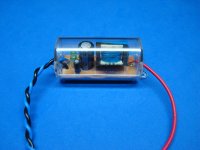
Are there off-the-shelf solutions with Pi-filters, etc?
Maybe someone would be able to determine if the CRT sweep can influence the noise level significantly of a common 12V rail (and other rails?) for a "modern" PSU... What tools would be needed, an oscilloscope?
Another page on PSU/ATX hacking (Japanese): http://take103.blog.fc2.com/blog-entry-22.html
Try it and find out. Any salvaged AT or ATX PSU should have all the necessary voltages. If you hook that up and it works well, you can be reasonably confident that a similar arrangement with a power supply that fits in the available space will work too.
It can be notoriously difficult to eliminate noise and interference though. You have to watch out for ground loops in particular.
It can be notoriously difficult to eliminate noise and interference though. You have to watch out for ground loops in particular.
There is concern here about phantom issues that changing the PSU may bring up. Combine those potential issues with risking rare PDS cards and other possibly flaky parts of the system, I would like try to make as an informed decision as possible before hacking hardware. That being said, overhauling the PSU should probably be done after recapping the analog board.
Please define "phantom issues" more specifically.
(Sorry, but some folks reading this may confuse your comment with "phantom power of audio equipment.")
(Sorry, but some folks reading this may confuse your comment with "phantom power of audio equipment.")
Guide to the Macintosh Family Hardware, Second Edition has more extensive power supply specs for the SE/30 on pages 259-260 that relate to this discussion. In particular on page 259 there is a peak load specification for disk seek servo current on the +12 V disk (4A, with certain duration and duty cycle limits and an allowed sag to 11V) and on page 260 there is what I consider a very tight requirement on +12 V sweep: The way I read it is that the + 12 V sweep supply volts will not vary by more than +_10 mV in response to any one load step on +5 V, +12 V disk, or -12 V, while supply rails other than the one being step load tested are at max load, and line input AC volts are anywhere within the wide AC spec range 85/135 or 170/270 VAC. The individual load steps are not full size between each rail's min/max current, but each designated load current step is considerable.
I speculate that the designers did not want the raster to shrink or move to any visible degree when disk seek activity or future expansion cards demanded peak current. Load step tests should be done with special attention to raster visual stability of position. It may be that commercial supplies cannot meet the strict 0.010 V sweep rail requirement, but that the raster visual appearance is satisfactory for your purposes.
Some cautions:
1. As detailed as pages 259/260 are concerning output limits, they nontheless fall far short of a design spec and/or requirements document. In particular they do not address in what order the rails decay when AC power is removed. It may not matter, but sometimes the magic smoke gets out when most rails rapidly go to 0 volts but one rail hangs in there extra long.
2. It's always safer to do some bench load testing with switched resistor loads or an active load instrument by applying a series of increasing size step load steps while monitoring response with a scope, before connecting your treasure and finding out that at minimum load the supply goes out of regulation or oscillates and threatens to smoke stuff.
I speculate that the designers did not want the raster to shrink or move to any visible degree when disk seek activity or future expansion cards demanded peak current. Load step tests should be done with special attention to raster visual stability of position. It may be that commercial supplies cannot meet the strict 0.010 V sweep rail requirement, but that the raster visual appearance is satisfactory for your purposes.
Some cautions:
1. As detailed as pages 259/260 are concerning output limits, they nontheless fall far short of a design spec and/or requirements document. In particular they do not address in what order the rails decay when AC power is removed. It may not matter, but sometimes the magic smoke gets out when most rails rapidly go to 0 volts but one rail hangs in there extra long.
2. It's always safer to do some bench load testing with switched resistor loads or an active load instrument by applying a series of increasing size step load steps while monitoring response with a scope, before connecting your treasure and finding out that at minimum load the supply goes out of regulation or oscillates and threatens to smoke stuff.