Hax
| Filename | hax-13.hqx |
|---|---|
| Size | 1,351.0 KB (1383382 bytes) |
| Downloads | 17 |
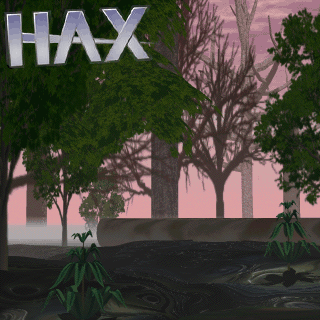
Hax is a 1999-2000 fantasy role-playing scenario for the popular Macintosh shareware engine Realmz, written by John Rawlins (boru@rainbowdragon.com). Adventurers travel to the Madwood in search of the elusive town of Hax, said to overflow with gem-bestowed powers; many a brave soul has sought to open a trade route there and found nothing but an unmarked grave.
Scenario Concept
The premise is a classic fortune-or-death adventure hook: players assemble a Realmz party and venture into Madwood territory in pursuit of a half-mythical settlement reputed to hold gems of tremendous power. Failed expeditions before yours have left the route littered with the dead, framing Hax as a high-risk, high-reward dungeon-crawl trek rather than a linear quest.
Engine Requirements
Hax 1.3 is built specifically against Realmz version 7.0.9 and may behave unpredictably on other engine versions. As a Realmz scenario it inherits the host's hardware floor: a 256-colour-capable Macintosh, at least 5 MB of free RAM, and a display of 640x480 or better. It will not run on the old Apple 12-inch monitors or other sub-VGA displays.
Disk Footprint
Realmz needs about 800 KB of free hard-disk space for temporary files during play, returned when you quit, plus roughly 300-800 KB per saved game depending on the scenario. If a new game fails to start, Rawlins's release notes specifically suggest checking that 800 KB of scratch space is available on the volume.
Distribution and Licence
Hax is distributed as a shareware add-on: about half of the scenario can be played for free, with a $10 registration fee unlocking the remainder. It will only run on a registered copy of Realmz, and the author explicitly authorised inclusion on the Info-Mac CD-ROM mirrors. Version 1.3 is described as fixing several monolithic bugs over earlier releases.


This file is part of the MacTrove archive. See the Thank You page for the upstream mirrors we rely on. It is BinHex encoded — use The Unarchiver to decode it.