


Forma
| Filename | forma-20.hqx |
|---|---|
| Size | 6,582.2 KB (6740154 bytes) |
| Mac OS | Mac OS 8Mac OS X |
| Downloads | 22 |
Released by Mitchell Haile via Degana Games in 2002 (with version 2.1.2 following shortly after), Forma is a Carbonized Macintosh puzzle game built around arranging falling block shapes into matching diagonal, vertical, or horizontal runs of three or more. This catalog entry corresponds to the later 2.1.2 maintenance release distributed as forma_mac_2.1.2.sit (5.74 MB).
Setting and theme
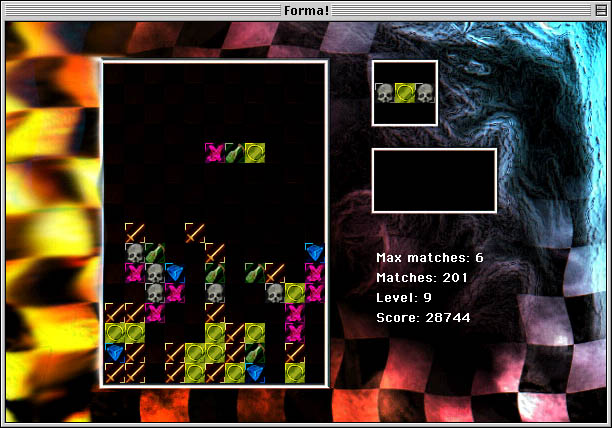
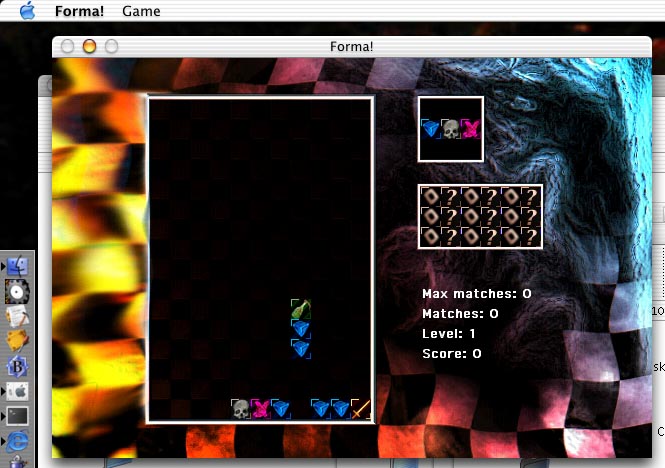
Forma forgoes any narrative wrapper in favor of a pure abstract grid: shaped blocks in saturated colors fall into a fixed playfield, and the visual interest comes from geometric pattern formation rather than characters or story. The 2.1.2 build retains the original art direction.
Gameplay
Block pairs drop into the well in either vertical or horizontal orientation. The player rotates and positions them so that identical shapes line up along any of three axes, clearing those runs and collapsing the remaining stack. Sustained scoring requires anticipating future drops to avoid orphaning blocks deep in the well.
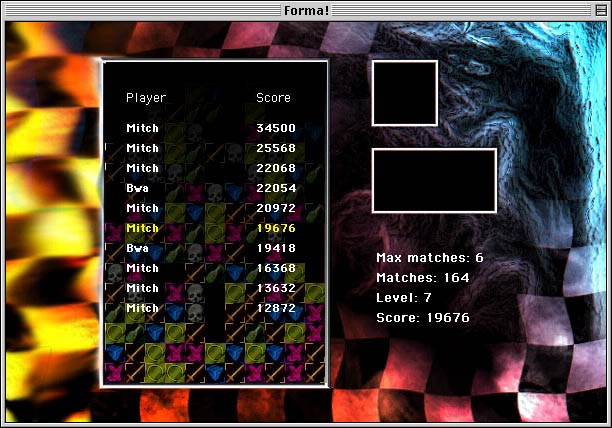
Difficulty rises with falling speed and the variety of shapes in rotation. A persistent high-score table tracks long-term progression, and the 2.1.2 release adjusts pacing and resolves bugs from the 2.0 build.
Engine and technical changes
The engine is a PowerPC Carbon binary requiring CarbonLib 1.1 or later, roughly 12 MB of free RAM, and a display set to thousands or millions of colors. It targets Mac OS 8.1 (with the Carbon update) through Mac OS X. SheepShaver compatibility is documented on Macintosh Garden.
Development and release
Mitchell Haile self-published Forma through Degana Games as shareware. Two builds are archived on Macintosh Garden: the original forma-20.hqx (6.43 MB) and this 2.1.2 update at 5.74 MB, the latter being smaller and incorporating maintenance fixes that postdate the original 2.0 release.
This file is part of the MacTrove archive. See the Thank You page for the upstream mirrors we rely on. It is BinHex encoded — use The Unarchiver to decode it.


