


Trisection
| Filename | trisection-12.hqx |
|---|---|
| Size | 8,919.8 KB (9133843 bytes) |
| Downloads | 13 |
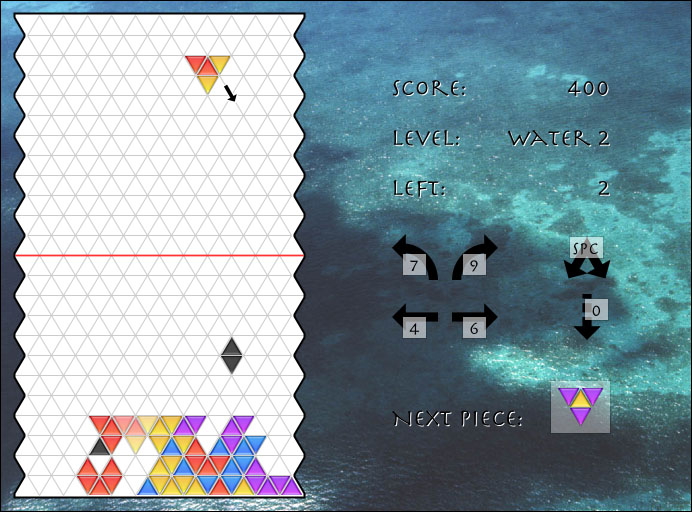
Released by Stick Software (Ben Haller) in 2004 as $15 Mac OS X shareware, Trisection reworks the Tetris formula on a grid of equilateral triangles instead of squares - players score by completing solid-color triangular regions rather than clearing horizontal lines, a constraint Haller pitched as "much more intellectually challenging than Tetris."
Setting and theme
There is no narrative; each level is presented over a full-screen photographic backdrop with one of two looping soundtracks. The visual emphasis is on the triangular tessellation itself - falling triangles, quadtriangles (clusters of four), and the antagonistic black-and-white "Terminator" piece that disrupts color regions.
Gameplay
Triangles fall onto a triangular grid; the player rotates and positions them to fuse contiguous same-color regions, which then clear for points. As levels advance the game introduces bouncing pieces, flipping pieces, additional colors, the Terminator, and a steadily rising drop speed. Two soundtracks and a sampled SFX bank accompany play.
Engine and technical changes
Native Mac OS X shareware, PowerPC-built, with localizations in English, French, and Dutch. Stick Software's own product page warns that Trisection "has not been updated in several years and does not work on recent versions of OS X," effectively limiting it today to PowerPC OS X installs and emulation under SheepShaver/QEMU-PPC.
Development and release
Trisection was part of Stick Software's small product line alongside Solarian II, Eyeballs, Fracture, Aquatint, Constrictor, Jiggler, and PhotoReviewer. Ben Haller, a software engineer turned evolutionary biologist, ran Stick Software as a one-person shareware shop through the 2000s.
Reception and legacy
The game found a niche among Mac OS X puzzle-shareware enthusiasts but never received broad commercial press. Like the rest of Stick Software's catalog, it stopped being maintained as Apple moved to Intel and then 64-bit-only macOS, surviving today on Macintosh Garden as a snapshot of the early-2000s indie OS X shareware scene.
This file is part of the MacTrove archive. See the Thank You page for the upstream mirrors we rely on. It is BinHex encoded — use The Unarchiver to decode it.


