
Crystal Quest
| Filename | crystalquest_2_2_5m.zip |
|---|---|
| Size | 901.3 KB (922884 bytes) |
| Year | 1987 |
| Mac OS | System 7 |
| Architecture | 68K |
| Downloads | 21 |
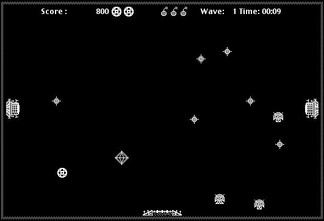
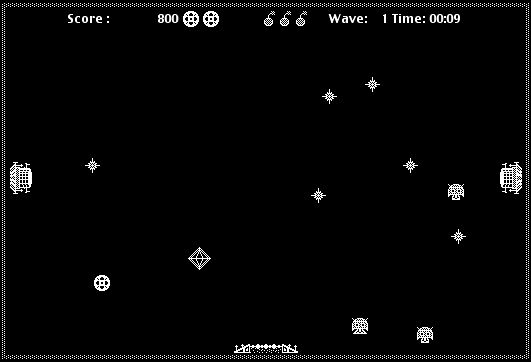
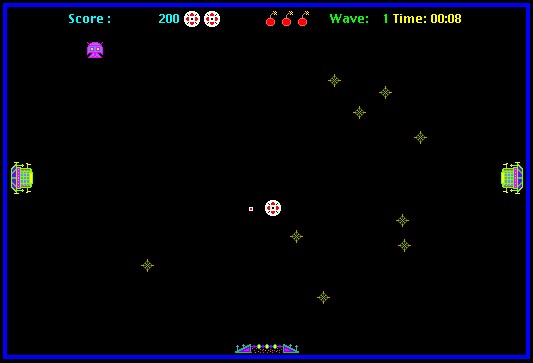
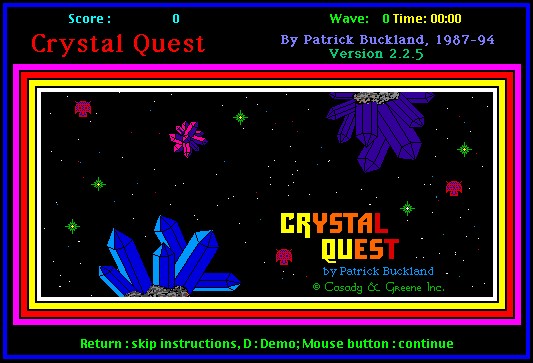
Patrick Buckland's frantic 1987 arcade collect-em-up, published by Casady & Greene, was the first Macintosh game to support the color displays of the Macintosh II. Across waves of escalating chaos, you steer a small ship through a single screen, sweeping up crystals while swarms of nasties hatch, multiply, and box you in toward a closing exit gateway.
Setting and theme
There is no story to speak of: each level is an abstract arena littered with crystals you must vacuum up before the gateway slams shut. The aesthetic is pure 1980s coin-op, all bright color cycling, geometric enemies, and satisfying digital pings. The game leans on tone and pace rather than fiction, and its identity is essentially the rhythm of one more wave.
Gameplay
You move with the mouse and fire with the button, hoovering crystals while dodging mines, smart bombs, and a steadily nastier menagerie that homes in, ricochets, or drops payloads. Clearing the crystals opens an exit; reaching it warps you to the next wave. A two-player alternating mode, demo attract sequence, and high-score table give the loop just enough structure to keep you reaching for the mouse again.
Engine and technical changes
Built originally for the monochrome Mac and updated for the Mac II's 256-color QuickDraw, Crystal Quest drew its visual punch from rapid color-cycling effects that Macworld compared favorably to dedicated arcade hardware. The color build paradoxically ran a little slower than the black-and-white version due to higher RAM demands, a quirk typical of early color Mac titles.
Development and release
Crystal Quest grew out of Buckland's earlier shareware effort Crystal Raider, adding two-player support, color, sound, and a demo mode. Casady & Greene shipped it commercially in 1987. An early release shipped with a demo glitch that crashed roughly one in ten Mac II units, which the publisher addressed via replacement disks. Rebecca Heineman ported the game to the Apple IIGS in 1989, and later versions reached the Amiga, Game Boy, Palm OS, iOS, Xbox 360 (2006, Stainless Games), and Windows (2016).
Reception and legacy
Macworld called it a genuine arcade-grade experience on home hardware, singling out its color-cycle graphics, and the game became one of the defining commercial Mac titles of the late 1980s. Buckland followed it in 1993 with the sequel Crystal Crazy, and the original remains a frequently cited landmark of early color Macintosh gaming.
This file is part of the MacTrove archive. See the Thank You page for the upstream mirrors we rely on. You may need The Unarchiver or a classic Mac emulator to open it.


