

Spectre Supreme
| Filename | spectre_supreme.zip |
|---|---|
| Size | 8,834.6 KB (9046645 bytes) |
| Year | 1992 |
| Developer | Green Dragon Creations |
| Mac OS | System 7 |
| Architecture | 68K |
| Downloads | 33 |
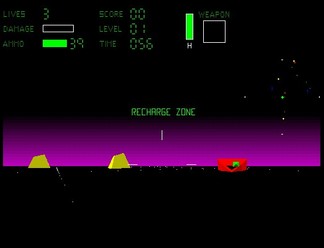
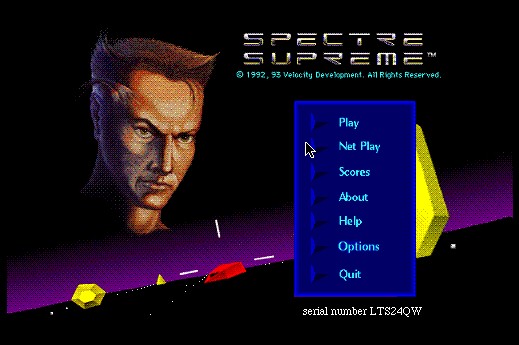
Velocity Development's 1992 sequel to Spectre, originally developed by Peninsula Gameworks, takes the studio's first-person flat-shaded tank battler into 256-color cyberspace. You hunt flags across geometric arenas in a hovertank, dodging acid pools, hunter-killers, and auto-turrets, while up to eight players can fight a single AppleTalk match across a roster of new game modes.
Setting and theme
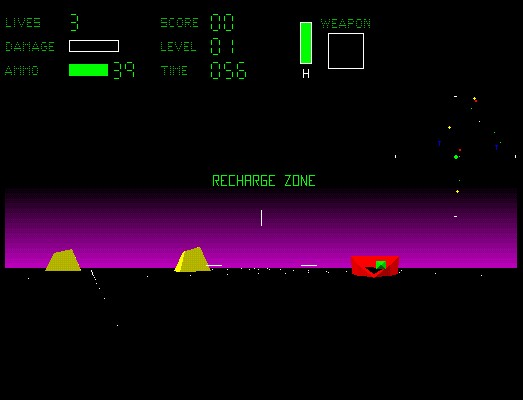
The fiction is pure early-90s cyberspace: a smooth, vector-flat grid stretches to a blue horizon, dotted with pyramids, slabs, and pulsing flags to capture. Spectre Supreme's look is the direct descendant of Atari's 1980 Battlezone, but rendered with filled, shaded polygons rather than wireframes — a clean, abstract aesthetic that became shorthand for "computer combat" on the early Mac.
Gameplay
You drive a hovertank through arenas, collecting ten flags per level while engaging enemy tanks and the new menagerie of slicers, hunter-killers, intelligent acid pools, and auto-gun turrets. The arsenal expanded sharply over the original: smart missiles, seekers, proximity mines, scattershots, and spinners. Transporter gateways and a submergence trapdoor open a "negative cyberspace" beneath the main grid, and new modes — Cyber Soccer, Flag Rally Deluxe, Bumper Tank, Zone Control — push the engine well beyond straight deathmatch.
Engine and technical changes
The headline upgrade was the jump from 1-bit and 16-color rendering to 256 colors, with smoother shading and a denser polygon count than the 1991 original. AppleTalk multiplayer was extended to eight simultaneous tanks on a single LAN, with each Mac running its own first-person view of the shared battlefield, and the engine retained the responsive control feel that had earned Spectre a 5-out-of-5 review from Dragon magazine.
Development and release
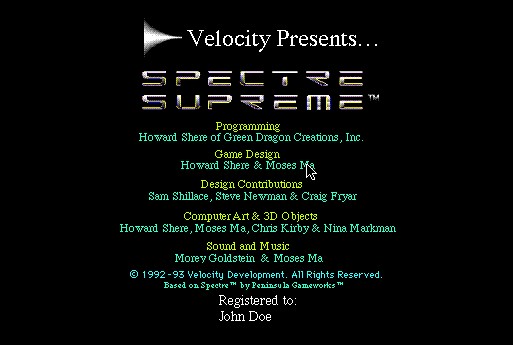
Velocity Development published Spectre Supreme in 1992 for Macintosh, following the 1991 original by Peninsula Gameworks. The series continued with Spectre VR in 1994, which added texture mapping and CD-ROM cinematics. PC and SNES ports of the line followed in 1993–94, though the Mac builds remained the design's home platform.
Reception and legacy
Reviewers praised Supreme's color graphics, expanded weapon set, and especially its eight-player AppleTalk play, which was rare and reliable at a time when LAN gaming on consumer hardware was barely emerging. Next Generation later ranked the original Mac Spectre 44th among the best games of all time, citing the very minimalist flat-shaded aesthetic that Supreme refined; the series remains a touchstone for early 90s networked Mac multiplayer.
Original Source: macgarden
This file is part of the MacTrove archive. See the Thank You page for the upstream mirrors we rely on. You may need The Unarchiver or a classic Mac emulator to open it.


