L-ZONE
| Filename | L-ZONE.cdr_.zip |
|---|---|
| Size | 209,472.7 KB (214500000 bytes) |
| Year | 1992 |
| Mac OS | System 7 |
| Architecture | 68K |
| Downloads | 26 |
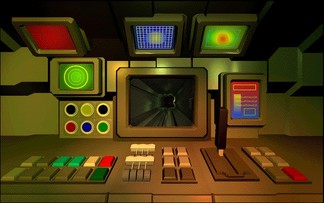
Synergy Inc.'s December 1992 silent CD-ROM adventure, directed by Japanese visual artist Haruhiko Shono, drops the player into a deserted domed city on a red planet and asks them to fiddle with every console, switch, and machine they encounter. There is no dialogue, no text, and no inventory - only exploration through pre-rendered 3D corridors and reactive industrial soundscapes.
Setting and theme
The unnamed Dome City sits in a valley on a far-future red planet, its inhabitants long gone. Pipes hiss, fluorescent panels flicker, and trap-laden chambers hint at why the city was abandoned. Shono treats the architecture itself as the protagonist, in deliberate contrast to his prior Alice: An Interactive Museum, swapping that game's fine-art galleries for stark hi-tech industrial labyrinths.
Gameplay
L-ZONE is a node-based first-person explorer: click directional hotspots to move, click machines to operate them, watch a brief QuickTime clip play, then continue. There are no puzzles in the traditional sense, no death screens, no score; progress is measured by curiosity. Audio direction by Norikazu Miura layers buzzing pipes, resonant metal, and ambient techno to do most of the storytelling.
Engine and technical changes
Like Shono's other Synergy titles, L-ZONE was authored in Macromedia Director, with small embedded QuickTime movies sized for then-current 1x and 2x CD-ROM read speeds. The Mac and Windows 3.1 builds shipped first; an Apple Pippin port titled L-Zone Interactive Theater followed via Bandai Digital Entertainment in March 1996.
Development and release
Originally published December 1992 in Japan by Synergy Inc., L-ZONE reached the United States in 1993 through Synergy's American subsidiary Synergy Interactive. It earned the MITI Prize and the 1992 Multimedia Association Chairman's Award and stayed on Japan's best-selling CD-ROM charts for several years, helping define the country's mid-1990s art-CD-ROM boom.
Reception and legacy
Tony Reveaux in Computer Gaming World called it "an embodiment of technological adventure in the future tense." The title is now read alongside Shono's Gadget (1993) as a foundational work of Japanese atmospheric exploration design, and its dieselpunk-meets-techno aesthetic anticipates titles such as Myst and the later Submachine series.
This file is part of the MacTrove archive. See the Thank You page for the upstream mirrors we rely on. You may need The Unarchiver or a classic Mac emulator to open it.