Home Documents ADB Scorpius 22ADB Version 2.2 Pic16c57 Decap C085 Ncp.Bin
Scorpius 22ADB Version 2.2 Pic16c57 Decap C085 Ncp.Bin

Scorpius 22ADB Version 2.2 Pic16c57 Decap C085 Ncp.Bin

ADB · MacBinary / raw
FilenameScorpius_22ADB-version-2.2_pic16c57_decap-c085_ncp.bin
Size0.00 MB
Subsection Qtronix / Qtronix_Scorpius_22ADB
Downloads4
Enjoying MacTrove? Anonymous downloads are free and unlimited. Create a free account to track favorites, contribute metadata corrections, and join the community chat.
About this file

This is a MacBinary / raw — a binary artifact that can't be previewed in the browser. MacBinary or raw binary — The Unarchiver handles the MacBinary variant.

Home Documents ADB Pat5428369
Pat5428369

Pat5428369

ADB · 1995 · PDF
Filenamepat5428369.pdf
Size0.57 MB
Year1995
Subsection Kensington / Kensington_Turbo_Mouse_Model_64210
Downloads4
Enjoying MacTrove? Anonymous downloads are free and unlimited. Create a free account to track favorites, contribute metadata corrections, and join the community chat.
Reader
Pat5428369
/
Loading…
OCR / Text contents
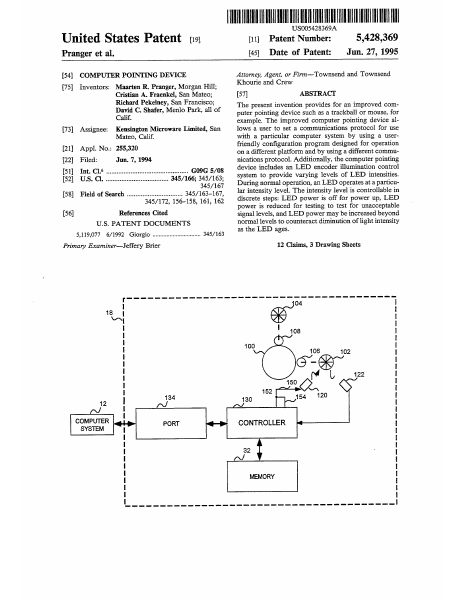
United States Patent 9 Pranger et al. INNO ENON US005428369A. [11] Patent Number: 5,428,369 [45] Date of Patent: Jun, 27, 1995 [54] COMPUTER POINTING DEVICE [75] Inventors: Maarten R. Pranger, Morgan Hill, Cristian A. Fraenkel, San Mateo; Richard Pekelney, San Francisco; David C. Shafer, Menlo Park, all of Calif. [73] Assignee: Kensington Microware Limited, San Mateo, Calif. [21] Appl. No.: 255,320 [22] Fiied: Jun. 7, 1994 (51] Int. CLS G09G 5/08 (52] U.S. CL. 345/166; 345/163; 345/167 [58] Field of Search ..........-s::sssssscsssessscees 345/163-167, 345/172, 156-158, 161, 162 [56] References Cited U.S. PATENT DOCUMENTS 5,119,077 6/1992 Giorgio Primary Examiner—Jefiery Brier 345/163 Attorney, Agent, or Firm—Townsend and Townsend Khourie and Crew [57] ABSTRACT The present invention provides for an improved com- puter pointing device such as a trackball or mouse, for example. The improved computer pointing device al- lows a user to set a communications protocol for use with a particular computer system by using a user- friendly configuration program designed for operation on a different platform and by using a different commu- nications protocol. Additionally, the computer pointing device includes an LED encoder illumination control system to provide varying levels of LED intensities. During normal operation, an LED operates at a particu- lar intensity level. The intensity level is controllable in discrete steps: LED power is off for power up, LED power is reduced for testing to test for unacceptable signal levels, and LED power may be increased beyond normal levels to counteract diminution of light intensity as the LED ages. 12 Claims, 3 Drawing Sheets 04 ! 48 Se “~ H I 1 H 108 | H 100 I H 106 102 I C-e 1 L 122 I 1 150 I 1 152 134 154 120 ! 42 | 130 wt al Mad | COMPUTER SYSTEM iia PORT wi—p CONTROLLER I 1 1 ! if 32 { | law tl I 1 MEMORY I J t { 1 U.S. Patent June 27, 1995 Sheet 1 of 3 5,428,369 a 22 20 — U Oad 12 OU 18 LAS mM rico re FIG_1 Sheet 2 of 3 5,428,369 June 27, 1995 U.S. Patent Z Ola ra os Aiowew a6e10}S Alowe-w JOyeJajN00 JOA ypolqo - | weibold 7 A abew| (Ag eBew| vy | soludeig 4 so1ydesD gy Ae\dsiq Jew, JOWUOW solydeisy JAG J pueoqhey og JeAud asnow re | 2a6eJo}S 810 ze | Wvd o€ (nd9) yun Burssesold jequeg Sheet 3 of 3 5,428,369 June 27, 1995 U.S. Patent AXOWAW ! I ! I 1 i | } t I I i OSL ooF I | } | I I I I I I ! oY oct iv vel och zl “xP l I 1 I | I I i 1 I | at et peer sine net ed NO GO SE RE SNE ey SY Se a ee SUSE SSL ED SO Sa MD GD ESR SOU SEND SR eet Se HN GN eT Me SA SE YATIOULNOD => LuOd <4-+- > WALSAS YALAdWOD iw) (a) 5,428,369 1 COMPUTER POINTING DEVICE BACKGROUND OF THE INVENTION The present invention relates generally to computer pointing devices, and more specifically, to computer pointing devices that are capable of communicating using several different types of protocols or to those that use light-emitting diodes to generate positional info…

Showing first 3,000 characters of 29,856 total. Open the full document →

Home Documents ADB Pat4910655
Pat4910655

Pat4910655

ADB · 1990 · PDF
Filenamepat4910655.pdf
Size0.83 MB
Year1990
Subsection patents
Downloads4
Enjoying MacTrove? Anonymous downloads are free and unlimited. Create a free account to track favorites, contribute metadata corrections, and join the community chat.
Reader
Pat4910655
/
Loading…
OCR / Text contents
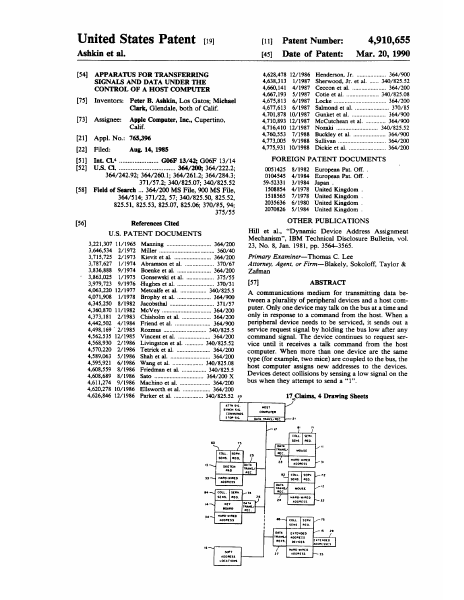
United States Patent 115 Ashkin et al. {11] Patent Number: 4,910,655 [45] Date of Patent: Mar. 20, 1990 [54] (75] (73] [21] (22] (51) [52] [58] [56] APPARATUS FOR TRANSFERRING SIGNALS AND DATA UNDER THE CONTROL OF A HOST COMPUTER Inventors: Peter B. Ashkin, Los Gatos; Michael Clark, Glendale, both of Calif. Assignee: Apple Computer, Inc., Cupertino, Calif. Appl. No.: 765,396 Filed: Ang. 14, 1985 Int. CL.*+ GO6F 13/42; GO6F 13/14 WS. CD. eeeccctesestsesserseeneeseeenes 364/200; 364/222.2; 364/242. 64/260.1; 364/261.2; 364/284.3; 371/57.2; 340/825.07; 340/825.52 Field of Search ... 364/200 MS File, 900 MS File, 364/514; 371/22, 57; 340/825.50, 825.52, 825.51, 825.53, 825.07, 825.06; 370/85, 94; 375/55 References Cited U.S. PATENT DOCUMENTS 3,221,307 11/1965 Manning . 364/200 360/40 . 364/200 370/67 - 364/200 375/55 3,646,534 2/1972 Miller 3,715,725 2/1973 Kievit . 3,787,627 1/1974 Abramson et 3,836,888 9/1974 Boenke et al. .. 3,863,025 1/1975 Gonsewski et al. 3,979,723 9/1976 Hughes et al. . 4,063,220 12/1977 Metcalfe et al. 340/825.5 4,071,908 1/1978 Brophy et al. . 364/900 4,345,250 8/1982 Jacobsthal 371/57 4,360,870 11/1982 McVey 4,373,181 2/1983 Chisholm . 364/900 - 340/825.52 - 364/200 - 340/825.08 4,628,478 12/1986 Henderson, Jr. ...... 4,638,313 1/1987 Sherwood, Jr. et al. 4,660,141 4/1987 4,667,193 5/1987 4,675,813 6/1987 364/200 4,677,613 6/1987 . 370/85 4,701,878 10/1987 Gunket et al. . 364/900 4,710,893 12/1987 McCutchean et al. 364/900 4,716,410 12/1987 Nozaki .... 340/825.52 4,760,553 7/1988 Buckley et al 4,773,005 9/1988 Sullivan .. 4,775,931 10/1988 Dickie et al. FOREIGN PATENT DOCUMENTS 0051425 8/1982 European Pat. Off. . 0104545 4/1984 European Pat. Off. . 59-52331 3/1984 Japan . 1508854 4/1978 United Kingdom . 1518565 7/1978 United Kingdom . 2035636 6/1980 United Kingdom . 2070826 5/1984 United Kingdom . OTHER PUBLICATIONS Hill et al, “Dynamic Device Address Assignment Mechanism”, IBM Technical Disclosure Bulletin, vol. 23, No. 8, Jan. 1981, pp. 3564-3565. Primary Examiner—Thomas C. Lee Attorney, Agent, or Firm—Blakely, Sokoloff, Taylor & Zafman [57] ABSTRACT A communications medium for transmitting data be- tween a plurality of peripheral devices and a host com- puter. Only one device may talk on the bus at a time and only in response to a command from the host. When a peripheral device needs to be serviced, it sends out a 4,442,502 4/1984 Friend et al. 364/900 4,498,169 2/1985 Rozmus .... 340/825.5 service request signal by holding the bus low after any 4,562,535 12/1985 Vincent et al . 364/200 command signal. The device continues to request ser- 4,568,930 2/1986 Livingston et al. 340/825.52 vice until it receives a talk command from the host 4,570,220 2/1986 Tetrick et al. . 364/200 computer. When more than one device are the same 5ge.063 ¥ 1986 Shah et al. 364/200 type (for example, two mice) are coupled to the bus, the Weer eio8e pang ot a i 330/875 08 host computer assigns new addresses to the d…

Showing first 3,000 characters of 39,737 total. Open the full document →

Home Documents ADB 620338 00A Logitech Mouseman Trackman Users Manual May1991
620338 00A Logitech Mouseman Trackman Users Manual May1991

620338 00A Logitech Mouseman Trackman Users Manual May1991

ADB · 1991 · PDF
Filename620338-00A_Logitech_Mouseman_Trackman_Users_Manual_May1991.pdf
Size1.77 MB
Year1991
Subsection Logitech
Downloads7
Enjoying MacTrove? Anonymous downloads are free and unlimited. Create a free account to track favorites, contribute metadata corrections, and join the community chat.
Reader
620338 00A Logitech Mouseman Trackman Users Manual May1991
/
Loading…
OCR / Text contents
I ~ User's Manual for TrackMan®, MouseMan®, and MouseKey™ I ~ lOOITlCH Copyright Copyright© 1991 Logitech All Rights Reserved First Edition No part of this document may be copied or reproduced in any form or by any means without the prior written consent of Logitech. Logitech makes no warranties with respect to this documentation and disclaims any implied warranties of merchantability or fitness for a particular purpose. Information in this document is subject to change without notice. Logitech assumes no responsibility for any errors that may appear in this document. From time to time changes may occur in the file names and in the files actually included on the distribution disks. Logitech makes no warranties that such files or facilities as mentioned in this documentation exist on the distribution disks or as part of the materials distributed. This edition applies to MouseKey™, Version 1.0. Document: 620338-00 Released: May 1991 Copy Protection The MouseKey™ software, available only from Logitech, is not copy-protected. This doesn't mean that you can make unlimited copies of it. The MouseKey™ software is protected by the copyright laws that pertain to computer software. It is illegal to make copies of the contents of this disk, except for your own backup, without written permission from Logitech. In particular, it is illegal to give a copy to another person. Trademarks: Logitech, the Logitech logo, TrackMan, and MouseMan are trademarks of Logitech Inc. Apple and Macintosh are registered trademarks of Apple Computer, Inc. Microsoft Word is a registered trademark of Microsoft Corporation. Adobe Illustrator is a trademark of Adobe Systems, Inc. QuicKeys 2 is a trademark of CE Software, Inc. THINK C is a trademark of Symantec Corporation. Excel is a registered trademark of Microsoft. PageMaker is a registered trademark of Aldus Corporation. MacWrite is a registered trademark of Claris Corporation. INITPicker is a trademark of Microseeds Publishing, Inc. Word Finder is a registered trademark of Microlytics, Inc. All other trademarks mentioned in this manual are the sole property of their respective manufacturers. ii Copyright Logitech Software License Agreement This document is a legal agreement between you, the Licensee, and Logitech, Inc. ("Logitech"). By using this program, you are agreeing to become bound by the terms of this agreement. If you do not agree to the terms of this agreement, promptly return the disk package and the other items that are part of this product in their original package, with your payment receipt (the "Receipt"), to your point of purchase for a refund. In consideration of payment of the License Fee, which is a part of the price evidenced by the Receipt, Logitech grants to the Licensee a nonexclusive right, without right to sublicense, to use this copy of this Logitech Software on a single Computer at a time. Logitech reserves all rights not expressly granted, and retains title and ownership of the Software…

Showing first 3,000 characters of 50,226 total. Open the full document →

Home Documents ADB Pat4918598
Pat4918598

Pat4918598

ADB · 1990 · PDF
Filenamepat4918598.pdf
Size0.67 MB
Year1990
Subsection patents
Downloads4
Enjoying MacTrove? Anonymous downloads are free and unlimited. Create a free account to track favorites, contribute metadata corrections, and join the community chat.
Reader
Pat4918598
/
Loading…
OCR / Text contents
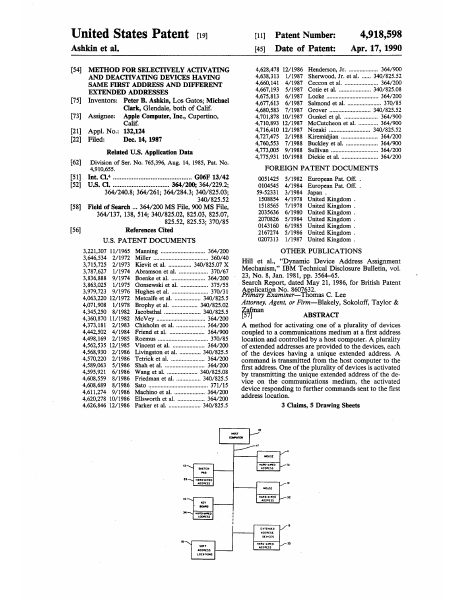
United States Patent 15 [11] Patent Number: 4,918,598 Ashkin et al. [45] Date of Patent: Apr. 17, 1990 [54] METHOD FOR SELECTIVELY ACTIVATING 4,628,478 12/1986 Henderson, Jr. ... sso 364/900 AND DEACTIVATING DEVICES HAVING 4,638,313 1/1987 Sherwood, Jr. et al. ...... 340/825.52 AME FIRS AND DIFFERENT 4,660,141 4/1987 Ceccon et al. 364/200 SA TENDED ADDReSSs D 4,667,193 5/1987 Cotie et al. 40/825.08 : , 4,675,813 6/1987 Locke ...... 364/200 [75] Inventors: Peter B. Ashkin, Los Gatos; Michael 4,677,613 6/1987 Salmond et . 370/85 ; Clark, Glendale, both of Calif. 4,680,583 7/1987 Grover ... 340/825.52 [73] Assignee: Apple Computer, Inc., Cupertino, 4,701,878 10/1987 Gunkel et al. 364/900 Calif. 4,710,893 12/1987 McCutcheon et al 364/900 [21] Appl. No.: 132,124 4,716,410 12/1987 Nozaki . 340/825.52 led. 4,727,475 2/1988 Kiremidjian .. 364/200 [22] Filed: Dec. 14, 1987 4,760,553 7/1988 Buckley et al 364/900 icati 4,773,005 9/1988 Sullivan ... 364/200 Related U.S. Application Data 4,775,931 10/1988 Dickie et al. 364/200 [62] Division of Ser. No. 765,396, Aug. 14, 1985, Pat. No. 4,910,655. FOREIGN PATENT DOCUMENTS (51] | Int. Ci.* GOGF 13/42 0051425 5/1982 European Pat. Off. . [52] U.S. Cl. . 364/200; 364/229.2; 0104545 4/1984 European Pat. Off. . 364/240.8; 364/261; 364/284.3; 340/825.03; 59-52331 3/1984 Japan . 340/825.52 1508854 4/1978 United Kingdom . [58] Field of Search ... 364/200 MS File, 900 MS File, 1518565 7/1978 United Kingdom . . 02, 03, .07, nite ingdom . 364/137, 138, 514; 340/ i ° 8s “a eve 2070826 5/1984 United Kingdom . woe 0143160 6/1985 United Kingdom . [56] References Cited 2167274 5/1986 United Kingdom . U.S. PATENT DOCUMENTS 0207313 1/1987 United Kingdom . 3,221,307 11/1965 Manning . . 364/200 OTHER PUBLICATIONS 3,646,534 2/1972 Miller . +. 360/40 3,715,725 2/1973 Kievit et al. 340/825.07 X 3,787,627 1/1974 Abramson et al ss» 370/67 3,836,888 9/1974 Boenke et al. . 364/200 3,863,025 1/1975 Gonsewski et al. 375/55 3,979,723 9/1976 Hughes et al. .. 370/31 4,063,220 12/1972 Metcalfe et al. 340/825.5 4,071,908 1/1978 Brophy et al }40/825.02 4,345,250 8/1982 Jacobsthal 340/825.5 4,360,870 11/1982 McVey ... 364/200 4,373,181 2/1983 Chisholm et al. 64/200 4,442,502 4/1984 Friend et al. 364/900 4,498,169 2/1985 Rozmus .. 370/85 4,562,535 12/1985 Vincent et al. 364/200 4,568,930 2/1986 Livingston et al. 340/825.5 4,570,220 2/1986 Tetrick et al. 364/200 4,589,063 5/1986 Shah et al. 364/200 4,595,921 6/1986 Wang et al. 340/825.08 4,608,559 8/1986 Friedman et al. 340/825.5 4,608,689 8/1986 Sato ...... 371/15 4,611,274 9/1986 Machino et al. 364/200 4,620,278 10/1986 Ellsworth et al 364/200 4,626,846 12/1986 Parker et al. .... Hili et al., “Dynamic Device Address Assignment Mechanism,” IBM Technical Disclosure Bulletin, vol. 23, No. 8, Jan. 1981, pp. 3564-65. Search Report, dated May 21, 1986, for British Patent Application No. 8607632. Primary Examiner—Thomas C. Lee Attorney, Agent, or Firm—Blakely, Sokoloff, Taylor & cia A method …

Showing first 3,000 characters of 32,615 total. Open the full document →

Home Documents ADB FDB Specification Rev B Proposal
FDB Specification Rev B Proposal

FDB Specification Rev B Proposal

ADB · 1985 · PDF
FilenameFDB_Specification_Rev_B_Proposal_19850613.pdf
Size0.64 MB
Year1985
Subsection fdb
Downloads4
Enjoying MacTrove? Anonymous downloads are free and unlimited. Create a free account to track favorites, contribute metadata corrections, and join the community chat.
Reader
FDB Specification Rev B Proposal
/
Loading…
OCR / Text contents
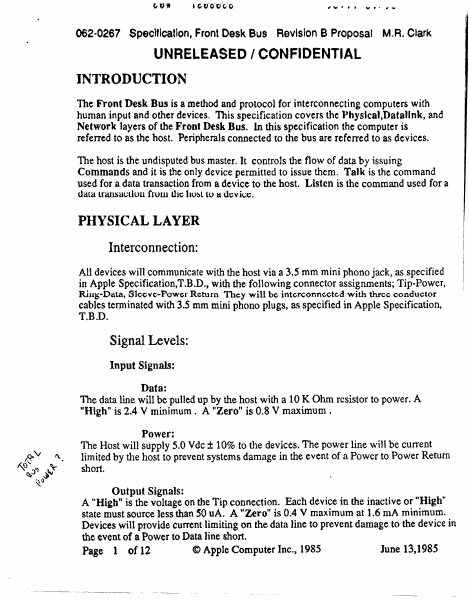
""""'' wr·,.,,, ,• 062-0267 Specltlcation, Front Desk Bus Revision B Proposal M.R. Ctark UNRELEASED I CONFIDENTIAL INTRODUCTION The Front Desk Bus is a method and protocol for interconnecting computers with human input and other devices. This specification covers the l'hyslca1,Datallnk, and Network 1ayers of the Front Desk Bus. In this specification the computer is referred to as the host. Peripherals connected to the bus are referred to as devices. The host is the undisputed bus master. It controls the flow of data by issuing Commands and it is the only device permitted to issue them. Talk is the command used for a data transaction from a device to the host. Listen is the command used for a data Lransa<.;Lluu frow lhc hu~l lu ts elev i\;~. PHYSICAL LAYER Interconnection: All devices will communicate with the host via a 3.5 mm mini phone jack, as specified in Apple Specification,T.B.D., with the following connector assignments; Tip-Power, Riu~·Data, SlceV'c-Powcr Return They will be interconnected with three conductor cables terminated with 3.5 mm mini phono plugs, as specified in Apple Specification, T.B.D. Signal Levels: Input Signals: Data: The data line will be pulled up by the host with a 10 K Ohm resistor to power. A "High" is 2.4 V minimum . A "Zero" is 0.8 V maximum . Power: The Host will supply 5.0 Vdc + 10% to the devices. The power line will be current limited by the host to prevent systems damage in the event of a Power to Power Return short. Output Signals: A "High" is the voltage on the Tip connection. Each device in the inactive or "High" state must source less than SO uA. A "Zero" is 0.4 V maximum at 1.6 mA minimum. Devices will provide current limiting on the data line to prevent damage to the device in the event of a Power to Data line short. Page 1 of 12 © Apple Computer Inc., 1985 June 13,1985 062·0267 Specification, Front Desk Bus Revision B Proposal M.R. Ctark UNRELEASED I CONFIDENTIAL Modulation: There are three f onns of modulation on the bus, Normal modulation which transmits commands and data, Hi&h Speed modulation which transmits data, and Signals which broadcast global messages such as s~rvk~ Rcquc~l auu Rt:set. Normal Modulation: An RZ code for modulation has been adopted for the Front Desk Bus. Each bit ce 11 boundary is signified by a falling edge on the bus. The period of each bit cell is the time between two falling edges on the bus. The time for a normal modulation bit cell, Teye' is 100 usec + 30%. All devices must support nonnal modulation for data transactions. The data is encoded as the ratio of low to high time of each bit cell. Thus a "O" is ~ncuc.le<l ct~ a hit cell in which thP. lnw timP. i~ 2reatcr thPtn th~ hieh t1me.. C.onver.~ely. a "l" is encoded as a bit cell in which the low time is kss than the high time. A Start is defined as a" l ".A Stop is similar to a "O", in that it has a low time of TO , but it does not have another negative edge to define the bit cell time. It is used to s…

Showing first 3,000 characters of 17,715 total. Open the full document →
Home Documents ADB Front Desk Bus An Alternative Proposal Rev 1.2
Front Desk Bus An Alternative Proposal Rev 1.2

Front Desk Bus An Alternative Proposal Rev 1.2

ADB · 1984 · PDF
FilenameFront_Desk_Bus_An_Alternative_Proposal_Rev_1.2_19840906.pdf
Size0.39 MB
Year1984
Subsection fdb
Downloads4
Enjoying MacTrove? Anonymous downloads are free and unlimited. Create a free account to track favorites, contribute metadata corrections, and join the community chat.
Reader
Front Desk Bus An Alternative Proposal Rev 1.2
/
Loading…
OCR / Text contents
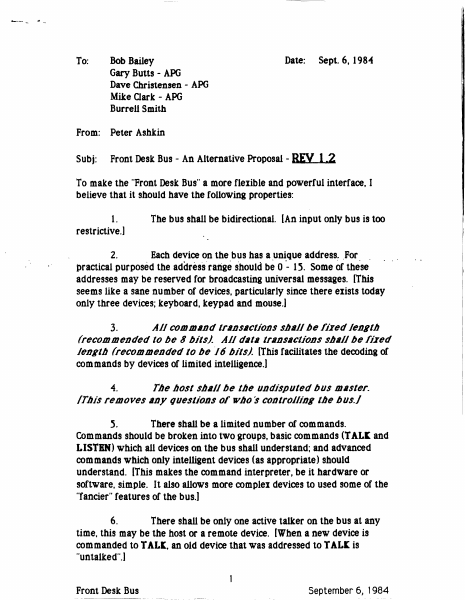
To: Bob Bailey Gary Butts - APG Date: Sept. 6, 1984 Dave Christensen - APG Mike Clark - APG Burrell Smith From: Peter Ashkin Subj: Front Desk Bus - An Alternative Proposal - REV 1.2 To make the "Front Desk Bus" a more fleiible and powerful interface, I believe that it should have the following properties: 1. The bus shall be bidirectional. [An input only bus is too restrictive.] 2. Each device on the.bus has a .un~que address... For. t>ractical purposed the address.range should be 0 - 15. Some of these addresses may be reserved for broadcasting universal messages. [This seems like a sane number of devices, particularly since there e1ists today only three devices; keyboard, keypad and mouse.) 3. All command tr11ns11ctio11s shall be fired Jen11h (recommended to be 8 bits). All d11t11 tr1111sactio11s shall be fired length (recommended 10 be 16 bits). [This facilitates the decoding of commands by devices of limited intelligence.) 4. The host shall be the undisputed bus master. /This removes any questions of who's controlling the bus./ 5. There shall be a limited number of commands. Commands should be broken into two grO\IPS, basic commands (TALI: and LISTBN) which all devices on the bus shall understand; and advanced commands which only intelligent devices (as appropriate) should understand. (This makes the command interpreter, be it hardware or software, simple,. It also allows more compleI devices to used some of the "fancier" features of the bus.) 6. There shall be only one active talker on the bus at any time, this may be the host or a remote device. [When a new device is commanded to TALI:, an old device that was addressed to T AL[ is "untalked".] Front Desk Bus September 6, 1984 7. Bus must accept devices that talk at different speeds. The host, at a minimum, must be able to listen at various speeds. (This implies that the data on the bus must be "self-clocked". By not rigidly fixing the speed of transmission, the bus does not need to be crystal (etc.) controlled.] 8. There can be multiple active listeners on the bus. (LISTEN commands are additive, as needed, multiple devices can be addressed to listen. To remove a selected listener, a special "unlisten" command is sent to globally deselect all listeners.) 9. An interrupt mechanism must be available which circumvents the needs to poll devices that need service. [Since the bus is relatively slow, the interrupt latency time in a polled environment is long. The ability to interrupt the master for service is important.] 10. There shall exist a mechanism that sends a unique message that puts all devices on the bus into the command (reset) mode.. .{This is important if for some r~ason.the bus gets "hung".) ... 11. There should be a minimum number of "time-outs" needed on the bus. The only needed time out should be to time out a non-responsive talker. (Timers are ugly, but waiting for a dead device is uglier.] 12. Hand-off of the bus from the master to a talker and /Jack again must be…

Showing first 3,000 characters of 12,296 total. Open the full document →
Home Documents ADB Pat4912627
Pat4912627

Pat4912627

ADB · 1990 · PDF
Filenamepat4912627.pdf
Size0.77 MB
Year1990
Subsection patents
Downloads4
Enjoying MacTrove? Anonymous downloads are free and unlimited. Create a free account to track favorites, contribute metadata corrections, and join the community chat.
Reader
Pat4912627
/
Loading…
OCR / Text contents
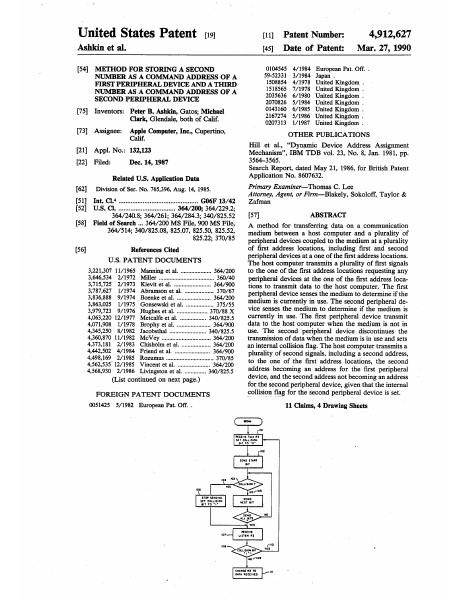
° United States Patent [19] [11] Patent Number: 4,912,627 Ashkin et al. [45] Date of Patent: Mar. 27, 1990 [54] METHOD FOR STORING A SECOND 0104545 4/1984 European Pat. Off. . NUMBER AS A COMMAND ADDRESS OF A 59-52331 3/1984 Japan . FIRST PERIPHERAL DEVICE AND A THIRD - 1508854 4/1978 United Kingdom . NUMBER AS A COMMAND ADDRESS OF A Moheeee lose uted Kingdom - SECOND PERIPHERAL DEVICE 2035636 6/1980 United Kingdom . 2070826 5/1984 United Kingdom . a 4 . 0143160 6/1985 United Kingdom . [75] Inventors: Gant Glenda Gatos: Michael 2167274 5/1986 United Kingdom . ? . 0207313 1/1987 United Kingdom . [73] Assignee: Apple Computer, Inc., Cupertino, OTHER PUBLICATIONS ; Hill et al., “Dynamic Device Address Assignment [21] Appl. No.: 132,123 Mechanism”, IBM TDB vol. 23, No. 8, Jan. 1981, pp. [22] Filed: Dec, 14, 1987 3564-3565. 7 Search Report, dated May 21, 1986, for British Patent Related U.S. Application Data Application No. 8607632. sotct Primary Examiner—Thomas C. Le: 62] Di . No. 765,396, Aug. 14, 1985. ry © [62] ivision of Ser. No ue 9 Attorney, Agent, or Firm—Blakely, Sokoloff, Taylor & [51] Int. C14 GO6F 13/42 Zafman [52] U.S. Cl. 364/200; 364/229.2; 364/240.8; 364/261; 364/284.3; 340/825.52 [57] ABSTRACT [58] Field of Search ... 364/200 MS File, 900 MS File, 4 method for transferring data on a communication 364/514; 340/825.08, 825.07, 825.50, 825.52, medium between a host computer and a plurality of 825.22; 370/85 peripheral devices coupled to the medium at a plurality [56] References Cited of first address locations, including first and second U.S. PATENT DOCUMENTS 3,221,307 11/1965 3,646,534 3,715,725 3,787,627 3,836,888 3,863,025 3,979,723 4,063,220 12/1977 4,071,908 4,345,250 4,360,870 4,373,181 4,442,502 4,498,169. 4,562,535" 12/1985 4,568,930 Manning et al. . Miller ........ Kievit et al. .. Abramson et Boenke et al. Gonsewski et al. . Hughes et al. ... Metcalfe et al. .. Brophy et al. Jacobsthal McVey ...... Chisholm et al. Friend et al. Rozumus .. Vincent et al. Livingston et al. 2/1972 2/1973 1/1974 9/1974 1/1975 9/1976 1/1978 8/1982 11/1982 2/1983 4/1984 2/1985 2/1986 (List continued on next page.) 364/200 - 360/40 364/900 - 370/67 364/200 « 375/55 - 370/88 X 340/825.5 .-. 364/900 340/825.5 364/200 364/200 364/900. - 370/85 364/200 340/825.5 FOREIGN PATENT DOCUMENTS 0051425 5/1982 European Pat. Off. . ‘STO SENDING SET COLLISION tare Wective Tue AS SET cOLLisiON unre 73" peripheral devices at a one of the first address locations. The host computer transmits a plurality of first signals to the one of the first address locations requesting any peripheral devices at the one of the first address loca- tions to transmit data to the host computer. The first peripheral device senses the medium to determine if the medium is currently in use. The second peripheral de- vice senses the medium to determine if the medium is currently in use. The first peripheral device transmit data to the host computer when the medium is not in use.…

Showing first 3,000 characters of 33,022 total. Open the full document →
Home Documents ADB 019000200 1090 C1 Kensington Turbo Mouse User Manual
019000200 1090 C1 Kensington Turbo Mouse User Manual

019000200 1090 C1 Kensington Turbo Mouse User Manual

ADB · 1990 · PDF
Filename019000200-1090-C1_Kensington_Turbo_Mouse_User_Manual_1990.pdf
Size0.98 MB
Year1990
Subsection Kensington
Downloads7
Enjoying MacTrove? Anonymous downloads are free and unlimited. Create a free account to track favorites, contribute metadata corrections, and join the community chat.
Reader
019000200 1090 C1 Kensington Turbo Mouse User Manual
/
Loading…
OCR / Text contents
Turbo Mouse® User Manual TURBO MOUSE USER MANUAL The contents of this manual are not intended to and do not constitute a warranty of any sort. Kensington Microware Limited specifically dis· claims any implied warranties of merchantability or fitness for any particular purpose resulting from this manual. Kensington Microware Limited reserves the right to revise and make changes to this manual (and to the Kensington product and software) from time to time without obligation to notify any person of, or to provide any person with such revision or changes. Turbo Mouse and Kensington are registered trademarks of Kensington Microware Limited. Apple, Macintosh, Finder, and TeachText are registered trademarks of Apple Computer, Inc. Any unauthorized copying, duplicating, or other reproduction of the contents hereof is prohibited without written consent from Kensington Microware Limited. Copyright © 1988, 1990 Kensington Microware Limited. All rights reserved. KENSINGTON .. Kensington Microware Limited 2855 Campus Drive San Mateo. CA 94403 (800) 535·4242 (415) 572·2700 Fax (415) 572·9675 DOCUMENT 019000200-1090-C I Turbo Mouse® User Manual TABLE OF CONTENTS Introduction Turbo Mouse Hardware ......................................................................................................................... I Personalizing Your Turbo Mouse ........................................................................................................... 1 Special Features of Turbo Mouse ADB ................................................................................................. 1 Connecting Your Turbo Mouse ...............................................................................................................3 Retiring Your Old Mouse .........................................................................................................................3 Using Your Turbo Mouse ........................................................................................................................4 Using the Chording Feature in Turbo Mouse ADB ..............................................................................5 Maintaining Your Turbo Mouse ..............................................................................................................5 Turbo Mouse Software ...........................................................................................................................6 Software Requirements ...........................................................................................................................6 Making a Backup Disk ..............................................................................................................................6 Installing the Turbo Mouse Software .....................................................................................................7 Accessing the Turbo Mouse cdev .............................................................................…

Showing first 3,000 characters of 33,490 total. Open the full document →
Home Documents ADB Front Desk Bus An Alternative Proposal
Front Desk Bus An Alternative Proposal

Front Desk Bus An Alternative Proposal

ADB · 1984 · PDF
FilenameFront_Desk_Bus_An_Alternative_Proposal_19840820.pdf
Size0.28 MB
Year1984
Subsection fdb
Downloads4
Enjoying MacTrove? Anonymous downloads are free and unlimited. Create a free account to track favorites, contribute metadata corrections, and join the community chat.
Reader
Front Desk Bus An Alternative Proposal
/
Loading…
OCR / Text contents
I ~' - --~-" To: Bob-Bailey Gary Butts - APG Dave Christensen - APG Mike Clark - - APG Burrell Smith From: Peter Ashkin Subj: Front Desk Bus - An Alternative Proposal Date: August 20, 1984 To make the "Front Desk Bus" a more fleiible and powerful interface, I believe that it should have the following properties: The bus shall be bidirectional. [An input only bus is too 1. restrictive.) 2. Each device on the bus has a unique address. For practical purposed the address range should be 0 - 15. Some of these addresses may be reserved for broadcasting universal messages. (This seems like a sane number of devices, particularly since there eiists today only three devices; keyboard, keypad and mouse.) 3. . All messages on the bus shall be filed length. (This facilitates the decoding of commands by devices of limited intelligence.) 4. Only one rdevice at a time can be "bus master". This ability can be relinquished, and another device can assume bus mastership. (Usually the host will be the bus master, but the interface should not preclude a future device which may master the bus. Also, by having an undisputed bus master, there are no bus contention problems.) 5. There shall be a limited number of commands. Commands should be broken into two groups, basic commands (T AL~ and LISTBN) which all devices on the bus shall understand; and advanced commands which only intelligent devices (as appropriate) should understand. (This makes the command interpreter, be it hardware or software, simple. It also allows more comple1 devices to used some of the "fancier" teatures of the bus.) There shall be only one active talker on the bus at any time, this may be the host or a remote device. (When a new device is commanded to T ALl, an old device that was addressed to T ALl is "untalked".) 6. FrontJ&s_k_B_u_s__ ~,-- __ _ Auaus.t 24. J 984 7. Bus must accept devices that talk at different speeds. The host, -at-a· minimum, must be able to listen at various speeds. (This implies that the data on the bus must be se1f-clocked... By not rigidly filing the speed of transmission, the bus does not need to be crystal (etc.) controlled.] 11 8. There can be multiple active listeners on the bus. (Listen commands are additive, as needed, multiple devices can be addressed to listen. To remove a selected listener, a special Unlisten" command is sent to globally deselect all listeners.) 11 9. An interrupt mechanism must be available which circumvents the needs to poll devices that need service. (Since the bus is relatively slow, the interrupt latency time in a polled environment is long. The ability to interrupt the master for service is important.) 10. There shall eiist a mechanism that sends a unique message that puts all devices on the bus into the command (reset) mode. (This is important if for some reason the bus gets hung".) 11 11. There should be a minimum number of "time-outs" needed on the bus. The only needed time out should be to time out a non-responsi…

Showing first 3,000 characters of 9,168 total. Open the full document →
Subscribe to ADB
mp.ls