Home Documents ADB CH Flightstick Pro Jetstick For Macintosh User Manual Version 1.0
CH Flightstick Pro Jetstick For Macintosh User Manual Version 1.0

CH Flightstick Pro Jetstick For Macintosh User Manual Version 1.0
ADB · PDF
FilenameCH_Flightstick_Pro_Jetstick_for_Macintosh_User_Manual_Version_1.0.pdf
Size1.04 MB
Subsection CH_Products
Downloads8
Enjoying MacTrove? Anonymous downloads are free and unlimited. Create a free account to track favorites, contribute metadata corrections, and join the community chat.
Reader
CH Flightstick Pro Jetstick For Macintosh User Manual Version 1.0
/
Loading…
OCR / Text contents
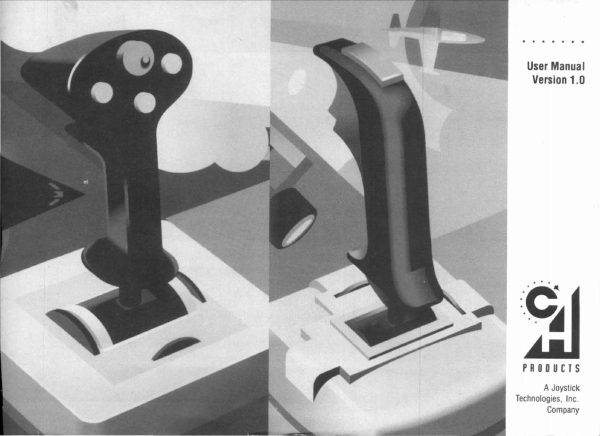
User Manual Version 1.0 :SJ PRODUCTS A Joystick Technologies , Inc. Company TRB~E OF CONTENTS F~IGHTSTICH PRO™ FOR MACINTOSH JETSTICH™ FOR MACINTOSH User Manual Version 1.0 Introduction .............................. 2 Package Contents .......................... 3 Connecting the Joystick .................... 3 Installing the software ...................... 3 The Control Panel ......................... 5 Modes ................................... 7 a. The Relative Mouse Mode ............. 7 b. The Absolute Mouse Mode ............. 8 c. The Keyboard Mode ................... 9 Fire Buttons ............................. 10 Stick Trim ............................... 11 Throttle ................................. 12 System Settings .......................... 13 Importing and Exporting Settings ........... 14 Miscellaneous Notes ...................... 15 Troubleshooting .......................... 16 Specifications ............................ 17 Warranty ................................ 18 Trademarks .............................. 19 FCC Notice ............................. 19 • INTRODUCTION a. The FLIGHTSTICK PRO for Macintosh (Figure 1) and the JETSTICK for Macintosh (Figure 2) are joysticks for the Apple Macintosh (Mac) family. They connect to the Apple Desktop Bus (ADB) of the Mac. Each can control the mouse cursor or emulate keypresses. The FLIGHTSTICK PRO offers four programmable buttons, which include a trigger and three fire buttons. In addition it offers a throttle control and an eight way switch which are also programmable. The JETSTICK offers a trigger and one fire button which are programmable. b. In the basic mode each joystick emulates a mouse. Each either moves the mouse cursor in relative mode (i.e., the cursor starts to move in the direction the stick is pointed) or they can control the cursor in absolute mode (i.e., releasing the stick to the center position will center the mouse cursor on the screen, likewise pulling it to upper left corner will place the cursor in the upper left corner of the screen). Additionally, each offers emulation of the keyboard by translating stick movement into keypresses. c. The joysticks can be used simultaneously with a keyboard, mouse, and other ADB devices. d. The joysticks come with a Control Panel file that allows the setting of various parameters such as speed and key codes. Settings can be saved for several hundred different programs. When a pro- Ergonom1cally 3 fire buttons give you - the full range of combat features and a profess1onalfeeL designed trigger andl1rrnerrest -fromour#lrated FUGHTSTICK. X-Alls Trim Alljuatment Responsive throttle control lets you command your speed. f1netuneyour aileron and elevator positions. • Figure 1 - The FLIGHTSTICK PRO Figure 2 - The JETSTICK gram is started for which settings exist, the settings will be automatically activated. e. System requirements: Any Macintosh with ADB except Mac 128, 512, 512e and MacPlus; System 6.0. 7 or later (also…

Showing first 3,000 characters of 34,837 total. Open the full document →
Home Documents ADB Front Desk Bus Rev 3.1
Front Desk Bus Rev 3.1

Front Desk Bus Rev 3.1

ADB · 1984 · PDF
FilenameFront_Desk_Bus_Rev_3.1_19841029.pdf
Size0.94 MB
Year1984
Subsection fdb
Downloads4
Enjoying MacTrove? Anonymous downloads are free and unlimited. Create a free account to track favorites, contribute metadata corrections, and join the community chat.
Reader
Front Desk Bus Rev 3.1
/
Loading…
OCR / Text contents
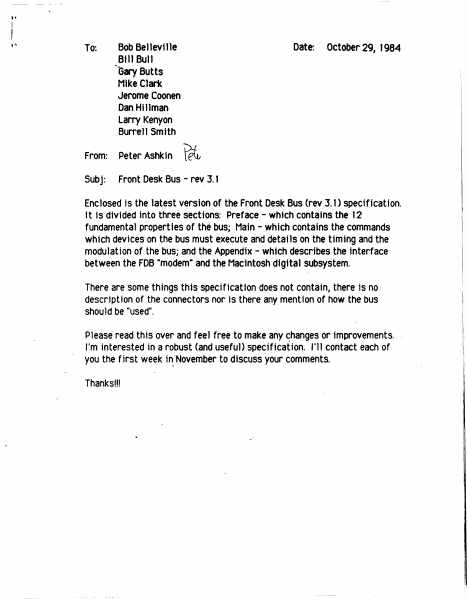
•• , I To: Bob Belleville Date: October 29, 1984 Bt11 Bu11 -c;ary· Butts Mike Clark Jerome Coonen Dan Hil1man Larry Kenyon Burre11 Smith ?et, From: Peter Ashkln Subj: Front Desk Bus - rev 3.1 Enclosed is the latest version of the Front Desk Bus (rev 3.1) specification. It is divided into three sections: Preface - which contains the 12 fundamental properties of the bus; Main - which contains the commands which devices on the bus must execute and deta11s on the timing and the moduJat ion of the bus; and the Appendix - which describes the interface between the FOB "modem· and the Macintosh digital subsystem. There are some things this specification does not contain, there is no description of the connectors nor is there any mention of how the bus should be "used". Please read this over and feel free to make any changes or improvements. I'm interested in a robust (and useful) spe~ification. 1911 contact each of you the first week in_·November to discuss your comments. Thanksm •• rtrrae - rroat Int .. I•• To mate the "Front Delk Bua" 1 more ne1ible and powerful interface, it should have the f ollowina properties: l. The bus shall be bidirectional. (An input only bus is too restrictive.) 2. Bach device on the bus has a unique address. For practical purposed the address range should be 0 - 1.f. Some of these addresses may be reserved for broadcasting universal messages. (This seems lite a sane number of devices, particularly since there eiists today only three devices; keyboard, keypad and mouse.) 3. All command transactions shall be eight bits Iona. All data transactions shall be 16 bits long. (This facilitates the decoding of commands by devices of limited intelligence.) The host shall be the undisputed bus master. (This removes any question of who's controlling the bus.) 4. 5. There shall be a limited number of commands. Commands should be broken into two groups, basic commands (TALI: and LISTBN) which all devices on the bus shall understand; and advanced commands which only intelligent devices (as appropriate) should understand. (This makes the command interpreter, be it hardware or software, simple. It also allows more comple1 devices to used some of the fancier" features of the bus.) · 0 6. There shall be only one active talker on the bus at any time, this may be the host or an addressed device. (A device addressed to TALI: with data to send untalts itself after it sends its 16 bits of data or if it has no data to send "untalts" itself immediately and allows the bus to time-out.I 0 0 The bus protocol must accept devices that talk at different speeds. The host, at a minimum, must be able to listen at various speeds. (This implies that the data on the bus must be self-clocked". By not rigidly filing the speed of transmission, the bus does not need to be crystal (etc.) controlled.) 7. 0 There shall be only one active listener on the bus at any time, this may be the host or an addressed device. (A device addressed to LISTBN…

Showing first 3,000 characters of 25,709 total. Open the full document →

Home Documents ADB Front Desk Bus Rev 2.1
Front Desk Bus Rev 2.1

Front Desk Bus Rev 2.1

ADB · 1984 · PDF
FilenameFront_Desk_Bus_Rev_2.1_19840926.pdf
Size0.39 MB
Year1984
Subsection fdb
Downloads4
Enjoying MacTrove? Anonymous downloads are free and unlimited. Create a free account to track favorites, contribute metadata corrections, and join the community chat.
Reader
Front Desk Bus Rev 2.1
/
Loading…
OCR / Text contents
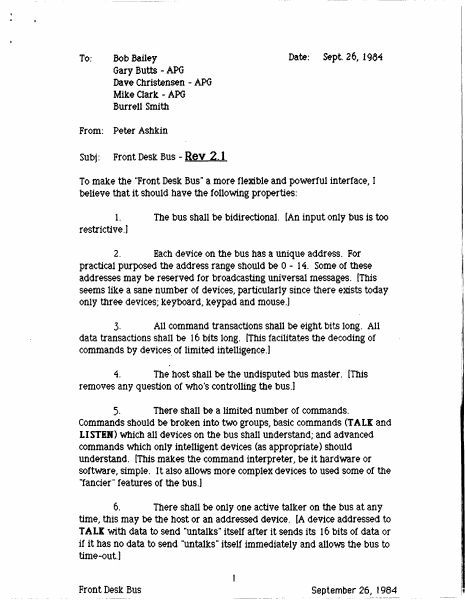
To: Bob Bailey Date: Sept. 26, 198-4 Gary Butts - APG Dave Christensen - APG Mike Clark - APG Burrell Smith From: Peter Ashkin Subj: Front Desk Bus - Rev 2.1 To make the "Front Desk Bus" a more flexible and powerful interface, I believe that it should have the follo"'1ing properties: 1. restrictive .J The bus shall be bidirectional. [An input only bus is too 2. Each device on the bus has a unique address. For practical purposed the address range should be o - 14. Some or these addresses may be reserved for broadcasting universal messages. [This seems like a sane number or devices, particularly since there exists today only three devices; keyboard, keypad and mouse .J 3. All command transactions shall be eight bits long. All data transactions shall be 16 bits long. [This facilitates the decoding of commands by devices. of limited iiltelligence.J 4. The host shall be the undisputed bus master. [This removes any question of who's controlling the bus.J 5. There shall be a limited number of commands. Commands should be broken int.o two groups, basic commands (TALK and LI STIR) Which all devices on the bus shall understand; and advanced commands vvhich only intelligent devices (as appropriate) should understand. [This makes the command interpreter, be it hardv.1are or soft"'1'8.re, Simple. It also allo'NS more complex devices to used some of tl:te "fancier" features of the bus.] There shall be only one active talker on the bus at any time, this may be the host or an addressed device. [A device addressed to TALI ¥\Tith data to send "untalks" itself after it sends its 16 bits of data or if it has no data to send "untalks" itself immediately and allo'\AIS the bus to time-out.] 6. Front Desk Bus September 26, 1984 7. The bus prot:ocol must accept devices that talk at different speeds. The host, at a minimum, must be able to listen at various speeds. (This implies that the data on the bus must be "self-clocked". By not rigidly fixing the speed of transmission. the bus does not need to be crystal (etc.) controlled.] There shall be only one active listener on the bus at any time, this may be tlle host or an addressed device. [A device addressed to LI STIR "unlistens" itself-after it receives 16 bits of data or if it receives a new command before receiving 16 bits of data.] 8. 9. An interrupt mechanism must be available which circumvents the needs to poll devices that need service. [Since the bus is relatively slow. tlle interrupt latency time in a polled environment is long. The ability to interrupt the master for service is important.] 10. There shall exist a mechanism that sends a unique signal that puts all devices on the bus into the command (reset) mode. [This is important if for some reason the bus gets "hung".) 11. There should be a minimum number of "time-outs" needed on the bus. The only needed time out should be to time out a non-responsive talker. [Timers are ugly, but "'1aiting for a dead device is uglier. The length of this time-…

Showing first 3,000 characters of 11,453 total. Open the full document →

Home Documents ADB R072589.1 Gravis Mousestick Users Guide ADB
R072589.1 Gravis Mousestick Users Guide ADB

R072589.1 Gravis Mousestick Users Guide ADB

ADB · 1989 · PDF
FilenameR072589.1_Gravis_Mousestick_Users_Guide_ADB_1989.pdf
Size2.71 MB
Year1989
Subsection Advanced_Gravis
Downloads5
Enjoying MacTrove? Anonymous downloads are free and unlimited. Create a free account to track favorites, contribute metadata corrections, and join the community chat.
Reader
R072589.1 Gravis Mousestick Users Guide ADB
/
Loading…
OCR / Text contents
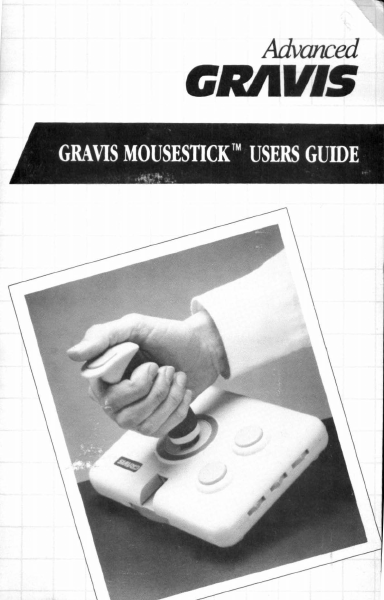
Advanced t:RAlllS GRAVIS MOUSESTICK™ USERS GUIDE ....... Gravis MouseStick™ Users Guide Macintosh™ ADB Model Copyright 1988, 1989 All Rights Reserved US Office Advanced Gravis Computer Technology Ltd. 1602 Carolina St., Suite Dl2 Bellingham, Washington 98226 Canadian Office Advanced Gravis Computer Technology Ltd. 7033 Antrim Ave. Burnaby, British Columbia V5J 4M5 Telephone: Facsimile: (604) 434-7274 (604) 434-7809 The Gravis MouseStick, Gravis MouseStick Processing Unit and all docwnentation and software supplied with these devices are copyrighted and all rights are reserved by Advanced Gravis Computer Technology Ltd. The Gravis MouseStick Processing Unit program, the MouseStick Utilities software and this Users Guide are published exclusively by Advanced Gravis Computer Technology Ltd. and are sold to the original purchaser for use only under the terms set out in the License Agreement and Limited Warranty included in this package. Information in these docwnents is subject to change without notice and does not represent any commitment on the part of Advanced Gravis Computer Technology Ltd., or its agents. The Gravis MouseStick, The Gravis MouseStick Processing Unit, the MouseStick Utilities and the Mouses tick cdev are trademarks of Advanced Gravis Computer Technology Ltd. Advanced Gravis is a trademark of Advanced Gravis Computer Technology Ud. Apple is a registered trademark of Apple Computer, Inc. Apple Ilgs and Macro Maker are trademarks of Apple Computer, Inc. Macintosh is a trademark licensed to Apple Computer, Inc. QuicKeys is a trademark of CE Software, Inc. Tempo II is a trademark of Affinity Microsystems, Ud. ©Advanced Gravis Computer Technology Ltd. 1988, 1989 All Rights Reserved Contents 1- Introduction ............................................. 1 About This Users Guide ............................................... 2 What You Need ............................................................ 5 Knowing Your Macintosh ............................................ 6 MouseStickComponents .............................................. 7 MouseStick Utilities Disk ............................................ 9 Making a Working Copy .............................................. 10 infoGuard™ ................................................................. 10 MouseStick Utilities ..................................................... 11 Custom Sets .................................................................. 12 2 - Quick Start ............................................. 15 MouseStick Utilities Installation .................................. 15 MouseSticklnstallation ................................................ 17 3 - Using the MouseStick ............................ 21 Tension Adjustment Ring ............................................. 21 Button Control Selectors .............................................. 22 Handle Grips ................................................................ 23 4 - Using the Mous…

Showing first 3,000 characters of 95,767 total. Open the full document →

Home Documents ADB Pat4875158
Pat4875158

Pat4875158

ADB · 1989 · PDF
Filenamepat4875158.pdf
Size0.64 MB
Year1989
Subsection patents
Downloads4
Enjoying MacTrove? Anonymous downloads are free and unlimited. Create a free account to track favorites, contribute metadata corrections, and join the community chat.
Reader
Pat4875158
/
Loading…
OCR / Text contents
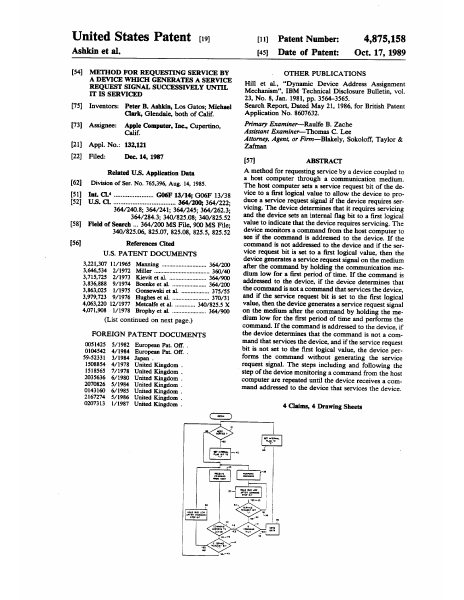
United States Patent 11 Ashkin et al, 4,875,158 Oct. 17, 1989 {11] Patent Number: (45) Date of Patent: [54] METHOD FOR REQUESTING SERVICE BY A DEVICE WHICH GENERATES A SERVICE REQUEST SIGNAL SUCCESSIVELY UNTIL IT IS SERVICED [75] Inventors: Peter B, Ashkin, Los Gatos; Michael Clark, Glendale, both of Calif. [73] Assignee: Apple Computer, Inc., Cupertino, Calif. [21] Appl. No.: 132,121 [22] Filed: Dec. 14, 1987 Related U.S. Application Data [62] Division of Ser. No. 765,396, Aug. 14, 1985. [51] Int, CLs... GO6F 13/14; GO6F 13/38 [52] U.S. CL. ... 364/200; 364/222; 364/240.8; 364/241; 364/245; 364/262.3; 364/284.3; 340/825.08; 340/825,52 [58] Field of Search ... 364/200 MS File, 900 MS File; 340/825.06, 825.07, 825.08, 825.5, 825.52 [56] References Cited U.S. PATENT DOCUMENTS 3,221,307 11/1965 3,646,534 2/1972 3,715,725 2/1973 3,836,888 9/1974 3,863,025 1/1975 3,979,723 9/1976 4,063,220 12/1977 4,071,908 1/1978 Brophy et al. .. (List continued on next page.) FOREIGN PATENT DOCUMENTS 0051425 5/1982 European Pat. Off. . 0104542 4/1984 European Pat. Off. . 59-52331 3/1984 Japan . 1308854 4/1978 United Kingdom . 1518565 7/1978 United Kingdom . 2035636 6/1980 United Kingdom . 2070826 5/1984 United Kingdom . 0143160 6/1985 United Kingdom . 2167274 5/1986 United Kingdom . 0207313 1/1987 United Kingdom . OTHER PUBLICATIONS Hill et al, “Dynamic Device Address Assignment Mechanism”, IBM Technical Disclosure Bulletin, vol. 23, No. 8, Jan. 1981, pp. 3564-3565. Search Report, Dated May 21, 1986, for British Patent Application No. 8607632. Primary Examiner—Raulfe B. Zache Assistant Examiner—Thomas C. Lee Attorney, Agent, or Firm—Blakely, Sokoloff, Taylor & Zafman [57] ABSTRACT A method for requesting service by a device coupled to a host computer through a communication medium. The host computer sets a service request bit of the de- vice to a first logical value to allow the device to pro- duce a service request signal if the device requires ser- vicing. The device determines that it requires servicing and the device sets an internal flag bit to a first logical value to indicate that the device requires servicing. The device monitors a command from the host computer to see if the command is addressed to the device. If the command is not addressed to the device and if the ser- vice request bit is set to a first logical value, then the device generates a service request signal on the medium after the command by holding the communication me- dium low for a first period of time. If the command is addressed to the device, if the device determines that the command is not a command that services the device, and if the service request bit is set to the first logical value, then the device generates a service request signal on the medium after the command by holding the me- dium low for the first period of time and performs the command. If the command is addressed to the device, if the device determines that the command is not a com- mand that ser…

Showing first 3,000 characters of 33,021 total. Open the full document →

Subscribe to ADB
mp.ls