Home Documents Lisa 04 Lisa Toolkit Self Paced Training
04 Lisa Toolkit Self Paced Training

04 Lisa Toolkit Self Paced Training
Lisa · PDF
Filename04_Lisa_Toolkit_Self-Paced_Training.pdf
Size10.15 MB
Subsection toolkit_3.0 / Package_2_Examples
Downloads9
Enjoying MacTrove? Anonymous downloads are free and unlimited. Create a free account to track favorites, contribute metadata corrections, and join the community chat.
Reader
04 Lisa Toolkit Self Paced Training
/
Loading…
OCR / Text contents
LISA TOOLKIT SELF-PACED TRAINING Preface. This self-paced training comprises eleven self-study segments. The intent of these segments is to get you started designing applications with the ToolKit. Although the initial segments have no code associated with them, the latter segments include labs allowing you to experiment with actual appl ication code. A single application is used as the context for this training. This is the Boxer appl ication. Boxer is implemented in stages over 8 of the eleven segments. The result is an application that exhibits the essential features of typical ToolKit appl ications. What those are is the subject of this training. CONTENTS The following table I ists the segments, labs, and the code associated with them: segftent nuftber seQ~ent na~e lab code stage Conceptual Foundation of the ToolKit no 1 Introduction to the ToolKit no 2 What is a Document? no 3 Creating from the Generic Application yes 4 BlankStationery no 5 6 Intro to the Boxer Appl ication yes 2Boxer Selections and Highl ighting in Boxer yes 3Boxer 7 Mov i ng Boxes yes 4Boxer 8 Creating a Box, A Second Selection Class yes 5Boxer 9 Recoloring .. Dupl icating.. and Clear All yes 6Boxer 1Boxer Commands with Undo 10 Filters yes 7Boxer 11 Cut & Paste and Mouse Key Events yes 8Boxer as Commands; Advanced Commands. The recommended sequence of segments is to start with "Conceptual Foundation of the ToolKit", and then continue sequentially with segments 1 through 11. PREREQUISITES You are expected to have read the following documents before starting this self-study: o Introduction to Clascal o WorkShop Manual, especially the QuickDraw and Pascal language sections To your future as II grellt ToolKit IIPPlic4tion designer! Conceptual Foundation of the ToolKit The ToolKit is en object-orierKlNi development system. This means that the . code to be executed is selected through the data, which is packaged into record-like constructs called Db~cts. This is in direct contrast to a procedure-oriented system. In that kind of' system the code to be called is tixed by the designer. The data must fit the celled code, rather than vice versa. The following discussion and slides provide a conceptual foundat ion for an object-oriented system, and how it contributes to the structure of' the ToolKit. Conceptual Foundations T<X>LJ<IT APPLICATION DESIGN The ToolKit is best described as a collection of interlocking hiererchies of classes. One special ToolKit class, TObject, is the ancestor of every other class. As the slide: The TooJ~~':jt ltpp/ieMi()f1 ,.1odtl showS, a user application is a collection of classes as well. Specifically it is 8 layer of' class hierarchies descended from those of the ToolKit. The user application 18y'er may either abut the ToolKit l~er directly, or have one or more building block layers of insulation. In either case, the user application may create subclasses from any classes in or above its layer. …

Showing first 3,000 characters of 371,089 total. Open the full document →
Home Documents NuBus 0002 0228 RasterOps 8XL GSXL Specification Rev A1
0002 0228 RasterOps 8XL GSXL Specification Rev A1

0002 0228 RasterOps 8XL GSXL Specification Rev A1

NuBus · 1990 · PDF
Filename0002-0228_RasterOps_8XL_GSXL_Specification_Rev_A1_19900219.pdf
Size0.78 MB
Year1990
Subsection rasterops / docs
Downloads9
Enjoying MacTrove? Anonymous downloads are free and unlimited. Create a free account to track favorites, contribute metadata corrections, and join the community chat.
Reader
0002 0228 RasterOps 8XL GSXL Specification Rev A1
/
Loading…
OCR / Text contents
RasterOps 8XL/GSXL Specification Revision A1 February 19, 1990 Jeff Tingley RasterOps Corporation PART # 0002-0228 RasterOps BXUGSXL Specification February 19, 1991 1.0 Introduction This document establishes the physical and electrical characteristics for the RasterOps 8XlJGSXL Graphics Display System. The RasterOps 8XlJGSXL, referred to as 8XL throughout the rest of this document, is a very high resolution, very high speed, graphics display system for the Macintosh II family of computers. The 8XL occupies 1 Nubus slot. It is capable of five pixel depths and several resolutions. A block diagram of the 8XL is shown in Figure 1-1. This document is the property of RasterOps Corporation and is confidential. Reproduction of this document is prohibited. RGS14188 VRAM Contrd Local Config. EEROM HghSpeedNulluo _ _ _ _Addtess _ _Bui ___................., . . _ _ Colorlloard ,......_ ....i Accolellllor Cdorl!oard Dala Bua Dil!My Memooy CdorBoerd Data Bua 1024x1024. 8 (1 Mertel Figure 1-1 8XL Block Diagram 2.0 Hardware Description 2.1 Features Switchable Resolutions of (Software Selectable) - 1152 x 870 (72 Hz Vertical Refresh) - 1024 x 768 (75 Hz Vertical Refresh) - 1024 x 768 (60 Hz Vertical Refresh) -800 x 600 -640 x 870 - 640 x 480 (66 Hz Non-interlaced) 2 BT478-110 February 19, 1991 RasterOps BXUGSXL Specification - 640 x 480 (30 Hz Interlaced) Pixel Depths of 1, 2, 4, and 8-bits Macintosh II "FAT" and "Skinny" NuBus Compatible ·1s.7 Million Color Palette 100, 80, 64, 57, 50, and 30.24, 12.2727 MHz Video Rate Single NuBus Slot Current Consumption of 1.5 Amps at 5 Volts Full Block Mode Support In All Bit-depths RS-343 Compatible 15-Pin D-Submininature Connector (Same as Apple) Hardware Zoom of 1x, 2x, 4x, and Bx Hardware Pan Extended Desktop State of the Art Surface Mount Technology Including three ASICs Supports the RasterOps Accelerator 2.2 Overview The 8XL is a stand alone frame buffer. This means one can plug this card into a NuBus Slot on a Macintosh and display up to 8-bits per pixel in one of several resolutions. As an added feature the 8XL also supports a direct interface, through the NuBus, to the RasterOps Accelerator. This card provides QuickDraw acceleration capabilities making the 8XL much faster when manipulating images in any bitdepth. 3 RasterOps BXUGSXL Specification February 19, 1991 3.0 Technical Data 3.1. Absolute Maximum Ratings Supply Voltage, VCC ......................................•............... Operating Ambient Temperature Range ......•..........•.... Storage Temperature ...................................................... ICC (Supply Current) .................................•..........•.... 5.25 Volts 0°Cto60°C -65 °C to 150 °C 1.5A@5.25 V 3.2 Reference Drawings The following items should be referenced for information on the 8XL. 8XL Top Assembly LM 8XL Assembly Drawing 8XL Schematics 8XL PCB Fab 8XL LJM 8XL Manual 8XL 0002-0224 0002-0223 0002-0225 0002-0226 0700-0069 3.3 Video Specifica…

Showing first 3,000 characters of 17,307 total. Open the full document →
Home Documents NuBus 0002 0154 Accelerator Board Model 800 Specification Rev D2
0002 0154 Accelerator Board Model 800 Specification Rev D2

0002 0154 Accelerator Board Model 800 Specification Rev D2

NuBus · 1990 · PDF
Filename0002-0154_Accelerator_Board_Model_800_Specification_Rev_D2_19900912.pdf
Size0.74 MB
Year1990
Subsection rasterops / docs
Downloads10
Enjoying MacTrove? Anonymous downloads are free and unlimited. Create a free account to track favorites, contribute metadata corrections, and join the community chat.
Reader
0002 0154 Accelerator Board Model 800 Specification Rev D2
/
Loading…
OCR / Text contents
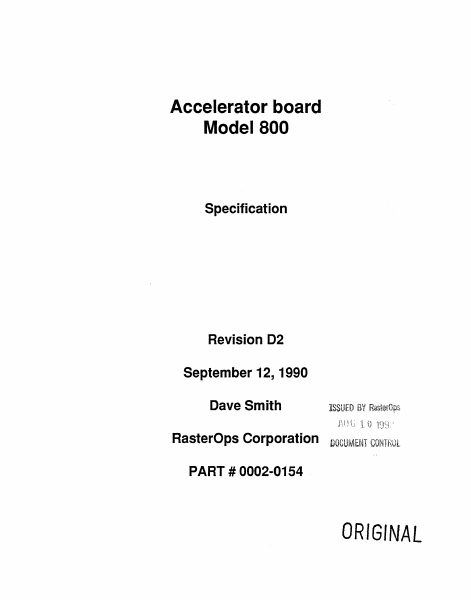
Accelerator board Model 800 Specification Revision 02 September 12, 1990 Dave Smith 1ssurn )\t J. !; 1 \j RasterOps Corporation oocuMENT PART# 0002-0154 ORIGINAL Introduction The Accelerator is a dedicated longword BITBLT-FILL engine optimized for the NuBus. The Accelerator has 8 modes of operation: FILL-CONSTANT, FILL-PA1TERN, PRAM-FILL, BITBLT, INVERT-FILL, INVERT-PA1TERN, INVERT-PRAM-FILL, and INVERT-BITBLT. In addition the programmer can enable BUS-LOCKING to prevent other NuBus masters from interrupting an operation.This function combined with automatic Block Transfer enable the Accelerator to fill data at a peak rate of 9 million pixels-per-second, and blit data at a peak rate of 4.5 million pixels-per second on a fast block mode video board. The Accelerator has been designed for maximum performance by minimizing the amount of software overhead required to initiate an operation and by a novel use of a large pixel Cache (SRAM). A flexible architecture has been created which allows any 32 bit address within the Macintosh computer to be accessed for each operation. A programmable translation memory (TRAM) is placed discontinuous data the motherboard to the video board. This function is required for the Macintosh Ilci and future machines with non-contiguous main memory. A large pixmap memory (PRAM) is included to allow offscreen pixmaps to reside locally and to be moved at high speed to the video cards. The Accelerator can support up to two Block-Mode capable videocards and an unlimited number of non-Block-Mode video cards. The Accelerator is not limited to just video cards, but can be used with memory cards as well. The Accelerator resides in its own NuBus slot and has a power consumption of 2 Amp. Reference Documents The following is a list of related documents for the Accelerator product: Schematic ,. 0002-0149 Assembly Drawing 0002-0150 PC Fab drawing/Artwork 0002-0151 Board List of Materials 0002-0152 Top Assembly LM 800 Manual 0700-0044 Block Diagram -AD(31 :0) TRANSLATION RAM I---' ADDRESSGENEPATOR CHIP N u .____ ADDRESS c 20-26 I---' 1-- B u s 1 I N T PIXMAP MEMORY 1---J 4-16 MEGS T 1-- E R F A c E ,. DATAGENERATCFl CHIP BK BYTE PIXEL CACHE ADD i--- DATA Accelerator Register Address Map FSFF Fxxx ID REGISTER FSFF C020 PRAM POINTER FSFFC01C MODE REGISTER FSFF C018 BLOCK COMPARE #2 FSFF C014 BLOCK COMPARE #1 FSFF C010 COUNT LENGTH FSFFCOOC SRAM POINTER FSFF COOS SEMAPHORE POINTER FSFF C004 DESTINATION POINTER FSFF COOO SOURCE POINTER FSFFA3FC TRANSLATION TRAM 1K BYTES FSFFAOOO FSFF9FFC PIXEL CACHE SRAM BK BYTES FSFF 8000 Pixel Cache SRAM The Pixel Cache SRAM (SRAM will be used from now on) is comprised of four 2048 x 8-25ns static rams arranged as long words. The SRAM may be written to or read from whenever the Accelerator is not busy with an operation (FILL, etc.). Locations 0- 1983 are used for BITBLT and Fll.L-CONSTANT mode, while locations 1984 - 2047 ar…

Showing first 3,000 characters of 17,658 total. Open the full document →
Home Documents NuBus 65 2800 101 Avatar MacMainFrame Token Ring Workstation Installation Guide
65 2800 101 Avatar MacMainFrame Token Ring Workstation Installation Guide

65 2800 101 Avatar MacMainFrame Token Ring Workstation Installation Guide

NuBus · 1990 · PDF
Filename65-2800-101_Avatar_MacMainFrame_Token-Ring_Workstation_Installation_Guide_1990.pdf
Size3.33 MB
Year1990
Subsection avatar / MacMainframeII
Downloads5
Enjoying MacTrove? Anonymous downloads are free and unlimited. Create a free account to track favorites, contribute metadata corrections, and join the community chat.
Reader
65 2800 101 Avatar MacMainFrame Token Ring Workstation Installation Guide
/
Loading…
OCR / Text contents
I Avatar MacMainFrame™ Series Macintosh-to-Mainftame Link Token-Ring Workstation Installation Guide MacMainFrame TM Series Macintosh to Mainframe Link Token-Ring Workstation Installation Guide This manual also includes instructions for ALL USERS of Avatar Token-Ring hardware. Avatar. 65-2800-101 Copyright © 1990 Avatar Corporation 65 South Street Hopkinton, MA 017 48 (508) 435-3000 All Rights Reserved The information contained herein is the property of Avatar Corporation. It shall not be reproduced, disclosed, or used in whole or in part without written permission of Avatar Corporation. MacMainFrame and EasyKeys are trademarks of Avatar Corporation. Fiber Optic System is a trademark of Du Pont Electronics. IBM PC, CICS, TSO, CMS, and IND$FILE are trademarks of International Business Machines Corporation. MacLinkPlus is a trademark of Dataviz Corporation. Microsoft is a registered trademark, and Excel is a trademark of Microsoft Corporation. PageMaker is a registered trademark of Aldus Corporation. PhoneNet is a trademark of Farallon Computing Inc. VAX is a trademark of Digital Equipment Corporation. The following are trademarks of Apple Computer, Incorporated: AppleTalk Macintosh Ilcx EtherTalk Macintosh Ilx HyperCard Macintosh SE HyperTalk Macintosh SE/30 LocalTalk MacTerminal Macintosh MultiFinder Macintosh II TokenTalk WARNING: This equipment generates, uses, and can radiate radio frequency energy; and if not installed and used in accordance with the instruction manual, may cause interference to radio communications. It has been tested and found to comply with the limits for a Class A computing device pursuant to Subpart J, Part 15 of FCC Rules, which are designed to provide reasonable protection against such interference when operated in a commercial environment. Operation of this equipment in a residential area is likely to cause interference; in which case the user must correct the interference at his/her own expense. WARNING: This equipment is a Class A digital apparatus which complies with the Radio Interference Regulations, CRC c. 1374. MacMainFrame Series Part# 65-2800-101-AB Printed in the United States of America Table of Contents Preface ................................................................................. v Audience ............................................................................ v How To Use This Book .......................................................... v Chapter 1 - Introduction ..................................................... 1 Avatar's Token-Ring Products .................................................. 2 How to Use This Book ........................................................... 3 What is MMF Token-Ring Workstation? ....................................... 5 Chapter 2 - What You Need First ........................................ 7 Experience .......................................................................... 7 Macintosh Hardware ....................................…

Showing first 3,000 characters of 60,626 total. Open the full document →

Home Documents Lisa 050 4009 H 5of5
050 4009 H 5of5

050 4009 H 5of5

Lisa · PDF
Filename050-4009-H-5of5.pdf
Size0.35 MB
Subsection hardware / Lisa_CPU
Downloads8
Enjoying MacTrove? Anonymous downloads are free and unlimited. Create a free account to track favorites, contribute metadata corrections, and join the community chat.
Reader
050 4009 H 5of5
/
Loading…
OCR / Text contents
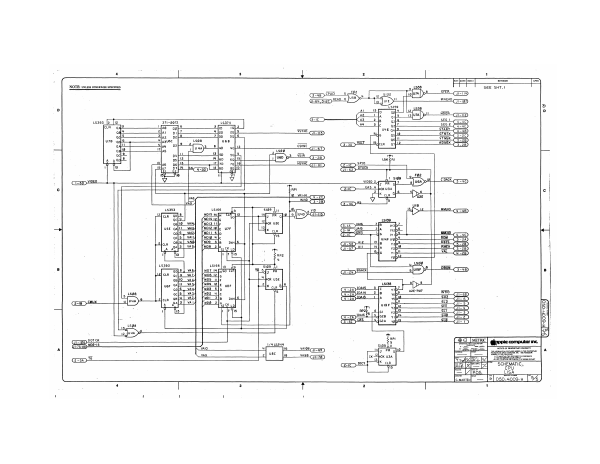
rc 1 2078 wasn conse enn Feet = ‘NOTE: untess omens sPECInED SEE SHT.1 FIEND a D is3s3_[2 Te 371-007 isa74 fcuk od ad pgp & 3fo 1ap2 ri Fl es leo 5 WE os oc = jaz 02/8 T\30 308 — u78 «Qt a jaause Lso8 vee aoe 3-28 a ay 08 2 fan of'g ce le en GED = ace — DY) W5iR a gage os P2 1 uso o> SB Gea vse ‘ FI Pele le: al aK sPIo ? Ye 7 she ere Baie) SO relay OF oa TACK 5° VIDEO. I sis9 2 oa 19} CDACK : VIDEO 3 7 3) ea ELS - fae RPI 2e SAS A pck USA C A sys K cin 3 vas, oD ote ae i vas Nv C328) so 5 ! ule Ls393 uses 313] bw nO > waio r2fcie cope oss fe Co ears 8) E> semr) G5 i ac{s_ mow 1216 2 1139 | asfia vans Poise K USE on a A use alt! vas4 MOIZ 10]. u7F SR as ah PS oof, vz) Puoit sl 2 wepS— — [wou 5 de ibs mM eal osT van) Pwo a] v1 wae oes unr eb FOW _C3=2A) Lelag o8}t VA) MOo_3)— INH|S Al2 i a RES cals vas] Pups 2a vert oan rm Pig Cen) | ice OA Herod) 1 Gi-s7)> ie yay a 3-28 y Ys t pt — pide — viplt VAL Cy=25 a Fa Ls303 usiss lis _G cagemorlt ass, | wor ww peso-ctk 3h EEC) 12 7 ras B i2lcur acl vaz4 wos i2]¢ 4 aB}!0_ vac) MOS ile K U3E usr anf vas] nos tele ype + 21k ce anf, vay Puos_5 1p cur , soe oc{S | va: woz ule 0 2 into 5 GED KY } rary Ee woo 21 cx | pa ——_______$t2_=55 - 3] sat 1 is |r Ys Tee e ts Sut . S10 _ 28 —Giez 1 808 Grr) 12 boreK = Ji i186 | METRIC Geis g6) O's iyis2uy can (@eppic computar inc, 7 ‘VAIO. 4 vse 16 VAIO8 FES) A = vag 2 18 vase = ¥E GET) PREIS AND Gx) TS hts 1 ara paiee 7 74 HEMATIC, — |, LISA ewanrenl — |] 050-u009-n_ | 54)
Home Documents PowerPC Chng C10
Chng C10

Chng C10

PowerPC · 1996 · PDF
Filenamechng_c10.pdf
Size0.15 MB
Year1996
Subsection CHRP
Downloads11
Enjoying MacTrove? Anonymous downloads are free and unlimited. Create a free account to track favorites, contribute metadata corrections, and join the community chat.
Reader
Chng C10
/
Loading…
OCR / Text contents
Page - 1 Common Hardware Reference Platform Architecture Version 1.0 Change Notice October 2, 1996 Apple/IBM/Motorola - CHRP Board Apple/IBM/Motorola - CHRP Board 2 This paper presents a chronological list of all changes approved for the published version of the PowerPC Microprocessor Common Hardware Reference Platform: A System Architecture (CHRP). These changes are approved by the CHRP Board. These changes will be incorporated into the next version of the CHRP document at the next printing. Editorial Comments June 6, 1996 The following editorial comments have been received through June 6, 1996. ■ Page xx add a paragraph before the paragraph starting “Sample implemen- tations ...” to describe the use of this material by component manufacturers. “This document is one of those needed by vendors building chips and adaptors for use in these platforms. Component manufacturers must produce components which conform to this architecture.” ■ Change the second paragraph on page xxiii to read “Big-Endian numbering of bytes is used in this document, unless indicated otherwise. Numbering of bits starts at zero for the most significant bit and continues to the least significant bit, unless indicated otherwise.” ■ Change the third paragraph on page xxiii to indicate the table number. “Ty- pographical ... in Table i on page xxiii.” ■ Change the table number on page xxiii to be “Table i.” ■ Change the last sentence in the paragraph and change the list under 2.5.1.4 on page 18. This paragraph should now read as follows: “The description column ... Two documents are referenced extensively using an abbreviation in this description column. The abbreviations are as follows: [20] refers to the PowerPC Microprocessor Common Hardware Reference Platform: I/O Device Reference. Use this document for additional information on the annotated specifications. [23] refers to the Macintosh Technology in the Common Hardware Reference Platform. Use this document for specific physical, timing, and electrical requirements of the annotated specifications.” ■ Remove the two instances of the phrase “(see note 1)” in the Specifications column for the Pointing Device row in Table 2 on page 19. ■ Add the phrase “For 64-bit addressing option in HBs:” to the start of re- quirement 3-5 on page 29 and 227. Apple/IBM/Motorola - CHRP Board 3 Editorial Comments June 6, 1996 ■ Remove a redundant sentence in the last paragraph on page 37. This para- graph should read “Addresses in peripheral I/O Space from BIO+64 KB to BIO + (8MB - 1) are reserved for hardware use. HBs may treat ...” ■ At the bottom of page 37 add a note which should read as follows: “Software Implementation Note: When in the discontiguous I/O mode software should not put out an operation to Peripheral I/O Space which crosses a 32-byte boundary. Results from such operations are undefined.” ■ Change the table reference for requirement 3-18 on page 39 and 230 to “Ta- ble 7 on page 44.” ■ Add a new bullet under “S…

Showing first 3,000 characters of 52,957 total. Open the full document →

Home Documents NuBus 65 2500 102 Avatar MacMainFrame Version 4.0 Release Notice
65 2500 102 Avatar MacMainFrame Version 4.0 Release Notice

65 2500 102 Avatar MacMainFrame Version 4.0 Release Notice

NuBus · 1991 · PDF
Filename65-2500-102_Avatar_MacMainFrame_Version_4.0_Release_Notice_1991.pdf
Size2.07 MB
Year1991
Subsection avatar / MacMainframeII
Downloads5
Enjoying MacTrove? Anonymous downloads are free and unlimited. Create a free account to track favorites, contribute metadata corrections, and join the community chat.
Reader
65 2500 102 Avatar MacMainFrame Version 4.0 Release Notice
/
Loading…
OCR / Text contents
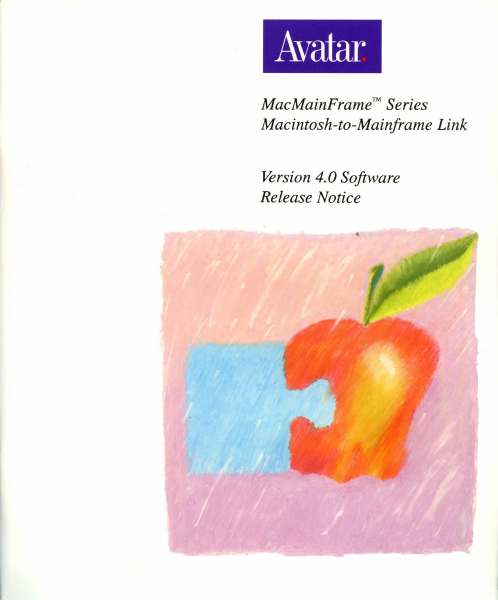
Avatar MacMainFrameTM Series Macintosh-to-Mainframe Link Version 4. 0 Software Release Notice MacMainFrame TM Series Macintosh to Mainframe Link Revision 4.0 Software Release Notice Avatai: 65-2500-102 Copyright © 1991 Avatar Corporation 65 South Street Hopkinton, MA 01748 (508) 435-3000 All Rights Reserved The information contained herein is the property of Avatar Corporation. It shall not be reproduced, disclosed, or used in whole or in part without written permission of Avatar Corporation. InSession For Macintosh, MacMainFrame and EasyKeys are trademarks of Avatar Corporation. Fiber Optic System is a trademark of Du Pont Electronics. IBM PC, CICS, TSO, CMS, and IND$FILE are trademarks of International Business Machines Corporation. MacLinkPlus is a trademark of Dataviz Corporation. Microsoft is a registered trademark, and Excel is a trademark of Microsoft Corporation. PageMaker is a registered trademark of Aldus Corporation. PhoneNet is a trademark of Farallon Computing Inc. VAX is a trademark of Digital Equipment Corporation. The following are trademarks of Apple Computer, Incorporated: AppleTalk Macintosh Ilcx EtherTalk Macintosh Ilx HyperCard Macintosh SE HyperTalk Macintosh SE/30 LocalTalk MacTerminal Macintosh MultiFinder Macintosh II TokenTalk WARNING: This equipment generates, uses, and can radiate radio frequency energy; and if not installed and used in accordance with the instruction manual, may cause interference to radio communications. It has been tested and found to comply with the limits for a Class A computing device pursuant to Subpart J, Part 15 of FCC Rules, which are designed to provide reasonable protection against such interference when operated in a commercial environment. Operation of this equipment in a residential area is likely to cause interference; in which case the user must correct the interference at his/her own expense. WARNING: This equipment is a Class A digital appararus which complies with the Radio Interference Regulations, CRC c. 1374. MacMainFrame Series Part # 65-2500-102-AA Printed in the United States of America Table of Contents Preface ................................................................................. v Audience ...................................................................................................vi How To Use This Document ........................................................................vi Related Documents ....................................................................................vi For More lnformation ...................................................................................vi For More Help.............................................................................................vi Terminology ...............................................................................................vi Introduction .......................................................................... 1 The User Interface Is Still The Same ...............…

Showing first 3,000 characters of 54,352 total. Open the full document →

Home Documents ADB Pat4875158
Pat4875158

Pat4875158

ADB · 1989 · PDF
Filenamepat4875158.pdf
Size0.64 MB
Year1989
Subsection patents
Downloads4
Enjoying MacTrove? Anonymous downloads are free and unlimited. Create a free account to track favorites, contribute metadata corrections, and join the community chat.
Reader
Pat4875158
/
Loading…
OCR / Text contents
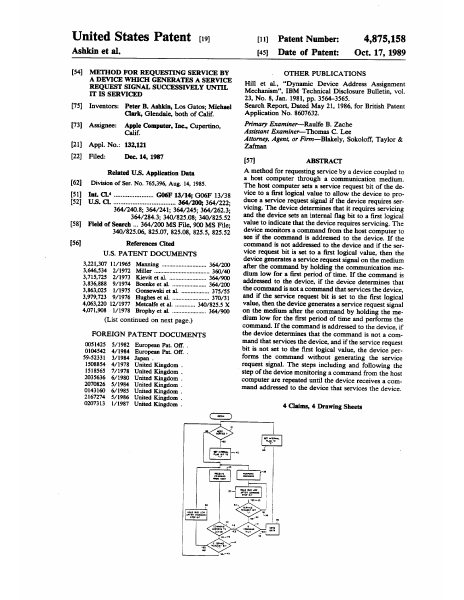
United States Patent 11 Ashkin et al, 4,875,158 Oct. 17, 1989 {11] Patent Number: (45) Date of Patent: [54] METHOD FOR REQUESTING SERVICE BY A DEVICE WHICH GENERATES A SERVICE REQUEST SIGNAL SUCCESSIVELY UNTIL IT IS SERVICED [75] Inventors: Peter B, Ashkin, Los Gatos; Michael Clark, Glendale, both of Calif. [73] Assignee: Apple Computer, Inc., Cupertino, Calif. [21] Appl. No.: 132,121 [22] Filed: Dec. 14, 1987 Related U.S. Application Data [62] Division of Ser. No. 765,396, Aug. 14, 1985. [51] Int, CLs... GO6F 13/14; GO6F 13/38 [52] U.S. CL. ... 364/200; 364/222; 364/240.8; 364/241; 364/245; 364/262.3; 364/284.3; 340/825.08; 340/825,52 [58] Field of Search ... 364/200 MS File, 900 MS File; 340/825.06, 825.07, 825.08, 825.5, 825.52 [56] References Cited U.S. PATENT DOCUMENTS 3,221,307 11/1965 3,646,534 2/1972 3,715,725 2/1973 3,836,888 9/1974 3,863,025 1/1975 3,979,723 9/1976 4,063,220 12/1977 4,071,908 1/1978 Brophy et al. .. (List continued on next page.) FOREIGN PATENT DOCUMENTS 0051425 5/1982 European Pat. Off. . 0104542 4/1984 European Pat. Off. . 59-52331 3/1984 Japan . 1308854 4/1978 United Kingdom . 1518565 7/1978 United Kingdom . 2035636 6/1980 United Kingdom . 2070826 5/1984 United Kingdom . 0143160 6/1985 United Kingdom . 2167274 5/1986 United Kingdom . 0207313 1/1987 United Kingdom . OTHER PUBLICATIONS Hill et al, “Dynamic Device Address Assignment Mechanism”, IBM Technical Disclosure Bulletin, vol. 23, No. 8, Jan. 1981, pp. 3564-3565. Search Report, Dated May 21, 1986, for British Patent Application No. 8607632. Primary Examiner—Raulfe B. Zache Assistant Examiner—Thomas C. Lee Attorney, Agent, or Firm—Blakely, Sokoloff, Taylor & Zafman [57] ABSTRACT A method for requesting service by a device coupled to a host computer through a communication medium. The host computer sets a service request bit of the de- vice to a first logical value to allow the device to pro- duce a service request signal if the device requires ser- vicing. The device determines that it requires servicing and the device sets an internal flag bit to a first logical value to indicate that the device requires servicing. The device monitors a command from the host computer to see if the command is addressed to the device. If the command is not addressed to the device and if the ser- vice request bit is set to a first logical value, then the device generates a service request signal on the medium after the command by holding the communication me- dium low for a first period of time. If the command is addressed to the device, if the device determines that the command is not a command that services the device, and if the service request bit is set to the first logical value, then the device generates a service request signal on the medium after the command by holding the me- dium low for the first period of time and performs the command. If the command is addressed to the device, if the device determines that the command is not a com- mand that ser…

Showing first 3,000 characters of 33,021 total. Open the full document →

Home Documents Apple I AppleI Manual
AppleI Manual

AppleI Manual

Apple I · PDF
FilenameAppleI_Manual.pdf
Size1.69 MB
Downloads13
Enjoying MacTrove? Anonymous downloads are free and unlimited. Create a free account to track favorites, contribute metadata corrections, and join the community chat.
Reader
AppleI Manual
/
Loading…
OCR / Text contents
APPLE -1 OPERATION MANUAL APPLE COMPUTER COMPANY 770 Welch Road Palo Alto, Calif. 94304 SPECIFICATIONS MIC ROPROCESSOR: Microprocessor Clock Frequency: Effective Cycle Frequency: (Including Refresh Waits) VIDEO OUTPUT: Line Rate: Frame Rate: Format: Display Memory: Character Matrix: RAM MEMORY: On-board RAM Capacity: POWER SUPPLIES: Input Power Requirements: Recommended Transformers: MOS TECHNOLOGY 6502 1.023 MHz 0.960 MHz Composite positive video, 75 ohms, level adjustable between zero and +5Vpp. 15734 Hz 60.05 Hz 40 characters/line, 24 lines; with automatic scrolling Dynamic shift registers (1K x 7) 5x7 16-pin, 4K Dynamic, type 4096 (2104) 8K bytes (4K supplied) +5 Volts @ 3 amps, +/- 12 Volts @0.5 amps, and -5 Volts @ 0.5 amps 8 to 10 Volts AC (RMS) @ 3 amps, 26 to 28 Volts AC (RMS) Center-Tapped, 1A. Stancor # P-8380 or Triad F31-X Stancor # P-8667 or Triad F40-X APPLE COMPUTER COMPANY 770 Welch Road, Suite 154 Palo Alto, California 94304 Phone: (415) 326-4248 [ INTRODUCTION ) The Apple Computer is a complete micro- processor system, consisting of a Mos Technology 6502 microprocessor and support hardware, tegral videodisplay electronics, dynamic memory and refresh hardware, and fully regulated power supplies. It contains resident system monitor software, enabling the user, via the keyboard and display, to write, examine, debug, and run programs efficiently; thus being an educational tool for the learning of microprocessor program- ming, and an aid in the development of software, in- The integral video display section and the keyboard interface renders unnecessary the need for an external teletype. The display section con- tains its ownmemory, leaving all of RAM for user programs, and the outputformat is 40 characters/ line, 24 lines/page, with auto scrolling, Almost any ASCII encoded keyboard will interface directly with the Apple system. The board has sockets for upto 8K bytes of the 16 pin, 4K type, RAM, and the system is fully expandable to 65K via the edge connector. The system uses dynamic memory (4K bytes sup- plied), although static memory may also be used. All refreshing of dynamic memory, including all 'off-board'' expansion memory, is done auto- matically. The entire system timing, including the microprocessor clock and all video signals, originates in a single crystal oscillator. Further, the printed circuit board contains a "breadboard area", in which the user can add additional ''on-board'! hardware (for example, extra PIA's, ACIA's, EROM's, and so on), This manual is divided into three Sections: Section GETTING THE SYSTEM RUNNING. SectionII USING THE SYSTEM MONITOR. (listing included) Section III EXPANDING THE SYSTEM, Please readSectionI thoroughly, before at- tempting to 'power-up'' your system, and study Section III carefully before attempting to expand your system. In addition to this manual, Apple "Tech Notes" are available which contain exam~ ples of expansion hardware and techniques…

Showing first 3,000 characters of 21,346 total. Open the full document →

Home Documents NuBus 700 0233 PAS16 Mac Installation Guide
700 0233 PAS16 Mac Installation Guide

700 0233 PAS16 Mac Installation Guide

NuBus · 1992 · PDF
Filename700-0233_PAS16_Mac_Installation_Guide_1992.pdf
Size2.17 MB
Year1992
Subsection mediaVision / Pro_Audio_Spectrum_16_Nubus
Downloads6
Enjoying MacTrove? Anonymous downloads are free and unlimited. Create a free account to track favorites, contribute metadata corrections, and join the community chat.
Reader
700 0233 PAS16 Mac Installation Guide
/
Loading…
OCR / Text contents
PRO AUDIO Installation Guide Media Vision Software License Statement The software described in this manual is protected by US and international copyright laws. You must not copy the software for any purpose other than making archival copies for the sole purpose of backing-up our software for protection against loss. The software must not be used on two or more machines at the same time. FCC Compliance Statement This equipment has been tested and found to comply with the limits of a Class B digital device. pursuant to Part 15 of the FCC Rules. Operations is subject to the following two conditions: (1) this device may not cause harmful interference; (2) this device must accept any interference received. including interference that may cause undesired operation. These limits are designed to provide reasonable protection against harmful interference in residential installations. This equipment generates. uses. and can radiate radio frequency energy. and if not installed and used in accordance with the instructions. may cause harmful interference to radio communications. However. there is no guarantee that interference will not occur in a particular installation. If this equipment does cause interference to radio or television equipment reception. which can be determined by turning the equipment off and on. the user is encouraged to try to correct the interference by one or more of the following measures: • Re-orient or relocate the receiving antenna • Move the equipment away from the receiver • Plug the equipment into an outlet and circuit different from that which powers the receiver • If necessary. the user should consult the dealer or an experi- enced radio/television technician for additional suggestions. (2) Media Vision warrants to you that the Sound Card will be free from significant defects in materials and workmanship for a period of three years from the date of purchase; the stereo speakers will be warranted for a period of one year from the date of purchase; the CD-ROM Drive will be warranted for a period of ninety days from the date of purchase. Media Vision·s sale and exclusive remedy with respect to defective hardware will be. at Media Vision·s option. to repair or replace the hardware. if it is determined to be defective by Media Vision in its sole discretion. or refund the purchase price of the hardware. (3) Media Vision does not and cannot warrant the performance or results you may obtain by using the software. hardware or documentation. The foregoing states the sole and exclusive remedies Media Vision will provide for breach of warranty. Except for the foregoing limited warranty. Media Vision makes no warrants. express or implied. as to non-infringement of third party rights. merchantability. or fitness for any particular purpose. (4) Some states do not allow the exclusion of implied warranties or limitations on how long an implied warranty may last. so the above limitations may not apply to you. This warranty gives you spe…

Showing first 3,000 characters of 53,343 total. Open the full document →

Subscribe to PDF
mp.ls