Home Documents Macintosh C++ Technical Notes 1 3
C++ Technical Notes 1 3

C++ Technical Notes 1 3
Macintosh · 1988 · PDF
FilenameC++_Technical_Notes_1-3_1988.pdf
Size2.21 MB
Year1988
Subsection developer / MPW
Downloads4
Enjoying MacTrove? Anonymous downloads are free and unlimited. Create a free account to track favorites, contribute metadata corrections, and join the community chat.
Reader
C++ Technical Notes 1 3
/
Loading…
OCR / Text contents
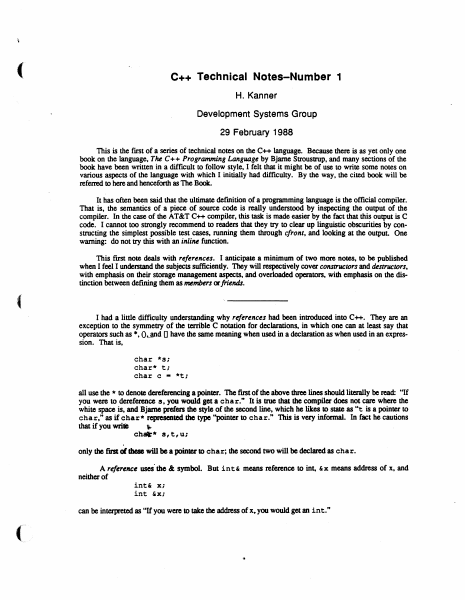
( C++ Technical Notes-Number 1 H. Kanner Development Systems Group 29 February 1988 This is the first of a series of technical notes on the C++ language. Because there is as yet only one book on the language, TM C++ Programming Language by Bjarne Stroustrup, and many sections of the book have been written in a difficult to follow style, I felt that it might be of use to write some notes on various aspects of the language with which I initially had difficulty. By the way, the cited book will be refeITed to here and henceforth as The Book. It has often been said that the ultimate definition of a programming language is the official compiler. That is, the semantics of a piece of source code is really understood by inspecting the output of the compiler. In the case of the AT&T C++ compiler, this task is made easier by the fact that this output is C code. I cannot too strongly recommend to readers that they try to clear up linguistic obscurities by consttucting the simplest possible test cases, running them through cfront, and looking at the output. One warning: do not try this with an inliM function. This fust note deals with references. I anticipate a minimum of two more notes, to be published when I feel I understand the subjects sufticiendy. They will respectively cover constructors and destn1etors, with emphasis on their storage management aspects, and overloaded opezators, with emphasis on the distinction between defining them as TMmbers or friends. I had a little difficulty understanding why references had been introduced into C++. They are an exception to the symmetry of the terrible C notation for declarations, in which one can at least say that operators such as •, Q,_311d Dhave the same meaning when used in a declaration as when used in an expression. That is, char *s; char* t; char c • *t; all use the * to denote dereferencing a pointer. The first of the above three lines should literally be read: "If you were to dereferences, you would get a char." It is ttue that the compiler does not care where the white space is, and Bjame prefers the style of the second line, which he likes to state as "t is a pointer to char," as if char* represented the type "pointer to char." This is very informal. In fact he cautions that if you wril8 ._ chait"* s,t,u; only the first~ dlele will be a poinrer to char; the second two will be declared as char. A reference uses the & symbol. But int& means reference to int, &x means address of x, and neither of int& x; int &x; can be interpreted as "If you were to take the address of x,. you would get an int." ,./ 2 I now whet the reader's interest by making a promise. By the end of this note, I will have illustrated that references make it possible for the following to be perfectly legal C++: int i; f(i) - 10; I introduce references by exploring to the point of tediousness what we really mean when we say int i. The symbol i is regarded as a synonym for the address, to be determined at some fuwre time, of a…

Showing first 3,000 characters of 64,249 total. Open the full document →
Home Documents Macintosh D11E4 Release Notes
D11E4 Release Notes

D11E4 Release Notes

Macintosh · PDF
FilenameD11E4_Release_Notes.pdf
Size0.12 MB
Subsection developer / Copland / D11E4_19960613
Downloads4
Enjoying MacTrove? Anonymous downloads are free and unlimited. Create a free account to track favorites, contribute metadata corrections, and join the community chat.
Reader
D11E4 Release Notes
/
Loading…
OCR / Text contents
 Mac OS 8 (D11E4) Release Notes These release notes describe some of the changes that have occurred since the previous developer release of Mac OS 8. There may be functionality and changes not described here. This document is provided to you as an aid in determining the functionality of this release and which bugs are already known by Apple. The seven-digit numbers (e.g. 1246744) are used internally for bug tracking. • Appearance Manager (Themes) Bugs Fixed: SetTheme now restores port on exit (1246744) Pen PixPat no longer uses same pat as back PixPat (1331809) Control directionality now masked for scrollbars (1339213) Popup controls now draw correctly when in Right-to-left orientation (1335344) Control Invisibility no longer asserts, just exits draw function (1338987, 1337889) Window variant codes now work for dialogs and floating windows (1263898, 1341133, 1331822) Known Bugs/Problems In This Release: A state may occur with some applications where the port pen or background pixpat ends up nil. This may cause a later crash is some cases. Window titles of some windows get clipped off when redrawn on update or uncollapse. Control focus is being redone and should finally work correctly. • Apple Technology (International) Kotoeri Bugs fixed since d11e1: 1340125 Kotoeri does not do kana-kanji conversion 1346425 Kotoeri Keyboard icon is wrong 1349013 Annoying DebugStr in KotoeriIMInitRoutine 1346218 Kotoeri palette disappears when zoomed, frame remains 1346221 Bad redraw when scrolling through character palette. Known bugs / unimplemented features: • Daruma returns kanji characters grouped into morphemes; Kotoeri should combine these morphemes into courser-grained groups based on part-of-speech, but currently does not do so. • Kotoeri should call Daruma multiple times to get a more comprehensive list of canidates, but currently only calls Daruma once (so you may not see the Kanji you're looking for). • Not all of the two-byte Roman punctuation and other special characters are correctly transliterated (the table is incomplete). • The following menu items have not been implemented: Kotoeri help \ Open Dictionary > the corresponding buttons on the command palette are also non-functional Kotoeri preferences / Retrieve fixed Yomi Transliterate ... Japanese Locale Bugs fixed In This Build: 1355895 D11E4c5: "Japanese" locale file requires 'lobj' resources for 'itlc' and 1355900 D11E4c5: an assert when boot in Japanese primary 1335203 Added Mac OS 8 collate table to the end of 'itl2' table 1344067 Correct wrong region ID What’s New In This Build: Add 'spfn' locale objects. Japanese Fonts No change since d11e2 Language Analysis No change since d11e2 Daruma Engine What’s New In This Build: Once changed grammar file structure (1338777), but backed to old structure since 1338777 isn't approved yet. Fixed a bug that the analysis cannot be done when the same string is specified as the last anaysis call (1344522) Update some part of speech code of grammar…

Showing first 3,000 characters of 24,887 total. Open the full document →

Home Documents Macintosh Copland Technical Overview
Copland Technical Overview

Copland Technical Overview

Macintosh · 1995 · PDF
FilenameCopland_Technical_Overview_19950505.pdf
Size0.93 MB
Year1995
Subsection developer / Copland
Downloads4
Enjoying MacTrove? Anonymous downloads are free and unlimited. Create a free account to track favorites, contribute metadata corrections, and join the community chat.
Reader
Copland Technical Overview
/
Loading…
OCR / Text contents
ð Copland Technical Overview ð Draft Developer Press  Apple Computer, Inc. 1995 This document was created with FrameMaker 4.0.4 ð Apple Computer, Inc.  1995 Apple Computer, Inc. All rights reserved. No part of this publication may be reproduced, stored in a retrieval system, or transmitted, in any form or by any means, mechanical, electronic, photocopying, recording, or otherwise, without prior written permission of Apple Computer, Inc. The Apple logo is a trademark of Apple Computer, Inc. Use of the “keyboard” Apple logo (Option-Shift-K) for commercial purposes without the prior written consent of Apple may constitute trademark infringement and unfair competition in violation of federal and state laws. No licenses, express or implied, are granted with respect to any of the technology described in this book. Apple retains all intellectual property rights associated with the technology described in this book. This book is intended to assist application developers to develop applications only for Apple Macintosh computers. Every effort has been made to ensure that the information in this manual is accurate. Apple is not responsible for typographical errors. Apple Computer, Inc. 1 Infinite Loop Cupertino, CA 95014 408-996-1010 Adobe Photoshop is a trademark of Adobe Systems Incorporated, which may be registered in certain jurisdictions. Palatino is a registered trademark of Linotype Company. IBM is a registered trademark of International Business Machines Corporation. MacPaint and MacWrite are registered trademarks, and Clarisworks is a trademark, of Claris Corporation. NuBus is a trademark of Texas Instruments. PowerPC is a trademark of International Business Machines Corporation, used under license therefrom. UNIX is a registered trademark of Novell, Inc. in the United States and other countries, licensed exclusively through X/Open Company, Ltd. Simultaneously published in the United States and Canada. Even though Apple has reviewed this manual, APPLE MAKES NO WARRANTY OR REPRESENTATION, EITHER EXPRESS OR IMPLIED, WITH RESPECT TO THIS MANUAL, ITS QUALITY, ACCURACY, MERCHANTABILITY, OR FITNESS FOR A PARTICULAR PURPOSE. AS A RESULT, THIS MANUAL IS SOLD “AS IS,” AND YOU, THE PURCHASER, ARE ASSUMING THE ENTIRE RISK AS TO ITS QUALITY AND ACCURACY. IN NO EVENT WILL APPLE BE LIABLE FOR DIRECT, INDIRECT, SPECIAL, INCIDENTAL, OR CONSEQUENTIAL DAMAGES RESULTING FROM ANY DEFECT OR INACCURACY IN THIS MANUAL, even if advised of the possibility of such damages. THE WARRANTY AND REMEDIES SET FORTH ABOVE ARE EXCLUSIVE AND IN LIEU OF ALL OTHERS, ORAL OR WRITTEN, EXPRESS OR IMPLIED. No Apple dealer, agent, or employee is authorized to make any modification, extension, or addition to this warranty. Some states do not allow the exclusion or limitation of implied warranties or liability for incidental or consequential damages, so the above limitation or exclusion may not apply to you. This warranty gives you specific legal rights, and you may also have other…

Showing first 3,000 characters of 294,019 total. Open the full document →

Home Documents Macintosh An Introduction To Copland
An Introduction To Copland

An Introduction To Copland

Macintosh · 1995 · PDF
FilenameAn_Introduction_to_Copland_1995.pdf
Size0.07 MB
Year1995
Subsection developer / Copland
Downloads4
Enjoying MacTrove? Anonymous downloads are free and unlimited. Create a free account to track favorites, contribute metadata corrections, and join the community chat.
Reader
An Introduction To Copland
/
Loading…
OCR / Text contents
An Introduction to Copland The Mac™ OS Foundation for the Next Generation of Personal Computers TM Copland is the development name for the next major release of the Mac™ OS from Apple® Computer, Inc. This document introduces Copland’s new architecture, its capabilities, and the benefits it will deliver to individuals and organizations. Product Primer Contents Welcome ..........................................................................................................................3 Introducing Copland: Foundation for the Future ........................................................4 Copland: The Next Step Toward Apple’s Vision for the Mac OS ......................................................4 Creating Copland: Apple’s Four-Point Plan for the Mac OS ..............................................................4 The Copland Advantage ......................................................................................................................5 Summary ................................................................................................................................................5 Setting New Standards for Ease of Use: The Copland User Interface ......................6 Automating Routine Tasks: From “Show Me” to “Do It for Me” ....................................................................6 Managing Information Overload......................................................................................................................7 Personalizing the Work Environment ..............................................................................................................7 Summary ..........................................................................................................................................................8 Improving on Superior Performance: Copland’s System Foundation ......................9 Copland OS Foundation ......................................................................................................................9 Exploiting the Power of RISC for Higher Performance ............................................................10 Memory Protection for Better System Reliability ......................................................................10 A More Efficient—and Cost-Effective—Memory Model ............................................................10 Easier System Extension ............................................................................................................10 More Options Through Hardware Abstraction ........................................................................11 Improvements in Networking ..........................................................................................................11 OpenDoc: Component Software for Innovative Solutions ............................................................11 Summary ...............................................................................................…

Showing first 3,000 characters of 50,117 total. Open the full document →

Subscribe to developer
mp.ls